
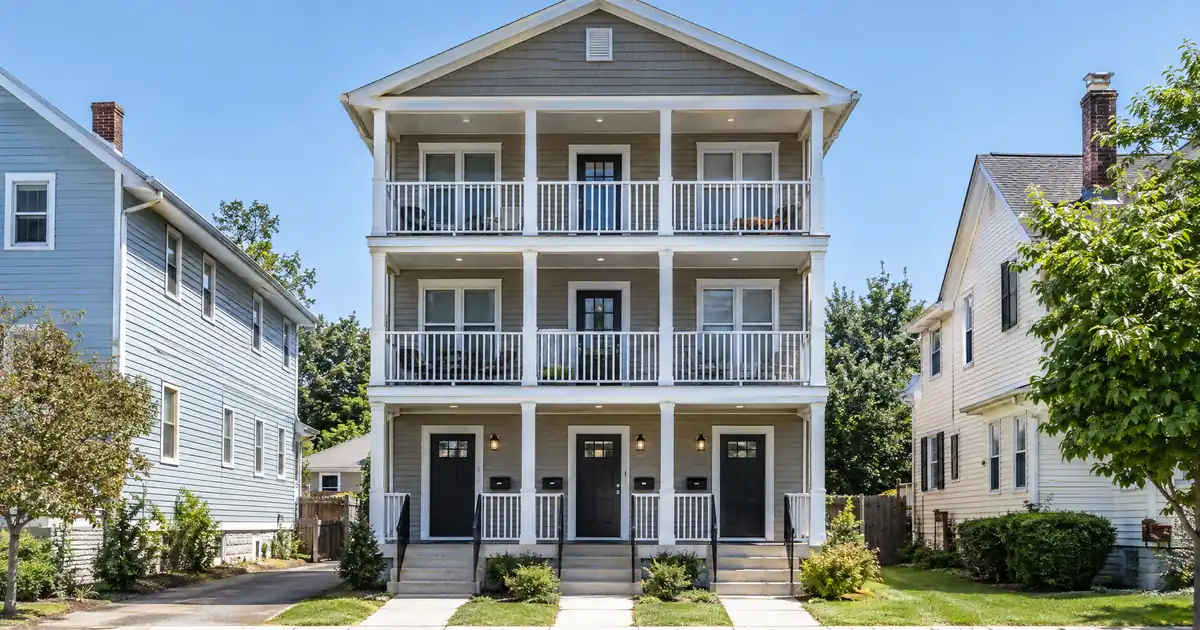
The Quick Read: On a conventional cash-out refinance of a duplex, triplex or fourplex you live in, mortgage insurance usually adds nothing to the monthly payment, because the loan-to-value cap sits below the point where it kicks in. An FHA cash-out does add it, as both an upfront premium and a monthly charge. VA loans swap it for a one-time funding fee. The program you pick decides which line items appear, and the appraisal decides how big they get.
Key Takeaways
- Conventional mortgage insurance is required above 80% loan-to-value. A conventional cash-out on a 2-4 unit home you live in is capped at 75%, so it normally stays under that line.
- FHA charges mortgage insurance on the whole new loan, not just the cash you take out.
- VA has no monthly mortgage insurance. Its funding fee takes that place.
- A “limited cash-out” refinance on the same building can reach a much higher loan-to-value, and mortgage insurance returns above 80%.
- More cash out means a bigger loan. On FHA, a bigger loan means bigger premiums.
Cash-out refinance estimate
The starting figures are an example value with a balance and a cash request in proportion. Replace them with yours.
Editable benchmark: 7.40% as of October 15, 2026 · Freddie Mac 30-year average via FRED®. A conventional market reference, not a cash-out refinance quote.
Illustrative starting assumptions: a $350,000 home value, a $193,000 current balance, the agency cap on a one-unit principal residence, a thirty-year term at the current Freddie Mac benchmark, and property taxes and insurance estimated at typical national rates. Every field is editable.
Illustrative estimate only — not a Loan Estimate, approval, quote, or commitment to lend. The rate field carries the weekly Freddie Mac thirty-year conventional benchmark, a market reference and not a cash-out refinance quote; a cash-out loan is priced by the lender at lock. The cash available is the loan the program cap allows less the balances paid off, before closing costs, which are not included. The HELOC line is the program’s combined loan-to-value ceiling applied to the same value and balance. Taxes and insurance are editable estimates. Licensed in sixteen states for consumer mortgages.
What Makes Up a 2-4 Unit Cash-Out Payment?
The payment is principal and interest, property taxes, homeowners insurance, mortgage insurance if it applies, and any association dues. Mortgage insurance is only one possible line. It is also the one most borrowers don’t expect.
Here is how each piece behaves:
| Component | What drives it | Where it shows up |
|---|---|---|
| Principal and interest | Loan size and term | Loan payment |
| Taxes and homeowners insurance | Property and location | Usually escrowed |
| Mortgage insurance | Program and loan-to-value | Monthly or upfront |
| Association dues | The property’s HOA, if any | Outside the loan |
On a 2-4 unit building, taxes and insurance tend to run higher than on a single-family home. That is a property trait, not a loan trait. It also means the payment can feel heavy even when mortgage insurance is absent.
When Does Mortgage Insurance Apply?
It depends on the program. Conventional loans trigger it above 80% loan-to-value. FHA charges it on every cash-out. VA doesn’t charge it, but adds a funding fee.
Lendmire’s brokers see this confusion often. Borrowers assume every cash-out refinance carries insurance, then compare programs on the wrong basis. Here is the side-by-side:
| Factor | Conventional | FHA | VA |
|---|---|---|---|
| Insurance form | Private mortgage insurance | Upfront and annual premium | Funding fee, no monthly insurance |
| Trigger | Loan-to-value above 80% | Charged on the loan | Charged on the loan, unless exempt |
| 2-4 unit cash-out cap | 75% | Set by HUD | Set by VA and the lender |
| Ends when | Cancellation or automatic termination | Per HUD duration table | One-time fee, nothing to end |
The conventional trigger comes straight from the Fannie Mae Selling Guide, which requires mortgage insurance on a conventional first mortgage with a loan-to-value above 80%. The cap on a 2-4 unit principal-residence cash-out is 75%. It appears in the Fannie Mae Eligibility Matrix, alongside 80% for a one-unit home.
So the arithmetic is simple. A cap of 75% sits five points under the insurance trigger. The price of that is less cash out.
Why 2-4 Units Change the Answer
Leverage on a 2-4 unit cash-out is lower than on a one-unit home, and that is the whole reason mortgage insurance often disappears. Lenders treat multi-unit buildings as a bit riskier, so they ask for more equity to stay in the loan.
Occupancy is the other lever. This article assumes you live in one of the units. Occupancy decides the leverage a file can reach, so tell your loan officer exactly how you use the property.
Compare that with buying. On a purchase, the same 2-4 unit principal residence can go up to 95% loan-to-value. At that level, private mortgage insurance is part of the payment. A cash-out refinance doesn’t get that treatment. Borrowers who saw a 95% figure for duplexes online sometimes assume it applies to cash-out. It doesn’t.
Worked Example: One Building, Three Paths
Picture a fourplex where you live in one unit. The home is appraised at a value the lender accepts. All three paths below use that same value. No dollar figures appear here, because percentages show the shape of the decision better.
Path one: conventional cash-out. The new loan is capped at 75% of value. Mortgage insurance is not triggered. The payment is principal, interest, taxes and homeowners insurance. Cash out is the new loan minus your payoff and costs.
Path two: FHA cash-out. The cap is set by HUD and runs higher than 75%. That means more cash. But the upfront premium applies to the whole new loan, and the annual premium is collected in the monthly payment. HUD’s announcement on premium changes explains that annual premiums are a percentage of the outstanding balance, paid in twelve monthly installments. HUD also counts that premium in the debt-to-income ratio. The upfront premium is typically financed into the balance, which nudges the loan up.
Path three: limited cash-out. You only pay off the old loan and costs. Fannie Mae’s matrix lets a 2-4 unit principal residence go up to 95% on this type, and mortgage insurance applies above 80%. This is a rate-and-term move, not a cash-out. You get no meaningful equity out of it.
The payment effect, in plain words:
- Path one has the lowest monthly burden from insurance, which is none, but pulls the least equity.
- Path two pulls the most equity and adds the most insurance cost.
- Path three adds insurance on a loan that returns no cash.
How Cash-Out Size Changes the Payment
A larger cash-out raises the loan balance. That pushes principal and interest up. On FHA, it also pushes both premiums up, because they are charged on the whole loan, not the cash portion.
This is where borrowers get caught. They think of the premium as a fee on the amount they pulled out. It isn’t. It is a charge on everything you owe after closing.
On a conventional loan, the sensitivity is different. Below the 75% cap, extra cash raises principal and interest only. Mortgage insurance isn’t in play. The cap is a hard stop, so you can’t buy more cash by paying more.
Honestly, this is a toss-up for many owners. A smaller conventional cash-out may keep the monthly cost lower. A bigger FHA cash-out buys more equity at a higher carrying cost. Which wins depends on what the money is for. A roof repair has a different payoff than a high-interest debt consolidation.
How the New Payment Affects Qualifying
Lenders test the full payment against your income. Mortgage insurance counts as part of it. So an FHA cash-out stresses the debt-to-income ratio more than a conventional one at the same balance.
Rent from the other units may help, but not the way many borrowers expect. Income from the units you don’t live in generally has to be documented, and the rent for your own unit is excluded. Treatment varies by program and lender. Ask early how rental income on the other units will be counted.
Reserves matter too. Some lenders size required reserves off the full payment, including any mortgage insurance. That is another reason the payment build-up matters before you apply.
Credit also shapes the choice. The wholesale conventional programs Lendmire works with start at a 620 decision score, and the automated finding governs most files. Jumbo lanes ask for more. Every parameter is subject to lender guidelines and full file review.
How Long Does Mortgage Insurance Last?
Conventional insurance can end. FHA insurance often doesn’t, at least not without a refinance. The difference is one of the biggest long-term costs in the decision.
On conventional loans, the borrower may request cancellation at 80% of the original value. That takes a good payment history, no subordinate liens and no decline in value. The servicer must end it automatically at 78%. These rules come from the Homeowners Protection Act, explained on the CFPB’s page on removing PMI. The CFPB frames them around single-family principal residences. A 2-4 unit building may fall outside the statutory rights, so check with your servicer about how your loan is treated.
FHA works differently. HUD’s FHA Connection guidance ties the duration to the loan term and the loan-to-value at origination. A higher starting loan-to-value can mean the premium runs for the life of the loan. Fannie Mae’s consumer page says FHA insurance is more complicated and may involve refinancing to end it.
VA is the simplest. The funding fee is one-time. The VA funding fee page lists separate cash-out fees for first and later use, and the fee doesn’t change with down payment on a refinance. Veterans receiving disability compensation and certain surviving spouses may be exempt. Financing the fee raises the loan balance.
Where the General Rule Breaks
The headline rule is “conventional 2-4 unit cash-out means no mortgage insurance.” Several situations bend it.
- Limited cash-out. As covered, the 95% ceiling brings insurance back above 80%.
- High-LTV refinance. Fannie Mae has a special option for existing Fannie Mae loans above the usual limits, with its own minimum thresholds on 2-4 units. It exists, but eligibility is narrow and rules change, so a loan officer has to confirm it.
- Existing insurance. On a high-LTV refinance, current coverage can sometimes carry onto the new loan. A transfer fee may be rolled in.
- Financed insurance. Fannie Mae’s option to finance borrower-paid insurance is limited to one-unit homes and to purchase, construction or limited cash-out. It isn’t available on a 2-4 unit cash-out.
- Streamlines. The FHA Streamline and the VA IRRRL are rate-and-term tools for existing government loans. They are not cash-out products. The FHA Streamline allows only a token amount of cash back, and the IRRRL carries a 0.5% funding fee unless exempt.
- Seasoning. The mortgage being paid off must be at least 12 months old, and the borrower must have been on title for six months, with exceptions for delayed financing, inheritance and legal awards.
One more note. Mortgage insurance cost is never a flat number. It depends on your loan-to-value, credit, program and loan size, so ask your loan officer to show it on your own Loan Estimate.
Key Terms Defined
Loan-to-value (LTV): The new loan balance divided by the appraised value of the home.
Private mortgage insurance (PMI): Coverage on a conventional loan that protects the lender, charged above 80% loan-to-value.
FHA mortgage insurance premium (MIP): An upfront premium plus an annual premium, both charged on an FHA loan.
VA funding fee: A one-time fee on a VA loan that takes the place of monthly mortgage insurance.
Limited cash-out refinance: A refinance that pays off the old loan and costs, with only incidental cash back.
What to Do If the Payment Doesn’t Work
Start by lowering the cash you take. On a conventional loan, that may keep you well under the insurance line. On FHA, it shrinks the loan the premium is charged on.
Then compare the other routes. A refinance can change the terms of your existing loan without raising the balance for cash. A separate second loan may leave your first mortgage alone. Each has its own costs, and some trade a lower first payment for a second payment elsewhere.
Tax treatment can depend on your situation; borrowers should speak with a qualified tax professional before relying on any deduction or credit.
If you are weighing the program choices, Lendmire’s cash-out refinance programs page lays out the options Lendmire arranges through wholesale lenders. Qualification is subject to lender guidelines and full file review, and nothing here is a commitment to lend.
Frequently Asked Questions
Does a conventional cash-out on a duplex require mortgage insurance?
Usually not. The cap on a 2-4 unit principal residence is 75%, and conventional insurance is triggered above 80%. Your own file can differ, so confirm the loan-to-value your lender uses after the appraisal.
Is FHA mortgage insurance charged only on the cash I take out?
No. The premiums apply to the whole new loan balance. The upfront portion is typically financed into the loan, which raises the balance slightly. The annual portion is built into your monthly payment.
Does the VA funding fee count as mortgage insurance?
No. It is a one-time fee that stands in for monthly insurance. It is charged on the whole new loan unless you are exempt, and it can be financed. Ask VA or your lender whether an exemption applies to you.
Can I use a streamline to pull equity out of my fourplex?
Not in any meaningful way. They limit cash back to a token amount, so equity access means a cash-out program.
Can mortgage insurance be removed after a 2-4 unit refinance?
It depends on the loan. Conventional insurance can be cancelled or ends automatically at set balances, though a 2-4 unit may fall outside the statutory rights, so ask your servicer. FHA premiums follow HUD’s duration table and can last for the loan term.
For your own numbers, request a scenario review with Lendmire.
About Lendmire
As a mortgage broker (NMLS# 2371349), Lendmire helps homeowners and home buyers in 16 states with FHA, VA, conventional and jumbo purchase and refinance loans arranged through wholesale lenders. Lendmire is never the lender; program terms are set by the lender and the agency guidelines. Scotsman Guide named Lendmire a Top Mortgage Workplace in both 2025 and 2026.
Get Started
Ready to find the right loan for you?
In about 30 seconds you can review financing options available for your home or investment property. No commitment required.
Informational only. Not a Loan Estimate, approval, or commitment to lend. Program availability and eligibility are subject to lender guidelines, credit approval, property review, and underwriting.
References
1. Fannie Mae Selling Guide B7-1-01: Provision of Mortgage Insurance
2. Fannie Mae Eligibility Matrix
3. HUD: FHA mortgage insurance premium announcement
4. CFPB’s page on removing PMI
5. HUD FHA Connection: MIP duration
6. VA: Funding fee and closing costs
This article is part of Lendmire’s Refinance series — every loan program’s qualification details, guidelines, and scenarios live on the loan options page.
Related reading: How Much a 2-4 Unit Cash-Out Refinance Releases at Its Cap · How to Qualify for a Cash-Out Refinance on a 2-4 Unit Primary Home · How Mortgage Insurance Adds to a Condo Cash-Out Refinance Payment
Brandon Miller
Founder & CEO, Mortgage Loan Originator, Lendmire LLC
- Mortgage Loan Originator · NMLS# 1129696 · Verify on NMLS Consumer Access
- North Carolina Real Estate Broker · License# 343312 · Verify on NCREC
- North Carolina Insurance Producer · License# 19053198 · Property, Casualty, Life, Health · Verify on NAIC SBS
- Lendmire LLC · Firm NMLS# 2371349 · Verify firm licensure
Compliance and disclosures. Lendmire (NMLS# 2371349) is a licensed mortgage broker and is not a direct lender, depository institution, financial advisor, or tax professional. Content in this article is general market analysis and educational information — not financial, legal, or tax advice for any specific situation. Lendmire does not guarantee loan approval; every transaction is subject to underwriting by the funding lender. Mortgage pricing and loan program guidelines are subject to change at any time without notice and vary by borrower characteristics, property type, and state regulations. Lendmire complies with Equal Housing Opportunity. Licensure verification: NMLS Consumer Access.