
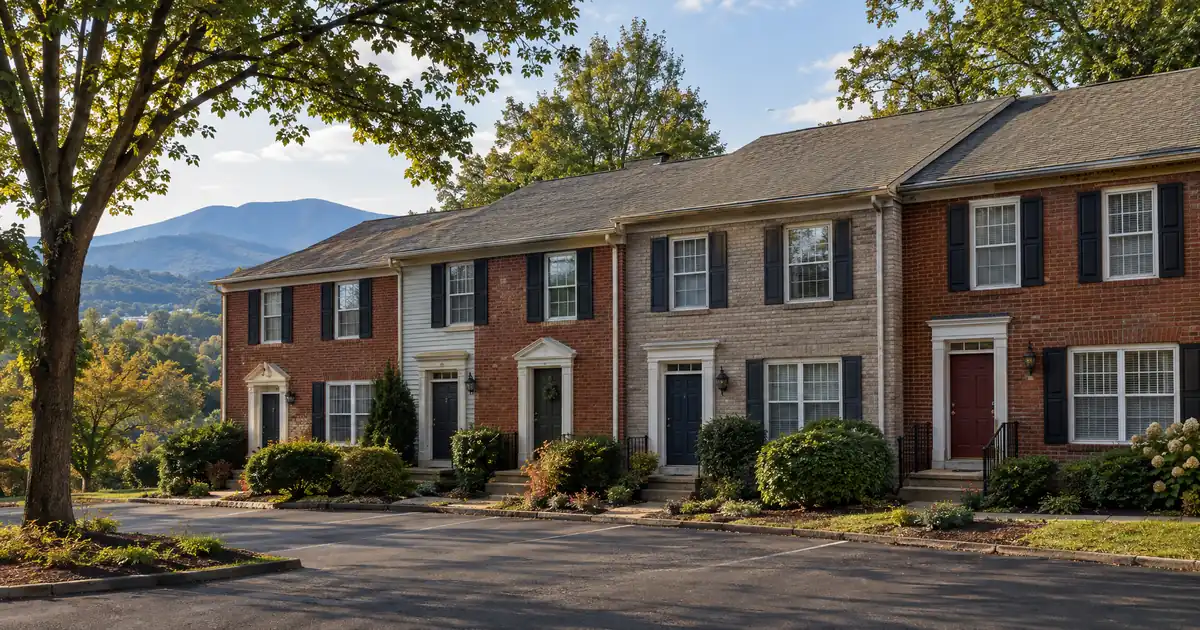
Zillow puts the typical Front Royal home value at $335,553, essentially unchanged over the past year. That one number frames every cash-out file in this town. Front Royal is a cash-flow market, not an appreciation market. Equity that comes out of a rental here has to come from the original purchase price, renovation work or years of paydown, and it has to survive an appraiser with few recent sales to lean on.
This article covers the owner who already holds a rental in Front Royal and wants to pull capital out through a DSCR cash-out refinance. It walks through the town’s rent and price data, modeled coverage ratios, the submarkets that carry demand, and the file mechanics that decide how much proceeds a lender will support.
DSCR Cash-Out Calculator
Run the cash-out numbers in Front Royal, VA
Rate source: Freddie Mac 30-yr average via FRED® — Federal Reserve Bank of St. Louis · effective Sep 24, 2026
Prefilled with starting assumptions — enter your property’s value, balance, taxes, and insurance for a more accurate picture.
Program parameters update from Lendmire’s centralized guideline source. Taxes and insurance are editable estimates.
As of Sep 24, 2026 · General Freddie Mac market benchmark, not a Lendmire loan offer. Property value, balance, taxes, and insurance are editable estimates. Maximum loan-to-value varies by lender, program, property type, and seasoning. Not a Loan Estimate, approval, or commitment to lend. Program availability and eligibility are subject to lender guidelines, credit approval, property review, and underwriting.
Key Takeaways:
A DSCR cash-out refinance in Front Royal, Virginia fits the investor who bought below market or improved a workforce rental, because the loan is underwritten primarily on the property’s rental income measured against its full monthly obligation, and the appraisal sets the ceiling. Flat values mean proceeds are earned, not assumed.
- Town-level value is flat: Zillow shows 0.0% change over the past year.
- Cash-out LTV tops out at 75%, with about 6 months of ownership before eligibility.
- Roughly 42.61% of housing units are rented, per NeighborhoodScout.
- Single-family at the median price models below 1.00 on full PITIA at 75% LTV.
- Lower-basis houses and townhouses are where coverage clears first.
- Every figure here varies by lender and program — guidelines, property type, leverage, and credit profile all apply.
Front Royal Market Snapshot
A quick read on the Front Royal investor landscape — figures come from the cited sources below. Confirm current property-level numbers before underwriting.
| Metric | Detail |
|---|---|
| Typical rents | $1,135 (Niche) |
| Recent appreciation | 6.22% annual (NeighborhoodScout) |
| Population | Population estimate 14,666 (Town of Front Royal) |
| Employment | 360+ employees (Valley Health news) |
Flat Prices, Thin Sales: What That Does to Proceeds
The appraisal is the controlling variable on Front Royal cash-out files. Price direction is flat to slightly negative, sales volume is low, and the sources disagree on the basic numbers. Proceeds are capped by whatever value the appraiser can defend, so the file should be built around that.
Here is the spread. Redfin shows a single-family median sale price that sits well above its townhouse median. Its housing market page shows a three-month median that is modestly lower than the same period a year earlier. Movoto reports a median sold price higher than either Redfin figure. Zillow’s typical value falls between the townhouse and single-family figures because it is an index across every home, not a median of closed sales. These are different methodologies measuring different things. None of them is wrong, and none of them is the number an appraiser will use.
Sales activity matters more than any of the medians. Redfin counts 46 sales in the latest month against 63 a year earlier, with homes selling after about 40 days and a competitiveness score of 63 out of 100. Thin volume means thin comps. An appraiser working a house in an older neighborhood may be reaching across subdivisions for support. That is when an appraisal reconsideration request becomes a normal step, not an escalation. A packet with closed sales, condition notes and documented improvements gives the reviewer something to adjust against.
Longer-run numbers look better. NeighborhoodScout says appreciation averaged 6.22% annually over the last ten years. Recent readings do not continue that pace. Zillow’s Warren County figure is $377,156, up 2.8%, so the county is not falling. The town is sitting still. An owner who bought a few years back with a discount or a rehab has real equity. An owner who bought at the top of a local run and is counting on market gains does not.
Which Rent Number Is Real?
Front Royal rent data is a mess, and a DSCR file lives or dies on which figure gets used. Town averages swing by more than 2x depending on the source and the property type, so any coverage example has to state what it is measuring.
The figures:
| Source | Figure | What it measures |
|---|---|---|
| Zumper | $1,685 average | All listed types, flat year over year |
| Niche | $1,135 median | Appears Census-based |
| Apartments.com | $774 one-bed; $979 two-bed | Apartments only, CoStar data |
| ApartmentHomeLiving | $2,113 average | Houses, condos, townhomes (asking) |
Zumper also says rents sit about 12% below the national average. The gap between $774 and $2,113 is not a contradiction. One is a one-bedroom in an apartment complex. The other is a house.
For a DSCR file, none of these averages is the coverage figure. The lender looks at the subject property’s own lease or a rent schedule from the appraisal, and that figure goes into the ratio. Asking rents from a listing site do not substitute for a signed lease. If the unit is leased below market, the file gets the lease number, and the owner can decide whether a rent reset belongs before the refinance.
Modeled Coverage: Three Property Types
DSCR is monthly rent divided by the full monthly obligation: principal, interest, taxes, insurance and any HOA dues. Lendmire’s primer on DSCR loans covers the mechanics. Most standard programs are built around a 1.00x benchmark, where rent covers the payment. Some lenders will look below that with stronger compensating factors, lower LTV or different pricing, but eligibility depends on lender guidelines, credit profile, reserves and property review.
The examples below are modeled assumptions, not market data. Each uses rent divided by full PITIA at 75% LTV, with taxes and insurance at Virginia-average loads included, and the bands are rounded down. Final terms depend on lender guidelines, property type, leverage, and the borrower’s complete credit picture.
Run the numbers on a house near the single-family median. Say a three-bedroom appraises near Redfin’s $376,250 single-family median and rents for a modeled $2,100. That is about 0.56% of price per month, illustrative arithmetic on asking rents. Coverage at 75% LTV lands around 0.9x including taxes and insurance. It sits under the benchmark. These specifics are subject to lender guidelines and a full review of property, leverage, and credit.
That is the honest picture of single-family at the median here. The rent-to-price ratio is thin.
Now say the same $2,100 house appraises at $300,000. At 75% LTV, coverage moves to roughly 1.15x including taxes and insurance. Same rent, lower value, cleaner ratio. The lesson is not that low appraisals are good. It is that houses bought below the median, or older homes held at a low basis, are the files where the ratio clears without gymnastics. Terms vary by lender guidelines, property type, leverage, credit profile, and full file review.
Townhouses sit in the same zone. Redfin’s $270,000 townhouse median is the lowest-priced product with enough sales behind it to price against. Pair a townhouse with rent at the lower end of the house band and coverage is plausible near or above 1.0x, but that depends on the actual lease.
When a file models under 1.00x, the paths a lender may review include a sub-1.00 program, a lower-LTV structure, an interest-only option, or rent documentation that better reflects the unit. Dropping the house in the first example to 60% LTV, for instance, brings coverage to about 1.1x. Whether any of those apply is subject to lender guidelines, credit approval and property review.
Duplexes are a different calculation. Redfin and Apartments.com data suggest per-unit rents in the $1,000 to $1,400 range for smaller apartment units. Two doors at that level collect roughly what one three-bedroom house does. A duplex wins on coverage only if its price per door is well below single-family. The multi-unit upside is real but conditional, and the side-by-side comparison of DSCR and conventional underwriting explains why per-door income matters more than headline rent.
Multi-unit stock itself is scarce. NeighborhoodScout says single-family detached homes are 59.43% of housing units, and three- and four-bedroom dwellings are the most common type. About 29.42% of the stock was built from 1940 to 1969 and 10.89% before 1939. Owners of legal 2–4 unit properties hold something uncommon. (Legal unit count is a local verification item, not an assumption.)
Downtown, the 340/522 Corridor and Linden
Three submarkets carry most of the rental-demand logic, and none of them has sourced neighborhood-level rent data. That limits what can be said with precision. It does not limit what can be said about who rents where.
Historic downtown is the best lead for older multi-unit and conversion properties. A local agent guide describes it as a mix of historic single-family homes, renovated historic properties and a few apartment buildings. It is also where condition and comp questions are sharpest on appraisals. Older housing stock comes in light when the appraiser cannot find renovated comparables, and documentation of updates is what recovers the value.
The Route 340/522 North corridor and the industrial parks are the employment-driven catchment. A market source’s comprehensive plan says manufacturing and transportation, logistics and distribution grew significantly from 2020 onward, and that major employers cluster in this corridor. Workforce three- and four-bedroom houses within reach of Stephens Industrial Park and Technology Park fit that demand.
Linden and the Route 55 East side is the commuter submarket. The county plan notes residents around Howellsville and Linden commute toward the D.C. area. The county’s demographics chapter says about 63.9% of county workers commute elsewhere for jobs, though that chapter is undated and likely older, so treat the percentage as approximate. The practical read: a meaningful share of renters earn outside the county and pay Front Royal rents, which are about 12% below the national average. That is the commuter-shed thesis, and it is why entry prices here sit well below Northern Virginia.
The Demand Anchors Behind the Leases
Long-term tenant demand rests on logistics, healthcare, public institutions and a small college. A cash-out lender cares about this indirectly. Stable tenant demand supports the rent figure in the file.
On logistics, the Town of Front Royal says the town sits near the I-66 and I-81 intersection, 70 miles west of Washington, D.C., and just south of the Virginia Inland Port, a truck-to-rail container port serving Norfolk. A local business publication’s older tally lists Axalta at 325 employees, Sysco Northeast at 320, Toray Plastics America at 150, and the Family Dollar and Ferguson distribution centers at nearly 600 combined. Those headcounts are dated approximations, not current counts. They show the type of employer base here.
On healthcare, Valley Health describes Warren Memorial Hospital as a 36-bed community hospital with more than 360 employees, 18 emergency department beds and 27 specialties. It hosts a family practice residency program. Nurses, technicians and residents tend to hold longer leases than seasonal tenants.
The county also hosts a cluster of federal and conservation sites. The county’s demographics chapter lists the U.S. Customs dog training center, ATF’s National Canine Training and Operations Center and the Smithsonian Conservation Biology Institute, alongside Shenandoah National Park and the George Washington National Forest. No headcounts are sourced, but these institutions bring rotating trainees, researchers and staff who need housing.
Christendom College lists 554 undergraduates with 90% living on campus. It is a minor source of rental demand, mostly faculty and staff. Skip any thesis that treats Front Royal as a college-town play.
Population context: the Town publishes its own estimate for Front Royal proper, and a separate source counts a substantially larger number of residents in the surrounding area. NeighborhoodScout’s figures for the town differ somewhat from the Town’s, and it also reports a housing-unit count in the same small range. Small town, small deal flow. That also explains the thin comps.
File Mechanics: Seasoning, LTV, Reserves and Entity Documents
The cash-out structure is simple and the friction is in the paperwork. Typical program guidance is a 75% LTV ceiling on cash-out, about 6 months of ownership measured from title recording, a 1.00x minimum DSCR, a credit floor of 620 and reserves of about 6 months of PITIA. Loan sizes run up to $3,000,000 on standard programs, with smaller balances routed through select lenders in the network. These are guideline ranges. Exact terms depend on lender program, credit profile and property.
The seasoning clock starts at recording, not at contract or closing-table signing. The settlement statement from the original purchase is the proof. Files that guess at the date and skip the statement are the ones kicked back. Equity available is not a fixed number either. It depends on rent used for lender review, the full obligation, reserves and the LTV ceiling together, and a file can clear the ratio and still be capped by the appraisal.
The failure modes on Front Royal files, in rough order:
1. Comp support on older stock. Thin sales volume and a spread of 1940s to 1960s housing mean appraisers adjust heavily. Build the reconsideration packet before it is needed: closed sales, receipts for updates, photos.
2. Rent evidence that does not match the appraisal schedule. A lease at $1,600 and an appraisal rent schedule at $2,000 invite questions. Reconcile them or explain the gap.
DSCR vs. conventional financing
There are two common ways to finance an investment property in Front Royal, VA, and they qualify you differently — here’s how investors weigh them.
Why investors choose it
- Qualifies on the property’s rental income — no personal tax returns, W-2s, or pay stubs needed to document income.
- No personal debt-to-income ceiling to clear, so existing mortgages and obligations don’t cap your borrowing the same way.
- Can be closed in an LLC, keeping the property inside a business entity.
- Built for scaling — not held to the limit on number of financed properties that conventional financing applies.
- Underwriting centers on the deal: generally qualifies when the rent covers the payment, a 1.00x coverage ratio being a common baseline (confirmed in underwriting).
- Designed specifically for investment property, including long-term and, where the program allows, short-term rentals.
Where it’s strong
- Often the lowest ongoing financing cost for a buyer who fully qualifies on personal income — a fit for a first property or a cost-first purchase.
Trade-offs for investors
- Requires full personal income documentation and must fit within a debt-to-income limit — salary, existing debts, and other mortgages all count.
- Typically held in your personal name rather than a business entity.
- Caps how many financed properties you can carry, which can become a ceiling as a portfolio grows.
- Evaluates you as a borrower as much as the property, which usually means more paperwork.
How investors usually choose: a first or single property often optimizes for the lowest financing cost; portfolio builders often optimize for leverage, vesting in an LLC, and scaling past conventional caps. The right answer depends on your goals, the property, and current guidelines — both paths run through select lenders in Lendmire’s wholesale network, with eligibility and terms confirmed in underwriting.
3. Reserves documentation. About 6 months of PITIA has to be sourced and seasoned in accounts. A recent transfer between accounts with no paper trail stalls a file.
4. Entity documents. For LLC-owned rentals, operating agreement, certificate of good standing and signing authority all need to be in order, subject to lender program eligibility. Title vesting that does not match the borrowing entity is a clearing-title problem, not a paperwork nuisance.
5. Stale insurance quotes. Coverage models on an old quote and breaks when the new one arrives. Get a current quote in before submission.
Working DSCR brokers see a recurring pattern in small commuter-shed markets like this one: the ratio is rarely what stops the file. The appraisal value and the rent documentation are. Owners who walk in with a lease, a condition packet and a clean title vesting tend to have fewer preventable gaps than owners who lead with a desired cash figure.
Lendmire, a DSCR-focused mortgage broker, structures these files through its wholesale lender network. Owners with a specific property can ask Lendmire to review the file before ordering anything. Lendmire’s pages on refinance details and the equity-extraction mechanics go further on structure, and the Virginia DSCR financing hub covers state-level context.
Where the Proceeds Go
Cash-out only makes sense if the capital has a job. In a flat market, that job is usually the next acquisition, a renovation on an existing unit, or reserves for a second property.
The cash-flow case has a catch. Cash taken out increases the monthly obligation on the refinanced property, which lowers its coverage ratio. A house that models at 1.15x before the refinance can drop toward 1.0x after, depending on how much is pulled. Run the post-refinance ratio, not the current one, before committing to a loan size. Then run the purchase math on the next deal separately, using its own rent and its own obligation.
Two things change the calculation here. Lower-basis stock is where coverage clears, so proceeds are most productive when redeployed into similar below-median houses or townhouses, not into assets that need a high appraisal to work. And because values are flat, a renovation that adds rentable value, like a bedroom count or a legal unit, does more for the appraisal than waiting does. Confirm local permitting and unit legality before treating any addition as income. Investors should verify current local rental rules, taxes and insurance with qualified local professionals.
One more point. Appreciation-led cash-out strategies that work in other metros do not transfer. A town where the three-month median is down 2.9% rewards conservative LTV and a reserve cushion.
Frequently Asked Questions
How much equity can an owner pull from a Front Royal rental?
The ceiling is 75% of the appraised value, minus the existing balance, and the appraisal sets the value. With flat prices and thin sales (46 in the latest month per Redfin), expect the appraisal to drive proceeds more than any online estimate. Final figures also depend on rent used for lender review, full PITIA and reserves, subject to lender guidelines.
Does a typical Front Royal single-family rental clear 1.00x?
At the single-family median, modeled coverage including taxes and insurance runs below 1.00x at 75% LTV. Lower-basis houses and townhouses are where the ratio is more likely to clear. A sub-1.00 file may be reviewed under a lower-LTV structure, an interest-only option or a sub-1.00 program, subject to lender guidelines and credit approval.
Which rent figure goes into the file?
The subject property’s signed lease, or the market rent schedule from the appraisal, not a town average. Town figures run from $774 for apartments to $2,113 for houses, condos and townhomes, per the Apartments.com and ApartmentHomeLiving data. The lender works from the property’s own documents.
Is a duplex easier to refinance than a house here?
Only if the price per door is well below single-family, since per-unit rents are modest. Multi-unit stock is also scarce in a town where single-family detached homes are 59.43% of units. Legal unit count and a rent schedule for each door need to be documented.
How long do I have to own the property before cash-out?
Typical guidance is about 6 months of ownership, measured from title recording and documented with the settlement statement.
For current guidelines and terms, see Lendmire’s DSCR loan programs page.
About Lendmire
Lendmire (NMLS# 2371349) is a DSCR and non-QM mortgage brokerage with investor loan programs in 41 markets, including Washington, D.C. Lenders commonly review DSCR eligibility around property-level rent rather than personal income documentation, subject to lender guidelines, and the brokerage helps arrange financing for LLC-owned portfolios beyond conventional financed-property limits. The firm was recognized by Scotsman Guide as a 2026 Top Workplace and is a 2025 Scotsman Guide Top Workplace. Questions on a specific property can go to 828-256-2183.
The ten-year appreciation average in Front Royal is 6.22% a year, while the latest twelve months on Zillow’s index read 0.0%, so a cash-out built on the flat recent reading holds up, while one built on the long-run average does not.
Get Started
Ready to find the right loan for you?
In about 30 seconds you can review financing options available for your investment property. No commitment required.
Informational only. Not a Loan Estimate, approval, or commitment to lend. Program availability and eligibility are subject to lender guidelines, credit approval, property review, and underwriting.
References
1. Zillow
3. Niche
6. Redfin
7. Redfin — Front Royal Housing Market
8. Movoto
9. Zillow’s Warren County figure
10. Zumper
11. Apartments.com
13. Townsquarepublications.com — Front Royal VA Business and Industry
15. recognized by Scotsman Guide as a 2026 Top Workplace
16. a 2025 Scotsman Guide Top Workplace
This article is part of Lendmire’s investment property cash-out refinance program — full qualification details, guidelines, and scenarios live on the program page.
Related reading: Luxury Rental DSCR Loans In New Jersey · Jersey Shore Vacation Rental Loans: DSCR Financing In Ocean City, Cape May And Long Beach Island · DSCR Cash-out Refinance In New Jersey: Pulling Equity From A Rental
Guides: Investment Property Cash-Out Refinance in Virginia
Brandon Miller
Founder & CEO, Mortgage Loan Originator, Lendmire LLC
- Mortgage Loan Originator · NMLS# 1129696 · Verify on NMLS Consumer Access
- North Carolina Real Estate Broker · License# 343312 · Verify on NCREC
- North Carolina Insurance Producer · License# 19053198 · Property, Casualty, Life, Health · Verify on NAIC SBS
- Lendmire LLC · Firm NMLS# 2371349 · Verify firm licensure
Disclosures. The information presented in this article is general market commentary, not financial, legal, or tax advice. Lendmire is a mortgage brokerage (NMLS# 2371349) — not a direct lender or depository institution — and loan placement is subject to lender underwriting. Nothing in this content represents a commitment to lend. Loan terms, pricing, and program availability vary based on borrower qualifications, property characteristics, and state of subject property, and are subject to change at any time. Lendmire complies with Equal Housing Opportunity requirements. Consumer access: nmlsconsumeraccess.org.