
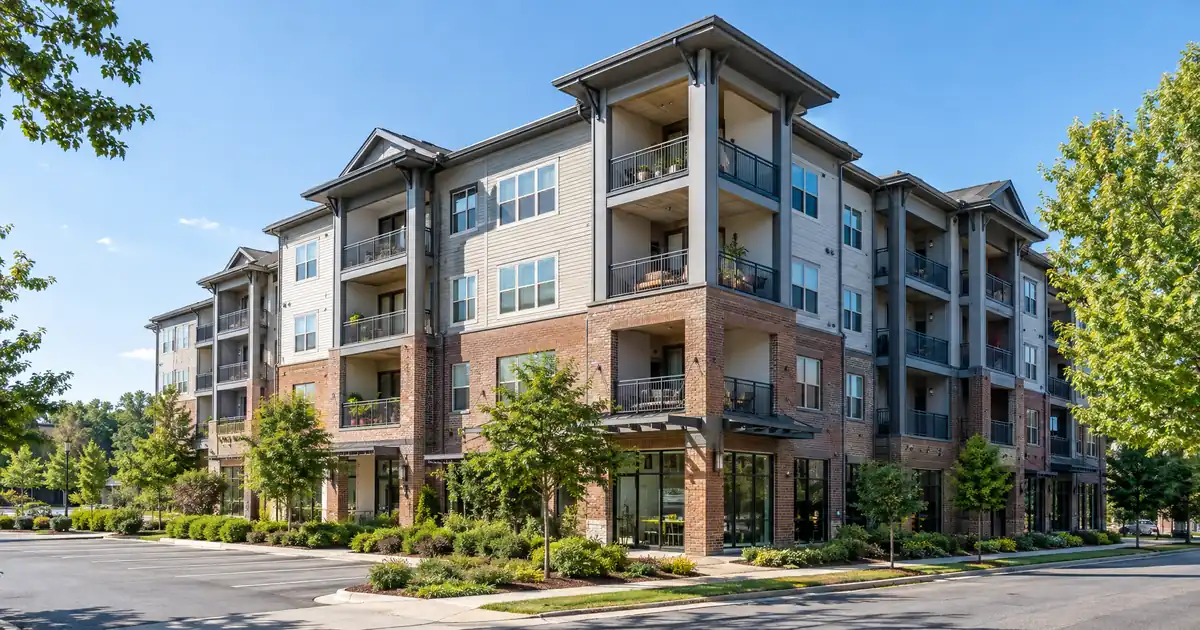
Picture an investor holding a single-family rental in Downtown Fuquay-Varina, purchased two years ago near the neighborhood’s older-stock price point. Downtown’s median sale price came in at $260K as of April 2025, up 4.0% year-over-year on Redfin’s neighborhood data. That property has likely gained equity since closing — and it’s still renting at or near the town’s median rent band, which Zillow Rental Manager puts at $2,100 with a range of $1,275 to $3,600 across property types. That gap between a low entry basis and a full-town rent ceiling is exactly the kind of equity an investor pulls out through a cash-out refinance instead of leaving parked in the deed.
Key Takeaways: A Fuquay Varina, North Carolina cash-out refinance is underwritten primarily on the property’s current market rent measured against its full monthly obligation, with the file cleared for equity extraction only after roughly six months of title seasoning and within a 75% loan-to-value ceiling.
DSCR Cash-Out Calculator
Run the cash-out numbers in Fuquay Varina, NC
Rate source: Freddie Mac 30-yr average via FRED® — Federal Reserve Bank of St. Louis · effective Sep 17, 2026
Prefilled with starting assumptions — enter your property’s value, balance, taxes, and insurance for a more accurate picture.
Program parameters update from Lendmire’s centralized guideline source. Taxes and insurance are editable estimates.
As of Sep 17, 2026 · General Freddie Mac market benchmark, not a Lendmire loan offer. Property value, balance, taxes, and insurance are editable estimates. Maximum loan-to-value varies by lender, program, property type, and seasoning. Not a Loan Estimate, approval, or commitment to lend. Program availability and eligibility are subject to lender guidelines, credit approval, property review, and underwriting.
- Cash-out LTV caps at 75% — never the 80% purchase ceiling
- Seasoning runs about six months from the recorded closing date
- Downtown’s $260K median basis versus town-wide rent levels creates some of the strongest coverage ratios in the market
- South Lakes and Sunset Bluffs skew appreciation-heavy, with rents historically lagging price growth
- Minimum qualifying DSCR sits at 1.00, rent against full PITIA
Fuquay Varina Market Snapshot
A quick read on the Fuquay Varina investor landscape — figures come from the cited sources below. Confirm current property-level numbers before underwriting.
| Metric | Detail |
|---|---|
| Home prices | $451,500 median property value (Data USA) |
| Population | 40,485 population (Census Reporter ACS Profile) |
| Employment | Duke university hospital 11,000+ employees (Town of Fuquay-Varina) |
Downtown Is Where the Equity Math Gets Interesting
Downtown Fuquay-Varina is the strongest cash-out candidate in town, not because it’s flashy, but because the price-to-rent gap is unusually wide for a growing Wake County suburb. The historic core along North Main Street has been picking up new businesses, restaurants and shops — the Mason Jar Tavern and Aviator Brewing Tap House among them — while many of the older buildings sit available for redevelopment into a mix of retail, office and residential space.
That redevelopment narrative matters for financing math. A workforce single-family home bought near Downtown’s below-market basis and rented at or near the town median produces a materially stronger rent-to-value ratio than a comparable property in a newer subdivision priced well above it. Run a modeled scenario: an investor bought a Downtown SFR two years ago at a modest basis and now carries meaningful equity after local appreciation. At a moderate leverage point on a refinanced value reflecting that appreciation, with rent assumed conservatively against full PITIA — principal, interest, taxes and insurance, with taxes and insurance treated only qualitatively as modest recurring carrying costs — coverage lands comfortably above the program floor, not a file merely scraping by. Final terms depend on lender guidelines, property type, leverage, and the borrower’s complete credit picture.
The WakeMed Fuquay-Varina Healthplex reinforces the Downtown thesis specifically. WakeMed received a Certificate of Need in mid-2025 to build a 25,000-square-foot facility with a 24/7 emergency department, expected to treat roughly 9,300 patients in its first year, according to WakeMed’s announcement. It’s sited on North Main Street, adjacent to the existing WakeMed Fuquay-Varina Medical Park, with construction starting in early 2026. That’s a fresh institutional anchor landing directly in the submarket where cash-out refinance math already works best — not a vague growth story, a dated one with a groundbreaking on the calendar.
South Lakes: Strong on Paper, Thinner on Day-One Cash Flow
South Lakes is the town’s most-cited growth corridor, but it’s an appreciation play first and a cash-flow play second. The community is a large planned unit development with 991 single-family homes plus 45 townhomes, a clubhouse, fitness center and pool. Current pricing runs in the mid-to-high $500,000s depending on the listing source, with price per square foot around $243.
Here’s the catch on South Lakes: historically tracked rent data for the neighborhood clusters well below what that price point would suggest is needed for strong coverage — a gap between new-construction pricing and achievable rent that hasn’t fully closed. That doesn’t kill the deal, but it changes the strategy. South Lakes and its neighbor Sunset Bluffs are better framed as buy-and-hold-for-appreciation plays, where a future cash-out refinance captures equity gains after the market catches up to the price basis, rather than an immediate rent-covers-everything scenario. An investor sitting on a South Lakes property with several years of appreciation baked in is often in better shape to refinance than one who bought last year — the equity has had time to build past what rent alone would justify on day one.
Woodcreek and Crooked Creek: The Workforce Middle Ground
Woodcreek and Crooked Creek sit between Downtown’s value-add basis and South Lakes’ new-construction premium. Woodcreek is an established master-planned community mixing single-family and some attached product, popular with move-up buyers and long-term renters — a reasonable workforce single-family hold. Crooked Creek carries a mix of home vintages and turns up often in investor searches for value-add single-family stock, similar in character to Downtown but without the same institutional catalyst nearby.
For an investor holding equity in either neighborhood, the cash-out refinance walkthrough covers how proceeds get structured once the six-month seasoning clock has run and the appraisal supports the higher value.
The Seasoning Clock and the LTV Ceiling — What Actually Gates the File
The two hard mechanical limits on a Fuquay Varina cash-out file are seasoning and leverage, and neither is negotiable inside standard program guidelines. Seasoning generally requires roughly six months of ownership measured from the recorded closing date before cash-out proceeds become available — the settlement statement is the document that proves it. Loan-to-value on a cash-out refinance caps at 75%, a hard ceiling that’s meaningfully tighter than the 80% commonly seen on a purchase file; don’t run purchase math on a refinance file and expect the same number to hold.
Reserves typically run around six months of PITIA, stepping up to roughly nine months on loan amounts above $1.5 million — unlikely territory for most single-family holds in this market but relevant for anyone stacking multiple Fuquay Varina properties. Credit tiers generally start around 620 on the low end, with better pricing tiers at 660, 680 and 700, though qualification always depends on the full file — property, reserves, and lender guidelines together, not credit score alone.
Fuquay Varina, North Carolina rental property investors can tap DSCR programs that Lendmire arranges, available across 41 markets, including Washington, D.C. For state-specific program details, Lendmire’s North Carolina DSCR loan programs page lays out the current framework.
What Actually Trips Up These Files
The recurring friction point on cash-out files in markets structurally similar to Fuquay Varina — fast-growing bedroom suburbs feeding a larger metro — tends to be rent documentation that doesn’t match the appraisal’s rent schedule. Lendmire’s deal desk sees this most often when an investor pulls a rent figure from an online estimator instead of an actual lease or a rent comp the appraiser can defend. The cleaner files pair a signed lease (or, for a vacant unit, a market-rent addendum on the appraisal) with a settlement statement that clearly documents the seasoning period. Files built on assumed rent numbers instead of appraiser-supported comps are the ones that come back for revision.
Entity documentation is the second common gap. If title sits in an LLC, the operating agreement and a certificate of good standing need to be current and match the name on title exactly — subject to lender program eligibility on entity-owned files. Small mismatches between the entity name on the deed and the entity name on the loan application cause more delay than almost anything else on these files.
Why the Bedroom-Community Structure Matters for Comps
Fuquay-Varina functions primarily as a commuter suburb feeding Raleigh and RTP employment, not a self-contained job center — the town’s own job count runs well below its resident population, per Redfin’s city data. That matters for appraisal support: comps and value trends in this market track regional southern-Wake commuter demand — Apex, Holly Springs, Garner — more than they track in-town employment announcements alone. An appraiser working a Fuquay Varina file who pulls comps only from within town limits, ignoring that broader corridor, sometimes comes in light. A reconsideration request that widens the comp radius to the immediate commuter corridor is a normal, expected step here, not a red flag.
That said, the town isn’t purely a bedroom community with nothing local. Bob Barker Company runs a roughly 210,000-square-foot distribution center on Purfoy Road, one of the larger local employers, and the regional biomanufacturing cluster nearby — Novo Nordisk’s multi-billion-dollar Clayton campus and Amgen’s Holly Springs facility — feeds a steady inflow of relocating pharma and biomanufacturing workers who rent in Fuquay-Varina’s newer subdivisions before buying. That’s a tenant pipeline distinct from the retiree cohort the new Healthplex is built to serve, and it supports demand across both the Downtown workforce niche and the South Lakes/Sunset Bluffs newer-construction stock.
The Bypass Study: A Slower-Burn Catalyst Worth Tracking
The CAMPO Executive Board formally endorsed final recommendations for a U.S. 401 Corridor Study in March 2024, covering roughly 19 miles from Wake County through Fuquay-Varina toward Lillington, including a proposed bypass segment, according to CAMPO’s corridor studies page. That’s a funded planning commitment, not just a growth forecast — though it’s a multi-year horizon, not a next-quarter one. For an investor holding property along that southern corridor, it’s a reason to think about the eventual cash-out refinance as a two-step process: buy and hold now, let the infrastructure and population growth (some projections have the town tripling in size over 25 years) build equity, then refinance once the appraisal reflects the corridor’s improved access.
A Quick Word on Property Type
The overwhelming majority of Fuquay Varina’s rental stock is single-family — Redfin’s recent monthly sales snapshot showed dozens of single-family and townhome closings against a single multi-family sale. Genuine 2-4 unit multiplex inventory just isn’t common here, so an income-stacking duplex or fourplex strategy is opportunistic at best, not a repeatable acquisition thesis in this specific town. Workforce single-family and townhome holds remain the more reviewable, more available path for DSCR investors working this market. (Manufactured homes, log homes and barndominiums fall outside standard DSCR program eligibility regardless of neighborhood.)
For investors weighing whether a DSCR structure makes more sense than a conventional refinance on an existing rental, conventional vs DSCR on investor loans breaks down the qualification difference — and Lendmire’s guide to DSCR qualification mechanics covers how the rent-to-PITIA ratio actually gets calculated before a file goes to a lender.
Investors weighing a cash-out move on a Fuquay Varina hold can reach the team at 828-256-2183 or pull a DSCR quote directly to see how the numbers run on a specific property.
Frequently Asked Questions
How much equity can an investor pull from a Fuquay Varina rental?
That depends on current appraised value, existing loan balance, rent used for lender review and the 75% LTV ceiling — there’s no fixed dollar figure until those inputs run through underwriting. A Downtown property bought near the $260K neighborhood median with two years of appreciation behind it will generally show a different equity position than a South Lakes property bought at a $535,000-plus basis last year.
DSCR vs. conventional financing
Two common ways to finance an investment property in Fuquay Varina, NC. They qualify you differently — here’s how investors weigh them.
Why investors choose it
- Qualifies on the property’s rental income — no personal tax returns, W-2s, or pay stubs needed to document income.
- No personal debt-to-income ceiling to clear, so existing mortgages and obligations don’t cap your borrowing the same way.
- Can be closed in an LLC, keeping the property inside a business entity.
- Built for scaling — not held to the limit on number of financed properties that conventional financing applies.
- Underwriting centers on the deal: generally qualifies when the rent covers the payment, a 1.00x coverage ratio being a common baseline (confirmed in underwriting).
- Designed specifically for investment property, including long-term and, where the program allows, short-term rentals.
Where it’s strong
- Often the lowest ongoing financing cost for a buyer who fully qualifies on personal income — a fit for a first property or a cost-first purchase.
Trade-offs for investors
- Requires full personal income documentation and must fit within a debt-to-income limit — salary, existing debts, and other mortgages all count.
- Typically held in your personal name rather than a business entity.
- Caps how many financed properties you can carry, which can become a ceiling as a portfolio grows.
- Evaluates you as a borrower as much as the property, which usually means more paperwork.
How investors usually choose: a first or single property often optimizes for the lowest financing cost; portfolio builders often optimize for leverage, vesting in an LLC, and scaling past conventional caps. The right answer depends on your goals, the property, and current guidelines — both paths run through select lenders in Lendmire’s wholesale network, with eligibility and terms confirmed in underwriting.
Does the six-month seasoning rule apply to inherited or gifted Fuquay Varina property?
Seasoning is typically measured from the date title records, regardless of how the property was acquired, though specific documentation requirements can vary by lender and file. The settlement or transfer document establishing the recorded date is what a lender reviews.
Why does South Lakes look strong on paper but weaker for immediate cash-out coverage?
Because pricing in South Lakes has outpaced historically tracked rent levels for the neighborhood, current rent alone may not clear a strong coverage ratio at today’s price point. It reads better as an appreciation-driven hold where equity — not day-one rent — is what eventually funds the refinance.
Is a Downtown Fuquay-Varina rowhouse or older single-family a good cash-out candidate?
Often, yes, relative to newer subdivisions — the lower acquisition basis paired with town-median rent levels tends to produce stronger coverage ratios than newer, higher-priced product. The upcoming WakeMed Healthplex on North Main Street adds a fresh anchor to that specific submarket.
Does the new WakeMed emergency department affect refinance timing?
Not directly for seasoning or LTV, which are fixed program mechanics, but it’s a relevant factor for an appraiser assessing forward-looking neighborhood demand in the Downtown submarket where the facility is being built.
Are multi-unit properties easy to refinance in Fuquay-Varina?
Genuine 2-4 unit properties are scarce in this town’s inventory, so most cash-out activity here involves single-family or townhome product rather than duplex or fourplex conversions.
For current guidelines and terms, see Lendmire’s DSCR loan programs page.
About Lendmire
Lendmire is a non-QM mortgage broker (NMLS# 2371349) that arranges DSCR financing for real estate investors across 41 markets — 40 states plus Washington, D.C. Because these loans qualify primarily on a property’s rental cash flow rather than personal income documentation, the structure fits self-employed borrowers and entity-titled portfolios well. Lendmire places loans with wholesale investor lenders rather than funding them directly. Scotsman Guide named Lendmire a Top Mortgage Workplace in both 2025 and 2026.
Fuquay-Varina’s own resident-to-job ratio inside town limits runs at roughly three residents for every local job — a number that says more about where this town’s real estate value actually comes from than any single price chart does.
Get Started
Ready to find the right loan for you?
See your offer in seconds. No credit pull, no obligation.
Informational only. Not a Loan Estimate, approval, or commitment to lend. Program availability and eligibility are subject to lender guidelines, credit approval, property review, and underwriting.
References
2. Data USA
3. Census Reporter ACS Profile
6. CAMPO’s corridor studies page
7. 2025
8. 2026
This article is part of Lendmire’s investment property cash-out refinance program — full qualification details, guidelines, and scenarios live on the program page.
Related reading: Cash Out Refinance on Investment Property in Fuquay-Varina NC · DSCR Cash Out Refinance in Hendersonville, North Carolina: The Duplex Equity Play · Cash Out Refinance on a Carolina Beach Investment Property
Guides: Investment Property Cash-Out Refinance in North Carolina
Brandon Miller
Founder & CEO, Mortgage Loan Originator, Lendmire LLC
- Mortgage Loan Originator · NMLS# 1129696 · Verify on NMLS Consumer Access
- North Carolina Real Estate Broker · License# 343312 · Verify on NCREC
- North Carolina Insurance Producer · License# 19053198 · Property, Casualty, Life, Health · Verify on NAIC SBS
- Lendmire LLC · Firm NMLS# 2371349 · Verify firm licensure
Disclosures. The information presented in this article is general market commentary, not financial, legal, or tax advice. Lendmire is a mortgage brokerage (NMLS# 2371349) — not a direct lender or depository institution — and loan placement is subject to lender underwriting. Nothing in this content represents a commitment to lend. Loan terms, pricing, and program availability vary based on borrower qualifications, property characteristics, and state of subject property, and are subject to change at any time. Lendmire complies with Equal Housing Opportunity requirements. Consumer access: nmlsconsumeraccess.org.