
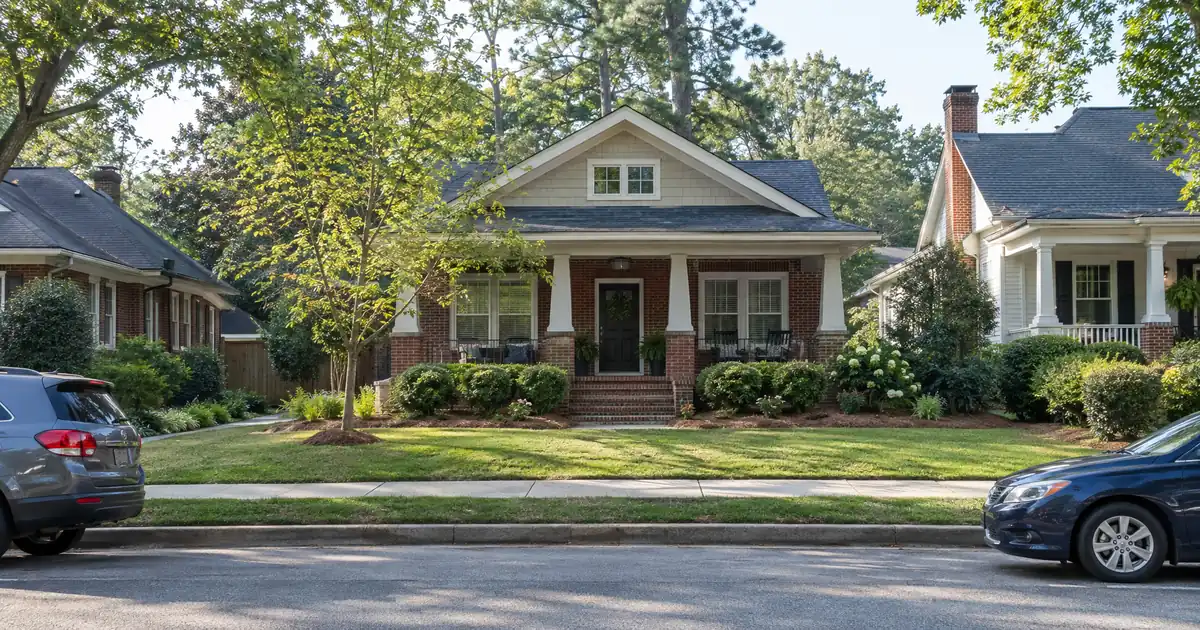
One data point explains most of what an investor needs to know about this market. In the last month of Redfin’s recently sold listings, Sugar Hill showed 1 multi-family unit against 29 townhouses. The city is built almost entirely out of detached houses and townhomes, and the cash-out math follows from that. It does not look like a duplex market, and it does not look like a market where a rising tide does the work for you.
Sugar Hill, Georgia is one of the 41 markets — 40 states plus Washington, D.C. — where Lendmire (NMLS# 2371349) places DSCR loans for investment-property borrowers. This article is for the investor who already owns here and wants to pull equity out. It covers what the numbers allow, which property types clear, and what to watch over the next 6-24 months.
DSCR Cash-Out Calculator
Run the cash-out numbers in Sugar Hill, GA
Rate source: Freddie Mac 30-yr average via FRED® — Federal Reserve Bank of St. Louis · effective Sep 24, 2026
Prefilled with starting assumptions — enter your property’s value, balance, taxes, and insurance for a more accurate picture.
Program parameters update from Lendmire’s centralized guideline source. Taxes and insurance are editable estimates.
As of Sep 24, 2026 · General Freddie Mac market benchmark, not a Lendmire loan offer. Property value, balance, taxes, and insurance are editable estimates. Maximum loan-to-value varies by lender, program, property type, and seasoning. Not a Loan Estimate, approval, or commitment to lend. Program availability and eligibility are subject to lender guidelines, credit approval, property review, and underwriting.
TL;DR: A DSCR cash-out refinance in Sugar Hill, Georgia is a loan against an investment property you already own, underwritten primarily on the rent the property supports measured against its full monthly obligation. Proceeds are capped by a 75% loan-to-value ceiling and remain subject to lender guidelines.
- The median sale price is $475K, down 4.1% year over year, per Redfin.
- Detached houses at market value run thin on coverage. Townhomes clear more easily.
- Cash-out here is limited by rent coverage before it is limited by equity.
- Seasoning runs about 6 months from title recording, with about 6 months of reserves.
- Exact terms depend on the lender’s guidelines, property type, leverage, and a full review of the borrower’s file.
Sugar Hill Market Snapshot
A quick read on the Sugar Hill investor landscape — figures come from the cited sources below. Confirm current property-level numbers before underwriting.
| Metric | Detail |
|---|---|
| Typical rents | Rents from $1,455 to $2,645 (Urbanize Atlanta) |
| Employment | Nearly 24,000 employees (Gwinnett County Public Schools) |
Why the Constraint Is Coverage, Not Equity
The binding constraint on a Sugar Hill cash-out is the rent-to-debt ratio, not the equity. A typical detached house here rents for well under what a 75% LTV loan demands once taxes and insurance are included. Investors who bought a few years ago often have plenty of equity and not enough rent to use it.
Start with the sale side. Redfin puts the median sale price at $475K for the most recent three-month window, down 4.1% year over year, with a median of $195 per square foot. Zillow shows an average home value of $462,439, down 3.1% over the past year. Two sources, same direction.
Now the rent side. Redfin’s rental page showed average rent of $1,785, though that data is stamped about a year before the sales data. Against the $475K median, that works out to roughly 0.38% monthly rent-to-value. That is a rough calculation across mismatched dates, but it tells you the direction. Homes.com lists a price-to-rent ratio of 15.4 and a single-family asking median of $2,295, which is a better read for houses than the all-renter averages.
Picture an investor holding a detached house valued near the $475K median and renting at that $2,295 asking level. Modeled including taxes and insurance, a 75% LTV cash-out lands around 0.8x. That sits well below the 1.00 benchmark most standard DSCR programs are built around. To approach 1.00x, leverage has to drop into the mid-50s LTV range. Those are modeled assumptions, not quoted terms. Every figure here varies by lender and program — guidelines, property type, leverage, and credit profile all apply.
Sub-1.00 files can sometimes be reviewed by select lenders, but they usually mean reduced leverage, stronger credit, and extra lender scrutiny. Whether a given file fits depends on the borrower, the property, and the program. The realistic plan for a typical Sugar Hill house is a smaller cash-out, not a maximum one.
Townhomes Are Where the Ratio Clears
Townhomes are the strongest DSCR fit in Sugar Hill, because asking rents run far higher relative to value than they do for detached houses. Homes.com shows townhouse asking rents at $2,800, against $2,295 for single-family and $1,400 for condos. Apartments.com reports an average townhome rent of $2,697.
City-Data puts attached-home values at $355,663 against $534,183 for detached houses. Say you own a townhome valued near that attached figure and renting near $2,697. Rent runs north of 0.7% of value, and modeled coverage including taxes and insurance lands around 1.2x at 75% LTV. That’s a different conversation from the house above. Final terms depend on lender guidelines, property type, leverage, and the borrower’s complete credit picture.
The caveat is that the price and rent data aren’t from the same date, so confirm with current sold comps before building a plan around it. The appraiser’s value is what counts, and the appraiser works from closed sales, not asking rents.
Townhome supply also exists in the pipeline, which matters for the next section. The Providence Group’s Millcroft sits where Buford meets Sugar Hill, and Redfin’s rental page lists Overlook at Sugar Hill townhomes at 1,257 to 1,549 square feet. A borrower with an older unit in one of these communities is competing against new product with the same floor plan.
Skip the Duplex Hunt
Multi-unit income stacking is close to unavailable in Sugar Hill. Point2Homes counts 8,698 housing units, 78% of them detached single-family. Add the one multi-family listing against 29 townhouses, and a duplex or fourplex plan is rarely realistic.
Small older multifamily does exist (one listing near Level Creek Road showed a renovated one-bedroom in a six-unit community), but that is a single listing, not a market statistic. Any 2-4 unit property that does trade will have thin comps, and thin comps are an appraiser’s reason to be conservative.
The practical read: if the portfolio is built on duplexes and fourplexes elsewhere, Sugar Hill is a place to hold a house or townhome, not a place to hunt for stacked units. For the single-family alternatives, it is worth weighing DSCR versus conventional before you decide which route fits a given property.
What Actually Supports Rent Here
Rent support in Sugar Hill comes from household income and commuter access, not from a single employer. Census-based data puts the city at 28,598 residents, up from 25,076 at the last census, making it the fourth-largest city in Gwinnett County. City-Data shows growth of 150.9% since 2000, and a median household income of $109,615. U.S. News lists an average commute near 30 minutes.
This is a bedroom-and-retail community in the Metro Atlanta commuter shed. The jobs sit county-wide. Gwinnett County Public Schools reports nearly 24,000 employees and is the county’s largest employer. Per Partnership Gwinnett figures, Northside Hospital employs 4,650 and the county labor force stood at 517,604 with unemployment of 3.1%. Those are county numbers, since no Sugar Hill employer list was found. Nearby hospital campuses include Northside Hospital Gwinnett and Northside Hospital Duluth.
On the tenant side, only 21% of households rent, per RentCafe. That is 1,814 households, against 6,731 owner-occupied. A small renter pool is a thin pool, but it skews toward houses and townhomes: RentCafe’s rental mix data shows 48% of rentals are single-family, 30% are in small complexes under 50 units, and 16% are in larger buildings. About 78% of apartment buildings were built since 2000. Your rental competes with newer product, not old cheap units, so condition and finishes matter at renewal.
Downtown and the Greenway
Downtown is the city’s redevelopment centerpiece. Per the AJC, the E Center is a $46 million mixed-use development owned by the Downtown Development Authority. It houses the 406-seat Eagle Theatre, and The Bowl adds 1,800 seats. The city’s Eagle Theatre page notes restaurants, shops, a history museum, and an art gallery nearby.
The Sugar Hill Greenway, a 16.5-mile multi-use trail still under construction, ties into this. Newer rentals such as The Refinery market themselves as greenway-adjacent. These amenities support walkable-core demand, but they don’t change the arithmetic of a $475K house renting for $2,295. Treat them as a reason tenants stay, not a reason the appraisal will rise.
The Supply Flag
New rental supply near downtown is the main risk to townhome rents. Urbanize Atlanta reported that Conclave Sugar Hill is a 306-unit mix of apartments and rental townhomes off Georgia Highway 20, just north of downtown.
New townhomes with fresh finishes and professional property management compete directly with investor-owned units, and that can cap rent growth and stretch lease-up. Conclave Sugar Hill is a useful example, since its rental townhomes would sit alongside the existing townhome stock investors already hold. No sourced vacancy or absorption rate turned up, so this is a supply flag, not a measured oversupply. It’s worth watching, though, because a cash-out that clears at 1.2x on today’s rent has less cushion if renewals soften.
What to Watch Over the Next 6-24 Months
The pattern in Sugar Hill right now is falling prices, thinning volume, and rents that haven’t moved enough to close the coverage gap. Redfin shows 85 homes sold in August against 99 a year earlier, with days on market near 47 against 45 a year ago. Homes get about 2 offers on average. That isn’t a collapse. It is a market drifting soft.
Here are the indicators that decide whether a cash-out still works:
- Sold comps versus list prices. If closed prices keep sliding 3-4% annually, an appraisal that works today may not work at the next refinance. Anyone planning a cash-out should do it against current comps, not a projected value.
- Townhome rent after new deliveries. If asking rents on existing townhomes hold near the $2,700 range as Conclave leases up, coverage holds. If they slip, the 1.2x cushion thins.
- Asking rent on houses. Houses need rent growth or price declines to close the gap. Neither is a plan.
- Sales volume. Thinner volume means fewer comps and more conservative appraisals.
(An investor waiting for appreciation to bail out a thin file is making a bet this data doesn’t support.) The stronger play is to size the loan against today’s rent and today’s comps, and let any appreciation be a bonus.
Seasoning, Appraisal Cushion, and Putting Proceeds to Work
The program mechanics are simple, even if the Sugar Hill math is not. Standard cash-out structures cap LTV at 75%, with about 6 months of seasoning measured from title recording and about 6 months of PITIA in reserves. Credit tiers generally start at a 620 floor, and standard loan amounts run up to $3,000,000. The cash you can actually take out depends on rent used for lender review, the debt service, reserves, and that ceiling, so it is never a guaranteed figure. All of this is subject to lender review and program guidelines, and the guide “The Refi Options” covers the mechanics in more depth.
On files from soft-appreciation suburbs like this one, the common friction point is the gap between the owner’s expected value and the appraised value. The cleaner files from a documentation standpoint tend to be the ones where the owner has already pulled current sold comps, has a signed lease at or near market rent, and has set the loan request below the ceiling instead of at it. Deal desks reviewing these files tend to see more trouble from an optimistic value than from a thin credit score.
If the equity is real, the next question is where it goes. Proceeds from a Sugar Hill house often make more sense deployed into a stronger-coverage property than held against another thin file. Sugar Hill’s single-family stock and a limited renter pool mean the next deal is probably a townhome, or a multi-unit property in a different market. Lendmire’s Georgia DSCR loan programs page covers the state specifics.
DSCR vs. conventional financing
There are two common ways to finance an investment property in Sugar Hill, GA, and they qualify you differently — here’s how investors weigh them.
Why investors choose it
- Qualifies on the property’s rental income — no personal tax returns, W-2s, or pay stubs needed to document income.
- No personal debt-to-income ceiling to clear, so existing mortgages and obligations don’t cap your borrowing the same way.
- Can be closed in an LLC, keeping the property inside a business entity.
- Built for scaling — not held to the limit on number of financed properties that conventional financing applies.
- Underwriting centers on the deal: generally qualifies when the rent covers the payment, a 1.00x coverage ratio being a common baseline (confirmed in underwriting).
- Designed specifically for investment property, including long-term and, where the program allows, short-term rentals.
Where it’s strong
- Often the lowest ongoing financing cost for a buyer who fully qualifies on personal income — a fit for a first property or a cost-first purchase.
Trade-offs for investors
- Requires full personal income documentation and must fit within a debt-to-income limit — salary, existing debts, and other mortgages all count.
- Typically held in your personal name rather than a business entity.
- Caps how many financed properties you can carry, which can become a ceiling as a portfolio grows.
- Evaluates you as a borrower as much as the property, which usually means more paperwork.
How investors usually choose: a first or single property often optimizes for the lowest financing cost; portfolio builders often optimize for leverage, vesting in an LLC, and scaling past conventional caps. The right answer depends on your goals, the property, and current guidelines — both paths run through select lenders in Lendmire’s wholesale network, with eligibility and terms confirmed in underwriting.
Frequently Asked Questions
Can a detached Sugar Hill house support a maximum cash-out?
Usually not at 75% LTV. At the $475K median and an asking rent near $2,295, modeled coverage including taxes and insurance sits well under 1.00x. Leverage typically has to come down substantially for the number to approach 1.00, and whether a specific file fits is for the lender to decide.
Why do townhomes outperform houses for cash-out here?
Asking rents run $2,697-$2,800 on townhomes, against roughly $2,295 for houses, while attached values sit well below detached values. Rent is a larger share of value, so coverage clears more easily. Confirm with current sold comps, since the sources are not dated identically.
Should an investor count on appreciation to improve a cash-out?
No. Redfin shows the median down 4.1% year over year and Zillow shows a 3.1% decline. Size the loan against today’s comps and rent, and treat any future appreciation as upside.
Is a duplex or fourplex refinance realistic in Sugar Hill?
Not usually. Most of the city’s housing units are detached homes, and the single multi-family listing in the past month compares with a much larger number of townhouses. Any small multifamily that does trade will have thin comps, which tends to push appraisals conservative.
How long must I own the property before a cash-out?
Standard structures look for about 6 months of ownership, measured from title recording. Reserves of about 6 months of PITIA are typical, and exact requirements vary by lender and program.
The One Step Worth Taking First
Before any application, pull the last several months of closed sales for your exact property type in your exact subdivision, whether that is a Windward-area house or a Millcroft-style townhome, and compare them to your rent. Closed comps against a signed lease will tell you more about how much Sugar Hill equity you can actually extract than any city-wide median will.
About Lendmire
Lendmire, NMLS# 2371349, is a non-QM mortgage broker serving real estate investors across 41 markets, including Washington, D.C., through DSCR investor loan programs. Qualification is generally reviewed around the subject property’s rental income rather than the borrower’s W-2 history, which suits LLC-titled portfolios and self-employed investors. All scenarios remain subject to lender review and program guidelines. The team has been recognized by Scotsman Guide as a 2026 Top Workplace, following a top-ranked workplace result in 2025, for two consecutive Top Mortgage Workplace recognitions. Investors can reach the team at 828-256-2183, or talk to Lendmire about a specific file.
Get Started
Ready to find the right loan for you?
In about 30 seconds you can review financing options available for your investment property. No commitment required.
Informational only. Not a Loan Estimate, approval, or commitment to lend. Program availability and eligibility are subject to lender guidelines, credit approval, property review, and underwriting.
References
1. Redfin: Sugar Hill recently sold
2. Redfin: Sugar Hill housing market
4. Gwinnett County Public Schools
5. Zillow: Sugar Hill home values
7. Homes.com: Sugar Hill rentals
9. City-Data
10. Point2Homes
11. Partnership Gwinnett figures
12. RentCafe
13. RentCafe — Apartments for Rent Sugar Hill GA
14. Atlanta Journal-Constitution: E Center award
16. recognized by Scotsman Guide as a 2026 Top Workplace
17. Scotsman Guide — Top Workplaces 2025
This article is part of Lendmire’s investment property cash-out refinance program — full qualification details, guidelines, and scenarios live on the program page.
Related reading: Luxury Rental DSCR Loans In New Jersey · Jersey Shore Vacation Rental Loans: DSCR Financing In Ocean City, Cape May And Long Beach Island · DSCR Cash-out Refinance In New Jersey: Pulling Equity From A Rental
Guides: Investment Property Cash-Out Refinance in Georgia
Brandon Miller
Founder & CEO, Mortgage Loan Originator, Lendmire LLC
- Mortgage Loan Originator · NMLS# 1129696 · Verify on NMLS Consumer Access
- North Carolina Real Estate Broker · License# 343312 · Verify on NCREC
- North Carolina Insurance Producer · License# 19053198 · Property, Casualty, Life, Health · Verify on NAIC SBS
- Lendmire LLC · Firm NMLS# 2371349 · Verify firm licensure
Legal disclosures. Lendmire (NMLS# 2371349) is a state-licensed mortgage brokerage that arranges financing through wholesale lender relationships. Lendmire is not a direct lender, depository institution, or registered financial advisor. The discussion above is general informational content about real estate financing — it is not financial, legal, or tax advice, and readers should consult licensed professionals for guidance on their individual circumstances. Loan inquiries are subject to lender underwriting; this article does not represent a commitment to lend. Loan terms, rates, and qualification standards vary by borrower, property, and state, and are subject to change at any time. Equal Housing Opportunity. NMLS Consumer Access: nmlsconsumeraccess.org.