
Current FHA guidelines, updated from one source.
Every figure in this block comes from one guideline source built on HUD’s handbook and updates here when the rules change. These are purchase terms; refinance leverage and the seller-contribution limit are summarized under the ladders.
Up to 96.5% loan-to-value on a purchase
A 3.5% minimum investment opens a purchase at up to 96.5% loan-to-value; the investment can be the buyer’s own funds, a gift from a family member or other acceptable donor, or approved secondary financing.
Decision score for maximum financing
580 is the decision score for maximum financing, and the floor of the wholesale programs behind these pages; the decision score is the lowest of the borrowers’ middle scores, and a thin or non-traditional credit file can still qualify under manual underwriting.
Plus 0.50%–0.55% a year on most thirty-year loans
The upfront premium is 1.75% of the base loan and is financed into the total; the annual premium runs 0.50%–0.55% on most thirty-year loans and ends after eleven years only when the loan started at or below ninety percent loan-to-value.
Housing and total debt, manual reference
Housing and total debt ratios of 31/43 need no compensating factors; higher ratios are approvable with the factors in the ladder below, and files scored by HUD’s automated system follow the system’s finding rather than the manual table.
| Decision score | Housing / total | Compensating factors |
|---|---|---|
| 500–579 or no credit score | 31% / 43% | not applicable — ratios may not exceed 31/43 (energy efficient homes 33/45) |
| 580 and above | 31% / 43% | no compensating factors required (energy efficient homes 33/45) |
| 580 and above | 37% / 47% | one of: verified and documented cash reserves; minimal increase in housing payment; residual income |
| 580 and above | 40% / 40% | no discretionary debt |
| 580 and above | 40% / 50% | two of: verified cash reserves; minimal increase in housing payment; significant additional income not reflected in effective income; residual income |
| Base loan | Leverage | Annual premium | Duration |
|---|---|---|---|
| Standard base loan amounts | at or below 90% LTV | 0.50% | 11 years |
| Standard base loan amounts | above 90% to 95% LTV | 0.50% | mortgage term |
| Standard base loan amounts | above 95% LTV | 0.55% | mortgage term |
| Larger base loan amounts | at or below 90% LTV | 0.70% | 11 years |
| Larger base loan amounts | above 90% to 95% LTV | 0.70% | mortgage term |
| Larger base loan amounts | above 95% LTV | 0.75% | mortgage term |
Refinances: rate-and-term to 97.75% loan-to-value on a home occupied for the past year; cash-out to 80% after twelve months of ownership and occupancy; streamline refinances of an existing FHA loan without an appraisal. Sellers and other interested parties may contribute up to 6% of the price toward closing costs; the entire minimum investment may be a gift.
Current FHA snapshot · updated October 1, 2026 · owner-occupied principal residences, one to four units · county loan limits apply — ask a Lendmire loan officer for the limit where you are buying · FHA loans are assumable · Lendmire is not affiliated with FHA or HUD.
This page describes program parameters, not an offer. The investment, the premiums, the score tiers, and the ratios are FHA guidelines and lender overlays, subject to change without notice and to full underwriting; the appraisal, the credit report, the property, and the county limit decide every file. No rate, payment, or cost is stated here; a licensed Lendmire loan officer provides them in writing. Lendmire is a mortgage broker, never the lender, licensed for consumer mortgage lending in sixteen states, and not affiliated with FHA, HUD, or the federal government. Lendmire, LLC, NMLS #2371349. Equal Housing Opportunity.
What an FHA loan is — and how the file is qualified.
An FHA file in Philadelphia is built from four pieces: the minimum required investment, the decision score, the mortgage insurance, and the qualifying ratios. Each has a rule, and each rule has a reason, which the cards below explain.
For the program overview, see Lendmire’s FHA loan program, or the statewide guide at FHA Loans in Pennsylvania.
The minimum required investment
Unlike a conventional down payment, the FHA minimum investment can come entirely from an acceptable gift, which is why a Philadelphia first purchase can close with help from family. The investment is fixed by HUD; what varies is where it comes from.
The decision score sets the leverage
FHA reads credit through the decision score, and the threshold for maximum financing is far below conventional norms. A thin file or a non-traditional credit history is not a bar: it is underwritten manually on rent, utilities, and other payment records, with the ratios held to the base table.
Two premiums: upfront and annual
The annual premium is where FHA and conventional diverge most: private mortgage insurance on a conventional loan cancels as equity grows, while the FHA annual premium on a full-leverage thirty-year loan lasts for the term. A Philadelphia buyer who expects to refinance out of FHA later treats the premium as a bridge.
Qualifying ratios and compensating factors
The ratios are a ladder: a base pair with nothing extra, a higher pair with one compensating factor, a pair for borrowers with no discretionary debt, and the top pair with two factors. Files scored by HUD’s automated system follow the system’s finding, which commonly allows more than the manual table.
This is the same arithmetic the lender runs on a Philadelphia file. The moving parts are the price, which the appraisal may lower, the down payment, which can be a gift, and the rate, which the lender sets at lock; the premium schedule does not move.
Where Philadelphia’s first-time and moderate-income buyers shop — and how FHA fits.
The Census figures below are the Philadelphia backdrop for an FHA loan: ownership, value, and income. They are context for sizing, not inputs to a credit decision, which rests on the appraisal and the file.
Citywide figures provide general market context, not an appraisal or an income calculation. Household income matters for the ratios, value for the investment and the premium, and the county limit for the ceiling; the Census tells you the market, the file tells you the loan.
Data sources: U.S. Census Bureau — ACS 5-Year (2024) housing and population estimates, including tenure, home values, gross rents, and household income.
Distinct Philadelphia neighborhoods, distinct FHA files.
Philadelphia is not one FHA picture. The neighborhoods below hold different housing stock, different price points, and different property questions, and each shapes how an FHA file is built there.
Two-to-four-unit homes
The multi-unit Philadelphia file is where FHA’s leverage does the most work: a small investment on a two- to four-unit property, the buyer in one unit, and the other units’ rent documented toward the ratios the way HUD allows. Roughly 351,905 Philadelphia households own their homes on the latest Census estimate — 52% of all households, the pool an FHA purchase joins.
Higher-value homes
On Philadelphia’s higher-value homes the FHA loan runs into the county limit before anything else. A buyer above it brings a larger investment to bring the loan under the cap, or moves to a conventional loan; the loan officer confirms the current limit before the offer. The median owner-occupied home value in Philadelphia runs near $243,100 on the latest Census estimate.
Historic districts
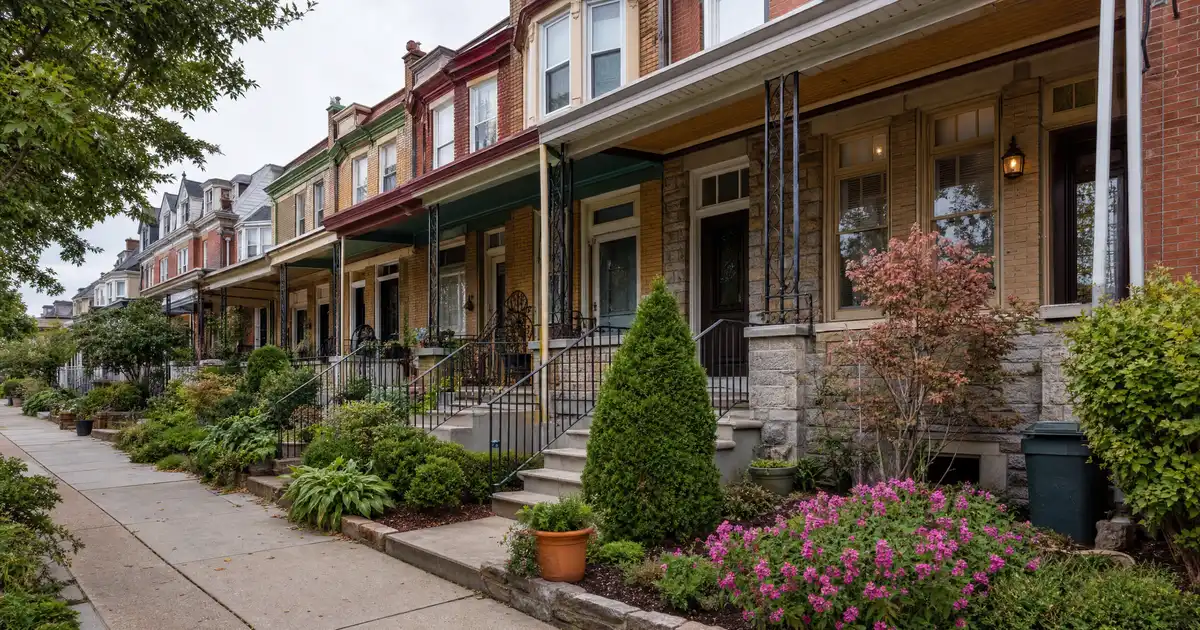
A historic Philadelphia home is eligible like any other, with the appraiser’s condition findings as the usual detour. Buyers and sellers who expect them settle the repairs in the contract rather than at the closing table. On a home at Philadelphia’s median value, the FHA minimum investment comes to about $8,500 — the cash the program asks a buyer to bring before closing costs.
Newer infill and recent construction
Infill rows and newer Philadelphia construction appraise cleanly under HUD’s standards, and the question there is price: a contract near the county limit needs the limit confirmed before the offer, and a larger investment where the price runs past it. About 48% of Philadelphia’s households rent — roughly 327,523 renter households on the latest Census estimate.
Established close-in neighborhoods
The Philadelphia neighborhoods closest to the core hold the oldest housing stock, and the FHA appraisal reads condition as well as value there: peeling paint, aging roofs, and missing handrails bring required repairs, usually settled by the seller before closing. Philadelphia counts a population near 1.58M within the Philadelphia-Camden-Wilmington, PA-NJ-DE-MD area.
Condominiums and townhomes
Condominiums are often the entry point in Philadelphia, and FHA finances them in approved projects or through single-unit approval. The lender confirms the project’s status before the appraisal, the association’s dues enter the ratios, and the minimum investment is unchanged. Median household income in Philadelphia sits near $61,953 on the latest Census estimate.
The property drives the file as much as the credit: the program accepts houses, condominiums in approved projects, planned developments, manufactured homes meeting HUD rules, and owner-occupied homes of up to four units, while second homes and rentals are outside it.
Four ways Philadelphia buyers put an FHA loan to work.
FHA is more than a first-purchase program: it refinances, it takes cash out, it finances small multi-unit homes, and it accepts the buyer a conventional file would turn away. These are the four uses that bring Philadelphia borrowers to it most often.
Buy on a recovering credit profile
FHA is the program for the buyer a conventional file turns away: a decision score below agency norms, a seasoned derogatory event, or a thin file underwritten on rent and utilities. In Philadelphia that buyer qualifies on the whole picture.
Buy a condominium in an approved project
An FHA condominium file in Philadelphia adds one step to the house file: the project review. Approved projects and single-unit approvals both work, dues count in the ratios, and the minimum investment and premiums are unchanged.
Refinance an existing FHA loan
The streamline refinance is the simplest shape in the program: no appraisal, no full credit review, a net tangible benefit, and the existing FHA loan’s payment history as the main test. Many Philadelphia owners use it when the market moves in their favor.
Buy a first home with the minimum investment
For a first purchase in Philadelphia, FHA pairs a small investment with a forgiving score and a ratio ladder that stretches with compensating factors; the file closes on the appraisal, the income, and the decision score.
Estimate the FHA payment on a Philadelphia price before requesting a quote.
Use this to see what a Philadelphia FHA purchase costs each month at the program’s leverage: it applies the upfront premium to the base loan, the annual premium for the term and leverage, and the escrows, then measures the ratios against any income you enter. The rate is the weekly Freddie Mac average, editable, and not a quote.
Philadelphia FHA payment estimate
A Philadelphia starting point, nothing more: change the price, the down payment, the term, and the escrows to match your purchase.
Editable benchmark: 7.03% as of September 24, 2026 · Freddie Mac 30-year average via FRED®. A conventional market reference, not an FHA loan quote.
Illustrative starting assumptions: a $245,000 price near Philadelphia’s median owner-occupied home value (kept where an FHA loan is realistic in most counties), the FHA minimum investment as the down payment, a thirty-year term at the current Freddie Mac benchmark, property taxes and insurance estimated for Pennsylvania (U.S. Census Bureau). Every field is editable.
Illustrative estimate only — not a Loan Estimate, approval, quote, or commitment to lend. The rate field carries the weekly Freddie Mac thirty-year conventional benchmark, a market reference and not an FHA loan quote; your rate is set by the lender at lock. FHA mortgage insurance follows HUD’s published schedule for the term, leverage and loan size entered; taxes, insurance and dues are editable estimates; closing costs are not included; county loan limits are not checked here. Licensed in sixteen states for consumer mortgages. Lendmire is not affiliated with or acting on behalf of FHA, HUD, or the federal government.
Same buyer, three very different closings.
The same buyer can often close three ways, and the structures differ more than the headlines suggest: FHA with its insurance schedule, a conventional loan with private mortgage insurance that cancels, or a VA loan for an eligible borrower with no mortgage insurance at all.
FHA, conventional with mortgage insurance, or VA.
The program’s strengths are the investment, the score, and the ratios; its cost is the insurance structure. A Philadelphia buyer with a modest score and a small down payment usually pays less each month on FHA than on conventional with private insurance.
Where FHA charges by schedule, conventional charges by score. A Philadelphia buyer with strong credit and a small down payment may find the private premium smaller and the payment lower; a buyer with a modest score will not. See Lendmire’s conventional loan program.
VA undercuts FHA for the eligible borrower on the recurring costs: no investment, no monthly premium, no upfront premium, with a one-time funding fee in their place. The questions are eligibility, entitlement, and whether the home meets VA’s property standards. See Lendmire’s VA loan program.
Choose by profile: a modest score and a small down payment point to FHA; a strong score points to conventional; VA eligibility points to VA. A Philadelphia loan officer runs all three on the same numbers before recommending one.
What to prepare for a Philadelphia scenario review.
An FHA file is documented more fully than a streamline refinance; the items below are what a Philadelphia scenario review typically draws on.
This is a general preparation guide, not a universal checklist. The selected lender may request additional information based on the transaction, the property, the credit profile, and the income picture. Nothing here is legal or tax advice.
Local details that can change the loan.
A few local and structural details change the size of a Philadelphia FHA loan, or whether the file is eligible at all. The ones that come up most often are below.
Use these checks to keep the Philadelphia file clean and fundable.
A clean Philadelphia file answers three questions in advance: what decision score, what premium schedule, and whether the property is inside HUD’s rules and the county limit.
- Confirm the score: the lender’s report sets the decision score, the lowest middle score among the borrowers.
- Know the premium: ten percent down or more ends it after eleven years.
- Match the occupancy: at least one borrower occupies the home within two months and for at least a year.
The decision score decides the leverage
Two borrowers, two sets of scores, one decision score: the lowest of the middle scores. A Philadelphia couple with one weak file is read on that file, which is why the score is confirmed from the lender’s report before anything is sized or any offer is written.
How long the annual premium runs
On a thirty-year loan at full leverage the annual premium runs for the term; it ends after eleven years only when the loan started at or below ninety percent loan-to-value. A Philadelphia buyer at the minimum investment carries it until a refinance or payoff, which is why many plan a refinance later.
Occupancy and the non-occupying co-borrower
Second homes and rentals are outside the program. A Philadelphia buyer who will not live in the home cannot use FHA for it; a family member who will not live there can still co-sign, with full leverage preserved on a one-unit purchase.
Two- to four-unit homes and rental income
The multi-unit Philadelphia purchase is an FHA specialty, with two things to plan: the buyer must occupy one unit, and the rental income from the others is documented and counted the way HUD allows, which is less than the full rent.
Seller contributions and the minimum investment
A Philadelphia contract can shift most of the closing costs to the seller within the program’s limit, which leaves the buyer bringing the minimum investment and little else. The investment must be the buyer’s own or a gift; the contributions cover the rest.
From a Philadelphia pre-approval to keys in hand.
Four steps, each with an FHA rule inside it: the pre-approval, the appraisal, the underwriting, and the closing. Here is the Philadelphia path.
Pre-approval
The first conversation settles the shape: where the decision score lands, what the ratios support, whether a gift will cover the investment, and whether FHA is the right program next to conventional and VA for the Philadelphia purchase.
Contract and appraisal
The Philadelphia contract sets the price and the contributions; the appraisal sets the value and the condition. Both feed the loan amount, and the lender confirms the county limit and the project approval before underwriting begins.
Underwriting
The file is scored by HUD’s automated system or underwritten manually, with income, assets, credit, and any compensating factors documented. Seasoning after a credit event is confirmed from the discharge or transfer papers, and the ratios are measured on effective income.
Closing
At closing the upfront premium is added to the loan, the escrows for taxes and insurance are set up, and the annual premium begins with the first payment. A Philadelphia buyer signs the note and the security instrument, occupies the home within HUD’s window, and the loan is insured.
A brokerage that matches the program to the buyer.
Lendmire is a mortgage brokerage licensed for consumer lending in sixteen states. On an FHA loan that means the program run against conventional and VA on the same numbers, the decision score and the premium schedule explained before the offer, and the terms in writing from a licensed loan officer.
Three programs, one set of numbers
FHA, conventional, and VA are run on the same Philadelphia price, score, and income before a recommendation is made. The buyer sees the payment, the insurance, and the cash to close on each, and the choice is made on the figures rather than on habit.
The premium explained before the offer
The insurance structure is the program’s cost, and Lendmire treats it as the first thing to explain rather than the last: how much, how long, and when a refinance would remove it for a Philadelphia buyer.
Licensed, consumer-purpose, in writing
The parameters on this page are HUD’s and the wholesale overlays’; the terms for a specific Philadelphia loan come from a licensed loan officer, in writing, after the review. Lendmire is a broker, never the lender, and not affiliated with the federal government.
Trusted by first-time buyers & families alike.


Philadelphia FHA loan FAQs
What an FHA loan is, how much it takes to buy, what score it needs, what the mortgage insurance costs, and how the county limit works, answered for Philadelphia buyers.
What is an FHA loan, and who is it for?
An FHA loan is a mortgage insured by the Federal Housing Administration, part of HUD: the lender makes the loan, HUD insures it against loss, and in exchange the program sets a small minimum investment, a forgiving credit threshold, ratios that stretch with compensating factors, and mortgage insurance premiums that fund the insurance. It is for owner-occupied homes of one to four units.
How much do I need to put down on an FHA loan in Philadelphia?
HUD sets the minimum investment as a small share of the price or value, whichever is lower; the snapshot and the calculator show it on a Philadelphia price. The whole investment can be a gift from a family member or another acceptable donor.
What credit score do I need for an FHA loan?
FHA’s threshold is well below conventional norms, and the snapshot shows it. A Philadelphia buyer at or above it reaches maximum financing; the lender’s report decides the decision score, and recent housing lates matter more than an old event that has seasoned.
How does FHA mortgage insurance work, and how long do I pay it?
Two premiums: an upfront premium, a share of the base loan that is usually financed into the total, and an annual premium charged monthly, set by HUD’s schedule for the term, the leverage, and the loan size. On a thirty-year loan at full leverage the annual premium runs for the term; it ends after eleven years only when the loan started at or below ninety percent loan-to-value.
What is the FHA loan limit in Philadelphia?
County limits apply, differ by unit count, and move annually; the current figure for the county is confirmed by a Lendmire loan officer at pre-approval. These pages state the program’s structure rather than a number that changes every year.
Can I buy a duplex or fourplex with an FHA loan?
A duplex, triplex, or fourplex is an FHA purchase when it is the buyer’s principal residence. The lender documents the rents and applies HUD’s rules for counting them.
Can I combine an FHA loan with down payment help?
Yes, through HUD-permitted secondary financing. The FHA loan on this page is the first lien; the assistance options that can cover the investment are covered on Lendmire’s Down Payment Assistance program page.
Can I use an FHA loan to buy a condominium?
Yes, when the project holds HUD approval or the unit qualifies for single-unit approval. The lender confirms the project’s status before the appraisal, the association’s dues enter the ratios, and the rest of the file is the same as for a house.
Should I choose FHA or a conventional loan?
Neither is better in general. FHA’s insurance stays for the term at full leverage; conventional’s cancels. FHA’s score threshold is lower; conventional’s premium is cheaper for strong credit. The loan officer compares them in writing.
Can the seller pay my closing costs on an FHA loan?
Sellers and other interested parties may contribute toward closing costs and prepaids up to the limit in the snapshot. A Philadelphia contract structured that way leaves the buyer bringing little beyond the investment.
The Philadelphia FHA file, built on HUD’s rules and explained plainly.
Ready when you are: a Philadelphia review sizes the loan, settles the program, and delivers the written terms. Nothing on this page is a commitment to lend.
This guide covers Philadelphia — for the statewide guidelines, markets, and scenarios, see FHA Loans in Pennsylvania, part of Lendmire’s FHA loan program.
Nearby markets in Pennsylvania: Allentown · Bethlehem · Scranton · Pittsburgh · Erie
Related programs: Down Payment Assistance · FHA 203(k) Rehab Loans · Conventional Loans