
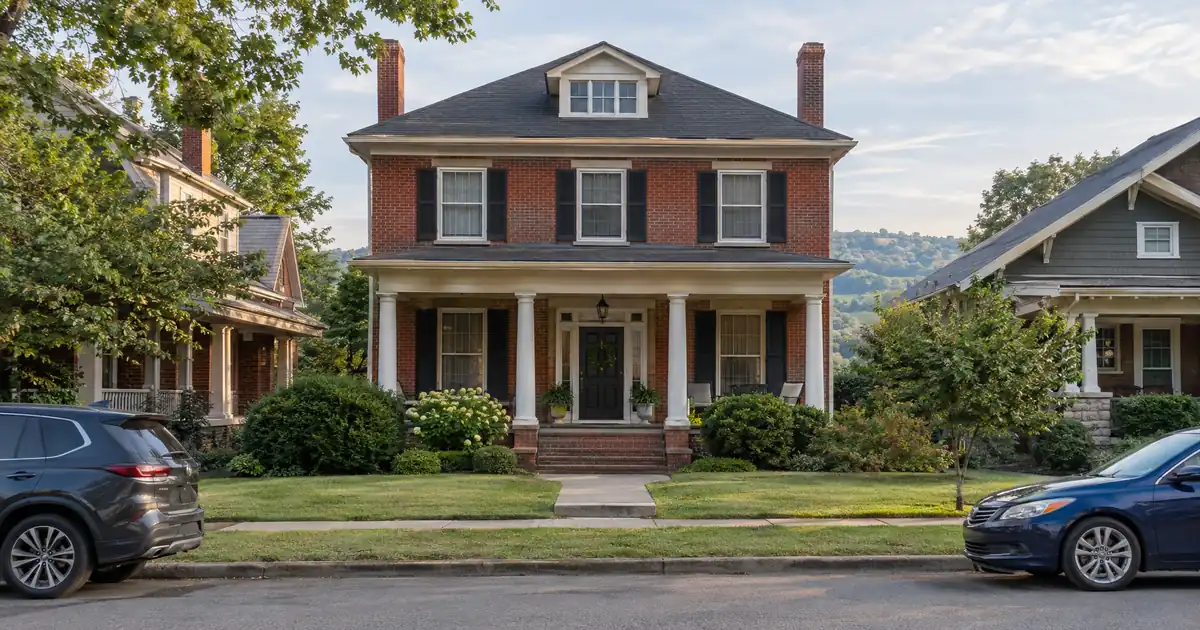
Picture an investor in Cincinnati or Nashville scrolling Shelbyville listings. A small Kentucky town is about to host a large battery plant, and the headlines make that sound like a rent-growth story. The catch is that the growth hasn’t reached pricing yet. Redfin shows the median sale price essentially flat year over year, with homes sitting noticeably longer on the market than they did a year earlier. That changes how a cash-out refinance on a Shelbyville rental should be planned. Equity here comes from purchase basis, improvements, and unit mix more than from the market lifting everything. This piece covers pulling equity out of a property you already own, and what pulling equity out looks like when the numbers are tight.
At a Glance: A DSCR cash-out refinance in Shelbyville, Kentucky is underwritten primarily on the property’s rental income measured against its full monthly obligation, then capped by a 75% loan-to-value ceiling on the appraised value. Seasoning, reserves, and credit tiers decide how much of that equity is actually reachable.
DSCR Cash-Out Calculator
Run the cash-out numbers in Shelbyville, KY
Rate source: Freddie Mac 30-yr average via FRED® — Federal Reserve Bank of St. Louis · effective Sep 24, 2026
Prefilled with starting assumptions — enter your property’s value, balance, taxes, and insurance for a more accurate picture.
Program parameters update from Lendmire’s centralized guideline source. Taxes and insurance are editable estimates.
As of Sep 24, 2026 · General Freddie Mac market benchmark, not a Lendmire loan offer. Property value, balance, taxes, and insurance are editable estimates. Maximum loan-to-value varies by lender, program, property type, and seasoning. Not a Loan Estimate, approval, or commitment to lend. Program availability and eligibility are subject to lender guidelines, credit approval, property review, and underwriting.
- Median sale prices are roughly flat year over year, according to Redfin.
- Average rents are modest per RentCafe, so single-family coverage runs thin.
- Cash-out is capped at 75% LTV, with about six months of seasoning from title recording.
- Multi-unit properties generally carry the stronger rent-to-value ratios here.
Shelbyville Market Snapshot
A quick read on the Shelbyville investor landscape — figures come from the cited sources below. Confirm current property-level numbers before underwriting.
| Metric | Detail |
|---|---|
| Population | 17,668 population (Census Reporter, Shelbyville KY) |
| Employment | 1,572 jobs (Kentucky Cabinet for Economic) |
| Vacancy | 3% (Affordable Housing Online) |
What Does Equity Look Like in a Flat Market?
Equity in Shelbyville is mostly manufactured, not inherited from appreciation. With the city median up only 0.4% in the Redfin data, an investor who bought at market and waited hasn’t built much of a cushion. Buyers who purchased at a discount, renovated, or bought before the current price level have more to pull.
Sources disagree on what “median” means here. Redfin’s county-level figure for Shelby County is $385K, up 20.3%, but that’s built on just 51 sales and swings with mix. Treat it as noise, not trend. The city figure, with only 17 sales in its data month, is also thin. That matters for appraisals: when comps are sparse, an appraiser leans on whatever closed recently, and your value can land above or below what a listing-portal estimate suggests.
The appreciation-versus-cash-flow tension is sharp here. If you’re counting on the battery plant to lift your value before you refinance, you’re underwriting a story. If you’re refinancing on basis and rent, you’re underwriting math. The second approach holds up better.
The Coverage Math on a $343K House
A single-family rental at the median price struggles to clear 1.00 once taxes and insurance are in the debt service. Run the numbers this way, using modeled assumptions rather than sourced market data: a house valued at $343K, a 75% cash-out loan, and monthly rent of $1,600 (in the neighborhood of RentCafe’s $1,410 three-bedroom average, pushed a bit higher for a house). Against full PITIA including taxes and insurance, coverage lands around 0.75x. Not close. Terms vary by lender guidelines, property type, leverage, credit profile, and full file review.
Sub-1.00 doesn’t automatically end the conversation, but the question worth asking is whether it should be used. A lender may review structures such as a sub-1.00 program, an interest-only period, or lower leverage, and each trades a thinner cash-out for a workable file. Qualification stays subject to lender guidelines, credit approval, and property review. If the only way your Shelbyville house works is a sub-1.00 structure at maximum leverage, that’s a signal to reconsider the property or the amount you’re pulling, not to hunt for a looser program.
Now a modeled two-unit scenario. Assume a duplex valued around the same $343K, with each side renting near the $1,222 two-bedroom average. At the same 75% leverage and with taxes and insurance included, coverage rounds down to roughly 1.15x. Same price, same leverage, meaningfully different file. That gap is the whole argument for multi-unit in this market. Nothing in the research confirms how much duplex or fourplex stock Shelbyville actually has, so this is a framework for evaluating what you own or find, not a claim about supply. Exact terms depend on the lender’s guidelines, property type, leverage, and a full review of the borrower’s file.
The DSCR qualification mechanics work the same in every market: rent used for lender review divided by full monthly obligation. What differs in Shelbyville is how often a single-family house misses.
Demand Is Real, but It Builds Slowly
The demand anchor is the battery plant. The Kentucky Cabinet for Economic Development announced Shelbyville Battery Manufacturing, a subsidiary of Canadian Solar’s e-Storage, as a roughly $712 million project creating 1,572 jobs. Kentucky Lantern reports that the job ramp runs over 15 years, which is a slow drip of tenant demand, not a one-time surge. Utility Dive describes a converted facility of about one million square feet. Treat all of it as announced and planned until you see actual hiring.
The base underneath is broader than one plant. The Lane Report lists Martinrea, Faurecia Automotive Seating, and Katayama American among county manufacturers, and reports manufacturing as the county’s largest industry by jobs. Wieland announced 225 jobs, and Kentuckiana Curb Co. is building in Simpsonville with 700 planned jobs. UofL Health’s Shelbyville Hospital adds a steady medical employer with 24/7 emergency care. That diversification helps: rental demand has more than one driver.
Supply is tight on paper. One affordable-housing aggregator puts vacancy at 3% and about 1.05 rental units per renter household, per Affordable Housing Online. That’s a secondary source, so check it against a local property manager before it goes into a lender package. The regional backdrop points the same direction: Energy News Network cites a legislative study finding Kentucky 206,207 housing units short, with battery-plant communities feeling it. The sources don’t quantify Shelbyville’s own gap, so read that as context, not a local guarantee.
Renters account for 44% of households, and about 89% of rentals fall between $1,001 and $1,500 a month. Underwrite inside that band. Rent estimates across listing sites vary by a couple hundred dollars, so stress-test coverage on the lower end.
Where the Equity Tends to Sit
No reliable neighborhood-level price or rent data exists for Shelbyville, so this section is about submarket character, not numbers.
Near downtown. The Lane Report describes antique shops, coffee houses, and boutiques. Older, lower-basis buildings here are the most plausible candidates for multi-unit income stacking and value-add.
The I-64 corridor. The battery plant sits at the I-64 Logistics Center area, and the Shelby County Industrial and Development Foundation positions the county in the “Golden Triangle” between Louisville and Lexington. Workforce rentals within reach of that corridor benefit most if hiring lands as announced. Commute time is 26.9 minutes per Census Bureau QuickFacts, so renters in the area may be spread across the county.
Simpsonville. A neighboring city in the county with a new industrial plant. Worth watching, but thin on data.
Working DSCR brokers see a recurring pattern in small industrial-anchor markets like this one: the headline employer drives the narrative, but the file turns on rent versus the appraised value of one specific property. Investors who budget for the appraisal gap, meaning the distance between what they paid and what the comps support, avoid most surprises at the refinance table.
Seasoning, LTV, and Reserves: The Mechanics
Three parameters shape how much equity you can reach. Figures below reflect typical guidance and are subject to lender guidelines and borrower profile.
- Seasoning. Cash-out generally requires about six months of ownership, measured from title recording. Buy in January, expect to wait until July.
- Leverage. The cash-out ceiling is 75% of appraised value. That’s lower than the purchase ceiling, so don’t borrow the purchase number in your planning.
- Reserves and credit. Expect roughly six months of PITIA in reserves, with credit tiers generally starting at a 620 floor. Stronger scores improve the file.
Usable proceeds are whatever remains after the existing payoff, reserves, and the 75% ceiling. A coverage ratio below the 1.00 benchmark shrinks that number or forces a different structure. The cash-out amount is never guaranteed; it depends on rent, debt service, and appraisal.
If you hold a mix of properties, the comparison with conventional financing matters. A W-2 borrower with one or two rentals may find conventional cheaper. Once a portfolio is entity-owned, self-employed, or past conventional financed-property limits, rental-income underwriting becomes the practical lane. For LLC-titled rentals, eligibility is subject to lender program requirements. Lendmire’s Kentucky DSCR platform covers the state-level picture. To see how your own numbers sort out, get a rental-income loan quote.
Where This Plan Flips
Pulling cash out of a Shelbyville single-family house to buy another Shelbyville single-family house compounds a thin ratio. Skip it. Pulling from a multi-unit, or from a property bought well below the median, to fund a second multi-unit is a different decision. It pencils far better, though you should still run the stress test on the lower rent band.
And if your plan leans on the plant to lift values before you refinance, consider waiting. With flat pricing, 66 days on market, and a 15-year hiring ramp, patience costs little and forcing it could cost more. Verify current local rental rules, taxes, and insurance with qualified local professionals before you commit. That’s the one reminder this market needs.
DSCR vs. conventional financing
Two common ways to finance an investment property in Shelbyville, KY. They qualify you differently — here’s how investors weigh them.
Why investors choose it
- Qualifies on the property’s rental income — no personal tax returns, W-2s, or pay stubs needed to document income.
- No personal debt-to-income ceiling to clear, so existing mortgages and obligations don’t cap your borrowing the same way.
- Can be closed in an LLC, keeping the property inside a business entity.
- Built for scaling — not held to the limit on number of financed properties that conventional financing applies.
- Underwriting centers on the deal: generally qualifies when the rent covers the payment, a 1.00x coverage ratio being a common baseline (confirmed in underwriting).
- Designed specifically for investment property, including long-term and, where the program allows, short-term rentals.
Where it’s strong
- Often the lowest ongoing financing cost for a buyer who fully qualifies on personal income — a fit for a first property or a cost-first purchase.
Trade-offs for investors
- Requires full personal income documentation and must fit within a debt-to-income limit — salary, existing debts, and other mortgages all count.
- Typically held in your personal name rather than a business entity.
- Caps how many financed properties you can carry, which can become a ceiling as a portfolio grows.
- Evaluates you as a borrower as much as the property, which usually means more paperwork.
How investors usually choose: a first or single property often optimizes for the lowest financing cost; portfolio builders often optimize for leverage, vesting in an LLC, and scaling past conventional caps. The right answer depends on your goals, the property, and current guidelines — both paths run through select lenders in Lendmire’s wholesale network, with eligibility and terms confirmed in underwriting.
Frequently Asked Questions
How do you qualify for a DSCR cash-out refinance in Shelbyville, Kentucky?
You generally need about six months of ownership, a property whose rent covers its debt service near the 1.00 benchmark, and credit at or above a 620 floor. Reserves of roughly six months of PITIA are typical, and the loan can’t exceed 75% of appraised value. Lender guidelines, credit review, and the property appraisal all affect the result.
What are the requirements for an investment property loan in Shelbyville, Kentucky?
Expect a rental-income-based review, a credit tier that starts around 620, reserves, and eligible property types. Manufactured homes, log homes, and barndominiums fall outside these DSCR programs. Because Shelbyville’s median price is high relative to average rent of $1,190, leverage and property type matter more than in cheaper markets.
Can I count on the battery plant to raise my Shelbyville property’s appraised value?
Not as a planning assumption. The plant is announced with a 15-year hiring ramp, and city pricing was up only 0.4% in the Redfin data. Underwrite on current rent and comparable sales, and treat any plant-driven lift as upside.
Is a duplex or a single-family house the better cash-out candidate in Shelbyville?
A duplex or small multi-unit generally pencils better because combined rents are larger relative to value. In modeled math at the same price and leverage, a two-unit lands near 1.15x while a median-priced house sits around 0.75x with taxes and insurance included. Nothing in the research confirms how common small multi-unit stock is locally, so verify what’s available.
For current guidelines and terms, see Lendmire’s DSCR loan programs page.
About Lendmire
Lendmire is a DSCR-focused mortgage brokerage, NMLS# 2371349, placing investor loans across 41 markets, including Washington, D.C. DSCR eligibility is generally reviewed by the lender on a property’s rental income rather than personal income documentation, which fits LLC-held rentals, self-employed investors, and portfolios scaling past conventional financed-property limits. The firm has been recognized by Scotsman Guide as a 2026 Top Workplace and recognized by Scotsman Guide in 2025. Investors can reach the team at 828-256-2183.
Get Started
Ready to find the right loan for you?
In about 30 seconds you can review financing options available for your investment property. No commitment required.
Informational only. Not a Loan Estimate, approval, or commitment to lend. Program availability and eligibility are subject to lender guidelines, credit approval, property review, and underwriting.
References
1. Redfin, Shelbyville housing market
2. RentCafe, Shelbyville average rent
3. Census Reporter, Shelbyville KY
4. Kentucky Cabinet for Economic Development
7. Utility Dive
9. UofL Health, Shelbyville Hospital
11. Shelby County Industrial and Development Foundation
13. recognized by Scotsman Guide as a 2026 Top Workplace
14. recognized by Scotsman Guide in 2025
This article is part of Lendmire’s investment property cash-out refinance program — full qualification details, guidelines, and scenarios live on the program page.
Related reading: Luxury Rental DSCR Loans In New Jersey · Jersey Shore Vacation Rental Loans: DSCR Financing In Ocean City, Cape May And Long Beach Island · DSCR Cash-out Refinance In New Jersey: Pulling Equity From A Rental
Guides: Investment Property Cash-Out Refinance in Kentucky
Brandon Miller
Founder & CEO, Mortgage Loan Originator, Lendmire LLC
- Mortgage Loan Originator · NMLS# 1129696 · Verify on NMLS Consumer Access
- North Carolina Real Estate Broker · License# 343312 · Verify on NCREC
- North Carolina Insurance Producer · License# 19053198 · Property, Casualty, Life, Health · Verify on NAIC SBS
- Lendmire LLC · Firm NMLS# 2371349 · Verify firm licensure
Important disclosures. Lendmire (NMLS# 2371349) is a licensed mortgage brokerage. Lendmire is not a direct lender, depository institution, or financial advisor. All loan inquiries are subject to lender underwriting; this article does not constitute a commitment to lend. Rates, terms, and program guidelines are subject to change without notice and vary by borrower profile, property type, and state. Information in this article is general in nature and is not financial, legal, or tax advice. Equal Housing Opportunity. NMLS Consumer Access: nmlsconsumeraccess.org.