
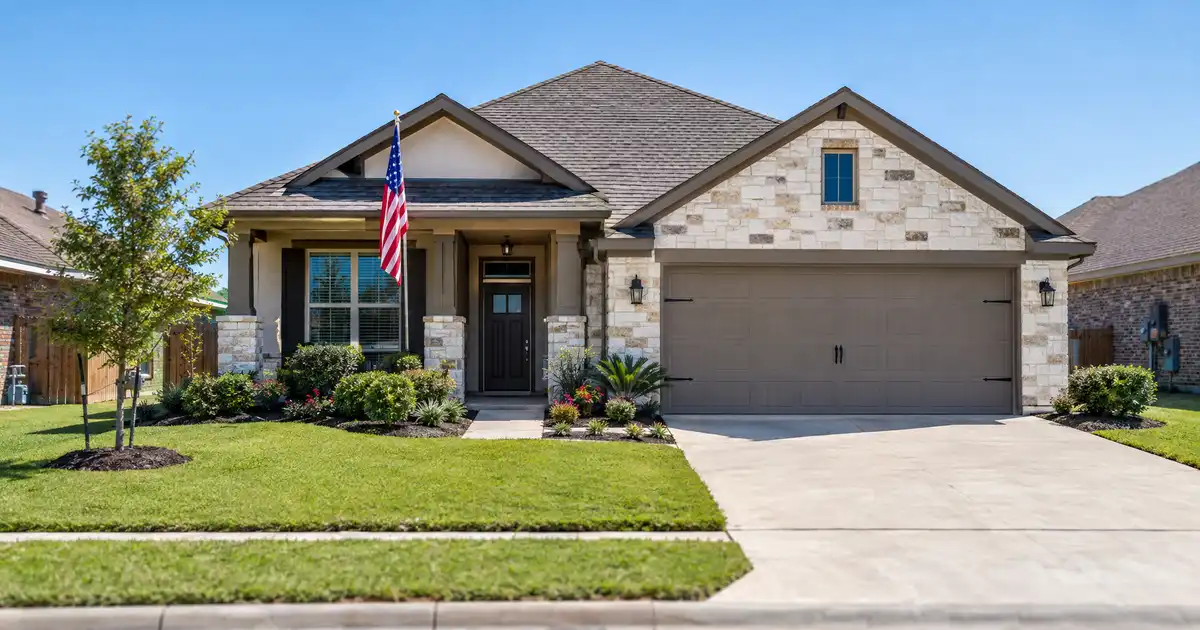
Current VA guidelines, updated from one source.
A handful of figures and the tables behind them decide most VA files, and all of them are here, drawn from one guideline source built on VA’s published rules: the down payment with full entitlement, the absence of mortgage insurance, the funding fee by first or subsequent use, the ratio guideline, and the residual-income table for the region.
100% financing with full entitlement
The purchase leverage is 100% loan-to-value with full entitlement, which means 0% down on a home that appraises at the price; a price above the appraised value is paid in cash or renegotiated, and the guaranty covers the lender’s exposure.
No monthly premium, no upfront premium
Mortgage insurance does not exist on a VA loan: no monthly premium, no upfront premium, no cancellation rules to track. The calculator below shows a payment with nothing in that line, which is where VA differs from every other high-leverage program.
First use; 3.3% after first use; exempt for many disabled veterans
2.15% of the loan on first use and 3.3% after, both lower with five or ten percent down; the fee can be rolled into the loan or paid at closing, and VA waives it for disabled veterans receiving compensation, surviving spouses receiving DIC, and active-duty Purple Heart recipients.
Residual income decides the file
41% is the ratio VA names, and residual income is the test it trusts: the monthly income left after the housing payment, debts, taxes, and maintenance, measured against a table by family size and region. A ratio above 41% needs residual income well above the table or a documented justification.
| Loan type | Use | Down payment | Fee |
|---|---|---|---|
| Purchase or construction | First use | less than 5% down | 2.15% |
| Purchase or construction | First use | 5% to 9.99% down | 1.5% |
| Purchase or construction | First use | 10% or more down | 1.25% |
| Purchase or construction | After first use | less than 5% down | 3.3% |
| Purchase or construction | After first use | 5% to 9.99% down | 1.5% |
| Purchase or construction | After first use | 10% or more down | 1.25% |
| Cash-out refinance | First use | Any | 2.15% |
| Cash-out refinance | After first use | Any | 3.3% |
| IRRRL | Any | Any | 0.5% |
| Manufactured home (not permanently affixed) | Any | Any | 1% |
| Loan assumption | Any | Any | 0.5% |
| Vendee loan | Any | Any | 2.25% |
| Family size | Residual income |
|---|---|
| 1 | $441 |
| 2 | $738 |
| 3 | $889 |
| 4 | $1,003 |
| 5 | $1,039 |
| Each additional member, up to seven | + $80 |
Exempt from the funding fee: veterans receiving VA compensation for a service-connected disability, those eligible for it but receiving retirement or active-duty pay instead, surviving spouses receiving Dependency and Indemnity Compensation, service members with a pre-discharge claim rating, and active-duty service members who have received the Purple Heart. VA sets no minimum credit score; the wholesale programs behind these pages start at a 580 decision score and serve loan amounts up to $4,000,000, including loans above the conforming limit with full entitlement.
Refinances: cash-out to 100% loan-to-value after seasoning of 210 days and six payments with a net tangible benefit; rate-reduction refinances of an existing VA loan at a 0.5% fee without a VA appraisal. Current VA snapshot · updated October 1, 2026 · owner-occupied principal residences, one to four units · no VA loan limit with full entitlement · loans are assumable · no prepayment penalty · Lendmire is not affiliated with the Department of Veterans Affairs.
Informational only; not a commitment to lend, an approval, or a quote. Every figure on this page is a program parameter read from Lendmire’s guideline source, built on VA’s published rules, and may change without notice; eligibility, the loan amount, the fee, and the residual-income test depend on the Certificate of Eligibility, the credit profile, the property, and underwriting. Lendmire is a mortgage broker licensed in sixteen states for consumer mortgages and is not affiliated with the Department of Veterans Affairs. NMLS #2371349.
What a VA loan is — and how the file is qualified.
Every Laredo VA file has the same skeleton: a certificate that proves eligibility, an entitlement figure that sets how much VA will back, a funding fee that pays for the backing or is waived, and an underwriting test that reads the household’s leftover income. The cards below explain each bone.
For the program overview, see Lendmire’s VA loan program, or the statewide guide at VA Loans in Texas; to request a Certificate of Eligibility, see VA.gov.
The guaranty replaces the down payment
Think of the guaranty as VA standing where the down payment would stand. With full entitlement the backing covers a quarter of whatever the loan is, so a Laredo buyer is not capped by a county figure; with reduced entitlement the backing is smaller, and a lender may ask for a down payment to make up the difference.
Eligibility, entitlement, and the COE
Three questions settle eligibility on a Laredo file: the service history, the character of discharge, and whether entitlement is full or partly in use. The COE answers all three. Surviving spouses, National Guard and Reserve members, and veterans with an earlier VA loan each have their own path to the certificate.
The funding fee, and who is exempt
What the funding fee buys is the absence of mortgage insurance. On a Laredo purchase the fee is paid once, usually financed, while an FHA or conventional borrower at the same leverage pays a premium every month for years; the comparison usually favors VA unless the fee tier is high and the loan is short-lived, and an exempt veteran pays no fee at all.
Residual income over ratios
VA qualifies a household on what is left, not only on what is owed: residual income is the monthly income remaining after the proposed housing payment, other debts, taxes, and an allowance for maintenance and utilities, measured against a table by family size and region. A Laredo family must meet the table for its size.
The calculator turns this arithmetic into a Laredo scenario: price in, down payment in, fee tier chosen, and out come the funding fee, the total loan, principal and interest, and the escrows. Add income and family size to see the ratio and a rough residual against VA’s table.
Where Laredo’s veterans and service members buy — and how VA fits.
Residual income is measured against a real payment on a real Laredo price, so the market matters before the file does. The Census figures below describe that market: ownership, home values, and household income.
Read the figures as backdrop. These are ranges, not predictions. The lender appraises one home, documents one income, and runs the residual-income test for one household of a specific size.
Data sources: U.S. Census Bureau — ACS 5-Year (2024) housing and population estimates, including tenure, home values, gross rents, and household income.
Distinct Laredo neighborhoods, distinct VA files.
The house decides the file as much as the borrower. These Laredo submarkets differ in the property types VA accepts, the condition questions the appraisal raises, and the prices a typical buyer carries.
Service members and the occupancy rule
Where Laredo sits near a base or a reserve center, VA files cluster in the neighborhoods service members choose, and the occupancy rule bends there in defined ways: a spouse can occupy for a member on orders, and a veteran may later rent the home out after living in it. Median household income in Laredo sits near $63,915 on the latest Census estimate.
Established close-in neighborhoods
The Laredo blocks nearest the core carry the oldest houses, and VA’s appraiser reads them for condition as well as price: paint, roof, railings, systems. Findings become required repairs, and sellers usually complete them before closing. On a home at Laredo’s median value, a VA purchase with full entitlement needs no down payment at all — the funding fee on the full $193,500 is the program’s cost, and it can be financed.
Higher-value homes
On Laredo’s higher-value homes the VA loan’s reach shows: with full entitlement there is no down payment above the conforming limit, up to the maximum loan amount shown in the guidelines above. The credit floor is the lender overlay, and the file is qualified on residual income. Laredo is home to about 258K people.
Two-to-four-unit homes
The small multi-unit Laredo purchase is where VA’s leverage goes furthest: no down payment on two to four units, the buyer living in one, and the documented rent from the others helping the ratios and the residual income. About 36% of Laredo’s households rent — roughly 28,062 renter households on the latest Census estimate.
Newer infill and recent construction
On recent construction in Laredo the appraisal rarely raises findings and the arithmetic is the issue: does residual income clear VA’s table once the funding fee is financed into a larger loan, and does the certificate show full entitlement at that amount. The median owner-occupied home value in Laredo runs near $193,500 on the latest Census estimate.
Condominiums and townhomes
A VA-approved Laredo project turns a condominium into a routine file. The buyer’s side does not change; the lender confirms the project before ordering the appraisal, which is the step that saves a contract from a dead end. Roughly 50,020 Laredo households own their homes on the latest Census estimate — 64% of all households, the pool a VA purchase joins.
What the program accepts is the same everywhere in Laredo: houses, condominiums in VA-approved projects, planned developments, manufactured homes that meet VA’s rules, and owner-occupied homes of up to four units. What it declines is also the same: second homes and investment property.
Four ways Laredo veterans put the VA benefit to work.
A good use of VA is one the program’s shape fits: no down payment, no mortgage insurance, residual-income underwriting, and a guaranty that scales with the loan. Four common Laredo uses follow.
Take cash out of a home with equity
The cash-out refinance replaces the Laredo home’s first mortgage with a larger VA loan and hands over the difference, to the program’s leverage and after seasoning; it is also the route for refinancing a non-VA loan into the program, and a loan officer compares it with a second-lien option before recommending either.
Buy a first home with nothing down
The most common Laredo VA file: a veteran with steady income and full entitlement buys at the appraised value with no down payment, finances the funding fee, and pays no mortgage insurance; the seller can cover closing costs, with VA’s cap applying to concessions beyond them.
Buy above the conforming limit
With full entitlement, the VA sets no loan limit, so a Laredo buyer can finance a home above the conforming limit with no down payment. A conventional jumbo loan would ask for a large one. The wholesale programs behind these pages serve loan amounts up to the ceiling shown in the snapshot on this page.
Buy a condominium in an approved project
VA keeps its own list of approved condominium projects, and a Laredo unit in one of them is financed like a house with the association’s dues added to the ratios and the residual-income math. The appraisal covers the project as well as the unit.
Estimate the VA payment on a Laredo price before requesting a quote.
Before you ask for a quote, size the payment yourself: the Laredo price, the fee tier, the term, the benchmark rate, and the escrows go in, and the funding fee table and the residual-income figures come from the same guideline source as the block above. The result is an estimate, and the rate is a published market average, not an offer.
Laredo VA payment estimate
Price starts from a Laredo value, with no down payment; fields update as you type.
Editable benchmark: 7.28% as of October 1, 2026 · Freddie Mac 30-year average via FRED®. A conventional market reference, not a VA loan quote.
Illustrative starting assumptions: a $195,000 price near Laredo’s median owner-occupied home value, no down payment with full entitlement, a first-use funding fee financed into the loan, a thirty-year term at the current Freddie Mac benchmark, property taxes and insurance estimated for Texas (U.S. Census Bureau). Every field is editable.
Illustrative estimate only — not a Loan Estimate, approval, quote, or commitment to lend. The rate field carries the weekly Freddie Mac thirty-year conventional benchmark, a market reference and not a VA loan quote; your rate is set by the lender at lock. The funding fee follows VA’s published table for the use and down payment entered; the residual-income figure is VA’s guideline for the region and family size, and the rough residual shown subtracts only the housing payment and the debts entered, while VA also deducts taxes, maintenance and utilities. Taxes, insurance and dues are editable estimates; closing costs are not included. Licensed in sixteen states for consumer mortgages. Lendmire is not affiliated with or acting on behalf of the Department of Veterans Affairs.
Same veteran, three very different closings.
Choosing among VA, FHA, and conventional in Laredo is really choosing an insurance structure and a down payment at the same time. Each is laid out below with the buyer it fits.
VA, FHA, or conventional.
No down payment with full entitlement, no mortgage insurance at any leverage, a one-time funding fee that can be financed or waived, residual-income underwriting, no loan limit with full entitlement, and a loan that can be assumed. The cost is the funding fee, and the condition is eligibility.
Where VA charges a one-time fee, FHA charges a premium every month and an upfront premium at closing. FHA fits the buyer with no entitlement or a property VA will not approve; it rarely wins for a Laredo buyer who holds a COE. See Lendmire’s FHA loan program.
Conventional is the comparison for a veteran with savings: with twenty percent down there is no mortgage insurance and no funding fee, and the payment can beat VA with a financed fee. Below that down payment, VA usually wins for a Laredo buyer. See Lendmire’s conventional loan program.
VA for the eligible buyer who wants no down payment and no mortgage insurance; FHA for the buyer without eligibility who needs the small investment and the forgiving score; conventional for the buyer with twenty percent down or a strong score who wants cancellable insurance.
What to prepare for a Laredo scenario review.
Gather these before a Laredo review: ordinary mortgage documents plus the proof of service that opens the file.
This is a general preparation guide, not a universal checklist. The selected lender may request additional information based on the transaction, the property, entitlement, and the income picture. Nothing here is legal or tax advice.
Local details that can change the loan.
When a Laredo VA file surprises someone, the cause is usually one of these: entitlement partly in use, a higher fee tier than expected, required repairs from the appraisal, a condominium without VA approval, or residual income below the table.
Use these checks to keep the Laredo file clean and fundable.
Three things to settle before a Laredo review: what the certificate says about entitlement, which funding fee tier applies, and whether the property has any VA question attached.
- Confirm the entitlement: entitlement is restored once the earlier loan is paid off and the home sold.
- Know the fee: disabled veterans receiving compensation and the other exempt groups pay no fee.
- Mind the appraisal: the appraisal reports condition against VA’s requirements as well as value.
Full or remaining entitlement
Two veterans, two COEs, two different loans: one with full entitlement buys above the conforming limit with nothing down, the other with an earlier loan still open brings a down payment on the uncovered portion. A Laredo loan officer reads the certificate before anything is sized.
The funding fee tier and the exemptions
The fee depends on whether the benefit has been used before and on the down payment, and it is waived for veterans receiving compensation for a service-connected disability, surviving spouses receiving DIC, active-duty Purple Heart recipients, and service members rated before discharge. On a Laredo file the tier is confirmed from the COE.
The VA appraisal and the Notice of Value
VA assigns the appraiser, and the appraiser reports on two things: what the Laredo home is worth and whether it meets VA’s minimum property requirements for a safe, structurally sound, and sanitary home. Peeling paint, a failing roof, or missing handrails become required repairs, and a wood-destroying insect inspection is ordered where VA calls for one.
Occupancy and the reasonable-time rule
Second homes and rentals are not VA purchases. A Laredo buyer who will never live in the home cannot use the benefit for it, but a service member whose spouse will occupy it during a deployment can, and a veteran may later move out and keep the home as a rental without refinancing.
Assumption and release of liability
Assumability is one of the program’s quieter advantages for a Laredo owner who may sell into a higher-rate market, and one of its traps: without a release of liability the seller remains responsible, and without substitution of entitlement the seller’s benefit stays in use on a home they no longer own.
From a Laredo Certificate of Eligibility to keys in hand.
From the certificate to the closing table, a Laredo VA purchase takes four steps, and each one carries a VA rule inside it.
COE and pre-approval
Start with the Certificate of Eligibility, the income, and the household size. A Lendmire loan officer confirms the entitlement, the funding fee tier, the ratio, and the residual income, runs the VA structure against FHA and conventional on the same numbers, and provides the terms in writing.
Contract and appraisal
The Laredo contract sets the price and the concessions; the appraisal sets the value and the condition. Both feed the loan amount, and the lender confirms the project approval and the wood-destroying insect inspection where VA requires one for the state before underwriting begins.
Underwriting
Underwriting on a Laredo VA file reads the whole picture: the entitlement on the certificate, the housing payment history, the seasoning of any derogatory event, and the residual income after VA’s deductions for taxes and upkeep. Conditions are issued, documented, and cleared before the approval is final.
Closing
At closing the funding fee is added to the loan or paid, the escrows for taxes and insurance are set up, and there is no mortgage insurance to begin. A Laredo buyer signs the note and the security instrument, certifies occupancy, and VA’s guaranty attaches to the loan.
A brokerage that puts the benefit to work.
Lendmire is a mortgage brokerage licensed for consumer lending in sixteen states, and on a VA file that buys three things: the program run against FHA and conventional on the same numbers, the entitlement and the fee tier confirmed before an offer is written, and the terms in writing from a licensed loan officer.
Three programs, one set of numbers
The comparison printed on this page is run for real on every Laredo file: VA with the fee financed beside FHA with its premiums beside conventional with private insurance, and the written terms follow from whichever column serves the veteran.
The fee and the entitlement explained before the offer
The certificate fixes two things a buyer should know before signing a contract: the funding fee tier and the entitlement available. Lendmire states both for the Laredo purchase and explains the exemption and the refund rules where they apply.
Licensed, consumer-purpose, in writing
Lendmire is licensed in sixteen states for consumer mortgages, each loan is a consumer-purpose transaction with the full set of disclosures, and every figure a Laredo buyer relies on, from the fee to the leverage to the final terms, comes in writing from a licensed loan officer.
Trusted by veterans & families alike.


Laredo VA loan FAQs
Plain answers to the questions Laredo veterans ask most about VA loans, in the order they usually ask them.
What is a VA loan, and who is it for?
A VA loan is the mortgage an eligible Laredo buyer should compare first: backed by VA, offered through lenders, written with no down payment and no insurance line, and qualified on residual income rather than ratios alone.
Who is eligible for a VA loan in Laredo?
Service decides it: a minimum period of active duty, a qualifying period in the Guard or Reserve, or eligible surviving-spouse status, with a character of discharge VA accepts. A Laredo buyer unsure of the answer can request the certificate from VA.gov or have the lender pull it.
How do I get a Certificate of Eligibility?
Online at VA.gov, through the lender, or by mail. Have the service documents ready: the DD-214 for a veteran, a statement of service for a service member, Guard or Reserve records, or the spouse’s documentation. Some certificates issue instantly and some need VA to review the record.
What is the VA funding fee, and do I have to pay it?
The fee is the program’s only charge for the guaranty, and the snapshot shows the tiers. A Laredo buyer who is receiving VA disability compensation, or who falls in one of the other exempt groups, pays nothing; everyone else pays the tier for their use and down payment, usually by financing it.
Is there a VA loan limit in Laredo?
VA removed the loan limit for veterans with full entitlement; the wholesale programs behind these pages serve loan amounts up to the ceiling in the snapshot. Only a Laredo buyer with entitlement still in use on another loan needs the county figure, and it is confirmed by a loan officer rather than quoted here.
Can I buy a duplex or fourplex with a VA loan?
Up to four units with the buyer living in one, and nothing down with full entitlement, which makes the multi-unit purchase a distinctive use of the benefit in Laredo.
Do I have to live in the home to use a VA loan?
Yes, as a principal residence. A Laredo service member on orders elsewhere can meet the rule through a spouse who occupies the home, and VA allows extra time for extended duty and for a veteran retiring within a year.
Do I need a down payment for a VA loan?
No, in the ordinary Laredo case. The three exceptions are a price above the appraised value, which is paid in cash or renegotiated; remaining entitlement, where the lender may ask for a down payment on the uncovered portion; and a voluntary down payment to reach a lower fee tier.
What credit score do I need for a VA loan?
There is no VA minimum, and the snapshot shows where the wholesale programs begin. A Laredo buyer below that floor should ask a loan officer what the file needs, because VA’s own rules weigh the payment history and residual income, not a score alone.
What happens after my Laredo offer is accepted?
Your Laredo contract goes to the lender, VA assigns the appraiser, and underwriting follows the Notice of Value. The usual detours are required repairs or a value under the price, which VA’s reconsideration process and the escape clause are built for; a loan officer keeps the timeline honest.
A Laredo VA loan sized to the price, the entitlement, and the budget.
Put your Laredo figures into the calculator, then ask for a review. Entitlement, the funding fee tier, residual income, and the loan VA supports are confirmed against the program’s rules, and a licensed loan officer provides the terms in writing.
This guide covers Laredo — for the statewide guidelines, markets, and scenarios, see VA Loans in Texas, part of Lendmire’s VA loan program.
Nearby markets in Texas: Eagle Pass · Mission · Edinburg · McAllen · Pharr · Corpus Christi · San Antonio · Harlingen
Related programs: Conventional Loans · FHA Loans · Jumbo Loans