
The Quick Read: A $50,000 draw on a duplex you live in is a full cash-out refinance, and it re-prices your entire first mortgage, not just the $50,000. Conventional programs cap a two-unit owner-occupied cash-out at 75% of the appraised value, so the draw has to fit under that ceiling after the old payoff and the costs. The money has to earn more than the extra interest and fees it adds. If it pays off costlier debt or raises the value and rent of the duplex, the math can work. If it funds one-off spending, it earns nothing. Terms depend on the lender’s guidelines, the property type, the leverage, and a full review of the credit profile.
Key Takeaways
- A cash-out on a 2-unit home you occupy is capped at 75% LTV. A one-unit home gets 80%.
- Appraised value, the payoff balance, and financed costs decide how much of the $50,000 you can actually reach.
- Only part of the second unit’s rent counts toward qualifying.
- FHA Streamline and VA IRRRL loans do not pay out cash.
- The draw is worth it only if the proceeds beat the full cost of re-pricing the whole loan. The exact numbers vary by lender and program and follow a full review of property, leverage, and credit.
What Is a Duplex Cash-Out Refinance?
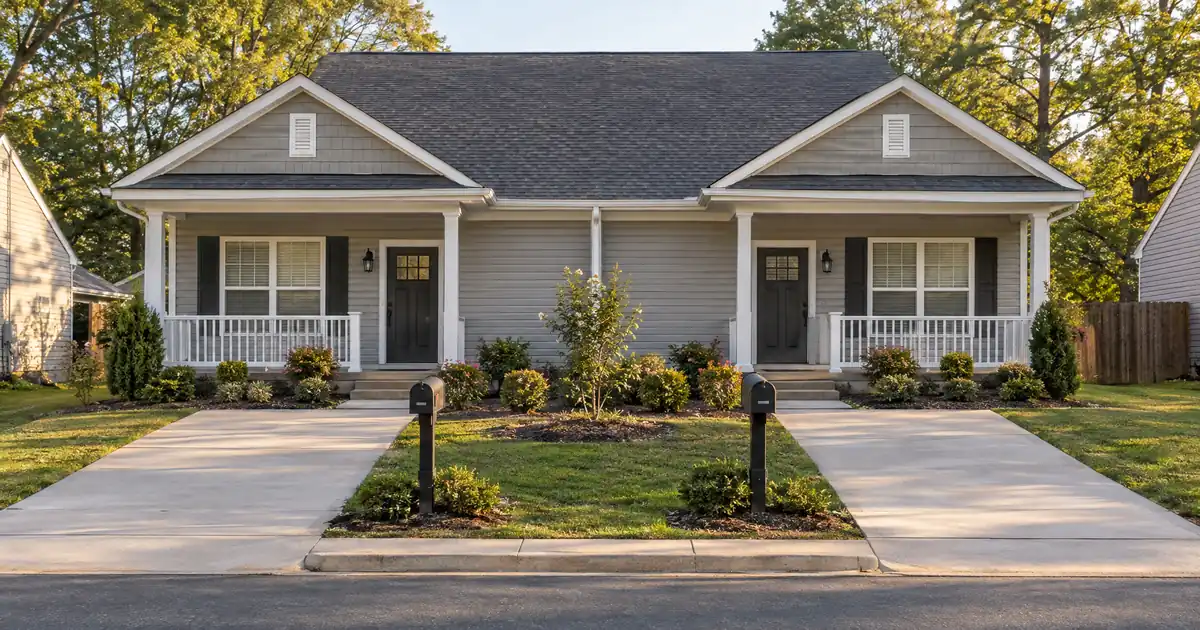
It is a new first mortgage, larger than your old one, on a two-unit home where you live in one unit. The new loan pays off the existing first mortgage and covers closing costs. Whatever is left comes to you as cash.
Many borrowers confuse this with a rate-and-term refinance. They are different products. A rate-and-term refinance, also called limited cash-out, pays off the existing first mortgage, the closing costs, and a purchase-money second lien. Only incidental cash comes back. Once you want $50,000 in spendable money, you are in a full cash-out refinance with its own leverage cap, seasoning rules, and pricing.
Across the wholesale programs Lendmire places files with, this is the first correction made on a duplex file. The borrower says “refinance.” The loan officer says “cash-out.” The cap drops, and the plan has to be rebuilt around it. Lendmire’s cash-out refinance programs cover conventional, FHA, VA, and jumbo paths, depending on the loan you hold today and the equity you have.
How Is the $50,000 Actually Calculated?
The maximum new loan is the cap times the appraised value. The cash you can reach is that maximum, minus the old payoff, minus any costs rolled into the loan.
The ceiling drives everything, so here is the arithmetic in percentages. Say your current first mortgage balance equals 60% of the appraised value. A 75% cap leaves 15 points of value. The $50,000, plus any financed costs, has to fit inside those 15 points. If it does not, the draw shrinks. Nothing about the cash is negotiable once the appraisal lands.
Three things set the number:
1. Appraised value. A 2- to 4-unit appraisal includes a rent analysis for the other unit. The value can come in below your estimate, and that moves the cap.
2. Payoff balance. The whole old loan comes off first, including any subordinate lien you want paid.
3. Costs rolled in. Financed costs enlarge the new balance and shrink the net cash.
Keep that last point straight. Rolling costs into the loan does not remove them. It converts them into a bigger balance you pay interest on.
Why Does a Duplex Get a Lower Cap Than a House?
Lenders see more risk in a multi-unit property. The Fannie Mae Eligibility Matrix sets the principal-residence cash-out maximum at 75% for two to four units and 80% for one unit. That 5-point gap means a duplex draw can come in smaller than a comparable single-family draw.
Freddie Mac also treats cash-out as an eligible transaction on 2- to 4-unit homes.
Occupancy matters too. If you move out of the duplex, you lose owner-occupant treatment. Second homes and investment properties on two to four units sit at the same 75% tier in the programs Lendmire works with. The rules around credit, reserves, and pricing change when you stop living there.
How Does the Lender Count the Rent From the Other Unit?
Only part of it counts. For a 2- to 4-unit owner-occupied home, the rent from the unit you do not occupy can help you qualify. The rent from your own unit cannot.
Per the Fannie Mae Desktop Underwriter job aid, the system takes 75% of gross monthly rent by default when no net figure is entered. A negative result is treated as a liability in your debt-to-income ratio. The mortgage payment is always counted as a liability and is not netted against the rent.
In practice, that means:
- A 25% haircut applies before the rent ever reaches your ratios.
- A rent that looks strong on paper can still leave the total ratio high once the bigger new payment is counted.
- Freddie Mac’s page confirms the same idea: rent from the other units can be added to income when computing housing expense and DTI.
On the wholesale conventional programs, the automated finding governs most files, with a total ratio ceiling of 50%. A manually underwritten loan runs tighter, at 36% or 45% depending on the reserve and score factors in the Eligibility Matrix. A cash-out that raises the payment without raising the rent used for lender review is the file that gets squeezed.
What Credit, Seasoning, and Title Rules Apply?
Cash-out files face seasoning rules that rate-and-term files do not. They are the quiet friction on most duplex draws.
| Item | Typical conventional cash-out rule |
|---|---|
| Credit score | Wholesale programs start at a 620 decision score |
| First mortgage age | At least 12 months, note date to note date |
| Time on title | A borrower on title for 6 months |
| Exceptions | Delayed financing, inheritance, legal award |
| Total ratio | Up to 50% on the automated finding |
Program figures vary by lender guidelines and full file review. Minimums rise with leverage and unit count, so a 620 score is the start, not the target. Reserves may be requested, especially at a higher ratio.
The seasoning rule catches people who bought recently. Borrowers who assume they are clear of the seasoning period without checking their dates are the ones whose files get kicked back. Bring the settlement statement from the purchase and the note date of the loan you are paying off. Both should be in hand before the file goes in.
A wholesale conventional lane exists that reaches 89.99% LTV with no mortgage insurance at a 680 score and a 50% ratio, on a thirty-year fixed primary residence with a conforming balance. It is built for one-unit primary homes. It does not turn a 75% duplex cap into something higher, and it is not written in Texas. Final terms depend on the lender’s guidelines, the property type, and the borrower’s complete credit picture.
What Does the Cash Really Cost?
The cost is not the closing fees alone. It is the interest on the new, larger mortgage plus the fees to get it. The CFPB’s research on cash-out refinances frames the test this way: using equity to pay off other debt makes sense only if the cost of getting the cash is lower than the cost of the debt it replaces.
That has two consequences on a duplex.
You re-price the whole loan. A cash-out replaces the entire first mortgage. If your current loan has a good rate, you give it up on the full balance to access a slice of equity. Compare that against a second lien or a home equity line, which touch only the new money. This is the cost-of-money test, and it is the step most borrowers skip.
The term usually resets. Cash-out loans often run thirty years. Payments stretch out, but total cost goes up, and equity drops as the balance climbs. Converting equity into cash creates debt you must repay.
Lendmire’s piece How Much a Cash-Out Must Earn to Justify Replacing a Seasoned First Lien walks through the same trade from the other side. Use it if your existing loan is older and well priced.
Closing costs also show up as points and fees on the Loan Estimate. Those are specific to the lender and the loan, so compare the estimates side by side rather than trusting a rule of thumb. A “no-cost” refinance is still a refinance with costs. They are built into the rate or the balance.
What Must the Money Earn?
The money has to earn more than the extra cost of carrying it. Run three tests before you sign.
1. Cost-of-money test. Compare the whole-loan cost against the alternative, such as a second lien or a line of credit. Count the change on the full balance, not on the $50,000 alone.
2. Use-of-proceeds test. What the cash does decides whether it earns.
- Debt payoff. Compare the old debt’s cost to the cost of the new, larger mortgage. Defaulting on a credit card is unlikely to cost you the home. Defaulting on a mortgage can. Moving that debt into the mortgage puts the house behind it.
- Improvements to the duplex. Does the work raise the rent or value enough to pay for itself? Rent counts twice here. It lifts income, and 75% of it counts toward qualifying.
- One-off spending. A trip or a purchase earns nothing. The balance stays and the interest keeps running.
3. Break-even test. Divide the total closing costs by the monthly benefit. The result is the number of months to recoup the cost. If you may sell or refinance again before that point, the draw loses money.
Here is the spine of the formula in words:
Maximum new loan equals 75% times the appraised value. Cash available is about that amount, minus the old payoff, minus financed costs.
If the first line leaves no room, the second line is a smaller number than you want. Then ask whether a smaller draw still earns its keep.
Where Does the General Rule Break?
Several situations change the picture.
Streamlines do not pay out. An FHA Streamline and a VA IRRRL are rate-and-term tools for existing government loans. They lower the cost of a loan you already have. They cannot deliver a $50,000 check, apart from a narrow improvement exception on the VA side that you should confirm with VA directly. VA home loan information describes the IRRRL as a VA-to-VA loan, and VA cash-out is a separate product.
FHA cash-out has its own cap. HUD sets it, and it applies to owner-occupied primary residences. Occupancy history applies. Confirm the current limit with the lender before you plan around a number.
VA cash-out can pay off a non-VA loan. That makes it a different product from the IRRRL. It uses new or additional entitlement. Limits and the funding fee vary, so confirm with the lender and with VA.
Jumbo loans. Above the conforming limit, jumbo lanes take over. The wholesale programs Lendmire works with set a 660 decision score, leverage up to 90% on certain lanes, loans up to $5,000,000, and a 50% ratio ceiling on the fixed lanes. Cash-out leverage on a duplex is tighter than the headline number, and the lender sets the exact terms. Each figure is subject to lender guidelines and a complete review of property type, leverage, and credit.
Short-term rental income. If you rent a unit by the night, expect stricter documentation. Do not assume it counts the same as a lease.
Moving out. Leaving the duplex after the loan closes changes the occupancy the loan was written on. Talk to your loan officer before you plan that.
Texas homesteads. A cash-out on the homestead is capped by the state constitution at the agency figure. The 89.99% wholesale lane is not written there.
What Are the Cancel Rights After Signing?
On a refinance of your primary home, federal law gives you a short window after signing to cancel. The window starts only after you have signed the note and received the required disclosures. Late or defective disclosures can extend it. Funds are generally not disbursed until it closes.
Two points are often misunderstood. Cancelling must be done in writing, not by phone. And cancelling the refinance does not erase your debt. The original loan is still owed.
You also receive a Loan Estimate after you apply and a Closing Disclosure before closing. Read them against each other. Compare the loan amount, the cash to you, and the costs line by line. If the cash to you has shrunk, the appraisal or the costs moved.
What Should You Do Before Applying?
A duplex cash-out file clears cleanly when the paperwork is ready. Gather these first:
- The current mortgage statement, showing the payoff and the note date.
- The settlement statement from your purchase, to prove time on title.
- Leases for the other unit, with deposit and payment records.
- Proof of any improvement plan, such as contractor bids, if the cash funds work on the building.
- A clear list of debts you intend to pay off, with balances.
Then ask your loan officer three questions. What does the appraisal need to show for the $50,000 to fit under the 75% cap? How does the lender count the other unit’s rent? And what is the whole-loan cost against keeping what you have?
Tax treatment can depend on your situation; borrowers should speak with a qualified tax professional before relying on any deduction or credit.
Key Terms Defined
Cash-out refinance. A new first mortgage larger than the old one, with the difference paid to you.
Limited cash-out (rate-and-term). A refinance that pays off the first mortgage, costs, and a purchase-money second lien, with only incidental cash back.
LTV (loan-to-value). The loan balance as a percentage of the appraised value.
Seasoning. The minimum time you must have held the property or the existing loan before a cash-out is allowed.
Debt-to-income (DTI). Your monthly debts as a share of your monthly income.
Rescission. The short window after signing in which you may cancel a refinance on your home.
Streamline. A rate-and-term refinance of an existing FHA or VA loan, with reduced paperwork and no cash out.
Next Step
If you are weighing a cash-out refinance against keeping the loan you have, Lendmire can help you compare the programs and the equity each one reaches. Program figures are subject to lender guidelines and full file review, and nothing here is a commitment to lend.
Frequently Asked Questions
Can I take $50,000 out of a duplex I live in?
Only if the appraised value leaves room under the 75% cap after your payoff and costs. The conventional cash-out ceiling for a two-unit primary residence is 75% LTV. A one-unit home reaches 80%. The draw is whatever remains after the old loan and any financed costs come off the top. Leverage, reserves, and pricing vary by lender and program; the final terms follow the full file review.
Does all the rent from the second unit count toward qualifying?
No. Under the Fannie Mae Desktop Underwriter job aid, the default is 75% of gross monthly rent, and only for the other unit. The new mortgage payment is counted in full as a liability. A negative rental result is treated as a debt.
Can an FHA Streamline or VA IRRRL give me cash for repairs?
Not for a $50,000 draw. These are rate-and-term products for existing government loans, and they do not pay out equity. VA does have a narrow improvement exception, so confirm the details with VA. A cash-out refinance is the product that delivers spendable cash.
How long must I own the duplex before a cash-out?
On the conventional programs Lendmire places files with, a borrower must be on title for 6 months, and the first mortgage being paid off must be at least 12 months old. Delayed financing, inheritance, and legal-award exceptions exist. Bring the settlement statement and the note date.
Is the cash-out worth it if my current loan is well priced?
Often not, unless the proceeds earn more than the added cost. A cash-out re-prices the entire balance, not just the new money. Compare it with a second lien or a line of credit, and run the break-even test: closing costs divided by the monthly benefit.
For your own numbers, request a scenario review with Lendmire.
About Lendmire
Lendmire (NMLS# 2371349) is a mortgage broker licensed for consumer lending in 16 states. Lendmire arranges FHA, VA, conventional and jumbo purchase and refinance loans through wholesale lenders; every file is underwritten by the lender under the applicable program guidelines. Scotsman Guide named Lendmire a Top Mortgage Workplace in both 2025 and 2026.
Get Started
Ready to find the right loan for you?
In about 30 seconds you can review financing options available for your home or investment property. No commitment required.
Informational only. Not a Loan Estimate, approval, or commitment to lend. Program availability and eligibility are subject to lender guidelines, credit approval, property review, and underwriting.
References
1. Fannie Mae Eligibility Matrix
2. Freddie Mac: Mortgages for 2- to 4-Unit Properties
3. Fannie Mae Desktop Underwriter Job Aid: Entering Income from Rental Property
4. CFPB: Cash-Out Refinances and Paydown Behavior of Non-Mortgage Debt Balances
5. U.S. Department of Veterans Affairs: Home Loans
This article is part of Lendmire’s Refinance series — every loan program’s qualification details, guidelines, and scenarios live on the loan options page.
Related reading: How Much a Cash-Out Refinance Releases to Buy Out a Partner on Title · Cash-Out Refinance vs Selling When a Partner Holds Only a Note · How Much Return a Cash-Out Refi on a 2–4 Unit Needs to Pencil
Brandon Miller
Founder & CEO, Mortgage Loan Originator, Lendmire LLC
- Mortgage Loan Originator · NMLS# 1129696 · Verify on NMLS Consumer Access
- North Carolina Real Estate Broker · License# 343312 · Verify on NCREC
- North Carolina Insurance Producer · License# 19053198 · Property, Casualty, Life, Health · Verify on NAIC SBS
- Lendmire LLC · Firm NMLS# 2371349 · Verify firm licensure
Required disclosures. Lendmire (NMLS# 2371349) operates as a licensed mortgage broker, not a direct lender or depository. The discussion in this article is general in nature and should not be relied upon as financial, legal, or tax advice — every investment scenario is unique and should be reviewed by a qualified professional. Any loan inquiry is subject to lender underwriting, and this article is not a commitment to lend or a guarantee of approval. Mortgage rates, loan terms, and program guidelines vary by borrower, property, and state, and may change without notice. Equal Housing Opportunity. Verify licensure at NMLS Consumer Access.