
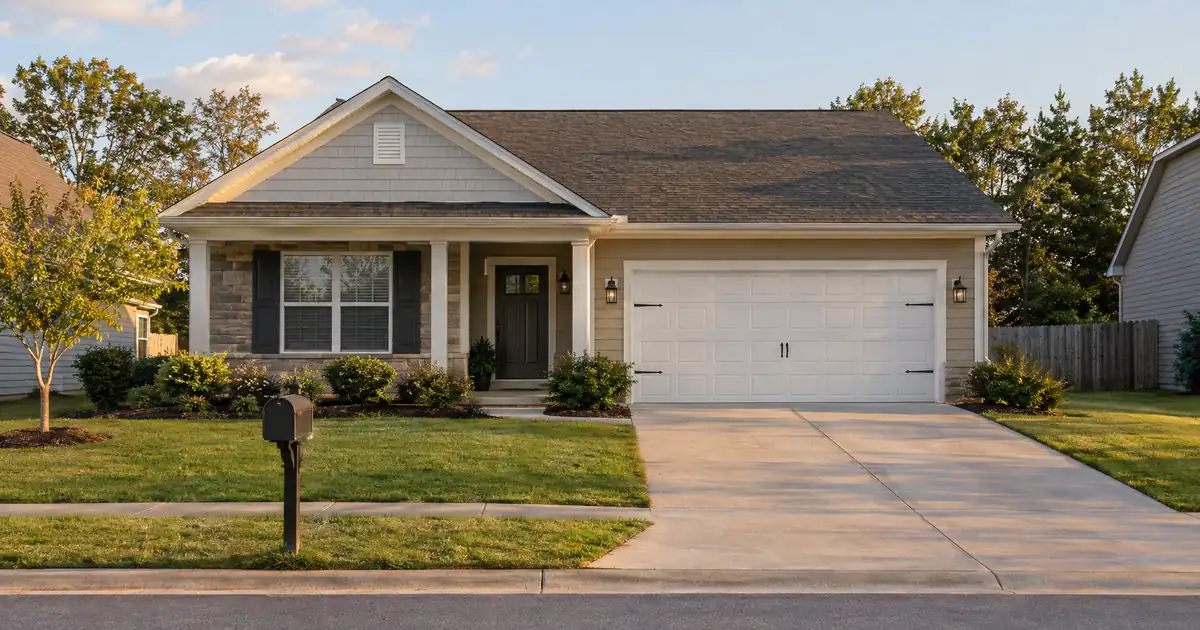
The Quick Read: It depends on three numbers: the appraised value, the leverage cap for your occupancy type, and what you still owe. On a one-unit home you live in, a conventional cash-out refinance typically reaches 80% of value. Whatever remains after the old payoff and closing costs is your cash. A low first mortgage leaves more room under that cap, but it does not make the cash equal to value minus balance.
This article covers how the cash is calculated, how the loan is underwritten, where the rule breaks, and what the choice looks like when your current mortgage is one you would rather keep. It assumes you are refinancing the home you live in and want the proceeds for a down payment on another property. Every program figure below is subject to lender guidelines and full file review, and nothing here is a commitment to lend.
Key Takeaways
- The cash comes from a new, larger first mortgage that replaces the old one entirely.
- The leverage cap, not your balance alone, sets the ceiling on the new loan.
- Closing costs and any required liens come out of the proceeds before you see a dollar.
- Limited cash-out and government streamlines are not tools for raising a down payment.
- A home equity loan or HELOC can leave a cherished first mortgage untouched. The tradeoff is worth running before you commit.
What Does a Cash-Out Refinance Actually Do?
A cash-out refinance pays off your existing first mortgage with a new, larger one and hands you the difference. Lendmire’s cash-out refinance programs work this way across the wholesale lenders it places files with. The key point is that the whole first mortgage is replaced. The new terms apply to the entire balance, not just the cash you pull.
That is why a “low first mortgage” cuts two ways. A low balance means plenty of equity, so the cap is rarely the problem. But if the low balance also carries terms you like, you are giving those terms up on every dollar you owe, not only on the extra cash.
Cash-out proceeds are not “down payment” on their own. They become down payment when you document them as the source of funds on the purchase. Lenders on the next property will want to see where the money came from.
How Is the Cash Calculated?
The cash is the new loan, minus the payoff, minus closing costs and prepaids. The new loan itself is capped by value times the allowed leverage for your occupancy. Four steps cover it:
1. Take the appraised value and multiply by the maximum leverage for your property type.
2. That gives the largest new loan you could have.
3. Subtract the payoff on your current first mortgage, plus any liens that must be cleared.
4. Subtract closing costs and prepaids. What is left is spendable cash.
Appraisal is the swing factor. A lower value shrinks the cap, and the cash shrinks with it. The cash is never simply “value minus balance.”
The Fannie Mae Eligibility Matrix sets the cash-out limits by occupancy. Across the wholesale conventional programs, these are the working figures:
| Property being refinanced | Typical cash-out maximum |
|---|---|
| One-unit principal residence | 80% of value |
| Two- to four-unit principal residence | 75% of value |
| Second home | 75% of value |
| Investment property | 75% of value |
Here is a way to think about it in percentages. Say your home appraises at a given value and you owe a small share of it, such as 30%. At an 80% cap, the new loan could be as large as 80% of value. The gap between 30% and 80% is 50 points of value. Closing costs and prepaids come out of that gap, so the cash you hold is somewhat under 50% of the home’s value. A lower balance means more room, but costs and the cap still decide the final figure.
How Much Down Payment Does It Cover?
Turn the cash into a share of the purchase price on the next property. This is the number most borrowers never calculate. A cash-out that nets, say, 20% of the new property’s price covers a 20% down payment and nothing more. It does not stretch to closing costs, reserves or repairs.
The purchase loan carries its own leverage limits. Across the Fannie Mae and Freddie Mac programs, a second home reaches 90% leverage, which means a 10% down payment. An investment property reaches 85% on one unit and 75% on two to four units. A new principal residence reaches 95%, or 97% for a first-time buyer on a fixed rate. Those percentages set the minimum cash you need. They are separate from the cap on your cash-out. Leverage, reserves, and pricing vary by lender and program; the final terms follow the full file review.
Work it backward and the answer gets clearer. Start from the down payment percentage the next property needs. Add closing costs and reserves. That total is the net cash your refinance has to produce. Then check whether the appraised value and the 80% cap can deliver it after the payoff.
One sentence on occupancy, since the title can raise it: the property you buy next decides its own leverage, and a second home or an investment property sits lower on the ladder than a principal residence.
Do You Have to Borrow the Maximum?
No. You can size the new loan to the cash you actually need. The cap is a ceiling, not a requirement.
Borrowing less keeps the new balance smaller and the monthly obligation lower. It also leaves more equity in the home. The catch is that closing costs do not shrink in proportion, so a small cash-out can feel expensive per dollar received. If you only need a modest sum, that math is worth checking against a home equity loan.
How Is a Cash-Out Underwritten?
Underwriting a cash-out refinance checks the property, your credit, your ratios, your seasoning and your reserves. Each one can cut the cash or end the deal.
Seasoning. Conventional cash-out has two clocks. The first mortgage you are paying off must be at least 12 months old, measured note date to note date. And a borrower must have been on title for six months. Exceptions exist for delayed financing after a cash purchase, for inheritance and for legal awards. The Fannie Mae Selling Guide lays out the 12-month rule and the delayed-financing exception. The 12-month test does not apply to subordinate liens being paid off.
Credit and ratios. Across the wholesale conventional programs, the decision score varies by scenario, and the automated finding governs most files. The total ratio ceiling is 50%. Manually underwritten loans run tighter. Your new, larger payment counts in that ratio, and so will the payment on the next property.
Reserves. Reserve rules depend on the property and the ratio. The Fannie Mae Eligibility Matrix notes that minimum reserves apply to cash-out refinances when the automated DTI exceeds 45%. Reserves are also higher on a second home or investment purchase than on a principal residence. If you own several financed properties, expect added reserve requirements on top. Terms vary by lender guidelines, property type, leverage, credit profile, and full file review.
Price adjustments. Cash-out loans usually carry loan-level price adjustments tied to leverage and credit score. This is part of the cost of the loan, built into the pricing. The size varies by file.
Appraisal. A cash-out refinance needs a new appraisal. There is no shortcut on value.
The Low First Mortgage Tradeoff
This is the real decision. A cash-out refinance replaces your whole loan. If the loan you hold has terms you value, you are paying to reprice the entire balance in order to get a slice of cash.
There are two borrower profiles here, and they are not the same.
A low balance, ordinary terms. If you owe little but your terms are nothing special, a cash-out refinance costs you little in lost terms. The refinance is mostly a matter of closing costs and the larger payment. This is the easy case.
A low balance, favorable terms. If you hold a first mortgage you would not replace on its own merits, a cash-out refinance forces you to give it up. A home equity loan or HELOC leaves the first mortgage intact. According to the CFPB’s Office of Research, home equity loans and HELOCs leave the original first lien in place, while a cash-out refinance takes its place.
Here is how the choice compares:
| Factor | Cash-out refinance | Home equity loan or HELOC |
|---|---|---|
| First mortgage | Replaced entirely | Stays in place |
| Number of payments | One | Two |
| Terms on existing balance | Reset to new terms | Unchanged |
| Leverage reached | Up to the cash-out cap | Set by the second-lien lender |
| Cost structure | One new set of closing costs | Separate costs on the second loan |
Neither is automatically better. If the cash you need is small and your first mortgage is a keeper, leaving it alone and borrowing against equity separately often pencils better. If you need a larger sum, or the second lien would be limited by your equity, replacing the first mortgage may be the only way to reach it. The flip point is the size of the cash relative to the balance you would be repricing. A big cash-out on a small balance leaves little to lose. A small cash-out on a large, favorable balance leaves a lot.
Not every lender offers a second-lien product, and what is available depends on your state and your credit. Lendmire arranges cash-out first mortgages through its wholesale lenders, so the comparison starts from what a replacement first-lien loan would look like.
Where the Rule Breaks
The 80% cap is a general rule. Several edge cases change it.
Limited cash-out is not a smaller cash-out. A rate-and-term (limited cash-out) refinance pays off the existing first mortgage, closing costs and any purchase-money second lien, with only incidental cash back. Fannie Mae caps that cash at the greater of 1% of the new loan or $2,000, per its SEL-2025-08 announcement. It will not fund a down payment. Paying off a junior lien used for something other than the purchase turns the deal into a cash-out.
FHA Streamline and VA IRRRL. These are streamlines for existing government loans. Neither is an equity tool. The FHA Streamline is designed to lower the payment on a current FHA loan, with no cash back beyond a minor closing adjustment. The VA IRRRL does not allow cash from loan proceeds, other than for energy-efficiency improvements, per the FDIC’s reproduction of the VA fact sheet. If you hold an FHA or VA loan and want down payment cash, a streamline is the wrong tool.
FHA and VA cash-out. FHA cash-out is capped at 80% of adjusted value under HUD Mortgagee Letter 2019-11, and it applies to the home you live in. VA cash-out can reach higher on paper, but many lenders set tighter limits of their own.
Free-and-clear homes. A home with no mortgage still counts as a cash-out refinance, not a limited one. If you bought for cash recently, delayed financing may let you pull cash out sooner than the usual seasoning allows.
The no-mortgage-insurance lane. One wholesale lane reaches 89.99% leverage with no mortgage insurance. It requires a 680 score, a 50% ratio, a thirty-year fixed rate, a primary residence, a conforming balance and its own six months of seasoning. It is not written in Texas, where the state constitution caps a homestead cash-out at the agency figure. Exact terms depend on the lender’s guidelines, property type, leverage, and a full review of the borrower’s file.
Jumbo balances. Above the conforming limit, the jumbo lanes take over. They carry a 660 decision score, leverage up to 90% and loans to $5,000,000, with a 50% ratio ceiling on the fixed lanes. Cash-out availability and leverage on jumbo files depend on the lender.
Timing and Sequencing
Close the refinance first when you can. The cash needs to land in your account, and lenders on the next purchase typically want to see it documented as the source of the down payment. That is a common practice point rather than a hard rule.
Three timing risks come up often. An appraisal that comes in low shrinks the cash. A seasoning clock you did not know about can delay the refinance. And a purchase contract with a hard deadline does not wait for a refinance that is still in underwriting. Build a margin into the plan.
Both loans follow consumer disclosure rules, which means a Loan Estimate and Closing Disclosure on each. The refinance and the purchase are separate transactions, each with its own appraisal and its own leverage.
Qualifying on Both Sides
The refinance is only half the test. After the purchase closes, you carry the refinanced first mortgage and the new purchase loan together. That is where the ratio ceiling and the reserves bite.
Run the combined picture before you start. Add the new, larger payment on the refinanced home to the payment on the next property. Check that total against the ratio ceiling. Then check reserves. Fannie Mae caps financed properties at ten where the subject loan is a second home or investment property, and extra reserves apply as the count climbs, with the primary residence excluded.
If the combined ratio does not fit, the answer is rarely a bigger refinance. It is a smaller purchase, a larger down payment from another source, or waiting.
Risk, Honestly
A cash-out refinance turns equity into debt secured by your home. The CFPB’s research notes that converting other debts into mortgage debt can put the home at risk of foreclosure if payments become unsustainable. You also draw down current wealth. Two mortgages mean two obligations that must be met even if the new property sits empty or its costs run above plan.
Tax treatment can depend on your situation; borrowers should speak with a qualified tax professional before relying on any deduction or credit.
When It Works and When It Doesn’t
- It tends to work when your first mortgage is small or ordinary, the cap leaves real room, the combined ratio clears with margin, and you have reserves to spare.
- It tends not to work when you hold a first mortgage you value, the cash you need is small, the appraisal is uncertain, or the combined payments leave no cushion.
- A different tool fits better when you hold an FHA or VA loan and only want a streamline, or when a separate home equity loan can reach what you need.
If you are weighing a cash-out refinance against keeping the loan you have, Lendmire can help you compare the programs and the equity each one reaches. Reach the team at 828-256-2183 to talk through your numbers.
Key Terms Defined
Cash-out refinance: A new, larger first mortgage that pays off the old one and gives you the difference in cash.
Loan-to-value (LTV): The loan amount divided by the appraised value, shown as a percentage.
Limited cash-out refinance: A refinance that pays off the existing loan and costs, with only incidental cash back.
Seasoning: The minimum time a loan or ownership must have existed before it can be refinanced.
Delayed financing: An exception that lets you take cash out soon after buying a home with cash.
Reserves: Liquid assets left after closing, counted in months of obligations.
Loan-level price adjustment: A pricing add-on tied to factors such as leverage and credit score.
Frequently Asked Questions
Can I borrow only as much as I need for the down payment?
Yes. The leverage cap is a ceiling, not a target. You can size the new loan to the cash you want. Closing costs do not scale down with the loan, so a small cash-out can cost more per dollar received than a large one.
Does a low first mortgage mean I get more cash?
Often, but not always. A lower balance leaves more room under the cap, so the cap is less likely to be the limit. The appraised value, closing costs and any liens you must clear still decide the final figure. Equity alone does not set the cash.
Can I use an FHA Streamline or VA IRRRL to raise a down payment?
No. Both are designed to improve the terms on an existing government loan, not to release equity. The FHA Streamline allows only minor closing adjustments, and the VA IRRRL does not allow cash from proceeds beyond energy-efficiency improvements.
How soon after buying my home can I do a cash-out refinance?
Conventional cash-out generally requires that the first mortgage being paid off is at least 12 months old, and that a borrower has been on title for six months. Delayed financing, inheritance and legal-award exceptions can change that, subject to lender guidelines.
Is a HELOC better than a cash-out refinance for a down payment?
It depends on what you hold. A HELOC or home equity loan leaves your first mortgage in place, which helps when you value the terms you have. A cash-out refinance may reach more equity and leaves you with one payment. The size of the cash relative to your balance is the deciding variable.
For your own numbers, request a scenario review with Lendmire.
For current guidelines and terms, see Lendmire’s refinance programs page.
About Lendmire
As a mortgage broker (NMLS# 2371349), Lendmire helps homeowners and home buyers in 16 states with FHA, VA, conventional and jumbo purchase and refinance loans arranged through wholesale lenders. Lendmire is never the lender; program terms are set by the lender and the agency guidelines. Scotsman Guide named Lendmire a Top Mortgage Workplace in both 2025 and 2026.
Get Started
Ready to find the right loan for you?
In about 30 seconds you can review financing options available for your home or investment property. No commitment required.
Informational only. Not a Loan Estimate, approval, or commitment to lend. Program availability and eligibility are subject to lender guidelines, credit approval, property review, and underwriting.
References
1. Fannie Mae Eligibility Matrix
2. Fannie Mae Selling Guide B2-1.3-03
3. Fannie Mae Eligibility Matrix
4. CFPB Office of Research blog on cash-out refinances
5. Fannie Mae SEL-2025-08 announcement
6. FDIC’s reproduction of the VA fact sheet
7. HUD Mortgagee Letter 2019-11
This article is part of Lendmire’s Refinance series — every loan program’s qualification details, guidelines, and scenarios live on the loan options page.
Related reading: Can You Repay a Family Down Payment Loan With a Cash-Out Refinance? · How to Document a Cash-Out Refinance Down Payment With a Low First Lien · How Much Down Payment a Primary Home Cash-Out Refinance Creates
Brandon Miller
Founder & CEO, Mortgage Loan Originator, Lendmire LLC
- Mortgage Loan Originator · NMLS# 1129696 · Verify on NMLS Consumer Access
- North Carolina Real Estate Broker · License# 343312 · Verify on NCREC
- North Carolina Insurance Producer · License# 19053198 · Property, Casualty, Life, Health · Verify on NAIC SBS
- Lendmire LLC · Firm NMLS# 2371349 · Verify firm licensure
Required disclosures. Lendmire (NMLS# 2371349) operates as a licensed mortgage broker, not a direct lender or depository. The discussion in this article is general in nature and should not be relied upon as financial, legal, or tax advice — every investment scenario is unique and should be reviewed by a qualified professional. Any loan inquiry is subject to lender underwriting, and this article is not a commitment to lend or a guarantee of approval. Mortgage rates, loan terms, and program guidelines vary by borrower, property, and state, and may change without notice. Equal Housing Opportunity. Verify licensure at NMLS Consumer Access.