
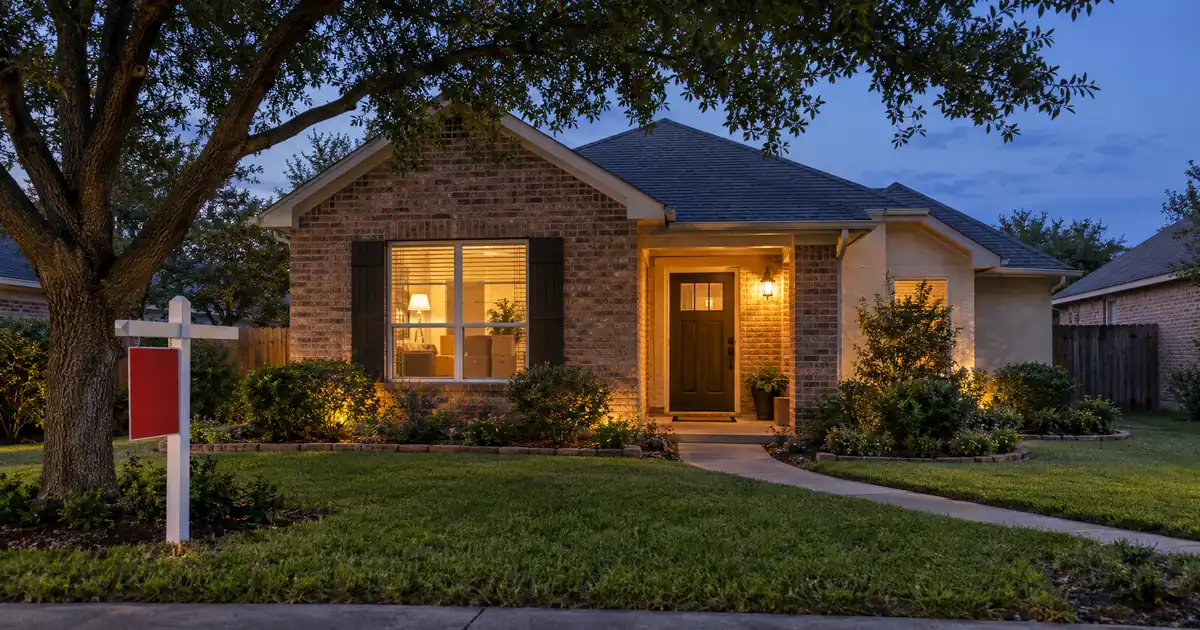
The Quick Read: A cash-out on your Texas home can retire credit cards and other balances at closing, and those payoffs can pull a stretched debt-to-income ratio back into range. The loan only works when three things line up: enough equity under the 80% cap, a lender willing to originate Texas homestead equity loans, and a ratio that clears after the new payment replaces the old one. The rest of this page walks through each step in order.
Key Takeaways
- Debts paid off at closing from loan proceeds can drop out of your ratio. The new, larger mortgage payment replaces them.
- The FHA cash-out tops out at 80% of the home’s value, and Texas applies its own 80% limit on combined liens. The lower reading controls.
- Base ratios run 31/43. Documented compensating factors can reach 40/50 at the top tier, and the automated finding governs most files.
- Texas adds a waiting period before closing, and federal law adds a cancellation window after it.
- You are trading unsecured debt for debt secured by your home. That is the real decision.
Texas FHA cash-out estimate
Seeded with an example value, a balance to match, and a round cash request; change any field.
Editable benchmark: 7.40% as of October 15, 2026 · Freddie Mac 30-year average via FRED®. A conventional market reference, not an FHA cash-out refinance quote.
Illustrative starting assumptions: a $285,000 home value, a $157,000 current balance, the FHA cap on a principal residence with the upfront premium financed, a thirty-year term at the current Freddie Mac benchmark, and property taxes and insurance estimated at typical rates for Texas. Every field is editable.
An illustration, not a Loan Estimate, an approval, a quote, or a commitment to lend. The rate shown is the weekly Freddie Mac thirty-year conventional benchmark, used as a market reference; an FHA cash-out is priced by the lender at lock, and this is not an FHA cash-out refinance quote. HUD’s cap limits the base loan; the upfront premium is financed inside the Texas homestead cap; the monthly premium for the first year follows the snapshot’s schedule. Cash available means the base loan the cap permits less the balances retired, before closing costs, which this calculator leaves out. The line figure applies the line program’s combined loan-to-value ceiling to the same value and balance. Taxes and insurance are estimates you can edit. Licensed in sixteen states for consumer mortgages. On a Texas homestead the state constitution caps the whole loan, financed premium included, at the FHA figure and adds a waiting period, a prescribed closing location, and a fee cap.
Can You Do an FHA Cash-Out in Texas?
Yes, in principle. Whether you can do one with a given lender is a separate question. FHA allows cash-out refinancing on a primary residence, and Texas allows cash-out on a homestead. The two sets of rules fit together. The catch is that some lenders skip Texas homestead equity loans altogether, which is why pages online contradict each other.
Some say FHA cash-out is banned in Texas. It is not. Others say it is easy. It is not that either. Availability depends on whether the lender behind your file will originate these loans.
Lendmire arranges the FHA cash-out refinance program through wholesale lenders. Across those programs, the cash-out reaches 80% LTV on a home you have owned and occupied for 12 months before the case number. LTV means loan-to-value: the loan balance as a share of the home’s value. Every figure here is subject to lender guidelines and full file review, and nothing is a commitment to lend.
How Is the Loan Underwritten, Step by Step?
The underwriting works through eligibility, appraisal, a debt payoff list, and a ratio check. Each step either opens room or closes it.
1. Eligibility. The home must be your Texas homestead and primary residence. You need the 12 months of ownership and occupancy noted above. The wholesale programs Lendmire places FHA loans with start at a 580 decision score.
2. Appraisal. The lender measures the 80% cap against the appraised value. Texas also requires a written acknowledgment of fair market value.
3. Payoff list. You choose which debts the proceeds retire. This list drives your ratio.
4. Ratio check. Underwriting adds the new payment, mortgage insurance included, and compares it with your gross monthly income.
5. Decision. Most files get an automated finding. A thin-credit or referred file goes to manual review, where the 31/43 base and the 40/50 ceiling with compensating factors come into play.
FHA’s maximum on a cash-out is 80%, a limit HUD’s Handbook 4000.1 update records. Texas caps combined liens on a homestead at the same level. Because both land at 80%, whichever reading comes in lower decides your maximum.
Mortgage insurance is part of the loan. FHA charges an upfront premium of 1.75% of the base loan, usually financed into the balance. It also charges an annual premium between 0.15% and 0.75%, depending on term, amount and LTV. On a thirty-year loan above 90% LTV, the annual premium lasts for the term. At or below 90%, it ends after eleven years.
How Do Debt Payoffs Change a High DTI?
Paying a debt at closing removes its monthly payment from your ratio. DTI is your monthly debt payments divided by your gross monthly income. The new mortgage payment goes in, and the paid-off accounts come out.
Many lenders let a revolving account drop out when it is paid in full at or before closing, with the payoff shown on the Closing Disclosure. The account may not need to be closed. This is lender-specific, so ask before you count on it.
Here is a modeled example. These are illustrative assumptions, not market data.
| Item | Before | After |
|---|---|---|
| Home value | 100% | 100% |
| Mortgage balance | 55% of value | Replaced by new loan |
| New loan | None | 78% of value |
| Card and loan payoffs | Open | Paid at closing |
| Total DTI | 52% | 41% |
Run through it: the borrower owes 55% of value on the mortgage and carries card and loan balances worth about 15% of value. The new loan at 78% of value pays off the old mortgage and those balances, and covers costs. Total DTI falls from 52% to 41%. That clears a 40/50 test only if compensating factors are documented, such as reserves and a clean payment history.
If the post-payoff ratio still sits above what the lender can use, the file needs a smaller loan, a co-borrower with income, or a different plan. A non-occupant co-borrower is not allowed on an FHA cash-out in the wholesale matrices Lendmire sees. The CFPB also notes that DTI limits vary by loan product and lender, so 43% is a benchmark, not a hard wall.
Which Debts Belong on the Payoff List?
Include the debts whose payments are hurting your ratio most. Leave alone the ones that are cheap, short, or protected. The list is a decision, not a sweep.
| Debt type | Usually include? | Watch for |
|---|---|---|
| Credit cards | Yes | Balances can creep back |
| Personal loans | Often | Payment size versus payoff |
| Collections | Often | Lenders may require payoff |
| Judgments | Required | Must be paid at or before closing |
| Auto loans | Sometimes | Short balances may not be worth it |
| Student loans | Rarely | Moving them can cost you protections |
Collections and judgments deserve extra attention. Wholesale matrices commonly require judgments paid at or before closing. Collection accounts above a threshold are handled by payoff, payment plan, or a percentage-of-balance payment in the ratio. Thresholds vary by lender, so get yours in writing early.
One Texas wrinkle: the homestead rules bar a lender from requiring you to direct proceeds to another debt, with exceptions. In practice, how payoffs are structured at closing depends on your lender, so ask how it handles them.
What Do the Texas Rules Add?
Texas puts a waiting period before closing, and federal law adds a cancellation window after it. The 12-day wait comes from the state constitution and applies to Texas home equity loans, which is what a cash-out on a homestead is. It is not lender policy. The cancellation window is a separate federal right on refinances of your home.
| Rule | What it means for you |
|---|---|
| 80% combined lien cap | Every lien left in place uses up room |
| 12-day wait | Closing cannot happen until at least 12 days after application or notice delivery |
| 2% fee limit | Lender fees are capped; third-party charges like appraisal and title are outside it |
| 3-business-day cancel right | Funds and payoffs go out after it ends |
The Finance Commission of Texas interpretive rules cover the closing date, pre-closing disclosures, the fee limit, and the fair-market-value acknowledgment. The Texas Bankers Association explains that the 12-day wait is separate from the post-closing cancellation period.
That second window comes from federal law. You have a right to cancel a refinance of your home, and the rescission period runs for a set time after closing. A waiver is allowed only for a genuine personal financial emergency, written in your own statement and signed by all owners, per the CFPB. Wanting your cards paid sooner does not count.
The closing walkthrough
1. You apply, and the Texas notice goes out. The clock starts.
2. The appraisal and underwriting run inside that window.
3. You gather payoff statements for every debt on your list. They expire, so the lender will update them.
4. Closing happens at a Texas title company.
5. The cancellation window runs.
6. Payoffs are sent directly to creditors. Any leftover cash goes to you.
Where Does the General Rule Break?
Several situations change the answer. Each is worth checking before you apply.
- Occupancy. This is a primary-residence loan. A rental or second home follows different leverage, so occupancy decides the answer.
- Prior equity loans. A previous Texas equity loan can limit when and how you refinance again. Seasoning, the required waiting period after the earlier loan, applies.
- Junior liens. A second lien that stays counts toward the 80% cap and eats your room.
- Property type. FHA permits cash-out on up to 4 units, but Texas homestead equity loans are narrower. Lender overlays may be stricter still.
- Credit events. HUD’s waiting periods are two years from a chapter 7 discharge and three years from a foreclosure. Those are HUD’s rules, not a promise from the network.
What Does It Cost You?
You pay in mortgage insurance, a bigger balance, and a change in risk. The upfront premium and annual premium described above raise your total cost, and the financed premium is added to the balance.
The larger risk is structural. Credit card debt is unsecured. After the payoff, that same debt sits inside a loan secured by your home. Texas equity loans are structured as non-recourse, but you can still lose the home to foreclosure if you stop paying. Texas also limits repeat equity borrowing, which affects later refinances.
The habit matters as much as the math. A paid-off card with a zero balance can be spent again. Some borrowers reduce limits or set an automatic payment plan to avoid that.
Tax treatment can depend on your situation; borrowers should speak with a qualified tax professional before relying on any deduction or credit.
What If the Numbers Do Not Work?
Three fixes come up most. First, reduce the payoff list or cash taken, so the loan stays under the cap. Second, add income, such as a qualified co-borrower, subject to lender rules. Third, compare programs. A conventional cash-out may weigh ratios and credit differently, and a Texas home equity line has its own limits.
If you already hold an FHA loan, the FHA Streamline refinances without an appraisal and a limited credit review, but it does not pay out cash. It requires a net tangible benefit, and the premium continues.
What Should You Gather First?
- Two recent pay stubs and your most recent tax filing or other income proof, as the lender requires
- Statements for every debt you plan to pay off
- Your current mortgage statement
- Homeowners insurance declaration page
- Documentation on any collections, judgments or disputed accounts
- Proof of reserves, if you want compensating factors to count
Key Terms Defined
Debt-to-income ratio (DTI): your total monthly debt payments divided by your gross monthly income.
Texas (a)(6) loan: a cash-out loan on a Texas homestead, governed by the state constitution’s equity-loan rules.
Seasoning: the waiting period you must own, occupy, or hold a prior loan before refinancing.
Payoff statement: a creditor’s written balance, good for a limited time, used to pay a debt at closing.
Compensating factor: a documented strength, such as reserves or a clean payment record, that supports a higher ratio.
If you are weighing a cash-out refinance against keeping the mortgage on the Texas home you live in, Lendmire can help you compare the programs and the equity each one reaches. A sound next step is to list every debt, its payment, and its balance.
Frequently Asked Questions
Can I pay off credit cards with a Texas FHA cash-out?
Yes, you can direct proceeds to cards, subject to how your lender structures payoffs. Texas rules limit what a lender can require you to pay, so the payoff list is usually your choice. Accounts paid at closing can drop out of your ratio.
What DTI is too high?
There is no single cutoff. Base ratios run 31/43, and documented compensating factors can reach 40/50 at the top tier. The automated finding governs most files, and lenders may set stricter limits.
Can I do a Texas cash-out twice in a year?
Generally no. Texas limits repeat equity borrowing on a homestead, and a prior equity loan can trigger a waiting period. Ask your lender how it counts your last loan.
Can I get a HELOC afterward?
Not easily. Every lien left in place counts toward the 80% cap, and Texas restricts second equity liens after a cash-out. The cash-out may use up the room.
What happens to leftover cash?
After the cancellation window ends, payoffs go directly to creditors. Any remainder is disbursed to you.
To see how a cash-out would work on your own Texas home, request a scenario review with Lendmire.
About Lendmire
Lendmire — NMLS# 2371349 — is a mortgage broker that arranges FHA, VA, conventional and jumbo home purchase and refinance financing in 16 states through wholesale lenders. Every option is subject to the lender’s guidelines and full underwriting. Scotsman Guide named Lendmire a Top Mortgage Workplace in both 2025 and 2026.
Get Started
Ready to find the right loan for you?
In about 30 seconds you can review financing options available for your home or investment property. No commitment required.
Informational only. Not a Loan Estimate, approval, or commitment to lend. Program availability and eligibility are subject to lender guidelines, credit approval, property review, and underwriting.
References
1. HUD Handbook 4000.1 Update 7.5 transmittal
2. CFPB: What is a debt-to-income ratio?
3. Texas Bankers Association: home equity loan requirements
4. CFPB: Can I ever waive my right to rescind?
This article is part of Lendmire’s FHA Loan series — every loan program’s qualification details, guidelines, and scenarios live on the loan options page.
Related reading: FHA Cash-Out vs Conventional Cash-Out on a Paid-Off Home · FHA Cash-Out Closing Costs Financed on a Texas Homestead · Is FHA Cash-Out Ever Smarter Than VA for a High-DTI Veteran?
Brandon Miller
Founder & CEO, Mortgage Loan Originator, Lendmire LLC
- Mortgage Loan Originator · NMLS# 1129696 · Verify on NMLS Consumer Access
- North Carolina Real Estate Broker · License# 343312 · Verify on NCREC
- North Carolina Insurance Producer · License# 19053198 · Property, Casualty, Life, Health · Verify on NAIC SBS
- Lendmire LLC · Firm NMLS# 2371349 · Verify firm licensure
Disclosures. The information presented in this article is general market commentary, not financial, legal, or tax advice. Lendmire is a mortgage brokerage (NMLS# 2371349) — not a direct lender or depository institution — and loan placement is subject to lender underwriting. Nothing in this content represents a commitment to lend. Loan terms, pricing, and program availability vary based on borrower qualifications, property characteristics, and state of subject property, and are subject to change at any time. Lendmire complies with Equal Housing Opportunity requirements. Consumer access: nmlsconsumeraccess.org.