
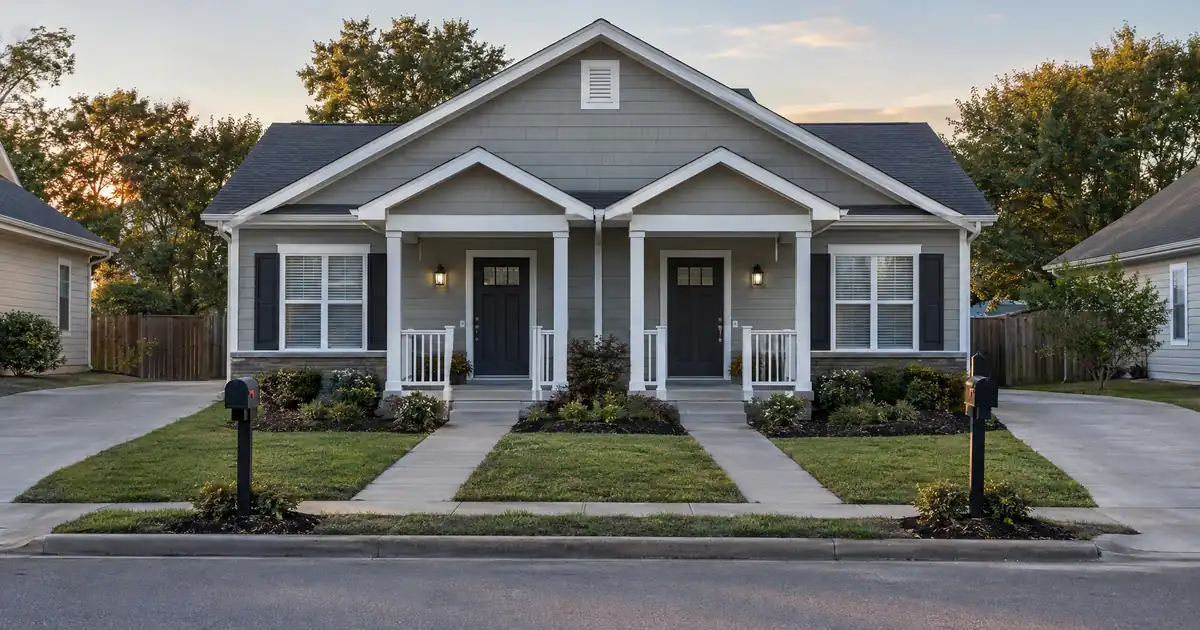
The Quick Read: Credit is one gate on an FHA cash-out of a duplex, triplex or fourplex, and it is not the one that sinks most files. The wholesale programs Lendmire places FHA loans with start at a 580 decision score, and the cash-out tops out at 80% LTV. You must live in one unit, own and occupy the building for 12 months before the case number, and show a clean housing payment record. On three- and four-unit buildings, the property’s own rents also have to pass a self-sufficiency test. Everything here is subject to lender guidelines and full file review, and none of it is a commitment to lend.
What Does an FHA Cash-Out on a 2-4 Unit Actually Mean?
An FHA cash-out refinance replaces your current mortgage with a new, larger FHA loan and pays you the difference. Your current loan can be FHA, conventional or another type. It can also be a free-and-clear home with no mortgage at all, which still counts as a cash-out. HUD’s own FAQ on cash-out refinances says the proceeds are not limited to specific purposes.
The building has to be your principal residence. That means you live in one of the units. A 2-4 unit you own purely as a rental is not eligible, and neither is a second home. For a building held as a rental, occupancy decides the leverage and the program, and this loan is not built for it.
Lendmire arranges FHA loans through wholesale lenders in the 16 states where it is licensed for consumer lending. The FHA cash-out refinance program is the same one described here. Across those wholesale programs, the credit conversation on a multi-unit starts with the same few questions every time. The sections below walk through them in order.
Key Terms Defined
Decision score: The credit score the lender uses to judge the file. With more than one borrower, lenders generally work from the lowest middle score among them.
Seasoning: The length of time you have owned and lived in the home before the refinance can start.
LTV and CLTV: Loan-to-value is the new loan divided by the appraised value. Combined loan-to-value adds any other liens on the home.
Self-sufficiency test: A rent-based check on three- and four-unit buildings. It asks whether the building’s net rent can carry its own housing payment.
Overlay: A rule a lender adds on top of the agency minimum. It is stricter than HUD, and it is common.
Manual underwriting: A file reviewed by an underwriter by hand instead of passing the automated finding.
How Is Credit Evaluated, Step by Step?
Credit evaluation on this loan runs in a set order: eligibility screen, case number and appraisal, then the borrower review. Here is how a file moves.
1. Eligibility screen. You live in one unit. You have owned and occupied the building for the 12 months before the FHA case number is assigned. Lenders look for employment records or utility bills to prove the occupancy.
2. Case number and appraisal. The case number locks the program rules that apply to your file. The appraiser values the building. On a 2-4 unit, the appraisal also carries a fair market rent estimate for the units.
3. Credit and payment history. The lender pulls your credit and reads the decision score. It then confirms 12 months of mortgage payments. If your current mortgage does not show on the credit report, HUD requires a verification of mortgage covering the prior 12 months, per HUD Mortgagee Letter 2020-30.
4. Automated finding or manual review. Most files run through FHA’s automated scorecard. A file that does not pass can go to manual underwriting, which looks harder at compensating factors.
5. Rent and self-sufficiency check. For a duplex, rent can be counted as income in the way the lender documents it. For three and four units, the self-sufficiency test applies as well.
6. Final loan sizing. The new loan, including the financed upfront premium, has to fit under the 80% cap on the appraised value.
A lower appraisal shrinks the cash you can take. It does not change the credit requirement, but it often decides whether the deal is still worth doing.
What Credit Score Do You Need?
For the wholesale programs Lendmire works with, the starting line is a 580 decision score. HUD’s published rules are lower than that. Under HUD Mortgagee Letter 10-29, the score tiers reach down to 500. The network does not reach below 580, so a borrower in the 500s will not find a path through these programs.
Two points matter here.
First, 580 is a floor, not a promise. Some lenders set a higher bar on cash-out because the borrower is pulling equity out. If a lender tells you it wants more than 580, that is an overlay, not a HUD rule. It is worth asking early which one you are hearing.
Second, the score is only part of how the lender reads credit. Real files turn on the details:
- Recent late payments on any account, but especially the mortgage.
- Collections and charge-offs that are open or recent.
- Judgments that show on the report.
- Bankruptcy and foreclosure waiting periods. These are HUD rules, not network promises: two years from a Chapter 7 discharge, and three years from a foreclosure.
A borrower with a score above the floor and a late mortgage payment last year can have a harder file than a borrower sitting right at 580 with spotless housing history. The mortgage record is the thing the cash-out looks at hardest.
What Is the Leverage Cap, and Why Did It Change?
The cash-out cap is 80% LTV on the appraised value, and the same 80% applies to combined LTV. HUD Mortgagee Letter 2019-11 lowered the cap from 85% to 80% for case numbers assigned on or after September 1, 2019. The letter does not set a lower cap for 2-4 unit buildings, so the duplex, triplex and fourplex all use the same 80%. Exact terms depend on the lender’s guidelines, property type, leverage, and a full review of the borrower’s file.
HUD described the change as a risk-reduction step and said it aligns FHA cash-out with the cap on conventional cash-out. See the HUD press release for the stated reasoning.
Two things trim the cash you actually receive. Any second lien or HELOC counts against the combined cap, so it leaves less room for the new first mortgage. And the upfront mortgage insurance premium, 1.75% of the base loan, is usually financed into the new loan. That financed amount has to fit under the same 80% ceiling.
The annual premium runs between 0.15% and 0.75% of the balance, depending on term, loan amount and LTV. On a thirty-year loan above 90% LTV the annual premium lasts for the term. At or below 90% LTV, it ends after eleven years. A cash-out at 80% falls in the second group. These are program facts, not an advertised price. Every figure here varies by lender and program — guidelines, property type, leverage, and credit profile all apply.
Where the 2-4 Unit Rules Differ
The credit rules are the same across unit counts. The income and rent rules are not.
Duplex. You qualify on your income and credit. Rent from the unit you do not occupy can be counted as income in the way the lender documents it. The unit you live in is left out of qualifying income. No self-sufficiency test applies.
Triplex and fourplex. The same income rules apply, and then the building has to pass the self-sufficiency test as well. The test starts with the appraiser’s fair market rent for all the units, including yours. It then subtracts a vacancy and maintenance factor. The housing payment cannot exceed 100% of what is left. This is a handbook test, so confirm the exact mechanics against the current HUD Handbook 4000.1 and with your lender.
Here is the catch. The test caps the loan size. It does not replace the income and credit review. A fourplex can fail the test with a strong borrower behind it, because the appraiser’s rent and vacancy estimates drive the answer. A borrower can also pass the test and still miss on credit or cash.
County loan limits apply, and they change every year. On a cash-out, the 80% cap usually binds before the county limit does, but check yours with the lender.
Quick Reference: Duplex vs. Three-to-Four Units
| Requirement | 2-unit | 3-4 unit |
|---|---|---|
| Occupancy | Live in one unit | Live in one unit |
| Max cash-out LTV | 80% | 80% |
| Decision score floor (network) | 580 | 580 |
| Housing history | 12 months verified | 12 months verified |
| Self-sufficiency test | Not required | Required |
| Rent counted as income | As documented | As documented |
What Do Ratios and Compensating Factors Look Like?
The base pair is 31/43. That is housing payment over income, and total debt over income, with no compensating factors. With documented compensating factors, the ratios can stretch up to 40/50 at the top tier. The automated finding governs most files.
Compensating factors are things like steady employment history, savings after closing, or a small payment change from your current loan. They have to be documented, not described. Some lenders advertise ratios above these, but those are lender-specific claims and not something the network promises.
For a 2-4 unit, rent from the other units can help, but only as documented, using the appraisal’s rent estimate and the lender’s own vacancy treatment. Do not count on a specific ratio before you see the lender’s worksheet.
Where the General Rule Breaks
These are the edge cases that move the 12-month clock or change the credit read.
Forbearance history. After a forbearance plan, a cash-out needs the plan completed and 12 consecutive on-time payments afterward. A purchase or no-cash-out refinance needs only 3. This comes from HUD Mortgagee Letter 2020-30. A borrower with fewer than three payments since the plan may also be pushed into manual underwriting. Do not assume the shorter wait applies to you.
Inheritance. A borrower who inherits a home generally does not have to meet the 12-month occupancy period before a cash-out, as long as it was never treated as a rental after the inheritance. If you rented it out after inheriting, the 12-month occupancy clock starts over. Check the handbook language with your lender before relying on this.
A new name on title. Adding or changing borrowers can reset the ownership clock. Sort out title before you apply, not after.
A recent rental period. If the building was a rental and you moved in, the 12 months of occupancy has to be real and documented. Utility bills and employment records are the usual proof.
Free-and-clear homes. With no mortgage at all, the loan still counts as a cash-out and follows the same 80% cap.
A house-hacker switching units. If you change which unit you live in, keep the paper trail of when you moved. The lender needs to see you in the building the whole 12 months.
What the Borrower’s Decision Looks Like
Picture a homeowner with a fourplex, living in one unit for three years. Credit is above the floor and the mortgage history is clean. The appraisal comes in with a rent estimate that looks fine. Then the self-sufficiency test returns a number close to the limit, because the appraiser’s vacancy factor was higher than the owner expected. The loan amount shrinks to pass the test, and the cash left over is smaller than planned. Nothing was wrong with the credit. The building’s own rents set the ceiling.
Now picture a duplex owner with a score just above the floor and one 30-day late on the mortgage eight months ago. The score is not the problem. The recent late payment on the very loan being refinanced is. That file often needs more seasoning of clean payments before it is worth submitting.
The CFPB’s guide on using home equity lays out the trade-offs plainly. A cash-out can raise the monthly payment because the new loan is larger. It can stretch the repayment term, and it resets the loan’s terms. It is also debt secured by the home, so falling behind puts the home at risk. Those costs are the reason to compare a cash-out against keeping the loan you have.
Tax treatment can depend on your situation; borrowers should speak with a qualified tax professional before relying on any deduction or credit.
If You Don’t Qualify Yet
Most misses on this loan can be fixed with time or paperwork.
- Score below the floor: pay down revolving balances and let new on-time history build. Do not open new accounts while you wait.
- Late mortgage payment: keep paying on time. The clean months are what the lender counts.
- Occupancy short of 12 months: gather utility bills and employment records in your name at the building address now.
- Title issues: resolve ownership changes before the case number is assigned.
- Self-sufficiency shortfall on 3-4 units: a smaller loan amount may pass where a larger one fails. Rents are set by the appraiser, so you cannot argue them up on your own.
- Wrong loan for the goal: if you only want a lower payment or a different term and do not need cash, a rate-and-term refinance on a principal residence reaches a higher LTV than the cash-out. If you hold an FHA loan already, the FHA Streamline skips the appraisal and uses a limited credit review, though it needs a net tangible benefit.
If you are weighing a cash-out refinance against keeping the loan you have, Lendmire can help you compare the programs and the equity each one reaches. Reach the team at 828-256-2183, or start a request through the quote form.
Frequently Asked Questions
Is 580 the minimum credit score for an FHA cash-out on a duplex?
For the wholesale programs Lendmire places FHA loans with, yes, 580 is where the decision score starts. HUD’s published tiers reach lower, but the network does not. Some lenders set a higher floor on cash-out. Subject to lender guidelines and full file review.
Can I do an FHA cash-out on a fourplex I rent out entirely?
No. The building must be your principal residence, so you have to live in one of the units. Cash-out is not available on second homes or buildings held only as rentals.
How much equity can I take out of a 2-4 unit?
The new loan, with the financed upfront premium included, can reach 80% of the appraised value. Any second lien counts against that same limit. A lower appraisal reduces the cash available.
Does my own unit count in the self-sufficiency test?
Yes, for the test itself. The appraiser’s market rent for all units, including yours, goes into the calculation. Your own unit is left out when the lender counts rent as qualifying income. Those are two different calculations, and the test applies only to three- and four-unit buildings.
What if I had a forbearance plan on my mortgage?
A cash-out requires that you completed the plan and then made 12 consecutive monthly payments. Other refinance types need only 3. If you fall short, waiting is usually the fix.
About Lendmire
Lendmire, NMLS# 2371349, is a mortgage brokerage with consumer lending licenses in 16 states. FHA, VA, conventional and jumbo purchase and refinance loans are arranged through wholesale lending partners, and each application is reviewed individually by the lender. Scotsman Guide named Lendmire a Top Mortgage Workplace in both 2025 and 2026.
For the program’s current guidelines, see FHA loan programs.
Get Started
Ready to find the right loan for you?
In about 30 seconds you can review financing options available for your home or investment property. No commitment required.
Informational only. Not a Loan Estimate, approval, or commitment to lend. Program availability and eligibility are subject to lender guidelines, credit approval, property review, and underwriting.
References
1. HUD Mortgagee Letter 2020-30
3. HUD Mortgagee Letter 2019-11
4. HUD press release on the cash-out change
6. CFPB guide on using home equity
This article is part of Lendmire’s FHA Loan series — every loan program’s qualification details, guidelines, and scenarios live on the loan options page.
Related reading: FHA Cash-Out Refinance Requirements at a Glance · How to Qualify for an FHA Cash-Out With a Thinner Credit Profile · FHA Cash-Out Occupancy Requirements for an Heir Living in the Home
Brandon Miller
Founder & CEO, Mortgage Loan Originator, Lendmire LLC
- Mortgage Loan Originator · NMLS# 1129696 · Verify on NMLS Consumer Access
- North Carolina Real Estate Broker · License# 343312 · Verify on NCREC
- North Carolina Insurance Producer · License# 19053198 · Property, Casualty, Life, Health · Verify on NAIC SBS
- Lendmire LLC · Firm NMLS# 2371349 · Verify firm licensure
Important disclosures. Lendmire (NMLS# 2371349) is a licensed mortgage brokerage. Lendmire is not a direct lender, depository institution, or financial advisor. All loan inquiries are subject to lender underwriting; this article does not constitute a commitment to lend. Rates, terms, and program guidelines are subject to change without notice and vary by borrower profile, property type, and state. Information in this article is general in nature and is not financial, legal, or tax advice. Equal Housing Opportunity. NMLS Consumer Access: nmlsconsumeraccess.org.