
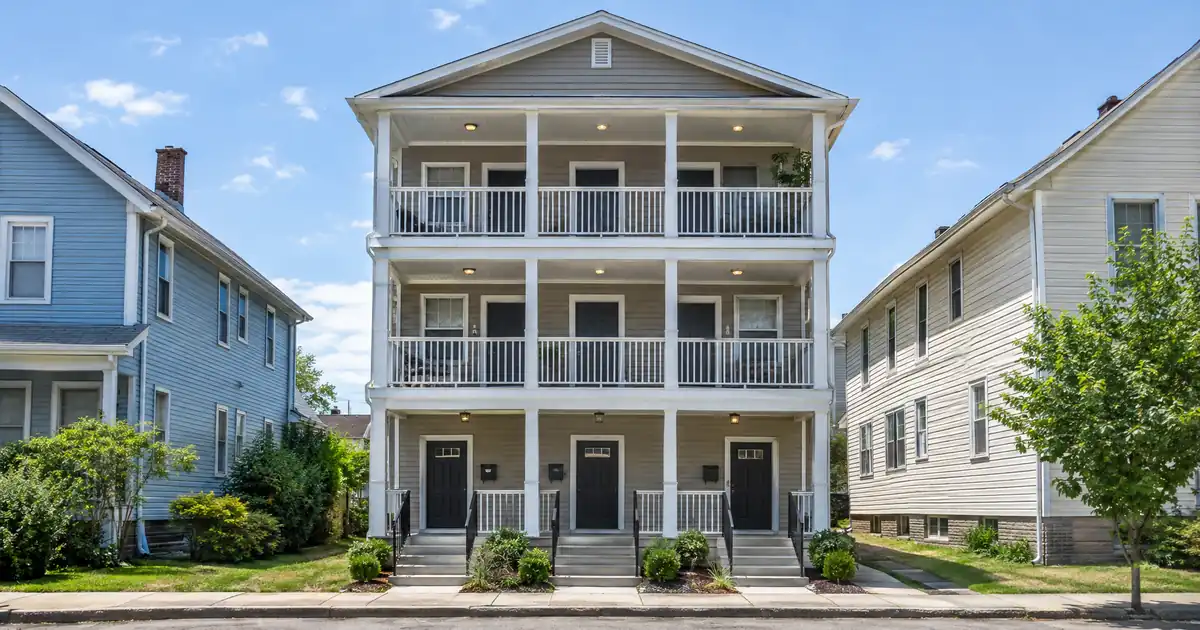
The Quick Read: To qualify, you must own the 2-4 unit building and have lived in one unit as your primary home for the 12 months before the case number is assigned. Your mortgage payment history over that window must be clean. The new loan can reach 80% of the appraised value. On a 3-4 unit building, the rent must also cover the full payment after a vacancy haircut, and you need cash reserves left over. Everything here is subject to lender guidelines and full file review, and none of it is a commitment to lend.
What Does an FHA Cash-Out Mean on a 2-4 Unit?
An FHA cash-out refinance replaces your current mortgage with a new, larger FHA-insured loan. The new loan pays off the old one, and you receive the difference in cash. On a 2-4 unit building, the rules are the same as on a single-family home, with extra tests layered on for the rental units.
The core limit is 80% of the property’s adjusted value. HUD Mortgagee Letter 2019-11 cut the cash-out ceiling from 85% to 80%, and the Handbook 4000.1 update transmittal records the same change. That means at least 20% equity stays in the building. Some older web pages still show 85%. They are stale.
Occupancy is the other anchor. FHA programs are for owner-occupied principal residences only. You cannot use this loan on a second home or a building you do not live in.
The program is available through Lendmire’s FHA cash-out refinance program. Lendmire is a mortgage broker. It arranges these loans through wholesale lenders in the 16 states where it is licensed for consumer lending: Alabama, California, Colorado, Florida, Georgia, Indiana, Michigan, Montana, New Mexico, North Carolina, Ohio, Pennsylvania, Tennessee, Texas, Virginia, and Washington.
Key Terms Defined
Adjusted value: The appraised value, adjusted under HUD’s rules, that the 80% cap is measured against.
Case number: The FHA identifier the lender requests for your loan. The 12-month occupancy and payment-history windows count back from the date it is assigned.
Seasoning: The time you must have owned and lived in the home before cash-out is available.
Self-sufficiency test: A test for 3-4 unit properties. The rent from all units, after a haircut, must cover the full monthly housing payment.
Reserves: Cash you still hold after closing, counted in months of the full housing payment (principal, interest, taxes, insurance).
Refer: The automated underwriting result that sends a file to manual underwriting, which is stricter.
How Is the Loan Underwritten, Step by Step?
Underwriting follows a set order. Each step can stop a file, so it helps to know them in sequence.
1. Check the timeline. The lender controls when the case number is requested. Because the 12-month windows run back from that date, a file that is a few weeks short of 12 months is usually better off waiting than applying early.
2. Application and automated review. The lender runs your file through FHA’s automated underwriting. A late payment inside the window forces a Refer finding and manual underwriting, per HUD Mortgagee Letter 2020-30.
3. Occupancy proof. Expect to show employment documents or utility bills at the building’s address. On a multi-unit, make sure those records name the unit you live in and not a mailing address elsewhere.
4. Appraisal. On 2-4 units, HUD’s rental-income rules call for an appraisal on the small residential income property form, which includes a fair market rent estimate for each unit. See HUD Mortgagee Letter 2023-17.
5. Value sets the cap. The loan cannot exceed 80% of the adjusted value. A light appraisal lowers your cash directly.
6. Payoffs. The lender collects payoff statements for every existing mortgage on the property. All of them must be cleared at closing.
7. Rental income review. Covered in its own section below.
8. Extra tests for 3-4 units. Self-sufficiency, a signed borrower’s contract on hotel and transient use (form HUD-92561), and verified reserves.
9. Mortgage insurance. The upfront premium is 1.75% of the base loan and can be financed. An annual premium also applies, between 0.15% and 0.75% of the balance depending on term, loan amount, and LTV. On a thirty-year loan above 90% LTV, the annual premium lasts for the term. At or below 90%, it ends after eleven years. Because cash-out tops out at 80%, the shorter schedule is the one that typically applies.
10. Closing. This is a consumer mortgage, so you receive a Loan Estimate and a Closing Disclosure. On a primary residence, a right to reconsider the loan typically applies after signing.
What Are the Occupancy and Payment History Rules?
You must have owned the property and lived in it as your principal residence for the 12 months before the case number. That is the rule for the wholesale programs Lendmire places FHA cash-out loans with.
Payment history is the quiet file-killer. Per HUD’s guidance, a cash-out loan must be downgraded to Refer and manually underwritten if any mortgage trade line shows:
- a current delinquency;
- a delinquency within 12 months of case-number assignment; or
- fewer than 12 consecutive payments since a forbearance plan was completed.
Manual underwriting is not an automatic decline. It is a tighter review with less room for weak ratios. If you stayed current under your original note and the forbearance plan ends at or before closing, no Refer downgrade is required. If your loan was modified, the history follows the modification agreement for the period it covers.
Where Does the Standard Rule Break? Named Edge Cases
The 12-month rule has exceptions. These are the ones that come up on 2-4 unit files.
- Inherited property. No minimum occupancy period is required if the property was never treated as an investment property after you inherited it. The lender will want the file to show that.
- Free-and-clear homes. A cash-out can pull equity from a home with no mortgage on it.
- Owned under 12 months. If you bought less than a year ago, the older HUD guidance based value on the lesser of appraisal or purchase price. Because cash-out also needs the 12-month history, this is rarely a path.
- Forbearance. Described above: finish the plan, then make 12 consecutive on-time payments.
- Ineligible borrowers. Nonprofits, state and local government agencies, and instrumentalities of government cannot use FHA cash-out.
- Non-occupant co-borrower. On a purchase, a non-occupant co-borrower is allowed. On a cash-out, that person’s income cannot be used to qualify.
- Second home or rental. FHA cash-out is for the home you live in. Occupancy decides the leverage, and a non-owner-occupied property falls outside this program.
How Does Rental Income Count on a 2-4 Unit?
Rent from the other units can help, but it is handled carefully and it never works as a direct offset to the payment.
For qualifying income, the lender documents rent using the appraiser’s market rent and any leases. In practice the lower of the two is generally what gets used, then a vacancy factor is applied. Rent from your own unit does not count as income. That is a common surprise.
Documents that support the rent figure typically include signed leases for the other units, the appraiser’s rent schedule, and, where it applies, proof of rent received.
What Is the Self-Sufficiency Test on 3-4 Units?
This test is where three- and four-unit files get tight, and it does not apply to duplexes.
Here is how it works. The lender starts with the appraiser’s fair market rent from all units, including your own. It subtracts the greater of the appraiser’s vacancy and maintenance estimate or 25% of that rent. That leaves net rental income. The full monthly payment (principal, interest, taxes, insurance) divided by that net figure may not exceed 100%.
You also need three months of the full payment in reserves after closing. A duplex needs one month. These reserve rules come from HUD Mortgagee Letter 2023-17.
A building with two units plus an accessory dwelling unit, or three units plus an ADU, is treated as 3-4 units and gets the full test. The reverse trap: on a one-unit home, ADU rent cannot be used for a cash-out.
Say you own a fourplex and live in one unit. The appraiser sets rent on all four. After the haircut, the net rent has to cover the whole payment on the new, larger loan. A cash-out that raises the loan balance can push that ratio over 100%, even if the old loan passed easily. Ask for the self-sufficiency check before you commit to a cash amount.
What Do Credit and Ratios Look Like?
On the wholesale programs Lendmire works with, FHA files start at a 580 decision score for maximum financing. HUD has a lower 500-579 tier, but the network does not reach below 580. Cash-out is capped at 80% regardless of score. Some lenders set a higher floor than 580, so overlays vary.
Debt ratios start at a base of 31/43 (housing and total debt as a share of income) with no compensating factors. Documented factors, such as reserves or a strong payment record, can reach 40/50 at the top tier. The automated finding governs most files.
Pass/Fail Self-Check
| Test | What the lender verifies | What you provide |
|---|---|---|
| Ownership and occupancy | 12 months before case number | Utility bills, pay stubs at the address |
| Payment history | No late payments in the window | Mortgage statements |
| Value | Loan at or under 80% of adjusted value | Appraisal (rent schedule included) |
| Borrower income | Your own income only | Pay stubs, traditional personal-income documentation |
| 3-4 units: rent test | Net rent covers full payment | Leases, appraiser rent schedule |
| 3-4 units: reserves | Three months after closing | Bank statements |
What Does It Cost You in Practice?
The loan is bigger, so the payment typically rises. Mortgage insurance adds an ongoing cost as well. The upfront premium can be financed, but reserves on a 3-4 unit must be cash on hand. The 80% cap leaves at least 20% equity in the building.
What people do with the cash matters too. The CFPB reports that paying off other debts was the top use of cash-out proceeds, with home repairs second. The CFPB also notes in its cash-out research that converting other debt into mortgage debt can put the home at risk of foreclosure if payments become unsustainable. Your home secures the new loan.
Tax treatment can depend on your situation; borrowers should speak with a qualified tax professional before relying on any deduction or credit.
What If You Don’t Qualify?
Match the fix to the failure.
- Short on occupancy or a recent late payment. Wait until the window is clean. The clock runs back from the case number, so a date the lender picks later is a date that helps you.
- Not enough equity. The 80% cap is fixed. A cosmetic improvement that raises appraised value may help, but the appraiser decides.
- Rent test fails on a 3-4 unit. A smaller cash-out amount lowers the new payment. Leases that match the appraiser’s rent also help.
- Reserves are short. Build them before applying.
Other products exist too. An FHA Streamline refinances an existing FHA loan with no appraisal and a limited credit review, but it gives no cash back. The FHA rate-and-term refinance with an appraisal reaches 97.75% on a principal residence occupied for the previous twelve months, but it does not pay out equity. A home equity loan or HELOC leaves your first loan in place, which can be the better path if your current loan is hard to replace. If a high debt-to-income ratio is the sticking point, Lendmire’s piece Can a 2-4 Unit Primary Home With a High DTI Get an FHA Cash-Out? covers that case.
Frequently Asked Questions
Can I use FHA cash-out on a duplex I live in?
Yes, if you own it and have lived in one unit for the 12 months before the case number. A duplex skips the self-sufficiency test and needs one month of reserves instead of three. The 80% cap still applies.
Does the rent from my other units count?
Some of it can, after a vacancy haircut, using the lower of lease rent or appraiser rent. The rent from your own unit does not count as income. Rent also cannot be used to directly offset the payment.
Can a relative who doesn’t live there co-sign?
Not for a cash-out. Income from a non-occupant co-borrower cannot be used to qualify.
Is 85% still the limit?
No. HUD cut cash-out to 80% of adjusted value, per Mortgagee Letter 2019-11. A rate-and-term refinance can go higher, but it pays no equity out.
Do county loan limits matter?
Yes. FHA limits are set by county and change every year, and they differ by unit count. Check HUD’s current limit lookup for your county before you plan a cash amount.
If you are weighing a cash-out refinance against keeping the loan you have, Lendmire can help you compare the programs and the equity each one reaches. For your own numbers, request a scenario review with Lendmire.
For current guidelines and terms, see Lendmire’s FHA loan programs page.
About Lendmire
Lendmire — NMLS# 2371349 — is a mortgage broker that arranges FHA, VA, conventional and jumbo home purchase and refinance financing in 16 states through wholesale lenders. Every option is subject to the lender’s guidelines and full underwriting. Scotsman Guide named Lendmire a Top Mortgage Workplace in both 2025 and 2026.
Get Started
Ready to find the right loan for you?
In about 30 seconds you can review financing options available for your home or investment property. No commitment required.
Informational only. Not a Loan Estimate, approval, or commitment to lend. Program availability and eligibility are subject to lender guidelines, credit approval, property review, and underwriting.
References
1. HUD Mortgagee Letter 2019-11
2. HUD Handbook 4000.1 Update transmittal
3. HUD Mortgagee Letter 2020-30
4. HUD Mortgagee Letter 2023-17
5. CFPB: CFPB Report Finds Cash Out Mortgage Refinance Borrowers Improve Credit Scores
6. CFPB cash-out refinance research PDF (Jan 2025)
This article is part of Lendmire’s FHA Loan series — every loan program’s qualification details, guidelines, and scenarios live on the loan options page.
Related reading: FHA Cash-Out Credit Requirements for a 2-4 Unit Primary Home · FHA Cash-Out Qualifying Ratios on a 2-4 Unit Primary Home · Can a 2-4 Unit Primary Home Get an FHA Cash-Out With Thin Credit?
Brandon Miller
Founder & CEO, Mortgage Loan Originator, Lendmire LLC
- Mortgage Loan Originator · NMLS# 1129696 · Verify on NMLS Consumer Access
- North Carolina Real Estate Broker · License# 343312 · Verify on NCREC
- North Carolina Insurance Producer · License# 19053198 · Property, Casualty, Life, Health · Verify on NAIC SBS
- Lendmire LLC · Firm NMLS# 2371349 · Verify firm licensure
Compliance and disclosures. Lendmire (NMLS# 2371349) is a licensed mortgage broker and is not a direct lender, depository institution, financial advisor, or tax professional. Content in this article is general market analysis and educational information — not financial, legal, or tax advice for any specific situation. Lendmire does not guarantee loan approval; every transaction is subject to underwriting by the funding lender. Mortgage pricing and loan program guidelines are subject to change at any time without notice and vary by borrower characteristics, property type, and state regulations. Lendmire complies with Equal Housing Opportunity. Licensure verification: NMLS Consumer Access.