
The Quick Read: Not directly. A cash-out replaces your loan with a new FHA loan that carries its own premiums. Because that new loan has to stay at or below 80% of the home’s value, its annual premium on a 30-year term typically ends after 11 years, subject to lender guidelines and full file review.
What Does an FHA Cash-Out Do to Your Mortgage Insurance?
It starts the insurance over. An FHA cash-out refinance is not an edit to your old loan. It is a new FHA loan that pays off the old one and puts cash in your pocket.
Mortgage insurance premium (MIP) is the insurance FHA loans carry to protect the lender. It comes in two parts. The upfront premium is 1.75% of the base loan, and most borrowers finance it. The annual premium is a percentage of the balance, between 0.15% and 0.75% depending on term, loan amount and LTV. LTV, or loan-to-value, is the loan balance divided by the home’s appraised value.
Here is what that means for you. Your old loan’s insurance history does not carry over. If you were five years into an 11-year schedule, the new loan starts at year one. You also pay a fresh upfront premium, and the annual premium applies to the whole new balance, not just the cash you take out.
Across the wholesale programs Lendmire places FHA files with, this restart is the part borrowers miss most. They hear “cash-out” and picture a cleaner slate. What they get is a new clock. If you want the program basics before the details, Lendmire’s FHA cash-out refinance program page lays out the structure.
So Where Does “Dropping MIP” Come From?
Dropping MIP is a real thing on FHA loans, but it is not something you trigger. It comes from how long the annual premium lasts, and that depends on your starting LTV and your term.
On a thirty-year loan, the rule works like this:
- Above 90% LTV: the annual premium lasts for the full term.
- At or below 90% LTV: the annual premium ends after 11 years. Leverage, reserves, and pricing vary by lender and program; the final terms follow the full file review.
A cash-out lands in the second bucket by design. The program caps the new loan at 80% LTV, which sits under the 90% line. So the premium has an end date built in. It does not end because you asked, and paying the balance down early does not shorten it. Terms vary by lender guidelines, property type, leverage, credit profile, and full file review.
Think of it as two rules stacked together. One caps your leverage. The other sets the premium’s length based on leverage. No single rule says “cash-outs get 11 years.” The result comes from putting the two side by side.
Does Unit Count Change How MIP Behaves?
No. A duplex, triplex and fourplex all follow the same duration test as a single-family home. The test looks at LTV and loan term. It does not look at how many doors you own.
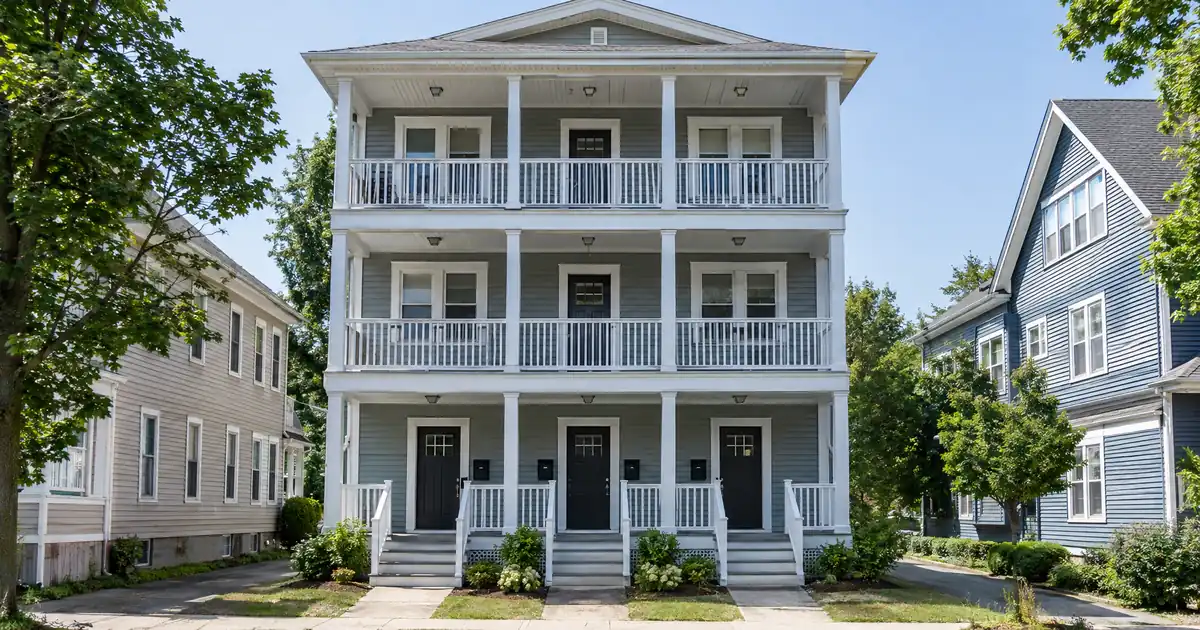
Unit count matters in other places. Cash-out is for a principal residence, so you must live in one of the units. You also need to have owned and lived in the home for 12 months before the case number is assigned. That is the program’s cash-out requirement, and it applies whether the building has two units or four.
Three- and four-unit homes face one extra hurdle. Lenders test whether the building can pay for itself, using the appraiser’s market rent for every unit, your own unit included. Some of that rent is set aside for vacancy and upkeep. What is left has to cover the full payment, mortgage insurance included. This is often called the self-sufficiency test. Two-unit homes do not face it.
Whether that test applies to your particular refinance is a question for the loan officer early on. It is not a reason to skip the building. It is a reason to ask before you order an appraisal.
Why the 80% Cap Is the Key Number
The 80% cap is the reason the duration math works in your favor. HUD lowered the cap on FHA cash-out refinances from 85% to 80% of value. Older articles still quote the 85% figure. Skip them.
The cap applies to the adjusted value, and it covers any second liens too. A home equity line or second mortgage that stays in place uses up part of that 80%. This is called CLTV, and it is worth checking before you plan around a number.
The new loan has to cover your payoff, closing costs and the cash you want. All of it fits under the cap. You are left with at least 20% equity after closing. That is the practical effect of the cap, and it is also the ceiling on how much cash you can take.
The 11-year tier also comes from HUD. Mortgagee Letter 2013-04, hosted by FHFA, sets annual premiums to last 11 years at or below 90% LTV and for the loan’s life above it. The financed upfront premium does not count toward that 90% test. The upfront premium itself stays at 1.75% under Mortgagee Letter 2023-05, which also changed annual premiums. Exact terms depend on the lender’s guidelines, property type, leverage, and a full review of the borrower’s file.
Key Terms Defined
Case number: the number assigned to your FHA loan when the lender orders the appraisal. Dates and cancellation rules key off it.
CLTV: combined loan-to-value. It adds your first mortgage and any second liens, then divides by the home’s value.
Adjusted value: the value the lender uses to test LTV, based on the appraisal.
Base loan amount: the loan before the financed upfront premium is added.
Self-sufficiency test: the rent test for three- and four-unit homes. The property’s net rent has to cover its own payment.
Annual MIP duration: how many years you keep paying the annual premium. It depends on LTV at the start and the loan term.
The Timeline: Old Loan, Payoff, New Loan
A simple walk-through shows why the clock restarts.
1. You own a 2-4 unit home and live in one unit. You have an FHA loan with some years of annual MIP already paid. 2. You apply for a cash-out. The lender orders an FHA appraisal and checks that you have owned and occupied the home for the past 12 months. 3. The new loan closes. It pays off the old FHA loan in full. The old loan, and its insurance history, are gone. 4. The new loan starts with a fresh upfront premium and a fresh annual schedule. On a 30-year term at or below 90% LTV, that schedule runs 11 years. Every figure here varies by lender and program — guidelines, property type, leverage, and credit profile all apply.
Step three is the whole story. The old loan does not get modified. It gets replaced.
FHA Cash-Out vs. Other Paths
Not every refinance treats insurance the same way. This table shows where the premium goes under each option.
| Option | Appraisal | Cash out | What happens to MIP |
|---|---|---|---|
| FHA Streamline | None | No | Premium continues |
| FHA rate-and-term | Yes | No | New FHA loan, new schedule |
| FHA cash-out | Yes | Yes | New FHA loan, new schedule |
| Conventional refinance | Yes | Yes, with limits | FHA MIP ends; PMI may apply |
The FHA rate-and-term refinance reaches 97.75% on a principal residence you have occupied for the previous twelve months. The cash-out stops at 80%. That gap is why cash-out files feel tighter on equity.
Conventional is the only path that actually ends FHA MIP early. Conventional cash-out limits on a 2-4 unit principal residence are often lower than on a one-unit home. That can shrink the cash you can take, or rule the exit out. Programs and limits differ by lender, so run it before you decide.
Private mortgage insurance, or PMI, is the conventional product. The CFPB explains the cancellation rights tied to PMI, and those rights belong to conventional loans. They are not FHA rules.
A Scenario in Percentages
Picture a homeowner with a fourplex who lives in one unit. The loan is eight years into an FHA schedule. The building has appreciated, and the owner wants cash for repairs and a debt payoff.
A cash-out can fund that, up to 80% of the adjusted value. Equity left after closing is at least 20%. But the eight years of premium already paid count for nothing. The new schedule starts at year one and runs 11 years.
Now compare the alternative. A conventional cash-out might end FHA MIP altogether. It might also cap the cash lower, ask for stronger credit and add its own PMI above a certain LTV. Then there is the second set of closing costs from the later exit. It is a cost-versus-benefit question, and the answer depends on how long you plan to keep the building.
(That “how long” question is the one that tips most files. Plan to hold ten years? The restart hurts. Plan to sell in three? It hardly matters.)
What About Older FHA Loans?
If your current loan is old enough, you may hold a better deal than any refinance can give you. FHA loans with case numbers assigned before HUD changed its duration rules can have annual MIP cancel at 78% LTV, after five years of payments on terms over 15 years. HUD’s handbook text describes this, and it works from the original amortization schedule. A new appraisal does not count. Final terms depend on lender guidelines, property type, leverage, and the borrower’s complete credit picture.
Check your case-number date with your servicer before you refinance. A cash-out would trade that cancellation right for a newer schedule. It is easy to give up a benefit you did not know you had.
Shorter terms and larger loans also change the schedule. A 15-year term, for example, has its own duration cells. Ask your loan officer which row your file lands in.
What the Lender Checks
For an FHA cash-out on a 2-4 unit home, expect the file review to cover:
- Owner occupancy: you live in one unit, and you have owned and occupied the home for 12 months before the case number.
- Credit: the programs Lendmire places FHA loans with start at a 580 decision score for the 96.5% purchase program. Cash-out files are reviewed on their own terms, so ask about your score early.
- Payment history: a clean record on your current mortgage.
- Ratios: the base pair is 31/43 (housing over total). Documented compensating factors can reach 40/50 at the top tier, and the automated finding governs most files.
- Appraisal: an FHA appraisal sets the value, and on 3-4 units it estimates rent for every unit.
- Full documentation: income, assets and credit, the same as any owner-occupied loan.
Everything here is subject to lender guidelines and full file review, and nothing is a commitment to lend. Loan limits are set by county, so county limits apply to your building.
Common Myths
“MIP is for life on every FHA loan.” No. Above 90% LTV it is. At or below 90% on a 30-year term, it ends after 11 years. These specifics are subject to lender guidelines and a full review of property, leverage, and credit.
“A cash-out puts me back on lifetime MIP.” Not when the loan stays under the 80% cap.
“Paying down to 78% or 80% removes my MIP.” Those numbers belong to conventional PMI. They apply to FHA only on the older loans described above.
“The cash-out cap is still 85%.” It was lowered to 80%.
“An appraisal that comes in higher cancels my MIP.” No. HUD works from the original amortization schedule, not new values.
“Every 2-4 unit FHA loan gets the same rent test.” Only three- and four-unit homes face the self-sufficiency test.
Who Should Choose What
| Your situation | Likely better fit |
|---|---|
| Need cash, limited equity, moderate credit | FHA cash-out |
| Strong credit, plenty of equity, want MIP gone | Conventional cash-out |
| Want lower costs, no cash needed | FHA Streamline |
| Old loan with 78% cancellation rights | Keep it; cash-out may cost you |
| Plan to sell soon | The restart matters less |
None of these are rules. They are starting points for a conversation about your numbers.
Next Step
If you are weighing a cash-out refinance against keeping the loan you have, Lendmire can help you compare the programs and the equity each one reaches. Reach the team at 828-256-2183 or through the quote page.
Frequently Asked Questions
Can I get rid of MIP with a cash-out refinance?
Not by staying with FHA. The new FHA loan carries its own insurance. A conventional refinance can end FHA mortgage insurance, though PMI may apply and conventional cash-out limits on 2-4 unit homes are often lower.
Does paying my balance down to 80% remove FHA MIP?
No, on newer FHA loans. The 80% and 78% rules are conventional PMI rules. FHA annual premiums follow a set schedule based on the starting LTV and term.
Do I need to live in the building to do a cash-out?
Yes. Cash-out is for a principal residence. You need to have owned and lived in the home for the 12 months before the case number. On a 2-4 unit, you occupy one unit and rent the others.
Does a duplex get different MIP treatment than a fourplex?
No. Duration is set by LTV and term, not unit count. The difference is the rent test on three- and four-unit buildings, which checks that the property can cover its own payment.
Is an FHA cash-out worth it if I may refinance again later?
It depends on how many years are left. An exit later means a second set of closing costs, and the new MIP clock may have years to run. Compare the cash you need now against the cost of leaving FHA, and do not assume savings.
About Lendmire
Lendmire (NMLS# 2371349) is a mortgage broker licensed for consumer lending in 16 states. Lendmire arranges FHA, VA, conventional and jumbo purchase and refinance loans through wholesale lenders; every file is underwritten by the lender under the applicable program guidelines. Scotsman Guide named Lendmire a Top Mortgage Workplace in both 2025 and 2026.
Get Started
Ready to find the right loan for you?
In about 30 seconds you can review financing options available for your home or investment property. No commitment required.
Informational only. Not a Loan Estimate, approval, or commitment to lend. Program availability and eligibility are subject to lender guidelines, credit approval, property review, and underwriting.
References
1. HUD press release on FHA cash-out refinance risk (archive)
2. HUD Mortgagee Letter 2013-04, hosted by FHFA
3. HUD Mortgagee Letter 2023-05
4. CFPB: When can I remove private mortgage insurance (PMI) from my loan?
5. HUD Handbook servicing text, transmittal 2025-06
This article is part of Lendmire’s FHA Loan series — every loan program’s qualification details, guidelines, and scenarios live on the loan options page.
Related reading: FHA Cash-Out Upfront MIP Rules for an Existing FHA Loan · Does an FHA Cash-Out From a Conventional Loan Carry MIP for Life? · Can an Heir Who Inherited the Home Get an FHA Cash-Out Refinance?
Brandon Miller
Founder & CEO, Mortgage Loan Originator, Lendmire LLC
- Mortgage Loan Originator · NMLS# 1129696 · Verify on NMLS Consumer Access
- North Carolina Real Estate Broker · License# 343312 · Verify on NCREC
- North Carolina Insurance Producer · License# 19053198 · Property, Casualty, Life, Health · Verify on NAIC SBS
- Lendmire LLC · Firm NMLS# 2371349 · Verify firm licensure
Important disclosures. Lendmire (NMLS# 2371349) is a licensed mortgage brokerage. Lendmire is not a direct lender, depository institution, or financial advisor. All loan inquiries are subject to lender underwriting; this article does not constitute a commitment to lend. Rates, terms, and program guidelines are subject to change without notice and vary by borrower profile, property type, and state. Information in this article is general in nature and is not financial, legal, or tax advice. Equal Housing Opportunity. NMLS Consumer Access: nmlsconsumeraccess.org.