
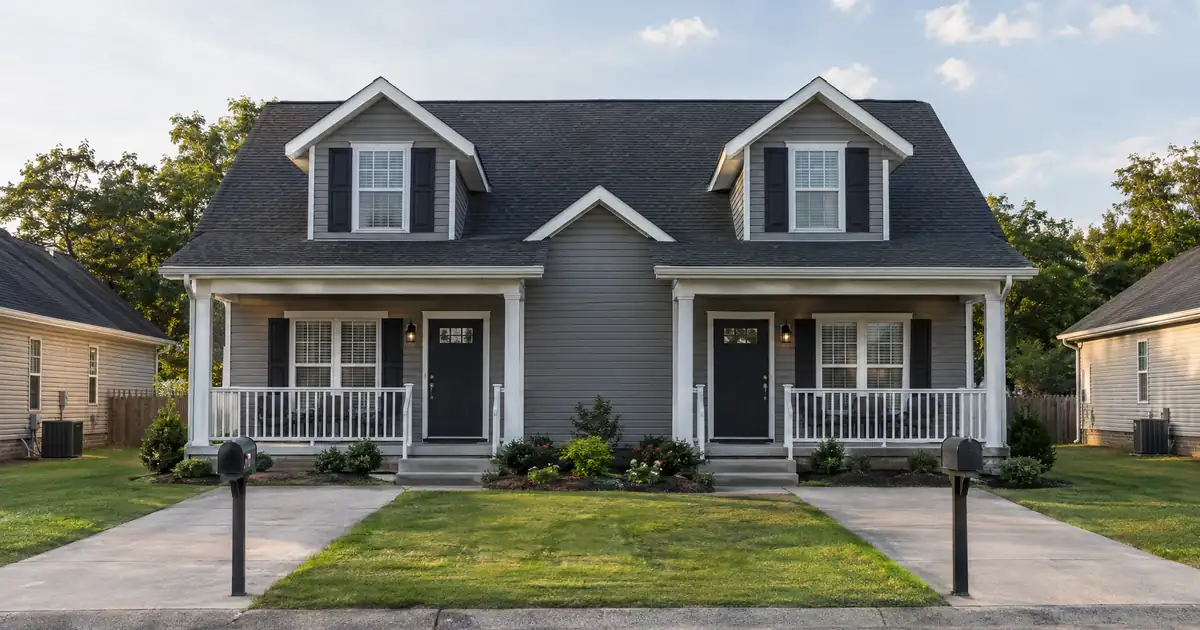
The Quick Read: It depends on what “thin” means. A duplex, triplex or fourplex you live in is an eligible property, and a short credit history does not bar you by itself. The hurdles are the 80% loan-to-value cap, 12 months of living there, a clean payment history, and, if you have no score at all, manual underwriting. Subject to lender guidelines and full file review.
How Does an FHA Cash-Out Work on a 2-4 Unit Home?
An FHA cash-out refinance replaces your current mortgage with a new, larger one. You keep the difference as cash. On a home with two to four units, you must live in one of them as your principal residence.
Lendmire’s FHA cash-out refinance program is built on that structure. Lendmire is a mortgage broker. It arranges FHA loans through wholesale lenders, and those lenders review the file and make the approval decision.
Three gates come before credit gets a vote:
- Leverage. The new loan can reach 80% of the home’s appraised value on a home you have owned and occupied for 12 months before the case number is assigned.
- Occupancy. You need to have owned the building and lived in it for those 12 months.
- Payment history. Your existing mortgage payments should be on time over that same stretch.
Credit comes next. FHA does not set a separate credit score for cash-out. It ties the score to how much financing you can get. Because cash-out stops at 80% anyway, the score matters mostly as a pass-or-fail question at the lender’s desk.
One more point on property type. A 2-4 unit home you live in is treated as a primary residence, so occupancy decides the leverage. That keeps the cash-out cap at 80% rather than something lower.
What Counts as “Thin” Credit?
“Thin credit” is not one thing. Underwriters sort files into four groups, and each one lands differently.
| File type | What it looks like | How it tends to be treated |
|---|---|---|
| No score | No usable credit history | Manual underwriting |
| Thin file | A score, but few accounts | Often automated review |
| Young file | A score, short history | Often automated review |
| Damaged file | Late pays, collections, major events | Waiting periods may apply |
A thin or young file has a score. The lender gets a decision score, and the automated finding governs most files. A few accounts paid on time can work fine.
A no-score file is a different story. The lender cannot pull a score, so a person underwrites it by hand. They build a record from documented payment histories, such as rent and utilities.
A damaged file is about events, not size. HUD sets waiting periods after certain events: two years from a chapter 7 discharge and three years from a foreclosure. Those are HUD’s rules, not a promise from any one lender.
If you are not sure which group you fit, pull your reports first. Many people who call themselves thin have a score. That puts them in the easier lane.
How Do Underwriters Read a Thin File?
They read it in one of two lanes. With a score, the file usually runs through an automated review. Without a score, it goes to manual review.
The score lane. The wholesale programs Lendmire places FHA loans with start at a 580 decision score. The decision score is the one the lender uses to qualify you. With more than one borrower, the lender uses the lowest score among them.
HUD has a lower tier for scores of 500 to 579, but those loans need a bigger minimum investment. The wholesale programs Lendmire works with do not reach below 580. A thin file at or above 580 can be a normal automated file.
The manual lane. With no score, the lender builds the credit story by hand. Expect these differences:
- Ratios sit near the base pair of 31/43. That means housing costs at 31% of income and total debts at 43%.
- Compensating factors, such as savings or a low payment jump, are the route to higher ratios. A file with no score has a harder time using them.
- At the top tier, documented compensating factors can stretch ratios as far as 40/50. Treat that as the exception.
- You will document 12 months of on-time rent, utilities and similar bills.
- Extra cash reserves are usually required, more so on 3-4 units.
Here is the catch. HUD’s rules are the floor, and lenders add their own layers on top. Some wholesale lenders refuse a no-score cash-out outright. Others allow it with a full set of references and a lot of reserves.
In Lendmire’s experience, the no-score cash-out is the narrowest door in this whole product.
Where Does the 80% Cap Leave You on Equity?
It leaves you roughly 20% of the home’s value. HUD lowered the cash-out cap to 80% of the appraised value in Mortgagee Letter 2019-11. Any second lien counts toward that same 80%.
HUD’s press release on the change said the cut brought FHA in line with the limit used for government-backed conventional loans. Older cash-out limits of 85% and 95% are gone. If a web page still shows them, it is out of date.
Equity is what sets your cash, so the order of operations goes like this:
1. The appraiser sets the value.
2. The lender takes 80% of it.
3. Your current mortgage balance and any other liens come out of that.
4. What remains, less financed costs, is the most cash you can take.
FHA mortgage insurance applies to the whole new loan. There is an upfront premium of 1.75% of the base loan, and it is financed into the balance. There is also an annual premium that runs between 0.15% and 0.75% of the balance. The exact level depends on term, loan amount and LTV.
Because cash-out tops out at 80%, you are at or below 90% LTV. On a thirty-year loan, that means the annual premium ends after eleven years. Above 90%, it lasts the full term. That is a program fact, not a price quote. Each figure is subject to lender guidelines and a complete review of property type, leverage, and credit.
What Changes With Two, Three or Four Units?
Unit count changes the paperwork more than the credit. Here is the side-by-side.
| Property | Self-sufficiency test | Reserves | Appraisal |
|---|---|---|---|
| Duplex | Not required | Standard | Full FHA appraisal |
| Triplex | Required | Higher | Full, with rent schedule |
| Fourplex | Required | Higher | Full, with rent schedule |
A duplex is the simplest. It needs no self-sufficiency test.
A triplex or fourplex must be self-sufficient, and this applies regardless of occupancy. HUD’s older refinance reference guide lists this test for 3-4 unit homes, along with a post-closing reserve. The same page also says the property may be a one-to-four unit home and must be owner-occupied.
In plain terms, the test asks whether the building’s rent can carry its own payment. Lenders generally count the appraiser’s market rent for every unit, including yours. Then they subtract a vacancy allowance. What is left must at least cover the full housing payment.
Two cautions apply here. First, the guide is archived and still shows the old 85% cap, so use it for property type and the 3-4 unit rules, not for leverage. Second, the details of the self-sufficiency test come from secondary sources, so your lender’s worksheet is the final word.
Rent that looks strong on paper can still fail. A vacancy cushion shrinks it fast.
Passing this test does not qualify you. It only limits the payment. You still qualify on your income, your debts and the ratios above.
How Does Rent Get Counted?
Rent helps, but not the way many owners expect. Projected rent can count as part of your qualifying income. It cannot be used to offset the payment. Treat this as a general rule, since lender worksheets differ.
For a refinance, expect to document rent in a few ways:
- The appraiser’s rent schedule, which sets market rent for each unit.
- Signed leases for the units you rent out.
- Traditional personal-income documentation or deposit records, if the lender asks for them.
Your own unit’s rent counts in the self-sufficiency math on a 3-4 unit home. It does not count as income you receive.
A Fourplex Walked Through
These are modeled numbers for illustration, not market facts.
Say you own and live in a fourplex. You have lived there well past 12 months, and your mortgage payments are all on time. Your credit file is young. You have a middle-tier score and a few accounts.
Here is how the deal works:
1. Gate check. Ownership, occupancy and payment history pass.
2. Score lane. A decision score at or above 580 sends the file to automated review.
3. Appraisal. The value comes in. Your current loan plus a home equity line already sits near 70% of that value.
4. Cap math. Only about 10 points of value remain under the 80% cap. Financed costs can use up part of that room.
5. Self-sufficiency. The appraiser’s rents, less the vacancy allowance, must cover the full payment on the larger loan.
6. Ratios. The base pair is 31/43. Documented compensating factors can lift it toward 40/50 at the top tier.
Change one input and the answer shifts. Drop the score and the deal goes to manual review. Add a second lien and the cash shrinks. Skip the rent math and a fourplex can fail on its own.
FHA Cash-Out, Conventional, Second Lien or Streamline?
If FHA cash-out does not fit, other routes exist. Here is how they compare for a thin-credit owner in a 2-4 unit home.
| Option | Gives you cash? | Credit fit | 2-4 unit fit |
|---|---|---|---|
| FHA cash-out | Yes, to 80% | Lenient for thin files | Works, with extra tests |
| Conventional cash-out | Yes | Often stricter | Often caps lower |
| Second lien or HELOC | Yes | Lender sets rules | Keeps your first loan |
| FHA Streamline | No | Limited credit review | Existing FHA loans only |
The FHA Streamline deserves a closer look. It refinances an existing FHA loan with no appraisal and a limited credit review. It needs a net tangible benefit, and your premium continues. It pays no cash.
If you only want to change your loan terms, the Streamline is the easier path for a thin file.
The conventional column is described in general terms on purpose. Conventional limits on 2-4 units are often lower, and credit standards are often stricter. A lender can tell you the exact limit for your property.
What Does a Cash-Out Cost You Over Time?
More than the cash itself. The CFPB’s guide to using home equity says a cash-out refinance can stretch your payoff time and raise your monthly payment. It also resets your loan terms.
Debt consolidation is a common use for the cash. CFPB research on cash-out refinances and non-mortgage debt warns about the risk. Turning card or loan balances into mortgage debt puts your home on the line if payments become hard to keep up.
On a multi-unit building, add one more layer. Your rent income can dip when a unit sits empty, but the mortgage payment does not. A thinner cushion matters more for a thin-credit borrower.
Plan for a full appraisal, title work, a Loan Estimate and a Closing Disclosure. A refinance on your home also carries a short right-to-cancel period after signing.
Five Myths That Trip Up Thin-File Owners
“A 500 score gets me a cash-out.” HUD has a 500-579 tier, but lenders typically set higher floors. Pricing and available terms vary by lender, borrower profile, property type, and full underwriting review.
“A cosigner fixes it.” On a purchase, a non-occupant co-borrower is allowed. HUD’s older reference guide says a non-owner-occupant co-borrower may not be added on this kind of refinance to meet credit guidelines. Do not plan around a relative saving the file.
“No score means no FHA.” Manual underwriting with non-traditional credit exists. Whether a lender extends it to cash-out is the open question.
“Rent pays the mortgage on a 3-4 unit.” Projected rent counts as income but does not offset the payment. The self-sufficiency test is a separate hurdle.
“FHA insurance drops off at 80% like conventional.” Not so. On FHA, the term depends on the loan, as described above.
What Can You Fix Before You Apply?
Thin files improve with time and a little structure. This checklist is general guidance, not a guarantee of any outcome.
- Pull all three reports. Check for errors and confirm whether you have a score.
- Keep paying on time. Your mortgage record over the past 12 months matters most.
- Build a payment record. If you have no score, document rent and utility payments you can show.
- Add a seasoned account. Ask whether an authorized-user line or a small installment loan fits your situation.
- Hold your balances low. Keep cards well below their limits.
- Check your occupancy clock. If you recently moved in or converted a rental, the 12-month wait can add up to a year.
- Get a realistic equity read. Know your likely value and every lien on the building.
If an inherited home was never rented, an exception to the 12-month rule can apply. If it was rented after you inherited it, the clock applies.
Key Terms Defined
Cash-out refinance: A new, larger mortgage that pays off your old one and gives you the difference in cash.
Loan-to-value (LTV): Your loan balance as a percentage of the home’s appraised value.
Decision score: The credit score a lender uses to qualify you, which is the lowest among borrowers.
Manual underwriting: A person reviews the file by hand instead of relying on an automated finding.
Non-traditional credit: A record built from rent, utilities and similar bills instead of credit cards and loans.
Self-sufficiency test: For a 3-4 unit home, a check that the building’s net rent can cover its full payment.
Reserves: Cash you hold after closing, which does not include cash-out proceeds.
Frequently Asked Questions
Can I qualify with no credit score?
Possibly, but it is the hardest version. The file goes to manual underwriting, and you document rent and utility history. Many wholesale lenders add their own limits on top of HUD’s, so some will not do it.
Do I have to live in the building?
Yes. At least one borrower must have owned the home and lived in it as a principal residence for the 12 months before the case number. Inherited homes that were never rented can be an exception.
Does the rent from my other units count?
It can count toward qualifying income, based on the appraiser’s market rent and your leases. On a 3-4 unit home, the rent also feeds the self-sufficiency test.
Can an FHA Streamline give me cash?
No. A Streamline refinances an existing FHA loan with no appraisal and a limited credit review, but it pays no cash. It also needs a net tangible benefit.
Can a relative co-borrow to help my credit?
Not on this type of refinance. HUD’s older reference guide says a non-owner-occupant co-borrower may not be added to meet credit guidelines. That differs from a purchase, where a non-occupant co-borrower is allowed.
Next Step
If you are weighing a cash-out refinance against keeping the loan you have, Lendmire can help you compare the programs and the equity each one reaches. Qualification is subject to lender guidelines, and nothing here is a commitment to lend.
For your own numbers, request a scenario review with Lendmire.
About Lendmire
Lendmire is a mortgage brokerage (NMLS# 2371349) licensed for consumer mortgage lending in 16 states, arranging FHA, VA, conventional and jumbo purchase and refinance loans through a wholesale lending network. Eligibility is determined by the lender on each file. Scotsman Guide named Lendmire a Top Mortgage Workplace in both 2025 and 2026.
Get Started
Ready to find the right loan for you?
In about 30 seconds you can review financing options available for your home or investment property. No commitment required.
Informational only. Not a Loan Estimate, approval, or commitment to lend. Program availability and eligibility are subject to lender guidelines, credit approval, property review, and underwriting.
References
1. HUD Mortgagee Letter 2019-11
2. HUD press release on cash-out refinance risk
3. HUD refinance reference guide (archived)
4. CFPB guide to using home equity
5. CFPB research on cash-out refinances and non-mortgage debt
This article is part of Lendmire’s FHA Loan series — every loan program’s qualification details, guidelines, and scenarios live on the loan options page.
Related reading: FHA Cash-Out DTI Limits With a Thinner Credit Profile · FHA Cash-Out vs Conventional Cash-Out With Thinner Credit · Should You Choose FHA Cash-Out Over Conventional With Lower Credit?
Brandon Miller
Founder & CEO, Mortgage Loan Originator, Lendmire LLC
- Mortgage Loan Originator · NMLS# 1129696 · Verify on NMLS Consumer Access
- North Carolina Real Estate Broker · License# 343312 · Verify on NCREC
- North Carolina Insurance Producer · License# 19053198 · Property, Casualty, Life, Health · Verify on NAIC SBS
- Lendmire LLC · Firm NMLS# 2371349 · Verify firm licensure
Legal disclosures. Lendmire (NMLS# 2371349) is a state-licensed mortgage brokerage that arranges financing through wholesale lender relationships. Lendmire is not a direct lender, depository institution, or registered financial advisor. The discussion above is general informational content about real estate financing — it is not financial, legal, or tax advice, and readers should consult licensed professionals for guidance on their individual circumstances. Loan inquiries are subject to lender underwriting; this article does not represent a commitment to lend. Loan terms, rates, and qualification standards vary by borrower, property, and state, and are subject to change at any time. Equal Housing Opportunity. NMLS Consumer Access: nmlsconsumeraccess.org.