
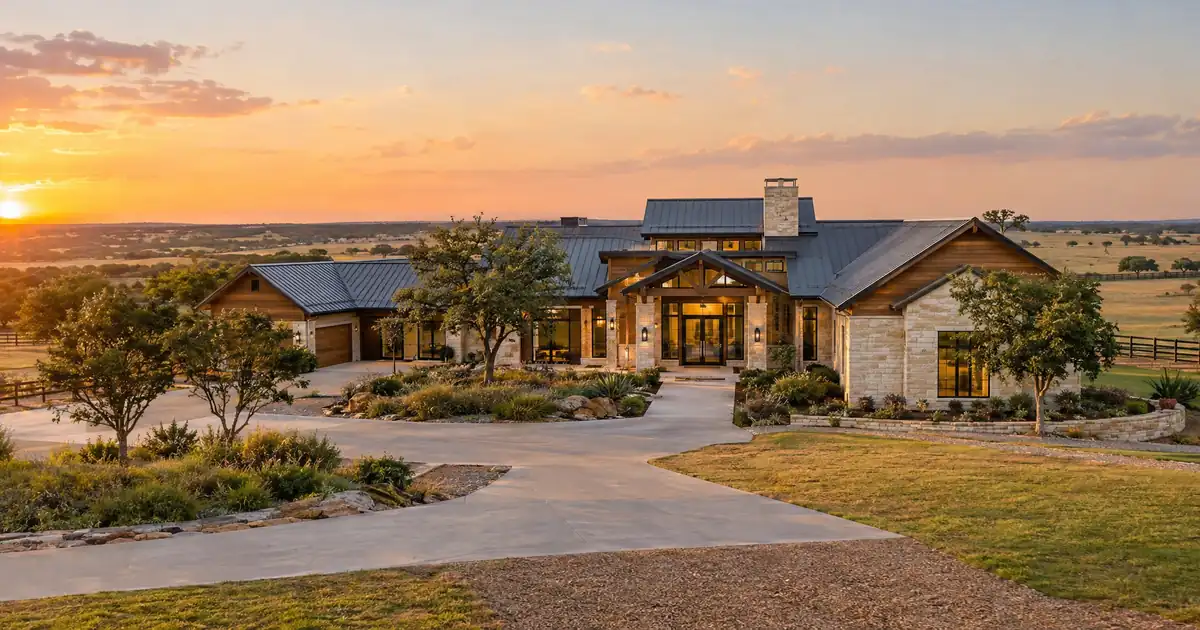
The Quick Read: Two rulebooks decide this loan, and the stricter one wins. Texas law caps how much total debt can sit against a homestead, and the lender sets its own limits on land, credit, and reserves. The appraisal then turns both into a dollar figure. A big balance and a big parcel are workable together, but the file has to be built around the land from the start.
Key Takeaways
- Texas treats any cash-out against a homestead as a special loan type, and loan size does not exempt it.
- The state caps all liens combined at 80% of appraised value. A lender cannot waive that.
- Only part of your land may count as homestead. The cutoff depends on whether the property is urban or rural.
- The appraiser has to value a house on acreage with thin comparable sales. That is where many files get tight.
- A lender’s acreage comfort zone is usually narrower than what the law allows.
What Makes a Cash-Out “Jumbo” on Acreage?
A cash-out is jumbo when the new loan is larger than the conforming limit for your county. The limit is set county by county and changes every year, so check yours before assuming anything. Most rural Texas counties sit at the standard baseline. That means a homestead on acreage can cross the jumbo line with a mid-sized balance, not just a mansion-sized one.
Jumbo loans are not bought by the big government-backed investors. Each lender sets its own rules. Across the wholesale programs Lendmire places files with, the headline lane starts at a 660 decision score. Leverage on that lane reaches 90% on a purchase, and loans run up to $5,000,000 on the largest lanes. Cash-out sits at lower leverage than purchase. Reserves, which are months of your full payment held in the bank, rise with the loan amount. All of this is subject to lender guidelines and a full file review.
Here is the catch for Texas homeowners. Those leverage ceilings are not the limit you will hit. The state’s own cap comes first, and it is lower.
How Does the Texas Equity Cap Shape the Loan?
Texas allows total debt against a homestead of no more than 80% of its fair market value. That counts your new loan plus every other lien on the property. Texas Legal Guide summarizes the cap, and it comes from the state constitution. It is not a lender preference.
So even where a lane would allow higher leverage elsewhere, a Texas homestead cash-out stops at 80% combined. The loan size does not change that. A $5,000,000 jumbo and a modest loan follow the same ceiling.
Here is why that matters on a high-value property. Say your first mortgage is still large. Every point of value it uses up comes out of what you can take. A recent purchase leaves little room. A long-held, mostly paid-down ranch home leaves a lot.
If you are curious how a home equity line and a cash-out loan can coexist on the same Texas homestead, Lendmire’s piece Can a Texas Homestead on Acreage Hold a HELOC and Cash-Out Lien? walks through the lien rules.
Step by Step: How the Loan Gets Underwritten
Lendmire’s jumbo cash-out refinance program arranges these loans through wholesale lenders. The sequence below is how a typical file moves.
Step 1: Confirm the home is your primary residence. Texas cash-out rules apply to your homestead. You need to live there and intend to treat it as home. A second home or a ranch you do not occupy falls under different rules. Occupancy changes the leverage a lane allows, so state it plainly up front.
Step 2: Sort the land into urban or rural. An urban homestead sits inside a city or a platted subdivision, with municipal services. Land outside that is generally rural. This label sets how many acres count.
Step 3: Measure the acreage against the homestead limits. More on this in the next section. Acres past the limit are not homestead.
Step 4: Receive the required Texas disclosure. The state requires a written notice about the extension of credit before you close. The Texas Office of Consumer Credit Commissioner says a 12-day waiting period applies. It starts only after you have applied and received that disclosure. Apply on Monday, get the notice on Wednesday, and the clock starts Wednesday. A late notice moves the whole schedule.
Step 5: Order the appraisal. The appraisal sets the value that the 80% cap is measured against. On larger loans, a lane may require two appraisals once the amount passes that lane’s threshold. On acreage, expect the appraiser to work harder.
Step 6: Underwrite your credit, income, assets, and reserves. The lender checks your decision score, your debt-to-income ratio, and your cash reserves. On the fixed lanes the ratio ceiling is 50%. It is 45% on the adjustable lanes and 43% on the interest-only lanes. These are program ceilings, not promises, and strong files sit well under them.
Step 7: Close at an authorized location and observe the cancellation window. Texas limits where these loans can close and gives you a window to cancel afterward. It also limits what a lender can charge on them. Your Loan Estimate and Closing Disclosure show the actual costs, and you should compare them line by line.
How Does Acreage Change the Answer?
Acreage changes three things: how much land counts as homestead, how the appraiser values the parcel, and how comfortable the lender is with the property. Texas law answers the first. The lender answers the second and third.
What Texas law counts as homestead. Under Article XVI, Section 51 of the Texas Constitution, a rural homestead can run up to 200 acres for a family and 100 acres for a single adult. An urban homestead is limited to ten acres. The rural acreage does not have to be one block. Parcels can be separate.
What the lender will lend against. This is narrower and varies. Many lenders get cautious as acreage grows, especially when the land looks more like a working property than a residence. Some ask for a survey, particularly if you own adjacent land. Treat the lender’s line as a different question from the legal line.
What happens to the extra acres. Say you hold 140 acres as a single adult. Only 100 acres qualify as homestead. The rest is not homestead, so it is exposed to creditors. Whether the lender takes that extra land into account, and at what value, is a lender and title question. Ask early, before the appraisal is ordered.
Two acreage numbers people mix up
Texas uses a different, smaller acreage figure for property-tax purposes. That tax definition has nothing to do with creditor protection or the cash-out rules. If a county tax record says one thing about your land and the constitution says another, they are measuring different things. Do not use the tax figure to decide whether your acreage qualifies.
How Does an Appraiser Value a Home on Acreage?
A good rural appraisal finds the best available sales, explains why they are the best, and adjusts for land, outbuildings, and location. The comparable sales are the hard part. In a rural area, few properties sell, and they rarely match yours.
When sales are scarce, an appraiser may reach back further in time or farther out in distance. Those comparisons need more adjustments, and more adjustments mean more room for a conservative number. Jumbo lenders set their own appraisal standards. On a large parcel, a lender may ask for a second appraisal or a review of the first.
Practical steps that help the appraisal:
- Gather a list of improvements: barns, wells, fencing, outbuildings, guest quarters.
- Provide a clean survey and legal description if you have them.
- Note any recent sales of similar land nearby.
- Be ready to explain land use. A homestead that is leased out or run as a business invites questions.
The appraisal is the biggest swing factor in the file. A conservative number does not just shrink your proceeds. Because of the 80% cap, it shrinks them by more than the value gap itself.
A Worked Example, in Percentages
This example uses modeled assumptions, not a quote and not a real file. We express everything as a share of appraised value.
- Appraised value: 100%.
- Texas combined-lien cap: 80%.
- Existing first mortgage: 40% of value.
- Room left under the cap: 40% of value.
- Closing costs come out of that room or out of the proceeds. Your Loan Estimate shows them.
- Net cash to you: what remains of that 40% after paying off the first mortgage and costs.
Now change one input. Say the appraisal comes in 10% lower than expected. The cap shrinks with it. The existing mortgage did not shrink, so it now takes a bigger bite out of the cap. The room under the cap falls by more than 10%. That is why acreage appraisals deserve attention before you apply, not after.
One more change. Suppose some of your acreage falls outside the homestead limit and the lender does not give it full credit. The value that counts is lower still. In that case, the cash you can take is smaller than the headline value suggests.
Key Terms Defined
Jumbo loan: A mortgage larger than the conforming limit for your county. The Federal Housing Finance Agency sets that limit each year and allows higher limits in high-cost areas.
Section 50(a)(6) loan: The Texas name for a cash-out loan or home equity loan against a homestead. It carries its own rules on equity, fees, and timing.
Combined loan-to-value (CLTV): All the debt on the home, added together, divided by its appraised value. Texas caps it at 80% on these loans.
Homestead: The home you live in and claim as your residence, plus the land the law lets you protect with it.
Reserves: Cash or liquid assets, counted in months of your full payment, that the lender wants to see after closing.
Seasoning: The time a loan has been in place. A seasoned Texas cash-out loan can later be refinanced into a regular loan under the right conditions.
Where the General Rule Breaks
Most of this article describes the standard path. These are the cases that bend it.
Ag-exempt land. Texas once barred these loans on property with an agricultural-use tax exemption. A 2017 amendment changed that. The Texas Legislature’s analysis of S.J.R. 60 says the change allows home equity loans on agricultural homesteads. Older advice calling ag-exempt land ineligible is out of date. A lender can still have its own view of working farm or ranch land, so ask.
Business or working-ranch use. A homestead that doubles as a commercial operation can put the claim at risk. Leasing out the land creates the same concern. Keep the use residential and be ready to document it.
Entity ownership. Homestead protection is for people, not LLCs or corporations. If the home sits in an entity, the homestead claim and the loan structure need a closer look, subject to lender program eligibility.
Manufactured homes. A manufactured home that is permanently affixed can be a homestead and can secure one of these loans. Lenders set their own limits for that property type, and leverage on those files is typically lower.
Second homes and rentals. One sentence covers this: occupancy sets the leverage a lane allows, and Texas’ homestead cash-out rules apply only to the home you live in.
A refinance with no cash out. This is not a Section 50(a)(6) loan. The equity rules do not apply the same way.
FHA and VA. Government-backed cash-outs follow their own program rules on top of the Texas rules.
Is a Jumbo Cash-Out the Right Move?
It depends on how much cash you need, what you already owe, and how long you want to hold the new loan. Here is how the main options compare for a Texas homestead.
| Option | Best fit | Main tradeoff |
|---|---|---|
| Jumbo cash-out refinance | Large cash need, loan above the county limit | Replaces your whole first mortgage |
| Home equity line | Flexible, repeated draws | Counts toward the 80% cap |
| Fixed home equity second | One lump sum, keep your first loan | Adds a second lien |
| Refinance with no cash out | Change the loan, take no cash | Does not raise cash |
A cash-out replaces your first mortgage, so its terms become your new loan for the whole balance. That makes it a strong choice if your current loan is already unfavorable, and a weaker one if you are happy with what you have. If you only need a moderate sum, a second lien or a line may leave your first loan untouched. Each option uses room under the same 80% cap, so the order matters.
Why These Files Stall
These are the problems that slow or stop a jumbo cash-out on acreage:
- Acreage over the line. The land exceeds the homestead limit or the lender’s comfort zone.
- Thin appraisal comps. The appraiser cannot support the value you expected.
- Late disclosure. The state notice goes out late, so the waiting period starts late.
- An existing second lien. A line or second loan has to be paid off or fit under the cap.
- Mixed use. Leased land or a home business raises homestead questions.
- Title issues. The home sits in an entity, or the legal description does not match the survey.
- Not enough reserves. Jumbo reserves rise with the loan amount.
Most of these are fixable if caught before the appraisal. Tax treatment can depend on your situation; borrowers should speak with a qualified tax professional before relying on any deduction or credit.
Frequently Asked Questions
Does a jumbo loan get around the Texas 80% rule?
No. The rule applies because of the type of lien, not the size of the loan. A jumbo cash-out on a homestead still has to keep all liens combined at or below 80% of appraised value.
How much of my acreage counts as homestead?
A rural homestead can include up to 200 acres for a family or 100 acres for a single adult. Acres beyond that are not homestead, and a lender may or may not give them value.
Can I do this if my land has an agricultural exemption?
Often yes. Texas removed the old bar on home equity loans for agricultural homesteads in 2017. Individual lenders still set their own comfort level with working farm or ranch land, so raise it at the start.
When does the 12-day waiting period begin?
It begins after you have applied and received the required Texas disclosure, not at application alone. If the notice arrives late, the clock starts late.
What if the appraisal comes in low?
Your available cash drops by more than the value gap, because the 80% cap and your existing debt stay fixed. You can ask what comparable sales the appraiser used, provide improvement details, or reconsider the amount you want to borrow.
Ready to Compare Your Options?
If you are weighing a cash-out refinance against keeping the loan you have, Lendmire can help you compare the programs and the equity each one reaches. Every program figure here is subject to lender guidelines and full file review, and nothing here is a commitment to lend.
For your own numbers, request a scenario review with Lendmire.
About Lendmire
Lendmire, NMLS# 2371349, is a mortgage brokerage with consumer lending licenses in 16 states. FHA, VA, conventional and jumbo purchase and refinance loans are arranged through wholesale lending partners, and each application is reviewed individually by the lender. Scotsman Guide named Lendmire a Top Mortgage Workplace in both 2025 and 2026.
For the program’s current guidelines, see jumbo loan programs.
Get Started
Ready to find the right loan for you?
In about 30 seconds you can review financing options available for your home or investment property. No commitment required.
Informational only. Not a Loan Estimate, approval, or commitment to lend. Program availability and eligibility are subject to lender guidelines, credit approval, property review, and underwriting.
References
1. Texas Legal Guide – Homestead protections
2. Texas Office of Consumer Credit Commissioner – Advisory bulletins and disclosures
3. Texas Constitution, Article XVI, Section 51
4. FHFA – 2026 conforming loan limit release
5. Texas Legislature – S.J.R. 60 bill analysis
This article is part of Lendmire’s Jumbo Loans series — every loan program’s qualification details, guidelines, and scenarios live on the loan options page.
Related reading: How to Get a Jumbo Cash-Out Refinance on a Texas Homestead · How to Structure a Jumbo Cash-Out Over the Cap as a W-2 Earner · Can an Heir Get a Jumbo Cash-Out Before Probate Closes?
Brandon Miller
Founder & CEO, Mortgage Loan Originator, Lendmire LLC
- Mortgage Loan Originator · NMLS# 1129696 · Verify on NMLS Consumer Access
- North Carolina Real Estate Broker · License# 343312 · Verify on NCREC
- North Carolina Insurance Producer · License# 19053198 · Property, Casualty, Life, Health · Verify on NAIC SBS
- Lendmire LLC · Firm NMLS# 2371349 · Verify firm licensure
Important disclosures. Lendmire (NMLS# 2371349) is a licensed mortgage brokerage. Lendmire is not a direct lender, depository institution, or financial advisor. All loan inquiries are subject to lender underwriting; this article does not constitute a commitment to lend. Rates, terms, and program guidelines are subject to change without notice and vary by borrower profile, property type, and state. Information in this article is general in nature and is not financial, legal, or tax advice. Equal Housing Opportunity. NMLS Consumer Access: nmlsconsumeraccess.org.