
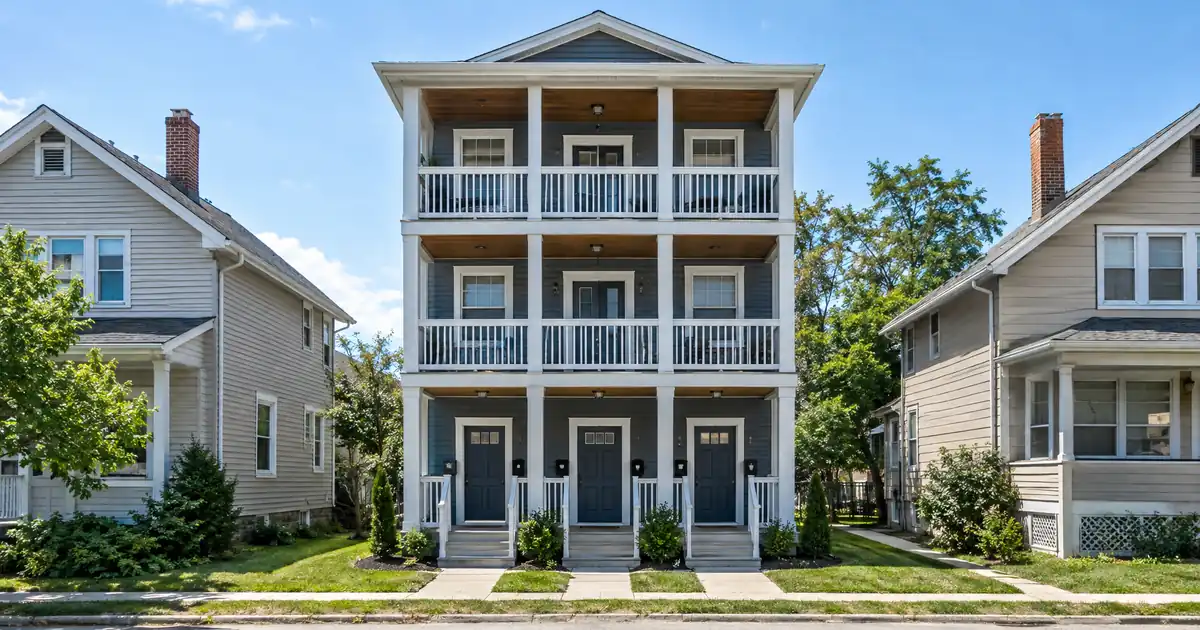
The Quick Read: Usually no. A conventional cash-out refinance on a 2-4 unit home you live in tops out at 75% loan-to-value, and mortgage insurance only applies above 80%. The cap sits below the trigger, so the insurance line never shows up on a standard cash-out. The cost lands elsewhere, in the pricing of the loan, and a lender can still add its own rules on top of the agency ones.
Why the Answer Is Usually No
The two numbers that matter are 75% and 80%. They never overlap on this loan.
Conventional loans sold to Fannie Mae or Freddie Mac need mortgage insurance when the first-lien balance is above 80% of the home’s value. Fannie Mae’s Selling Guide says so for first-lien loans it buys or securitizes. Freddie Mac’s Guide sets the same 80% line.
Now the cap. Across the wholesale programs placed through Lendmire’s lender network, a cash-out refinance on a two- to four-unit principal residence is limited to 75% LTV. A one-unit home you live in gets 80%. Fannie Mae’s Eligibility Matrix shows the same split between the one-unit and two-to-four-unit cash-out limits. Terms depend on the lender’s guidelines, the property type, the leverage, and a full review of the credit profile.
So the loan can’t be written high enough to need insurance. No PMI is required by the agencies at 75% or below. Say it that way, because a lender can add stricter rules of its own. Subject to lender guidelines and full file review, that is the baseline.
What Counts as “Cash-Out” Here?
The label decides everything, and it is where files go wrong.
A cash-out refinance pays off your current loan and gives you cash from equity, or lets you pay off other debt. A rate-and-term refinance, also called limited cash-out, only pays off the existing first mortgage, closing costs and any purchase-money second lien. You get only incidental cash back.
Those two products have very different ceilings. On the standard programs, a rate-and-term refinance can reach 95% on a one-unit principal residence, with mortgage insurance above 80%. Cash-out on a 2-4 unit stops at 75%.
If the file is classified as cash-out, you get the lower cap and no insurance line. If it is classified as limited cash-out at higher leverage, insurance applies. Decide which one you are doing before you talk numbers.
How Loan-to-Value Gets Figured
LTV is the loan amount divided by the home’s value. For a refinance, value comes from an appraisal or another method the investor accepts. Freddie Mac’s Guide divides the first-lien amount by the value.
Two practical points follow.
1. A second lien counts. The agencies apply the same ceiling to combined LTV, so a home equity loan or line you keep in place counts toward the limit.
2. The appraisal decides the cash. A low value shrinks the loan you can take. It can also push you under what it takes to pay off the old loan and roll in costs.
Does Unit Count Change the Answer?
No. Two, three and four units sit in the same bucket on a cash-out. All three get the 75% cap, so none of them reaches the 80% trigger.
| Property | Cash-out LTV cap | PMI on cash-out? |
|---|---|---|
| 1-unit principal residence | 80% | Not at or below 80% |
| 2-4 unit principal residence | 75% | No |
| Second home | 75% | No |
| Investment property | 75% | No |
For comparison, the purchase side reaches 95% on a two- to four-unit principal residence. That is where insurance matters on these properties. Occupancy sets the leverage. A home you live in is treated differently from a property you rent out, and the one-sentence takeaway is that living in a unit is what gets you the owner-occupied terms.
Where Mortgage Insurance Can Still Show Up
The word “usually” in the answer has edges. Here is where the general rule breaks.
Limited cash-out at high leverage. If you only want a rate-and-term refinance and the balance lands above 80%, insurance applies. The loan has not become a cash-out. It is a different product with a higher ceiling.
A purchase. If you are buying a 2-4 unit home with 5% down, insurance applies. Nothing about a cash-out changes that. The exact numbers vary by lender and program and follow a full review of property, leverage, and credit.
High-balance loans. Fannie Mae’s Selling Guide requires insurance on high-balance loans above 80% LTV. These loans have their own limit tables, so a high-cost-area file needs its own check. Final terms depend on the lender’s guidelines, the property type, and the borrower’s complete credit picture.
Lender overlays. An agency cap is a ceiling, not a promise. A lender can set a lower cash-out limit or a higher credit floor. Some lenders’ published matrices still show older or lower figures, which is why a quote from one lender can differ from another’s on the same home.
The Wholesale Lane That Skips Mortgage Insurance
One note belongs here for homeowners on a one-unit home. Across the programs placed through the wholesale network, one lane reaches 89.99% LTV with no mortgage insurance at a 680 score and a 50% ratio, on a thirty-year fixed, primary residence, conforming balance, with its own six months of seasoning. That lane is for a primary residence and is described here only for comparison. It does not extend the 2-4 unit cash-out cap, and Texas homestead cash-outs follow the state constitution’s limit, so that lane is not written there. Each figure is subject to lender guidelines and a complete review of property type, leverage, and credit.
Seasoning and Other Gates
Reaching the cap is only part of qualifying. The loan you are paying off must be at least 12 months old, counted note date to note date. At least one borrower must have been on title for 6 months. Exceptions exist for delayed financing, inheritance and legal awards.
Credit and ratios matter too. The wholesale conventional programs start at a 620 decision score, and the automated underwriting finding governs most files, with a total ratio ceiling of 50%. Manually underwritten loans use 36% or 45%, with reserve and score factors from the agency matrix. Reserves and credit scores tend to be stricter as leverage and unit count rise.
On a 2-4 unit, Freddie Mac says rental income from the other units can be added when figuring housing expense and debt-to-income. That is why an owner-occupied multi-unit can carry a higher payment than its owner’s paycheck alone would suggest.
Tax treatment can depend on your situation; borrowers should speak with a qualified tax professional before relying on any deduction or credit.
What You Pay Instead of PMI
No PMI does not mean no cost. A cash-out carries its own pricing. Freddie Mac applies a cash-out credit fee in the loan’s price, and a number-of-units adjustment can apply on 2-4 unit homes. Those adjustments show up in the rate or the closing costs, not as a separate insurance line.
The honest comparison runs like this. One option is extra cash, no PMI, a lower leverage cap and price adjustments. The other is higher leverage with PMI on a rate-and-term loan. Neither is free. Lendmire arranges the loan through wholesale lenders, and the Loan Estimate shows the real cost of each path before you commit.
A Worked Scenario, Without Dollar Figures
Picture a homeowner living in one unit of a fourplex, with the other three rented. The first mortgage was taken out several years ago, and the home has appreciated. They want cash for repairs on the building.
The loan can go up to 75% of the appraised value, and that figure includes any second lien they keep. If they owe 50% today, there is room for roughly another quarter of the value, less closing costs rolled in. If the appraisal comes in light, the room shrinks. No PMI applies because the total stays under 80%.
Now change one fact. The same owner wants only a lower payment and no cash. That is a rate-and-term loan with a higher ceiling, and if the new balance lands above 80%, insurance applies. The facts did not change. The product did.
What About the PMI You Already Have?
A cash-out refinance creates a new loan. The old loan, and the insurance attached to it, goes away at payoff. The CFPB explains that borrowers can request cancellation at 80% of the original value, subject to conditions, and that servicers must terminate it automatically at 78%. A refinance resets “original value,” so the clock starts over. If your new loan is under 80%, there is nothing to cancel.
One caution. The federal cancellation rules are written around single-family homes. Do not assume automatic termination rights apply to a 2-4 unit. Ask the servicer, and rely on the investor’s rules for the loan.
FHA mortgage insurance is a different system. It is not PMI, so keep the two separate.
Key Terms Defined
LTV (loan-to-value): The loan balance divided by the home’s value, shown as a percentage.
CLTV (combined loan-to-value): The same ratio, but counting every lien on the home, including a second mortgage.
PMI (private mortgage insurance): Insurance a conventional borrower pays when the loan is above 80% LTV, protecting the lender if the loan defaults. Leverage, reserves, and pricing vary by lender and program; the final terms follow the full file review.
Cash-out refinance: A new loan that pays off the old one and gives you part of your equity as cash.
Rate-and-term refinance: A refinance that only replaces the old loan and its costs, with minimal cash back. It is also called limited cash-out.
Seasoning: The minimum time you have owned the home or held the existing loan before a cash-out is allowed.
Which Situation Fits You?
- You want cash and live in the 2-4 unit. Expect the 75% cap and no PMI, subject to seasoning, credit and the appraisal.
- You want a lower payment, not cash. Compare the rate-and-term product, where leverage can go higher and insurance may apply.
- You want more cash than 75% allows. That is a limit, not a glitch. Look at a different structure, such as a smaller draw, or wait for equity to build.
- You moved out. Occupancy changes the category and the leverage. Raise it up front, because a rental has different limits.
If you are weighing a cash-out refinance against keeping the loan you have, Lendmire can help you compare the cash-out refinance programs and the equity each one reaches. For how reserves work when the building holds several rental units, Lendmire’s piece How Reserves Are Counted on a 2–4 Unit Rental Cash-Out Refinance covers the mechanics.
Frequently Asked Questions
Will I pay PMI if I take 75% cash-out on a duplex I live in?
No. Agency PMI rules start above 80% LTV, and 75% is below that line. Your lender can set stricter rules of its own, so confirm on the Loan Estimate. Pricing adjustments still apply and show up in the loan’s cost. Terms vary by lender guidelines, property type, leverage, credit profile, and full file review.
Is the cap really lower for a 2-4 unit than a single-family home?
Yes. A one-unit principal residence cash-out goes to 80%, while two to four units stop at 75%. The multi-unit cap is lower because the agencies treat the extra units as added risk.
Can I use rent from the other units to qualify?
Often, yes. Freddie Mac says rental income from the other units can be added to qualifying income when figuring housing expense and debt-to-income. How much counts depends on the lender’s documentation rules.
Does a rate-and-term refinance on a 2-4 unit need PMI?
It can, since that product allows higher leverage and mortgage insurance applies above 80% LTV. A cash-out stays under the trigger, which is the difference between the two loans. Exact terms depend on the lender’s guidelines, property type, leverage, and a full review of the borrower’s file.
What if my appraisal comes in low?
The loan amount shrinks to stay under the cap. That can reduce the cash you receive, or leave too little room to roll closing costs into the loan. A documented request to reconsider value can help if the comps support it.
For your own numbers, request a scenario review with Lendmire.
About Lendmire
Lendmire (NMLS# 2371349) is a mortgage broker licensed for consumer lending in 16 states. Lendmire arranges FHA, VA, conventional and jumbo purchase and refinance loans through wholesale lenders; every file is underwritten by the lender under the applicable program guidelines. Scotsman Guide named Lendmire a Top Mortgage Workplace in both 2025 and 2026.
For the program’s current guidelines, see conventional loan programs.
Get Started
Ready to find the right loan for you?
In about 30 seconds you can review financing options available for your home or investment property. No commitment required.
Informational only. Not a Loan Estimate, approval, or commitment to lend. Program availability and eligibility are subject to lender guidelines, credit approval, property review, and underwriting.
References
1. Fannie Mae Selling Guide: Provision of Mortgage Insurance
2. Freddie Mac Guide Section 4701.1
3. Fannie Mae Eligibility Matrix
4. Freddie Mac Guide Section 4203.1
5. Fannie Mae Selling Guide: High-Balance Pricing and Mortgage Insurance
6. Freddie Mac: Mortgages for 2- to 4-Unit Properties
7. CFPB: When can I remove PMI from my loan?
This article is part of Lendmire’s Conventional Loans series — every loan program’s qualification details, guidelines, and scenarios live on the loan options page.
Related reading: Conventional Cash-Out Refinance LTV Caps by Occupancy and Unit Count · Can You Get a Conventional Cash-Out on a Home in a Revocable Trust? · Does a Conventional Cash-Out Refinance Above the Cap Need PMI?
Brandon Miller
Founder & CEO, Mortgage Loan Originator, Lendmire LLC
- Mortgage Loan Originator · NMLS# 1129696 · Verify on NMLS Consumer Access
- North Carolina Real Estate Broker · License# 343312 · Verify on NCREC
- North Carolina Insurance Producer · License# 19053198 · Property, Casualty, Life, Health · Verify on NAIC SBS
- Lendmire LLC · Firm NMLS# 2371349 · Verify firm licensure
Legal disclosures. Lendmire (NMLS# 2371349) is a state-licensed mortgage brokerage that arranges financing through wholesale lender relationships. Lendmire is not a direct lender, depository institution, or registered financial advisor. The discussion above is general informational content about real estate financing — it is not financial, legal, or tax advice, and readers should consult licensed professionals for guidance on their individual circumstances. Loan inquiries are subject to lender underwriting; this article does not represent a commitment to lend. Loan terms, rates, and qualification standards vary by borrower, property, and state, and are subject to change at any time. Equal Housing Opportunity. NMLS Consumer Access: nmlsconsumeraccess.org.