
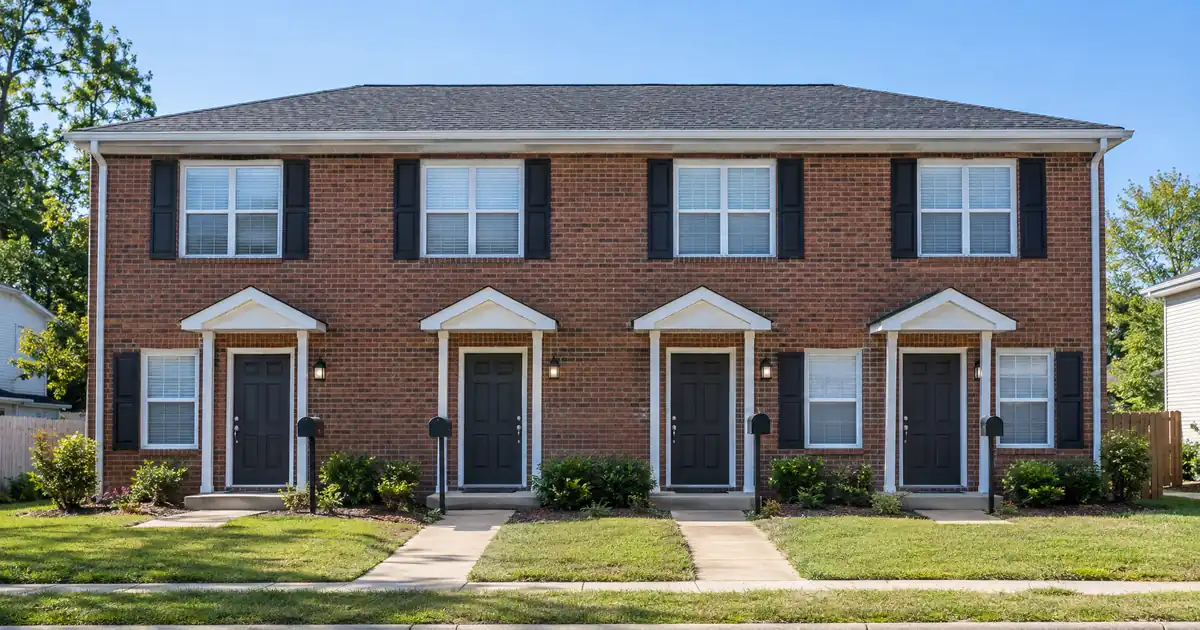
The Quick Read: The new loan can reach 100% of the building’s appraised value, and the funding fee counts inside that cap. The cash you receive is whatever is left after the old loan, the financed fee and your closing costs come out. Owning four units does not raise or lower that ceiling. It changes the appraisal, the income review and the occupancy rule, and those decide how close you get.
Key Takeaways
- The ceiling is the same on a fourplex as on a single-family home: 100% of appraised value, fee included.
- You must live in one of the four units. A fourplex you rent out entirely does not qualify.
- Cash released is a subtraction, not a percentage of equity. Fees and costs shrink it.
- Rent from the other units may help you qualify, but only a portion counts, and lenders may ask for reserves.
- At the ceiling, you keep no equity cushion. That is the real cost of “full value.”
What Does “Full Value” Actually Mean?
“Full value” means the appraised value, called reasonable value in VA terms. It does not mean your purchase price, a tax assessment or what a neighbor says the building is worth. The appraiser sets the number, and everything else is built on it.
Across the wholesale programs Lendmire places VA loans with, the VA cash-out refinance program reaches 100% of that appraised value. The financed funding fee sits inside that 100%. It does not stack on top.
So “full value” is a ceiling, not a payout. Many veterans receive less than the headline number suggests. The next sections show why.
The Cash-Released Formula
Here is the whole formula in one line:
Cash to you = new loan − payoff of existing liens − financed closing costs − any fee you pay in cash.
At full value, the new loan equals the appraised value. Whatever is owed on the building comes out first. That includes a first mortgage, a second lien or a home equity line. Then the funding fee and closing costs come out.
The funding fee on a cash-out refinance is 2.15% for first use and 3.3% for subsequent use. It is waived for veterans who receive compensation for a service-connected disability, and for other exempt groups. If you finance the fee, it adds to the loan. At the ceiling, there is no room above 100%, so a financed fee comes straight out of your proceeds. The federal rule says any fee that would push the loan over the cap must be paid in cash at closing. That rule appears in 38 CFR 36.4306.
A Fourplex Walk-Through in Percentages
Run the numbers on a fourplex appraised at 100% of value. Say the existing mortgage is 60% of that value. Gross equity is 40%.
Now subtract. A first-use fee is 2.15% of the loan, which at the ceiling is roughly 2% of value. A subsequent-use fee is 3.3%, so just over 3% of value. Then subtract closing costs, which vary by file. Net cash lands a bit under 40% of value, and it lands lower on subsequent use.
Change one input and the answer moves. A lower appraisal shrinks the ceiling. A larger payoff leaves less. An exempt veteran skips the fee entirely and keeps more.
| Step | What happens | Effect on your cash |
|---|---|---|
| Appraised value | Sets the 100% ceiling | Defines the maximum loan |
| Payoff | Existing liens retired | Largest deduction |
| Funding fee | 2.15% first use, 3.3% after | Reduces cash if financed |
| Closing costs | Paid from loan or out of pocket | Reduces cash or needs funds |
| Net check | What remains | Your released equity |
Does a Fourplex Change the Answer?
The ceiling stays put. The 100% cap and the net tangible benefit test apply to the loan, not to the number of units. A fourplex does not get a special investor rule. It is a primary-residence loan under normal VA rules.
Four things do change.
| Factor | Single-family | Fourplex |
|---|---|---|
| Ceiling | 100% of value | 100% of value |
| Occupancy | Live in the home | Live in one unit |
| Rent | Not used | A portion may help qualify |
| Appraisal | Home comps | Unit-by-unit review, rent opinion |
| Extra asks | Fewer | Reserves, lender overlays possible |
Rental income is the biggest difference. The appraiser typically gives an opinion of fair rent on the other units. A lender may count a discounted share of that rent, or of your existing leases, toward qualifying. It does not count in full. Rent also never replaces the underwriting of your own ability to repay.
Some lenders require reserves when rent is used, and they may not let cash-out proceeds count toward them. Others add a self-sufficiency test on three- and four-unit buildings, where the rent must cover the payment. That is a lender overlay, not a universal VA rule. Ask early which overlays apply before you assume a number.
Occupancy: You Have to Live There
VA’s cash-out page says you must live in the home being refinanced. On a fourplex, that means one of the four units is your residence. The other three can be rented.
This catches people. A veteran who bought a fourplex, moved out and rented all four units has an investment property. This benefit does not fit that file. The same is true if you live elsewhere and only collect rent.
Vacancy is a smaller wrinkle. An empty unit does not break eligibility, but every unit has to meet VA’s property standards at appraisal, vacant ones included. Expect repairs to matter. A unit with a failing roof or no working kitchen can hold up the whole file.
How the Appraiser Treats Four Units
Value is the main swing factor in this whole calculation. A fourplex is harder to appraise than a house because comparable sales are fewer. The appraiser weighs condition by unit, the rent each unit supports and recent sales of similar buildings.
If the value comes in short, your ceiling drops with it. Every point of lost value is a point of lost cash. You can scale the loan back to fit the number. You can also ask the lender about a reconsideration of value, which means giving the appraiser better comparable sales to review. It is not a guaranteed fix.
Where the Number Shrinks
Even at 100%, four things pull cash down.
The payoff. A building with a large balance, a second lien or a home equity line has less equity to release. Every lien has to be cleared.
The funding fee. First use costs less than subsequent use. Exempt veterans pay none. Check your Certificate of Eligibility (COE), which is the VA document that decides your eligibility.
Closing costs. These can be paid from the loan only if room exists under the cap. At full value, that room is gone, so you may pay them from the proceeds or out of pocket.
Lender-set limits. The VA ceiling is 100%, but a lender can choose to lend less. Some set a lower ceiling or a higher credit floor. The wholesale programs Lendmire places VA files with start at a 580 decision score. Lenders set their own, and a lower ceiling is a business choice, not a VA rule. Many borrowers hear “90%” and assume that is the VA cap. It is not.
State law is one more variable. Some states limit how much you can borrow against a home. Ask about it before you plan around the full number.
What Is the Equity Left Behind?
At the ceiling, you own none of the building’s value on paper. Your cushion is zero. If prices drop, the loan can end up larger than the property. That limits your options if you need to sell or refinance again.
The monthly picture changes too. A bigger balance means a bigger payment, and that payment must pass underwriting even after the rent credit. Vacancy on the other three units is a real risk, because your budget leans on that income.
Many borrowers choose a loan well under the ceiling for exactly this reason. The rules allow 100%, but you do not have to use it.
How the Loan Is Underwritten, Step by Step
1. Certificate of Eligibility. VA’s COE confirms your service and entitlement. Entitlement is the portion of the benefit VA stands behind. If an existing VA loan is on the building, your remaining entitlement matters.
2. Seasoning check. The loan you are replacing must be seasoned. That means the later of 210 days from the first payment and the sixth monthly payment. VA Circular 26-19-05 sets this condition.
3. Appraisal. VA’s appraiser sets reasonable value and, on a multi-unit, the fair rent.
4. Net tangible benefit. The new loan has to help you in a measurable way, such as a lower payment, a shorter term, a switch from adjustable to fixed or higher monthly residual income. The lender must give you a comparison of the old and new loans.
5. Underwriting. Residual income is the controlling test. That is the money left each month after major obligations and living costs. The 41% debt-to-income figure is a guideline, not a cap. A ratio above it needs residual income well above the table.
6. Disclosures. You get a Loan Estimate and a Closing Disclosure. The final numbers appear on the second one, so read it line by line.
A non-VA loan can also be refinanced into a VA loan. If you have an FHA or conventional mortgage on the fourplex, moving to VA can drop monthly mortgage insurance. That is one way to meet the net tangible benefit test.
Cash-Out, IRRRL or Keep What You Have?
| Option | Cash out? | Appraisal? | Fits when |
|---|---|---|---|
| VA cash-out | Yes, to 100% of value | Yes | You need equity released |
| IRRRL | No | No | You have a VA loan and want better terms |
| Keep current loan | No | No | The numbers do not help you |
The IRRRL, VA’s streamlined refinance, cannot release cash. It is for an existing VA loan and carries a 0.5% fee unless exempt. If you only want a different term, it can be simpler than a cash-out. If you want money out, a cash-out is the tool.
What to Gather Before You Apply
- Your Certificate of Eligibility
- A current mortgage statement and any second-lien or line statements
- Current leases and a rent roll for the other units
- Proof of the unit you live in
- Two recent months of bank statements, to show reserves
- Basic income and credit documents
Frequently Asked Questions
Can I take cash out of a fourplex if I rent all four units?
No. VA requires you to live in the home you are refinancing. One of the four units must be your residence. A fully rented building is an investment property and does not fit this benefit.
Does the VA limit how much I can borrow on a fourplex?
The ceiling is 100% of appraised value, the same as a single-family home. With full entitlement there is no VA loan limit. Lenders can set stricter limits of their own, so the amount you are offered may be lower.
Will the rent from my other units count toward qualifying?
A portion may. Lenders typically discount rent rather than count all of it. Some also ask for reserves or apply a self-sufficiency test on three- and four-unit buildings. These details vary by lender and are subject to full file review.
Does the funding fee come out of my cash?
Yes, if you finance it at the ceiling. The loan cannot exceed 100% of value, so the fee reduces your proceeds. Exempt veterans are not charged the fee, so it does not apply to their loans.
Can I refinance a non-VA loan into a VA cash-out on my fourplex?
Yes. VA allows a non-VA loan to be refinanced into a VA-backed loan, and doing so can remove monthly mortgage insurance. The loan still has to pass the net tangible benefit test and the seasoning rules.
Next Step
If you are weighing a cash-out refinance against keeping the loan you have, Lendmire can help you compare the programs and the equity each one reaches. Program figures are subject to lender guidelines and full file review, and nothing here is a commitment to lend. A fourplex rewards a careful look at the appraisal and the occupancy rules before you pick a number.
For your own numbers, request a scenario review with Lendmire.
About Lendmire
Lendmire — NMLS# 2371349 — is a mortgage broker that arranges FHA, VA, conventional and jumbo home purchase and refinance financing in 16 states through wholesale lenders. Every option is subject to the lender’s guidelines and full underwriting. Scotsman Guide named Lendmire a Top Mortgage Workplace in both 2025 and 2026.
Get Started
Ready to find the right loan for you?
In about 30 seconds you can review financing options available for your home or investment property. No commitment required.
Informational only. Not a Loan Estimate, approval, or commitment to lend. Program availability and eligibility are subject to lender guidelines, credit approval, property review, and underwriting.
References
2. VA.gov, Cash-out refinance loan
This article is part of Lendmire’s VA Loans series — every loan program’s qualification details, guidelines, and scenarios live on the loan options page.
Related reading: Can a Veteran Get a Full-Value VA Cash-Out If the Lender Capped It? · Does the VA Full-Value Cap Beat Conventional Cash-Out on High Equity? · How Much Cash the VA Full-Value Cap Releases on a High-Equity Home
Brandon Miller
Founder & CEO, Mortgage Loan Originator, Lendmire LLC
- Mortgage Loan Originator · NMLS# 1129696 · Verify on NMLS Consumer Access
- North Carolina Real Estate Broker · License# 343312 · Verify on NCREC
- North Carolina Insurance Producer · License# 19053198 · Property, Casualty, Life, Health · Verify on NAIC SBS
- Lendmire LLC · Firm NMLS# 2371349 · Verify firm licensure
Legal disclosures. Lendmire (NMLS# 2371349) is a state-licensed mortgage brokerage that arranges financing through wholesale lender relationships. Lendmire is not a direct lender, depository institution, or registered financial advisor. The discussion above is general informational content about real estate financing — it is not financial, legal, or tax advice, and readers should consult licensed professionals for guidance on their individual circumstances. Loan inquiries are subject to lender underwriting; this article does not represent a commitment to lend. Loan terms, rates, and qualification standards vary by borrower, property, and state, and are subject to change at any time. Equal Housing Opportunity. NMLS Consumer Access: nmlsconsumeraccess.org.