
The Quick Read: The cash you receive is the new loan minus what must be paid off, and that loan is capped at 80% of the appraised value. Equity sets only the ceiling. On a triplex, two more tests can shrink the number: your personal debt-to-income ratio and a rent test on the building. Whichever binds first decides your release.
What “Released” Means on a Triplex
“Released” means the cash that reaches your hands at closing. It is not the same as your equity, and it is not the same as the largest loan the building could support.
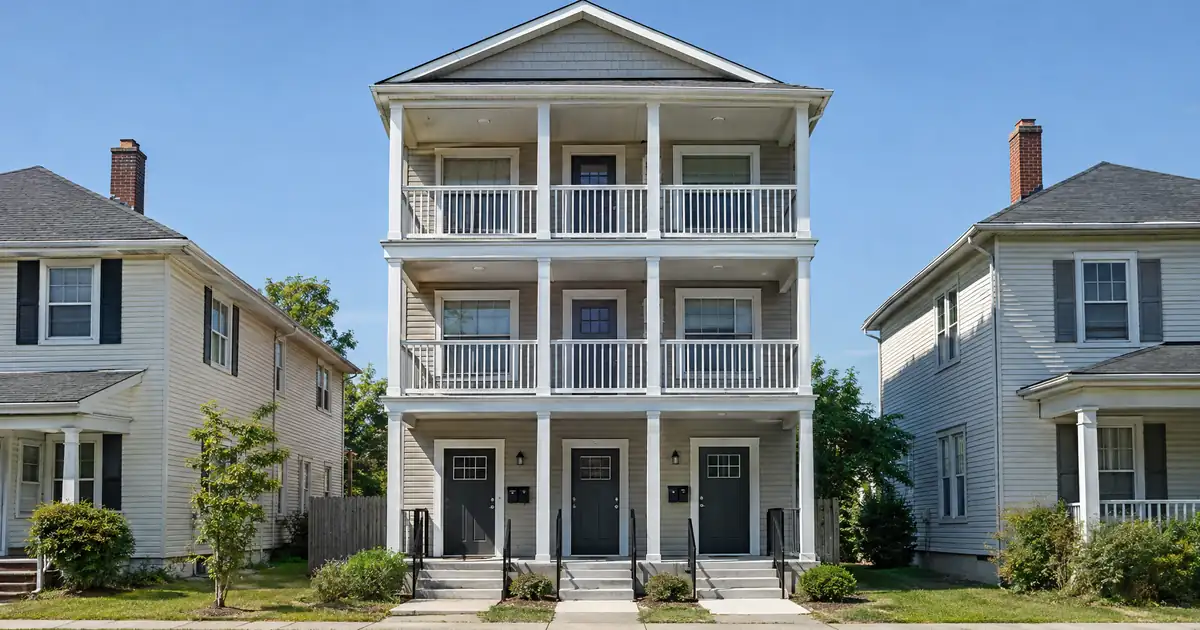
Say you live in one unit of a three-unit building and want cash for repairs or to clear other debts. The lender starts with the appraised value, applies the cap, and subtracts everything that has to be paid first. What remains is your cash. It is a leftover, not a set percentage of the value.
Through the wholesale lenders Lendmire works with, the FHA cash-out reaches 80% LTV on a home you have owned and occupied for 12 months before the case number. Subject to lender guidelines and full file review, that rule applies to a triplex the same way it applies to a single-family home. The unit count does not lower the cap. It adds an extra test, covered below.
LTV means loan-to-value: the loan balance divided by the home’s appraised value.
The Release Formula, Step by Step
The release is a waterfall. Each step takes a bite out of the ceiling before you see a dollar.
1. Value. An FHA-roster appraiser gives an opinion of value. HUD’s glossary describes this appraiser as someone who observes, analyzes, and reports the physical and economic characteristics of a property. On a triplex, the appraisal also supplies a market-rent opinion for the rent test.
2. Cap. Multiply the value by 80%. That is the most total debt the home can carry. HUD lowered this limit from a higher percentage in Mortgagee Letter 2019-11.
3. Subtract the payoff. Your existing first mortgage comes out first. So does any other lien you must clear.
4. Subtract financed costs. The upfront mortgage insurance premium is a percentage of the base loan, and it can be financed. Financed items sit inside the cap, so they reduce your net cash.
5. Receive the residual. What is left is what you can take, provided the two other tests pass.
A quick picture, in percentages only. Suppose the cap allows debt equal to 80% of value, and your current mortgage already equals 60% of value. The gap is 20 points of value, before the insurance premium and other costs shrink it. A home owned free and clear has no payoff to subtract, so more of the cap reaches you. HUD’s older reference guide on refinances confirms that properties owned free and clear can be refinanced as cash-out transactions.
The cap also covers any second mortgage. HUD’s Handbook defines combined LTV as the base loan plus the balances of all subordinate liens, divided by the adjusted value. Keep a second lien in place and it eats into the same 80%.
Gate One: The Property Ceiling
The ceiling is the appraisal times 80%. Everything else works downward from it.
A low appraisal hits hard. Every point of value you lose shrinks the cap, while your payoff stays fixed. That is why the cash released can swing so much between two homes with similar equity on paper.
Two edge cases deserve a mention. Mortgages insured under Section 247 are outside the 80% policy. And FHA’s single-family programs generally cover one- to four-unit properties that are owner-occupied principal residences, per HUD’s Handbook 4000.1 drafting materials. A triplex fits. A building with significant non-residential space needs a case-by-case look.
Gate Two: High DTI on an Owner-Occupied Triplex
A high DTI does not automatically block an FHA cash-out, but it does shrink the safe size of the loan. A bigger loan means a bigger payment, and the new payment replaces the old one in your ratio.
DTI is debt-to-income: your monthly debt payments divided by your gross monthly income. The CFPB notes that different loan products and lenders set different limits.
Here is how it works across the wholesale programs I place FHA files with. The base pair is 31/43. The first number is housing cost against income. The second is total debt against income. With documented compensating factors, such as strong reserves or a solid payment history, the ceiling reaches 40/50 at the top tier. The automated underwriting finding governs most files. A lender can also set stricter limits than FHA does, so two lenders can answer differently on the same file.
The 43% figure is not a wall. The CFPB’s original ability-to-repay summary used 43% as a general back-end test. It also acknowledged that many consumers can afford a ratio above that. FHA-insured loans were later treated differently from that general rule.
Two moves help the ratio on a cash-out:
- Pay debts off at closing. Debts cleared with the proceeds leave your ratio. But the larger loan raises the new payment, so the net effect depends on the balance between the two.
- Add a co-borrower, but only an occupant. HUD’s cash-out letter bars non-occupant co-borrowers on FHA cash-outs, so a relative who lives elsewhere cannot fix your ratio. This is stricter than on an FHA purchase.
Thin budgets carry real risk. Dallas Fed research found that borrowers with DTIs above 43% have little leeway if income drops. Taking less cash than the maximum is often the wiser file.
Gate Three: The Rent Test for Three and Four Units
Triplexes face one extra test that duplexes and single-family homes do not. It checks whether the building can carry its own payment.
HUD’s cash-out guidance states that the self-sufficiency test for three- and four-unit properties remains in effect. In plain terms, the appraiser’s market-rent opinion is discounted for vacancy and costs, then compared with the full housing payment. The discount is steep, and the exact percentage should be confirmed with your loan officer against current FHA policy. Older HUD reference material also lists a reserve requirement for three- and four-unit properties. Reserve rules have changed over time, so confirm the current one before you plan around it. Final terms depend on the lender’s guidelines, the property type, and the borrower’s complete credit picture.
The two tests measure different things. DTI measures your household. The rent test measures the building.
| Factor | DTI gate | Rent-test gate |
|---|---|---|
| What it measures | Your household | The building |
| Whose numbers | Your income and debts | Appraiser’s market rents |
| Applies to | Every FHA cash-out | Three- and four-unit homes |
| Effect of bigger loan | Payment rises, ratio rises | Payment rises, test gets harder |
Many borrowers assume the other two units’ rent simply adds to income. It does not. Rent is discounted and tested at the property level.
Which Gate Binds First?
Run each file through all three gates, and the tightest one sets your release. Here is how common situations play out.
| Your file | What binds | Effect on cash released |
|---|---|---|
| High DTI, strong rents | DTI | Release shrinks to fit the ratio |
| Low DTI, weak rents | Rent test | Release shrinks until the building covers the payment |
| Both tight | Both | Smallest release, or no release |
| Both clear | The 80% cap | Release equals cap minus payoffs and costs |
Across files like this, a high-DTI triplex owner often hits the DTI gate first and assumes the rent test is irrelevant. It is not. A larger loan pushes both tests at once, so trimming the cash-out helps on both fronts.
Levers That Raise the Release
You have several ways to improve a stretched file. Their effects differ.
| Lever | What changes | Effect on release |
|---|---|---|
| Pay off debts at closing | Removes those payments from DTI | Helps ratio, which can raise the amount you qualify to release |
| Take less cash | Smaller loan, smaller payment | Helps both DTI and the rent test |
| Pay down balances beforehand | Lowers debt without using proceeds | Keeps more of the cash |
| Raise your credit score | Can improve the automated finding | May widen what is allowed |
| Add occupant co-borrower | Adds income to the file | Helps DTI only |
| Build reserves | Acts as a compensating factor | Supports higher ratios |
Paying down a debt and paying it off are different. A paydown before closing uses your own cash. A payoff at closing uses the proceeds, so it lowers the cash you walk away with. Neither is better in every case.
Cost Drag: Mortgage Insurance and Closing Costs
FHA mortgage insurance has two parts. The upfront premium is 1.75% of the base loan, and it is usually financed. The annual premium ranges from 0.15% to 0.75% of the balance, depending on term, loan amount, and LTV. On a thirty-year loan above 90% LTV, the annual premium lasts for the term. At 90% LTV or below, it ends after eleven years. Because cash-out loans are capped at 80%, that lower threshold matters.
HUD cut annual premiums in Mortgagee Letter 2023-05, per the housing finance association NCSHA. Check the current HUD letter for today’s tiers.
Financed costs count inside the 80% cap. Every point financed is a point of cash you do not receive.
If the File Doesn’t Fit
A failed file is a starting point, not a verdict. Here is the order I usually try.
1. Trim the cash-out. This eases DTI and the rent test together.
2. Pay down debts or build reserves before applying again.
3. Look at a rate-and-term refinance. It reaches higher leverage (97.75% on a principal residence occupied for the prior twelve months), though it releases no cash.
4. Consider an FHA Streamline if your current loan is already FHA. It needs no appraisal and a limited credit review, but it must show a net tangible benefit and releases no cash either.
5. Compare with other programs. Conventional and VA cash-outs have different caps and ratio rules.
Lendmire’s FHA cash-out refinance program page lays out the basics. Two related pieces dig into specific angles: how much monthly payment an FHA cash-out frees with a high DTI, and how much debt an FHA cash-out can clear before a high DTI stops it.
Tax treatment can depend on your situation; borrowers should speak with a qualified tax professional before relying on any deduction or credit.
Key Terms Defined
DTI (debt-to-income): Your monthly debt payments divided by your gross monthly income.
LTV (loan-to-value): The loan balance divided by the home’s appraised value.
Combined LTV: The first mortgage plus all other liens, divided by value.
Self-sufficiency test: An FHA check that a three- or four-unit building’s discounted rents can carry its own housing payment.
Compensating factors: Documented strengths, such as reserves or a clean payment history, that can support higher ratios.
Seasoning: The required time you have owned and lived in the home before a cash-out.
Frequently Asked Questions
Can I do an FHA cash-out on a triplex?
Yes, if you live in one unit as your principal residence and have owned and occupied it for 12 months before the case number. The loan is capped at 80% LTV, and the building must also pass the rent test. All of this is subject to lender guidelines and full file review.
Does rent from the other units count toward my DTI?
Not as a simple add-on. Rent is discounted and tested at the building level in the self-sufficiency test. How a lender treats it in your income calculation depends on lender guidelines, so ask for it to be walked through on your file.
Does paying off debt at closing help?
It can help, since debts cleared with the proceeds leave your ratio, but the larger loan raises your new payment. The net result depends on how large the debts are compared with the added loan balance.
What if I fail the rent test?
Usually the fix is a smaller loan. A lower cash-out means a lower payment, which makes the rent test easier to pass. A rate-and-term refinance or a different program may also be worth comparing.
Can a relative who doesn’t live with me co-sign?
No. HUD’s cash-out guidance requires any co-borrower added to the note to be an occupant of the property. A non-occupant cannot be added to meet credit underwriting guidelines.
For your own numbers, request a scenario review with Lendmire.
About Lendmire
Lendmire, NMLS# 2371349, is a mortgage brokerage with consumer lending licenses in 16 states. FHA, VA, conventional and jumbo purchase and refinance loans are arranged through wholesale lending partners, and each application is reviewed individually by the lender. Scotsman Guide named Lendmire a Top Mortgage Workplace in both 2025 and 2026.
For the program’s current guidelines, see FHA loan programs.
Get Started
Ready to find the right loan for you?
In about 30 seconds you can review financing options available for your home or investment property. No commitment required.
Informational only. Not a Loan Estimate, approval, or commitment to lend. Program availability and eligibility are subject to lender guidelines, credit approval, property review, and underwriting.
References
1. HUD Handbook 4000.1 Glossary
2. HUD Mortgagee Letter 2019-11
3. HUD HOC Reference Guide, Refinances
4. HUD’s Handbook 4000.1 drafting materials
5. CFPB: What is a debt-to-income ratio?
6. CFPB Ability-to-Repay and QM summary
This article is part of Lendmire’s FHA Loan series — every loan program’s qualification details, guidelines, and scenarios live on the loan options page.
Related reading: How Much a High-Cost Closing State Like Florida Adds to an FHA Cash-Out · How to Get an FHA Cash-Out After a Quitclaim From a Parent · How Much the Upfront Premium Cuts an FHA Cash-Out at the County Limit
Brandon Miller
Founder & CEO, Mortgage Loan Originator, Lendmire LLC
- Mortgage Loan Originator · NMLS# 1129696 · Verify on NMLS Consumer Access
- North Carolina Real Estate Broker · License# 343312 · Verify on NCREC
- North Carolina Insurance Producer · License# 19053198 · Property, Casualty, Life, Health · Verify on NAIC SBS
- Lendmire LLC · Firm NMLS# 2371349 · Verify firm licensure
Required disclosures. Lendmire (NMLS# 2371349) operates as a licensed mortgage broker, not a direct lender or depository. The discussion in this article is general in nature and should not be relied upon as financial, legal, or tax advice — every investment scenario is unique and should be reviewed by a qualified professional. Any loan inquiry is subject to lender underwriting, and this article is not a commitment to lend or a guarantee of approval. Mortgage rates, loan terms, and program guidelines vary by borrower, property, and state, and may change without notice. Equal Housing Opportunity. Verify licensure at NMLS Consumer Access.