
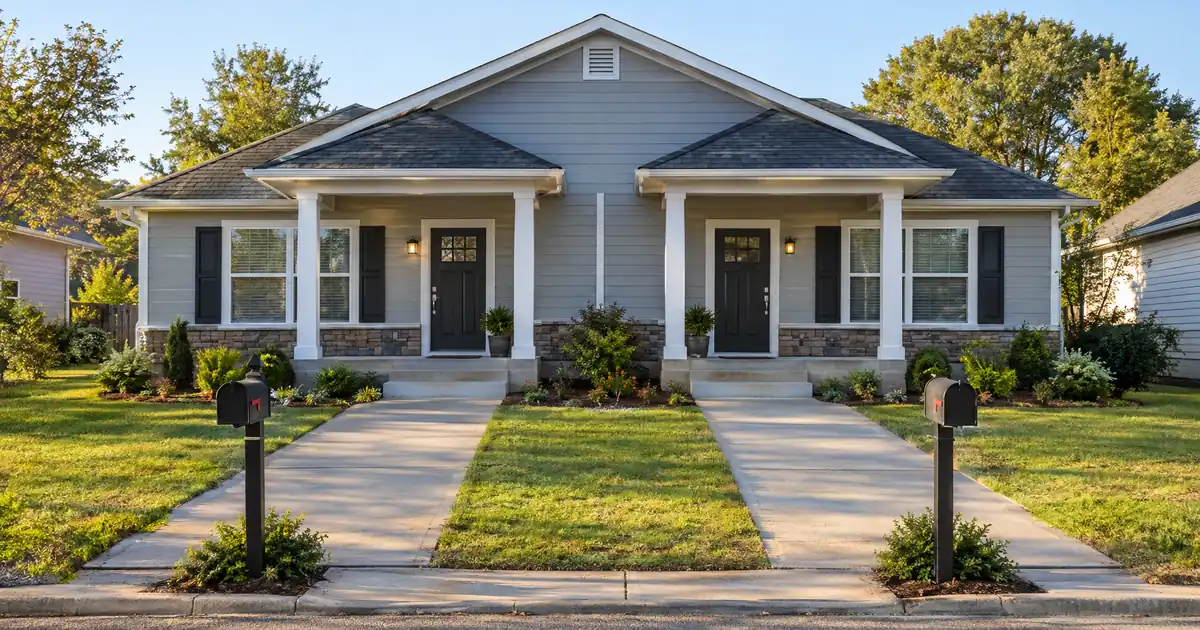
The Quick Read: Yes, in part. When you own and live in a duplex, FHA lets the lender count rent from the other unit as income, but only a portion of it, and it is added to your income rather than subtracted from your payment. It improves the income side of the ratio. It does not lift the 80% leverage cap, and it does not rescue a file that fails on credit, documentation or the appraisal. Final terms depend on the lender’s guidelines, the property type, and the borrower’s complete credit picture.
What Does “Counts as Income” Actually Mean?
Rent is added to your gross income. It is never used to shrink the mortgage payment.
HUD’s Mortgagee Letter 2023-17 allows net rental income from the subject property to be used as effective income when the home is a two- to four-unit dwelling. The lender adds that net figure to your gross monthly income. The same letter bars the lender from reducing your total mortgage payment by the rent.
That distinction trips up a lot of borrowers. They think a $1 rent credit lowers the payment by $1. It doesn’t. The full new payment, including mortgage insurance, taxes and homeowner’s insurance, sits on the housing side of the ratio. The rent shows up only in the denominator, as income.
Two things follow:
- The payment side stays heavy. A cash-out loan is larger than your current balance, so the payment usually goes up.
- The income side grows by less than the rent, because the lender doesn’t credit all of it.
How Much of the Rent Gets Credited?
Roughly three-quarters, and only of the lower of two numbers.
Under the same HUD letter, the lender uses 75% of the lesser of the appraiser’s fair market rent or the rent shown in the lease. The haircut stands in for vacancy and upkeep. The “lesser of” test means a generous lease doesn’t help if the appraiser’s market rent comes in lower.
Where you have limited or no rental history on the property, the appraisal must include a rent schedule. On a duplex, that means the small residential income property report, not the standard single-family form. Any prospective lease can be added to the file.
Where you do have history, the lender looks at traditional personal-income documentation instead. The letter describes using the last two years of returns with Schedule E, with listed add-backs and deductions. Tax-return rent tends to be lower than the lease on the table, because expenses come off. That gap surprises people. Tell your loan officer early which route your file will take.
Does Rent Fix a High DTI?
Sometimes it moves the ratio enough. Rarely does it do the whole job.
Run it as a modeled example, not a market fact. Say a borrower’s total ratio sits well above the standard 31/43 pair, because the new cash-out payment is large and several debts remain. Adding credited rent raises income by a modest slice. The total ratio drops, perhaps a few points. If the file was one point over, that can be enough. If it was ten points over, it isn’t.
Across the wholesale programs placed through Lendmire’s network, the standard FHA pair is 31/43 (housing over total) with no compensating factors. Documented compensating factors can push that to 40/50 at the top tier. The automated underwriting finding governs most files, and a lender can add its own overlays on top of HUD’s rules, so two lenders can read the same file differently. Reserves, a strong score and stable employment are the factors that tend to carry a stretched ratio.
Here is the honest read: rent is one lever. Stack it with other levers and it can matter. Alone, it usually doesn’t.
What Limits Stay the Same No Matter What the Rent Is?
Leverage, occupancy and county limits don’t move.
The 80% cap. The FHA cash-out reaches 80% loan-to-value on a home you’ve owned and occupied for 12 months before the case number is assigned. HUD lowered the cap in Mortgagee Letter 2019-11, and its press release on the change says the move aligned FHA with the maximum used by the government-sponsored enterprises. Rent has no effect on that number. The appraisal sets value, the cap sets the loan, and the new first mortgage plus any remaining liens count toward it.
County loan limits. FHA limits are set by county and change every year. On a higher-priced duplex, the county limit for the unit count can bind before the 80% cap does.
Occupancy. FHA cash-out is for your principal residence. If you’ve moved out and rent every unit, the file is outside this program. A duplex where you live in one side and rent the other is the fit.
Reserves on 3-4 units. Three- and four-unit properties require reserves equal to three months of housing payment after closing, per the HUD letter. A duplex is simpler. A further self-sufficiency test is commonly applied to 3-4 units, so confirm it with the lender if you own one.
Key Terms Defined
Back-end ratio: Your total monthly debts, including the new housing payment, divided by gross monthly income.
Front-end ratio: Your new housing payment alone divided by gross monthly income.
Effective income: The income a lender is allowed to count after the program’s rules and haircuts.
Compensating factors: Documented strengths, such as cash reserves or a strong score, that support a higher ratio.
Schedule E: The tax form where rental income and expenses are reported.
Fair market rent: The rent an appraiser says the unit would bring in the open market.
How the Pieces Stack in One Modeled File
Picture a borrower who lives in one side of a duplex and rents the other. The ratio is stretched. Here is how the levers line up, in the order they usually matter.
| Step | What changes | Effect on the ratio |
|---|---|---|
| Starting file | New cash-out payment, all debts remain | Highest total ratio |
| Add credited rent | 75% of the lesser rent added to income | Lower, by a modest amount |
| Pay off debts at closing | Proceeds retire monthly obligations | Lower, often the largest drop |
| Take a smaller cash-out | Smaller loan, smaller payment | Lower, with less cash in hand |
| Add documented reserves | Compensating factor, no ratio change | Supports a higher ceiling |
This table is a model of how the levers interact, not a prediction for any file. Paying off debts from proceeds usually does more for the ratio than the rent does, because it removes a payment instead of adding a haircut slice of income. The catch: the debts must be paid at closing, and the new loan is secured by your home. The CFPB’s research on cash-out refinances and non-mortgage debt notes that rolling unsecured debt into a mortgage can put the home at risk of foreclosure if payments stop. Defaulting on a credit card is unlikely to cost you the house. Defaulting on the mortgage can.
What Documents Prove the Rent?
Thin rent documentation is a common reason duplex files stall. Gather these before the file goes in:
- Signed leases for the rented unit, current and complete.
- Your last two years of traditional personal-income documentation with Schedule E, if the unit has been rented that long.
- The deed or closing paperwork showing when you acquired the property, if you’ve owned it under two years.
- Proof of how the rent is actually received, such as deposits.
- A clear statement of which unit you occupy.
The appraisal then adds its own rent schedule. When the appraiser’s rent and your lease disagree, the lower number wins. If your lease is far below market, expect that. If it’s far above, expect the haircut to land on the appraiser’s figure.
Commercial space doesn’t count. HUD’s letter says no commercial-space income may be included in the rental calculation. A storefront under an apartment adds nothing to your qualifying income.
What About Boarders, ADUs and Co-Borrowers?
These are the edge cases that cause the most confusion.
ADUs. A one-unit home with an accessory dwelling unit is still a one-unit property. Under the handbook text, ADU rent can’t be used as income on a cash-out refinance. It can be used on other transaction types, capped at 30% of total effective income. A duplex is a different property type, so don’t assume the ADU rule applies to it, and don’t assume the reverse.
Boarders. HUD’s Mortgagee Letter 2025-04 covers boarder income in your own dwelling. It requires a 12-month history, evidence of receipt in at least nine of the last 12 months, a matching address and a written agreement.
Co-borrowers. A co-borrower who doesn’t live in the home can’t help you on a cash-out. Non-occupant income isn’t usable for this transaction, even though a non-occupant co-borrower is allowed on an FHA purchase. People get this backwards.
When Is a Different Route the Better Move?
If you already hold an FHA loan, a Streamline refinance involves no appraisal and a limited credit review, but it isn’t a cash-out. You need a net tangible benefit, and the mortgage insurance premium continues. If the goal is cash, the full cash-out with its appraisal and 80% cap is the product.
If you have a low existing first mortgage, a cash-out replaces it with a larger new loan. The CFPB’s guide to using home equity says a cash-out replaces your current loan, the payment may rise, and the terms change. A home equity loan or line leaves the first mortgage in place, which can matter a great deal.
Mortgage insurance applies to the whole new loan. The upfront premium is 1.75% of the base loan, financed into the balance. The annual premium falls between 0.15% and 0.75% of the balance, depending on term, loan amount and LTV. At 80% LTV on a thirty-year loan, the annual premium ends after eleven years. Those are program mechanics, not prices, and they go into the payment on the housing side of the ratio. Each figure is subject to lender guidelines and a complete review of property type, leverage, and credit.
Experience note: on duplex cash-out files, the surprise is rarely the rent math. It’s a vacant unit at appraisal, a lease that doesn’t match the tax return, or a payment that grew more than the borrower expected. Fixing those before the file goes in beats explaining them after.
Reading a Denial
| Denial reason | What it usually means | Typical fix |
|---|---|---|
| Ratio too high | Payment plus debts outrun credited income | Pay off debts, reduce cash-out |
| Rent not supported | Lease, return and appraisal don’t agree | Reconcile documents, fresh lease |
| Value short | Appraisal under the 80% cap | Smaller loan, wait |
| Occupancy | Not owned and lived in for 12 months | Wait for seasoning |
| Reserves | Short on 3-4 unit requirement | Document more assets |
Not every denial is fixable. If the ratio fails with rent, payoffs and a smaller loan all applied, the honest answer may be to keep the loan you have.
When Not to Borrow
Skip the cash-out if the payment only works on paper. Rent is not guaranteed. The 75% factor is a qualifying convention, but vacancies, repairs and turnover are yours. If the new payment depends on every dollar of rent arriving, the plan is thin. Tax treatment can depend on your situation; borrowers should speak with a qualified tax professional before relying on any deduction or credit.
Frequently Asked Questions
Can I use the rent from the unit I live in?
No. You can’t charge yourself rent. Only the rented units count, and only under the 75% rule. The unit you occupy adds nothing to qualifying income.
Does the lease or the appraisal decide the rent used?
Whichever is lower. HUD’s letter uses 75% of the lesser of the appraiser’s market rent or the lease rent. A lease signed above market doesn’t raise the credit.
Can I do an FHA cash-out if I’ve moved out and rent both sides?
No. FHA cash-out is for a principal residence. A home you no longer occupy, with every unit rented, falls outside the program. Occupancy decides the leverage.
Is there one maximum DTI for FHA?
No. The base pair is 31/43, documented compensating factors can reach 40/50 at the top tier, and the automated finding governs most files. Lenders can add overlays, so the ceiling varies by lender, subject to lender guidelines and full file review.
What credit score does the network require?
Wholesale programs Lendmire places FHA loans with start at a 580 decision score. HUD has a lower tier, but the network doesn’t reach below 580. Nothing here is a commitment to lend.
What the Next Step Looks Like
Start by deciding whether your ratio problem is a payment problem or an income problem. Rent helps the second. Payoffs and a smaller loan help the first. Lendmire’s FHA cash-out refinance program page lays out the structure. If you are weighing a cash-out refinance against keeping the loan you have, Lendmire can help you compare the programs and the equity each one reaches.
For your own numbers, request a scenario review with Lendmire.
About Lendmire
Lendmire is a mortgage brokerage (NMLS# 2371349) licensed for consumer mortgage lending in 16 states, arranging FHA, VA, conventional and jumbo purchase and refinance loans through a wholesale lending network. Eligibility is determined by the lender on each file. Scotsman Guide named Lendmire a Top Mortgage Workplace in both 2025 and 2026.
Get Started
Ready to find the right loan for you?
In about 30 seconds you can review financing options available for your home or investment property. No commitment required.
Informational only. Not a Loan Estimate, approval, or commitment to lend. Program availability and eligibility are subject to lender guidelines, credit approval, property review, and underwriting.
References
1. HUD Mortgagee Letter 2023-17
2. HUD Mortgagee Letter 2019-11
3. HUD press release on cash-out refinance risk
4. CFPB research on cash-out refinances and non-mortgage debt
5. HUD Mortgagee Letter 2025-04
6. CFPB guide to using home equity
This article is part of Lendmire’s FHA Loan series — every loan program’s qualification details, guidelines, and scenarios live on the loan options page.
Related reading: How to Prepare a Condo for an FHA Cash-Out Appraisal · FHA Cash-Out Income Documentation by Borrower Type and Income Source · Conventional Cash-Out vs FHA Cash-Out on a Condo
Brandon Miller
Founder & CEO, Mortgage Loan Originator, Lendmire LLC
- Mortgage Loan Originator · NMLS# 1129696 · Verify on NMLS Consumer Access
- North Carolina Real Estate Broker · License# 343312 · Verify on NCREC
- North Carolina Insurance Producer · License# 19053198 · Property, Casualty, Life, Health · Verify on NAIC SBS
- Lendmire LLC · Firm NMLS# 2371349 · Verify firm licensure
Legal disclosures. Lendmire (NMLS# 2371349) is a state-licensed mortgage brokerage that arranges financing through wholesale lender relationships. Lendmire is not a direct lender, depository institution, or registered financial advisor. The discussion above is general informational content about real estate financing — it is not financial, legal, or tax advice, and readers should consult licensed professionals for guidance on their individual circumstances. Loan inquiries are subject to lender underwriting; this article does not represent a commitment to lend. Loan terms, rates, and qualification standards vary by borrower, property, and state, and are subject to change at any time. Equal Housing Opportunity. NMLS Consumer Access: nmlsconsumeraccess.org.