
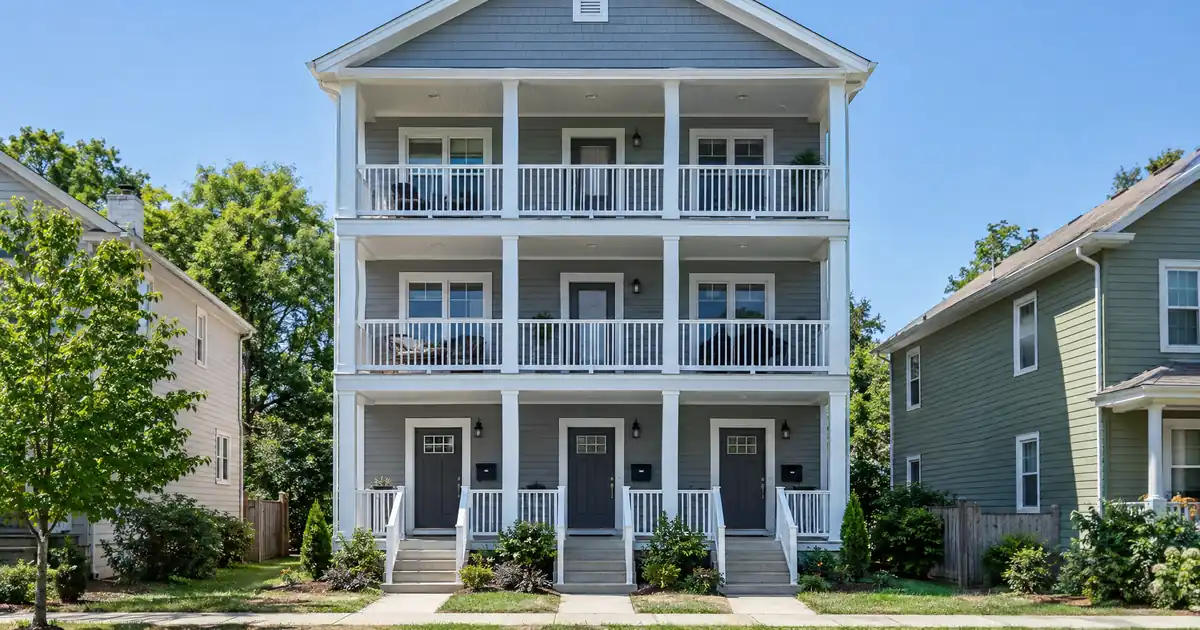
The Quick Read: A VA cash-out on a triplex works when you live in one unit and the other two are leased to tenants. The occupancy rule is the gate: VA cash-out is for the home you live in, so a triplex with no unit occupied by you does not fit. Leased units can help you qualify, but only in a discounted way and only under conditions. Program figures are subject to lender guidelines and full file review.
VA cash-out estimate
Seeded with an example value, a typical balance, and a round cash request at the first-use fee; change any field.
Editable benchmark: 7.40% as of October 15, 2026 · Freddie Mac 30-year average via FRED®. A conventional market reference, not a VA cash-out refinance quote.
Illustrative starting assumptions: a $350,000 home value, a $193,000 current balance, the full-value VA cap with the first-use funding fee financed, a thirty-year term at the current Freddie Mac benchmark, and property taxes and insurance estimated at typical national rates. Every field is editable.
Illustrative estimate only — not a Loan Estimate, approval, quote, or commitment to lend. The rate field carries the weekly Freddie Mac thirty-year conventional benchmark, a market reference and not a VA cash-out refinance quote; a VA loan is priced by the lender at lock. The total loan, funding fee included, is capped at the program leverage on the reasonable value; the fee follows the tier chosen. The cash available is what the cap allows less the balances paid off and the fee, before closing costs, which are not included. The HELOC line is the line program’s combined loan-to-value ceiling applied to the same value and balance. Taxes and insurance are editable estimates. The debt-to-income figure is a guideline; residual income decides a VA file. Licensed in sixteen states for consumer mortgages.
Does “All Other Units Leased” Fit a VA Cash-Out?
Yes, if “other” means the two units besides yours. The phrase “all units leased” is investor language, and it points the wrong way for this program.
VA lists three conditions for a cash-out refinance, and all must be true. You qualify for a Certificate of Eligibility (COE), you meet credit and income standards, and you will live in the home you are refinancing. VA guarantees loans on property of up to four units, so a triplex counts as a home when one unit is yours.
The scenarios sort out like this:
| Your situation | Fits VA cash-out? |
|---|---|
| You live in one unit, two are leased | Yes, this is the target case |
| All three units leased, you live elsewhere | No, the occupancy test fails |
| Spouse or dependent lives there, you are away | Depends on lender and VA review |
| One unit vacant at closing | Possible, but rent from it cannot be counted |
For the middle rows, ask a loan officer before you apply. Those cases turn on facts, not formulas.
If you want to see how a similar question plays out on a different program, Lendmire’s piece Does Rent From Other Units Help You Qualify for an FHA Cash-Out? covers it.
What the VA Cash-Out Actually Is
The VA cash-out refinance program replaces your current mortgage with a new VA-backed loan and hands you some of your equity as cash. Across the wholesale programs Lendmire places VA files with, the new loan can reach 100% of the appraised value, funding fee included. It can refinance any loan type into VA, so your existing loan does not have to be a VA loan.
There is no mortgage insurance. There is a funding fee: 2.15% on first use and 3.3% after that, waived for veterans receiving compensation for a service-connected disability and the other exempt groups. You can finance the fee, but it counts toward the 100% ceiling. That means the cash you actually receive is smaller than the headline equity number.
Two other basics. VA sets no minimum credit score, but the wholesale programs Lendmire works with start at a 580 decision score. And the cash-out carries the same seasoning as an IRRRL: the later of 210 days from your first payment and the sixth payment.
How the Loan Is Underwritten, Step by Step
A cash-out is a full-documentation loan. It is not a streamline. Here is the sequence on a triplex.
1. COE. The lender orders your Certificate of Eligibility. It shows your entitlement and any funding fee exemption.
2. Occupancy certification. You certify that the triplex is your home. This is the document that matters most when two units are leased. Misstate it and you have a bigger problem than a denied file.
3. Disclosures. For cash-outs, lenders must run a net tangible benefit test. Under VA Circular 26-18-30, you get the related information by the third business day after application and again at closing.
4. Full underwriting. Credit, income, debts and residual income are all reviewed.
5. Rental income treatment. Covered in the next section.
6. Appraisal. VA sets the reasonable value. All three units, leased ones included, must meet VA’s minimum property requirements.
7. Closing. The new loan pays off the old one first. Cash to you comes after.
Residual income is the controlling test here. That is the money left each month after your major obligations and living costs. The 41% debt-to-income figure is a guideline, not a cap. A ratio above it needs residual income well above the standard table.
How Lenders Treat the Leased Units
Rent from the other two units can help, but it is never counted at full value. The usual approach in the industry is to count only a portion of documented rent, since vacancy and upkeep eat into it. Handbook-level details on the exact percentage, and on the conditions that come with it, should be confirmed with your loan officer before you rely on them.
What the conditions tend to look like, in practice:
- Documented landlord experience or a property manager. A lender wants to see you can run rentals, or that someone else will.
- Reserves. When rent is used to qualify on a two-to-four unit home, lenders typically require reserves, meaning your own funds left over after closing.
- Your own funds only. Gifts and cash-out proceeds do not count as reserves.
Now the fork that decides everything. If you do not use the rent to qualify, those reserve and experience conditions may not apply. Your full payment simply counts as your debt. If you do use the rent, the conditions follow.
Many triplex owners assume counting rent is always the smart move. Not always. If your income carries the payment on its own, skipping the rent keeps the file simpler.
Leases versus the appraiser’s opinion
Two documents can speak to rent, and they can disagree.
| Document | What it is | What can go wrong |
|---|---|---|
| Signed leases | Rent your tenants actually pay | Month-to-month, expiring soon, below market |
| Appraiser’s rent opinion | Market rent for the units | Higher or lower than your actual leases |
When the two differ, lenders generally lean toward the lower, more supportable figure. A lease with a relative, no security deposit or missing signatures invites questions. Clean paperwork is one of the most affordable fixes you have.
The Reserves Trap
Here is the catch that surprises people. If you need the cash-out proceeds to build reserves, the math does not work, because proceeds cannot count as reserves. A borrower who plans to refinance, pocket the cash and use it to satisfy the reserve requirement will hit a wall. Every figure here varies by lender and program — guidelines, property type, leverage, and credit profile all apply.
Plan the reserves before you apply. They need to already sit in your accounts, in your own name, separate from the money the new loan will release.
The Self-Sufficiency Question on a Triplex
Three- and four-unit properties often draw an extra test: whether the property’s rental income can support its own payment. The exact standard depends on the program version and the lender, and some lenders add overlays beyond VA’s own rules.
In plain terms, the lender asks whether the leased units’ counted rent covers the payment on the whole property. Run it loosely: take the documented rent from the two leased units, discount it as your lender does, and compare it to the full housing payment. If the discounted rent falls short, the file may need a stronger residual income, more reserves or a different structure. Your loan officer can walk the numbers with you before you commit to an appraisal.
Where the General Rule Breaks
- All units leased, you live elsewhere. This is an investment-property scenario. VA cash-out does not serve it. Occupancy decides the leverage on any program.
- Moved-out veteran. Cash-out requires that you live in the home. A veteran who moved out and rented the whole building generally cannot use it, though an IRRRL on an existing VA loan has a lighter occupancy test.
- Active duty. A spouse or dependent may be able to certify occupancy in some cases. Confirm with VA and your lender first.
- Five or more units. Not eligible for a single veteran.
- Type I versus Type II. VA Circular 26-19-05 separates cash-outs where the loan stays at or below the payoff from those that exceed it. The net tangible benefit rules differ between the two.
- Lender overlays. Some lenders set a higher credit floor, add reserve months or cap leverage below VA’s ceiling. Those are lender choices, not VA rules.
What Net Tangible Benefit Means for You
The new loan has to be in your financial interest. Under 38 CFR 36.4306, the loan cannot exceed 100% of reasonable value and must provide a net tangible benefit. The regulation lists several qualifying benefits, such as eliminating monthly mortgage insurance, a shorter term, higher residual income, or a loan amount at or below 90% of reasonable value.
That last test is worth noticing. A cash-out that stays at or under 90% of value meets one of the listed benefits on its own. One that pushes toward 100% needs another reason to pass.
Your Decision in Practice
Start with the occupancy question, since it settles eligibility. Then decide whether to count the rent. Ask yourself:
- Do I live in one unit, and can I certify that honestly?
- Are my leases signed, current and at arm’s length?
- Do I hold reserves in my own funds, outside the cash-out?
- Would a loan near 100% of value still leave me a real benefit?
If three of those are yes, the triplex file is workable. If reserves are the gap, fixing that first beats applying and finding out. Tax treatment can depend on your situation; borrowers should speak with a qualified tax professional before relying on any deduction or credit.
Key Terms Defined
- Certificate of Eligibility (COE): The VA document that shows your entitlement and any funding fee exemption.
- Occupancy certification: Your signed statement that you live in, or will live in, the home.
- Reserves: Your own money left in the bank after closing, not counting gifts or cash-out proceeds.
- Residual income: Monthly money left after major obligations and living costs, the controlling VA test.
- Net tangible benefit: The requirement that a cash-out refinance be in your financial interest.
- Reasonable value: The value VA determines, which caps the loan.
Frequently Asked Questions
Can I use VA cash-out on a triplex if I rent out the other two units?
Yes, when you live in the third unit. VA guarantees property of up to four units, and the occupancy test asks that you live in one. Leasing the others does not break the rule, subject to lender guidelines.
Does the rent from my tenants count toward qualifying?
Partly. Lenders count a discounted share of documented rent, and usually attach conditions such as reserves and landlord experience. You can also choose not to use the rent, in which case your full payment counts as a debt.
Can cash-out proceeds serve as my reserves?
No. Reserves must come from your own funds. Proceeds, gifts and equity do not count, so the cash you pull out cannot also be the cushion that lets you pull it out.
What if I moved out and leased all three units?
Then VA cash-out generally does not fit, because the program requires that you live in the home. An IRRRL on an existing VA loan has a lighter occupancy test, but it allows no cash out.
How much can I borrow against a triplex?
The wholesale programs Lendmire places VA files with reach 100% of appraised value, funding fee included. Because the fee counts toward that ceiling, your usable cash is lower than the headline equity. Some lenders set a lower cap.
If you are weighing a cash-out refinance against keeping the loan you have, Lendmire can help you compare the programs and the equity each one reaches. Reach the team at 828-256-2183.
For your own numbers, request a scenario review with Lendmire.
About Lendmire
Lendmire (NMLS# 2371349) is a mortgage broker licensed for consumer lending in 16 states. Lendmire arranges FHA, VA, conventional and jumbo purchase and refinance loans through wholesale lenders; every file is underwritten by the lender under the applicable program guidelines. Scotsman Guide named Lendmire a Top Mortgage Workplace in both 2025 and 2026.
For the program’s current guidelines, see VA loan programs.
Get Started
Ready to find the right loan for you?
In about 30 seconds you can review financing options available for your home or investment property. No commitment required.
Informational only. Not a Loan Estimate, approval, or commitment to lend. Program availability and eligibility are subject to lender guidelines, credit approval, property review, and underwriting.
References
1. VA.gov: Cash-out refinance loan
This article is part of Lendmire’s VA Loans series — every loan program’s qualification details, guidelines, and scenarios live on the loan options page.
Related reading: Can You Use a VA Cash-Out on a Texas Homestead After a PCS? · How to Get a VA Cash-Out After a Quitclaim Deed From a Parent · VA Cash-Out Requirements for a Surviving Spouse at Full Value
Brandon Miller
Founder & CEO, Mortgage Loan Originator, Lendmire LLC
- Mortgage Loan Originator · NMLS# 1129696 · Verify on NMLS Consumer Access
- North Carolina Real Estate Broker · License# 343312 · Verify on NCREC
- North Carolina Insurance Producer · License# 19053198 · Property, Casualty, Life, Health · Verify on NAIC SBS
- Lendmire LLC · Firm NMLS# 2371349 · Verify firm licensure
Disclosures. The information presented in this article is general market commentary, not financial, legal, or tax advice. Lendmire is a mortgage brokerage (NMLS# 2371349) — not a direct lender or depository institution — and loan placement is subject to lender underwriting. Nothing in this content represents a commitment to lend. Loan terms, pricing, and program availability vary based on borrower qualifications, property characteristics, and state of subject property, and are subject to change at any time. Lendmire complies with Equal Housing Opportunity requirements. Consumer access: nmlsconsumeraccess.org.