
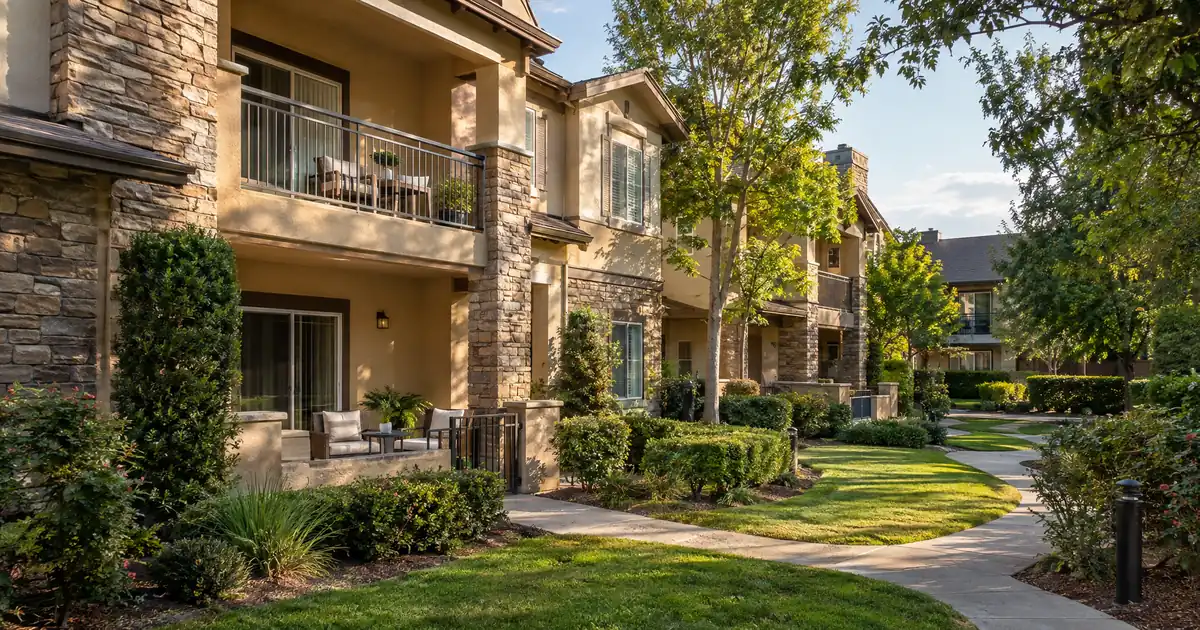
The Quick Read: A VA cash-out refinance cannot close on a condo that VA has not approved. VA approves the whole project, not just one unit, and that rule covers refinances as well as purchases. The borrower can be fully qualified and still get stopped by the building. If the project is not on VA’s approved list, the lender or the sponsor has to get it approved before the loan can be guaranteed.
VA cash-out estimate
Seeded with an example value, a typical balance, and a round cash request at the first-use fee; change any field.
Editable benchmark: 7.40% as of October 15, 2026 · Freddie Mac 30-year average via FRED®. A conventional market reference, not a VA cash-out refinance quote.
Illustrative starting assumptions: a $350,000 home value, a $193,000 current balance, the full-value VA cap with the first-use funding fee financed, a thirty-year term at the current Freddie Mac benchmark, and property taxes and insurance estimated at typical national rates. Every field is editable.
Illustrative estimate only — not a Loan Estimate, approval, quote, or commitment to lend. The rate field carries the weekly Freddie Mac thirty-year conventional benchmark, a market reference and not a VA cash-out refinance quote; a VA loan is priced by the lender at lock. The total loan, funding fee included, is capped at the program leverage on the reasonable value; the fee follows the tier chosen. The cash available is what the cap allows less the balances paid off and the fee, before closing costs, which are not included. The HELOC line is the line program’s combined loan-to-value ceiling applied to the same value and balance. Taxes and insurance are editable estimates. The debt-to-income figure is a guideline; residual income decides a VA file. Licensed in sixteen states for consumer mortgages.
Why Does the Building Matter More Than the Borrower?
A VA condo loan is two tests run side by side. The borrower test covers credit, income, residual income and entitlement. The building test covers the condo project itself. Passing the first does not pass the second.
The VA Lenders Handbook, Chapter 16 says condominiums, unlike planned unit developments, must be approved by VA before any unit in the project is eligible for guaranty. That is the rule. Everything else here is how it plays out on a real file.
On files like these, the borrower’s strength is rarely the problem. The HOA’s paperwork is. A veteran with strong residual income and a clean credit file can sit stalled because the association will not hand over its organizational documents.
The VA cash-out refinance program reaches up to 100% of the appraised value, including the financed funding fee, and it can refinance any loan type into VA. All of that assumes the property itself is eligible. For a condo, eligibility starts with the project.
Key Terms Defined
Project approval: VA’s review of a condo building’s organizational documents and finances, which makes every unit in it eligible for a VA guaranty.
Notice of Value (NOV): The document VA issues after the appraisal, stating the reasonable value and any conditions on the property.
Net tangible benefit: A test showing the new loan actually helps the borrower, such as removing monthly mortgage insurance.
Recoupment: Recovering the costs of a refinance through savings within a set period, which VA ties to 36 months.
PUD: A planned unit development, where owners hold a lot and share common areas through an HOA. VA does not require project approval for PUDs.
Entitlement: The amount of guaranty a veteran has available, shown on the certificate of eligibility.
How Do You Find Out Whether Your Condo Is Approved?
Check before anything else. The lender looks the project up on VA’s list of approved condominiums. VA’s Buyer’s Guide says VA keeps that list and that a project not on it must be submitted for review.
Timing matters here. Ask the loan officer to confirm the project status before you pay for an appraisal. The appraisal is mandatory on a cash-out, and an appraisal can come back before the project question is settled. A completed appraisal does not mean the loan can close.
A project can also show a status with conditions. A project accepted with open conditions is not the same as a clean approval, so the lender reads the status, not just whether the name appears.
| What you see | What it means | Can the file move? |
|---|---|---|
| Approved, no conditions | Project is on VA’s list | Yes, borrower underwriting proceeds |
| Approved with conditions | Approval carries items to satisfy | Only once the conditions are met |
| Not on the list | No current VA approval | No, project must be submitted first |
| Legally a PUD | Approval not required | Yes, different rules apply |
What Happens if the Project Is Not on the List?
Someone has to submit it, and it is not the homeowner. Per the Handbook, the package is a written request for VA approval plus a copy of the condominium’s organizational documents, sent to the VA Office of Jurisdiction. The lender or a sponsor files it. The HOA supplies the documents.
VA reviews those documents against its regulations and notifies the requesting lender or sponsor. The VA condo approval quick-reference guide shows packages going in through VA’s WebLGY system.
VA does not publish a turnaround figure for these reviews, so treat it as an open-ended wait that depends on the HOA and on VA’s review. That wait is the real cost on these files.
Reviewers look at the kinds of things that make a building risky: special assessments, reserves, litigation, budget and governing documents. Many failures trace to a fixable item, such as missing minutes or an incomplete budget. An HOA that will not cooperate is a harder stop.
Is There a Single-Unit Approval for VA?
Do not count on one. Some lender pages say VA has allowed approval of one unit at a time. VA’s own published guidance does not say that. The Handbook and VA’s help center both describe approval as project-level, and VA’s help center answer states the condominium must be approved before any unit is eligible.
Single-unit approval does exist in another program. HUD created it for FHA in a 2019 final rule. That is where the confusion comes from. If a source quotes a quick unit-level VA path with a set turnaround, ask which VA document says so. Lendmire’s piece on whether a condo owner can get an FHA cash-out without project approval covers the FHA side.
The practical advice: confirm the project’s status with the lender, and assume approval is for the building.
Does FHA Approval Count for VA?
Not on its own. VA Circular 26-09-19 rescinded VA’s old practice of accepting HUD/FHA condo approvals without separate review. Some sources describe an expedited path for projects approved by another federal agency. That makes FHA approval a possible head start, not a pass. The lender confirms what VA will accept for that building.
How Does a Cash-Out Run While the Project Question Is Open?
Borrower underwriting runs on its own track. Across the wholesale programs Lendmire places VA files with, the file goes through full credit and income review, with residual income as the controlling test. The 41% debt-to-income figure is a guideline, not a cap. A higher ratio needs residual income well above the table. The wholesale programs start at a 580 decision score, and each lender’s guidelines apply.
The loan itself has to meet VA’s cash-out rules. Under 38 CFR 36.4306, the new loan cannot exceed 100% of the reasonable value and must provide a net tangible benefit. The lender must give the borrower a net tangible benefit test. Fees and costs must be scheduled to be recouped within 36 months where recoupment applies.
The 100% ceiling counts the funding fee. VA Circular 26-19-05 says a financed funding fee cannot push the loan past the reasonable value. So a financed fee trims the cash you take out. The VA Lenders Handbook, Chapter 3 repeats that limit and lists a condo approved by VA as an eligible purpose.
The funding fee on a cash-out is 2.15% for first use and 3.3% for later use. It is waived for veterans receiving compensation for a service-connected disability and the other exempt groups. VA has no monthly mortgage insurance, so moving out of a loan that carries it can help satisfy the net tangible benefit test.
If your current loan is already a VA loan, seasoning applies. It is the later of 210 days from the first payment due date and the sixth payment. A conventional or FHA loan moving into VA has no VA-to-VA seasoning issue, but the net tangible benefit test still applies.
Where Does the General Rule Break?
Five named edge cases change the answer.
The property is a PUD, not a condo. The Handbook says PUDs do not require project approval. Some buildings called condos are legally PUDs or site condominiums. The legal description decides, not the marketing name. VA’s title and lien rules still apply, including the HOA lien sitting behind the VA mortgage.
Site condos. VA once told lenders in Michigan to process site condominiums like detached homes through a circular. Do not treat that as a national rule.
Phases. Amendments that annex phases under a development plan VA already accepted generally do not need a fresh approval, per secondary summaries of the Handbook. Ask the lender how it reads a given project.
A lower payment is not the goal here. An IRRRL is a different loan. It refinances an existing VA loan with no VA appraisal and a 0.5% fee unless exempt, and it returns no meaningful cash. If you want cash, you need the cash-out, and the project rule applies.
Occupancy matters too. A VA cash-out is for the home you live in. Active-duty rules allow a spouse or dependent to occupy it, and the lender confirms how that applies to your file.
What Does the Decision Look Like in Practice?
Picture a veteran with a condo financed through a conventional loan. Equity is solid, credit is clean, and monthly mortgage insurance is still on the loan. The condo is not on VA’s list.
1. The loan officer checks the project’s status before an appraisal is ordered.
2. The project is not approved, so the lender asks whether the HOA will supply organizational documents for a submission.
3. If the HOA cooperates, the lender or sponsor files. The cash-out waits on VA’s review. Rate and appraisal timing are the borrower’s exposure while it waits.
4. If the HOA refuses or the project fails review, VA cash-out is off the table for that building.
| Situation | Option |
|---|---|
| HOA will cooperate | Wait for the review, keep the file open |
| Fixable project issue | Press the HOA to correct it, then resubmit |
| Project fails or HOA refuses | Keep the current loan or compare another program |
| Building is approved for another program | Ask what that program allows; VA still needs its own approval |
The fallback is a non-VA cash-out, which gives up the VA’s 100% reach and no-mortgage-insurance structure. That trade is worth comparing, not assuming.
Costs are the other piece. VA Circular 26-24-19 lists the charges a veteran may pay and says lenders may not charge more than the actual amount for a fee or service. The funding fee and itemized fees still apply unless the borrower is exempt. Tax treatment can depend on your situation; borrowers should speak with a qualified tax professional before relying on any deduction or credit.
If you are weighing a cash-out refinance against keeping the loan you have, Lendmire can help you compare the programs and the equity each one reaches.
Frequently Asked Questions
Can a VA cash-out refinance close on a condo that is not VA-approved?
No. VA’s Handbook says the condominium must be approved before any unit is eligible. The project has to be approved first, either already or through a submission by the lender or sponsor. Program terms are subject to lender guidelines and full file review.
Does VA approve a single unit instead of the whole building?
VA’s published guidance describes approval as project-level and shows no unit-level exception. Single-unit approval is documented for FHA, which is the source of much of the confusion. Confirm the project’s status with the lender.
Who files the condo approval request?
The lender or a sponsor files it, not the homeowner. The HOA supplies the organizational documents. If the association will not cooperate, the review usually cannot go forward.
Is my building a condo or a PUD?
The legal description decides, not what the listing calls it. PUDs do not need VA project approval, though VA’s title and lien rules still apply. Ask the lender to read the recorded documents.
Does FHA approval make a condo eligible for VA?
Not on its own. VA ended its blanket acceptance of HUD/FHA condo approvals. The lender confirms what VA will accept for that project.
For your own numbers, request a scenario review with Lendmire.
About Lendmire
Lendmire is a mortgage brokerage (NMLS# 2371349) licensed for consumer mortgage lending in 16 states, arranging FHA, VA, conventional and jumbo purchase and refinance loans through a wholesale lending network. Eligibility is determined by the lender on each file. Scotsman Guide named Lendmire a Top Mortgage Workplace in both 2025 and 2026.
Get Started
Ready to find the right loan for you?
In about 30 seconds you can review financing options available for your home or investment property. No commitment required.
Informational only. Not a Loan Estimate, approval, or commitment to lend. Program availability and eligibility are subject to lender guidelines, credit approval, property review, and underwriting.
References
1. VA Lenders Handbook, Chapter 16
3. VA condo approval quick-reference guide
8. VA Lenders Handbook, Chapter 3
This article is part of Lendmire’s VA Loans series — every loan program’s qualification details, guidelines, and scenarios live on the loan options page.
Related reading: VA Cash-Out COE Requirements With Partial or Restored Entitlement · Can a Veteran Get a VA Cash-Out in an Irrevocable Trust? · VA Cash-Out Refinance Requirements for a Condo Project
Brandon Miller
Founder & CEO, Mortgage Loan Originator, Lendmire LLC
- Mortgage Loan Originator · NMLS# 1129696 · Verify on NMLS Consumer Access
- North Carolina Real Estate Broker · License# 343312 · Verify on NCREC
- North Carolina Insurance Producer · License# 19053198 · Property, Casualty, Life, Health · Verify on NAIC SBS
- Lendmire LLC · Firm NMLS# 2371349 · Verify firm licensure
Compliance and disclosures. Lendmire (NMLS# 2371349) is a licensed mortgage broker and is not a direct lender, depository institution, financial advisor, or tax professional. Content in this article is general market analysis and educational information — not financial, legal, or tax advice for any specific situation. Lendmire does not guarantee loan approval; every transaction is subject to underwriting by the funding lender. Mortgage pricing and loan program guidelines are subject to change at any time without notice and vary by borrower characteristics, property type, and state regulations. Lendmire complies with Equal Housing Opportunity. Licensure verification: NMLS Consumer Access.