
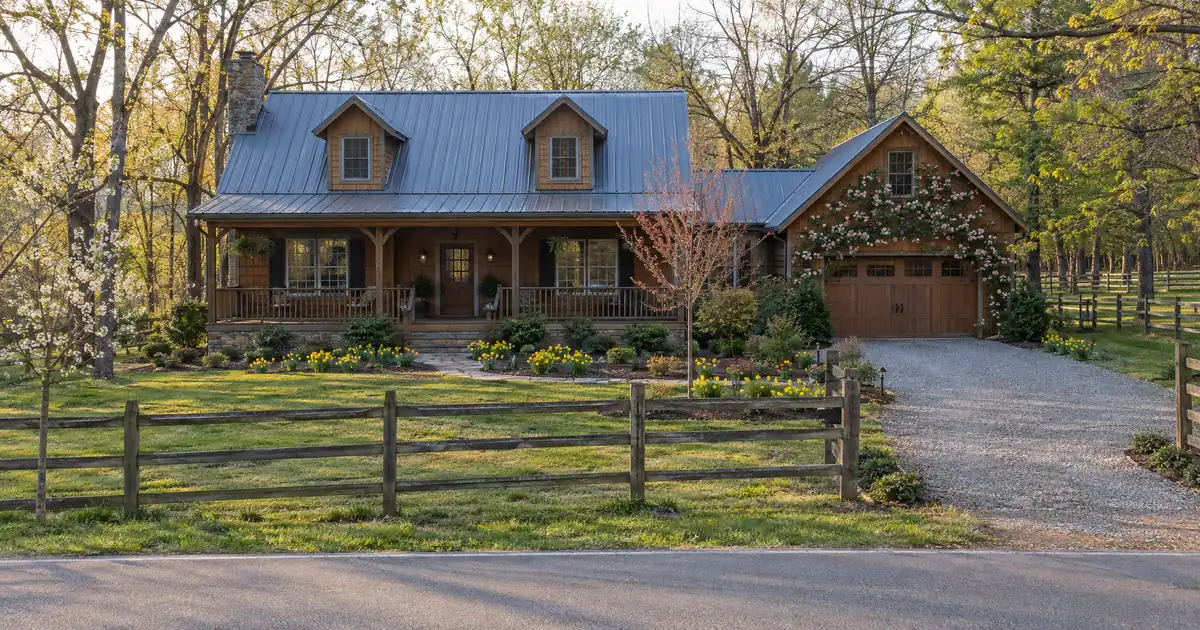
The Quick Read: No, a VA loan will not finance a bare lot by itself. It will finance a home on acreage, as long as the house is the veteran’s primary residence and the property is used as a home rather than a business. Land is also fundable when it is bought as part of a construction loan for the house that will sit on it. VA sets no acreage cap, but the appraisal and the lender’s own policies decide how much land a given file can carry.
Straight Answer: Where the Line Falls
Land alone is out. A home on acreage is in. Land bought together with a home you are building is in too.
VA payment estimate
Starting assumptions reflect an example price with no down payment and a first-use funding fee. Replace them with your own figures.
Editable benchmark: 7.32% as of October 22, 2026 · Freddie Mac 30-year average via FRED®. A conventional market reference, not a VA loan quote.
Illustrative starting assumptions: a $350,000 price, no down payment with full entitlement, a first-use funding fee financed into the loan, a thirty-year term at the current Freddie Mac benchmark, and property taxes and insurance estimated at typical national rates. Every field is editable.
Illustrative estimate only — not a Loan Estimate, approval, quote, or commitment to lend. The rate field carries the weekly Freddie Mac thirty-year conventional benchmark, a market reference and not a VA loan quote; your rate is set by the lender at lock. The funding fee follows VA’s published table for the use and down payment entered; the residual-income figure is VA’s guideline for the region and family size, and the rough residual shown subtracts only the housing payment and the debts entered, while VA also deducts taxes, maintenance and utilities. Taxes, insurance and dues are editable estimates; closing costs are not included. Licensed in sixteen states for consumer mortgages. Lendmire is not affiliated with or acting on behalf of the Department of Veterans Affairs.
The common thread is a dwelling the veteran will live in. The VA guaranty exists to help veterans own a home, not to hold land for later. Once a house is on the property, or is being built under the same loan, the file looks like a normal VA purchase. Everything after that is about size, value, and use.
| Situation | Works with a VA loan? | Route | Key condition |
|---|---|---|---|
| Bare lot, build “someday” | No | Cash or non-VA financing | No dwelling in the transaction |
| Lot plus a home built now | Yes | One-time-close construction loan | Land is part of the construction loan |
| Land you already own | Yes, for building | Construction loan for a residence | Lender confirms how the rules apply |
| Existing home on acreage | Yes | Standard VA purchase | Primary residence; value supports price |
| Working farm run as a business | Often no | Non-VA financing | VA loans are for residential use |
| Manufactured home on a lot | Yes, in set cases | Home and lot together | Home permanently affixed, treated as real property |
Why Can’t a VA Loan Buy Land by Itself?
The law ties the guaranty to a place the veteran occupies. 38 U.S.C. §3710 lists the covered purposes: buying or building a dwelling the veteran will own and occupy as a home, buying a farm with a farm residence, building a farm residence on land already owned, repairs and improvements, and refinancing liens on an owner-occupied dwelling. Land purchased by itself does not appear on that list.
The regulation closes the loop. 38 CFR Part 36, Subpart B defines residential property to include land bought with the proceeds of a construction loan, where the dwelling will be built on that land. So land enters the picture only as part of building a home.
That is why “I’ll buy the lot now and build later” does not work with VA. There is nothing yet to occupy, and nothing for an appraiser to value as a home. The same logic rules out land for recreation, a vacation cabin, or an investment.
How Does Buying Land and Building at the Same Time Work?
It works through a one-time-close construction loan, and it is the main route for land. The loan closes before construction starts. Its proceeds cover the building costs and the land cost, or the balance owed on the land. The remaining money sits in escrow and is released in stages as the work progresses. VA’s Circular 26-18-7 describes this structure, so confirm it against any later VA updates.
Here is the practical sequence:
1. Eligibility first. The veteran gets a Certificate of Eligibility, and the lender checks entitlement. VA, not the lender, decides eligibility.
2. Builder and plans. The lender reviews the builder and the construction plans before closing.
3. Appraisal. A VA-approved appraiser sets the reasonable value, which VA uses to decide how much of the loan to guarantee.
4. Closing, then draws. The loan closes, construction begins, and funds are disbursed as the work is completed.
Across the wholesale programs Lendmire works with, VA construction is a narrow lane. Fewer lenders offer it than offer a standard VA purchase, and builder review plus draw steps add work to the file. A veteran who wants this route should ask about it at the very start, not after choosing a lot. Program figures and eligibility are subject to lender guidelines and full file review.
What If You Already Own the Land?
Owning the land does not block a VA construction loan. The statute allows a loan to build a dwelling or farm residence on land the veteran already owns or is acquiring. One exception exists: land acquired directly or indirectly from a builder or developer who contracted to build the home. Because that exception can catch unusual deals, have the lender confirm how it applies to your purchase history.
Inherited land works the same way in principle. The question is whether the loan will fund a home you will live in on that parcel. If you want to take cash out of land you own, note that VA refinancing covers liens on an owner-occupied dwelling or farm residence, not bare land.
Can You Buy Land With Other Money and Use VA Later?
Yes, though it is a two-step plan, and the land step is not a VA loan. A veteran can buy a lot with cash or non-VA financing, then use a VA construction loan to build the home. The lender will look at what is owed on the land when it sets up the construction loan. How cleanly that works depends on the lender and on how the land was acquired, which is why the earlier builder exception matters.
The tradeoff is simple. Buying land first gives you time and control over the lot. It also means funding the land without VA, and lining up the VA construction financing before you commit to a plan.
Can a VA Loan Finance a Home on Acreage?
Yes, and this is where most veterans land. VA does not limit the number of acres. The VA Farm Loans fact sheet says so directly. It also says there must be a residence on the land, the veteran must live in it as the primary residence, and the loan is for residential purposes rather than buying a business.
So the acreage itself is rarely the problem. Three things decide the outcome:
- The home. A habitable dwelling must exist, or be built under the loan.
- The appraisal. The appraised value has to support the price, including the land.
- The lender. Lenders can set limits beyond VA’s rules.
Picture a buyer who finds a modest house on a large rural parcel and wants to use full entitlement. VA would not object to the acreage. The question is whether the appraiser can support the contract price. If the land is worth far more than the house, the appraisal may come in below the price, and the veteran would have to cover the gap in cash, renegotiate, or ask for a reconsideration of value with market data. VA’s Buyer’s Guide lists those options.
Why the Appraisal Is the Real Limit
An appraisal is mandatory on a VA purchase, and it produces the Notice of Value. The appraiser also checks that the home meets VA’s minimum property requirements. Think of that as a safe, sound, and sanitary check, not a home inspection. Repairs that are needed can be made a condition of the appraisal.
Here is the catch with acreage. VA’s guidance to appraisers on excess land is not fully uniform, and the Buyer’s Guide says the guaranteed loan cannot cover the non-residential value of farmland beyond the home site. In practice, the safest assumption is that a large parcel may appraise below the contract price. Plan for that possibility before you write an offer, not after.
What the loan will not cover on acreage:
- Non-residential farmland value beyond the home site
- Barns, silos, or other outbuildings needed for farm operations
- Farm equipment and livestock
Rural homes on well and septic still have to meet the property standards. Ask your loan officer how that plays out for your specific property.
VA Rules Versus Lender Overlays
VA sets no acreage limit. A lender, however, can. An overlay is a lender’s own rule layered on top of VA’s, and acreage caps and rural-comparable requirements are overlays, not VA policy. Some lenders set tighter limits on acreage or on how much of the value can come from land. Others are more flexible.
This matters for one reason: a “no” from one lender is not a “no” from VA. If a file stalls on acreage, the better question is whether a different lender’s guidelines fit the property. Lendmire is a mortgage broker licensed for consumer lending in 16 states, and it arranges VA loans through multiple wholesale lenders. That range is useful on odd properties, because the same file can read differently under different guidelines. Whether any lender can offer a loan depends on full review of the file and property.
What Does a VA Loan Look Like on a Home With Land?
The loan itself is the standard VA purchase, with the usual strengths. Across the wholesale programs Lendmire places VA loans with, a purchase can reach 100% financing with no down payment, provided the price is not above the appraised value. There is no mortgage insurance of any kind. With full entitlement there is no VA loan limit; with remaining entitlement a down payment may be required, so speak with a loan officer about your situation. The wholesale programs start at a 580 decision score, and VA itself sets no minimum.
The VA funding fee can be financed into the loan. For first use it is 2.15% with less than five percent down, 1.5% with five to under ten percent down, and 1.25% with ten percent or more down. For subsequent use it is 3.3% with less than five percent down, with the same 1.5% and 1.25% tiers above that. Veterans receiving compensation for a service-connected disability, and certain other exempt groups, do not pay it.
Underwriting turns on residual income, the money left each month after major obligations and living costs. The 41% debt-to-income figure is a guideline, not a cap, and a ratio above it needs residual income well above the minimum the guidelines call for. All of this is subject to lender guidelines and full file review, and none of it is a commitment to lend.
Edge Cases Worth Knowing
Working farms. A property operated mainly as a business may not qualify, because the benefit is for a residence. If the farm income is the point of the purchase, expect to look at non-VA financing.
Manufactured homes. Federal law covers a manufactured home permanently affixed to a lot the veteran owns, or the home and lot bought together. The home must be treated as real property under state law. The Congressional Research Service overview notes this is a distinct pathway.
Multiple parcels. When a property is made of more than one parcel, the appraisal is typically made subject to all parcels sitting on one deed. Ask the lender early.
Land plus a home that needs work. A repair can be made a condition of the appraisal, but the home still has to be safe, sound, and sanitary when the loan closes.
Common Misconceptions
- “I can buy a lot now and build later with VA.” No. Land qualifies only inside a construction loan for the home going on it.
- “VA caps acres.” It does not. Lenders and appraisal comparables are the practical limit.
- “A VA loan buys a working farm.” It buys a residence. It does not cover livestock, equipment, farm outbuildings, or non-residential acreage.
- “The VA appraisal is a home inspection.” It is not. The appraiser estimates value and notes readily apparent repairs, but does not test mechanical systems.
- “I must farm the land.” The requirement is primary-residence occupancy, not farming.
Questions to Ask Any Lender
Use these to separate VA rules from lender policy:
1. Do you offer VA one-time-close construction loans?
2. Do you have an acreage limit or a cap on land value as a share of the appraisal?
3. Do you require comparable sales with similar acreage?
4. How do you handle a property with more than one parcel?
5. What happens if the appraisal comes in below the price?
6. How does my remaining entitlement affect the down payment?
Key Terms Defined
Certificate of Eligibility (COE): The VA document that confirms you qualify for the benefit and shows your entitlement.
Entitlement: The amount of guaranty VA can back for your loan, which affects whether a down payment is needed.
Notice of Value (NOV): The result of the VA appraisal, stating the reasonable value VA will use for the guaranty.
One-time-close construction loan: A single loan that funds the land and construction, then becomes the permanent mortgage.
Lender overlay: A lender’s own rule that goes beyond what VA requires.
Minimum property requirements: VA’s standards that a home be safe, sound, and sanitary.
Frequently Asked Questions
Is there an acreage limit on a VA loan?
VA sets none. The VA farm-loan fact sheet confirms there is no limit on the number of acres. The practical limits come from the appraisal, which has to support the price, and from lender overlays, which vary from one lender to the next.
Can I buy land and build later with a VA loan?
Not with the land purchase itself. VA covers land only when it is bought as part of a construction loan for the home going on it. A veteran who wants to wait must buy the land another way, then use VA to fund construction.
Can I use a VA loan for land I’d use for investment, hunting, or a vacation home?
No. The guaranty is for a home the veteran will occupy as a primary residence. Recreational, vacation, investment, and business land fall outside it.
Do I have to farm the acreage to qualify?
No. The requirement is that the house is your primary residence. Farming is not required, and a property run mainly as a business may not fit the residential-use rule.
What happens if the appraisal comes in low on a large parcel?
You have options: ask for a reconsideration of value with market data, renegotiate the price, or cover the difference in cash. Planning for the possibility before you make an offer is the safer approach.
If you are buying a home and want to see whether a VA loan fits your file, Lendmire can help you compare the options and what each one asks of the file. Call 828-256-2183 or request a quote. Lendmire’s VA loan programs page covers the program basics.
About Lendmire
Lendmire is a mortgage brokerage (NMLS# 2371349) licensed for consumer mortgage lending in 16 states, arranging FHA, VA, conventional and jumbo purchase and refinance loans through a wholesale lending network. Eligibility is determined by the lender on each file. Scotsman Guide named Lendmire a Top Mortgage Workplace in both 2025 and 2026.
Get Started
Ready to find the right loan for you?
In about 30 seconds you can review financing options available for your home or investment property. No commitment required.
Informational only. Not a Loan Estimate, approval, or commitment to lend. Program availability and eligibility are subject to lender guidelines, credit approval, property review, and underwriting.
References
1. 38 CFR Part 36, Subpart B (eCFR)
2. VA Circular 26-18-7, Construction/Permanent Home Loans
4. VA Home Loan Guaranty Buyer’s Guide
5. Congressional Research Service overview
This article is part of Lendmire’s VA loan program — full qualification details, guidelines, and scenarios live on the program page.
Related reading: How to Refinance Into a VA Cash-Out From Another Loan Program · Can a Veteran Buy a High-Cost Home on a VA Loan With No Down Payment? · Refinancing a VA Loan Into a Conventional Loan to Restore Your Entitlement
Brandon Miller
Founder & CEO, Mortgage Loan Originator, Lendmire LLC
- Mortgage Loan Originator · NMLS# 1129696 · Verify on NMLS Consumer Access
- North Carolina Real Estate Broker · License# 343312 · Verify on NCREC
- North Carolina Insurance Producer · License# 19053198 · Property, Casualty, Life, Health · Verify on NAIC SBS
- Lendmire LLC · Firm NMLS# 2371349 · Verify firm licensure
Compliance and disclosures. Lendmire (NMLS# 2371349) is a licensed mortgage broker and is not a direct lender, depository institution, financial advisor, or tax professional. Content in this article is general market analysis and educational information — not financial, legal, or tax advice for any specific situation. Lendmire does not guarantee loan approval; every transaction is subject to underwriting by the funding lender. Mortgage pricing and loan program guidelines are subject to change at any time without notice and vary by borrower characteristics, property type, and state regulations. Lendmire complies with Equal Housing Opportunity. Licensure verification: NMLS Consumer Access.