
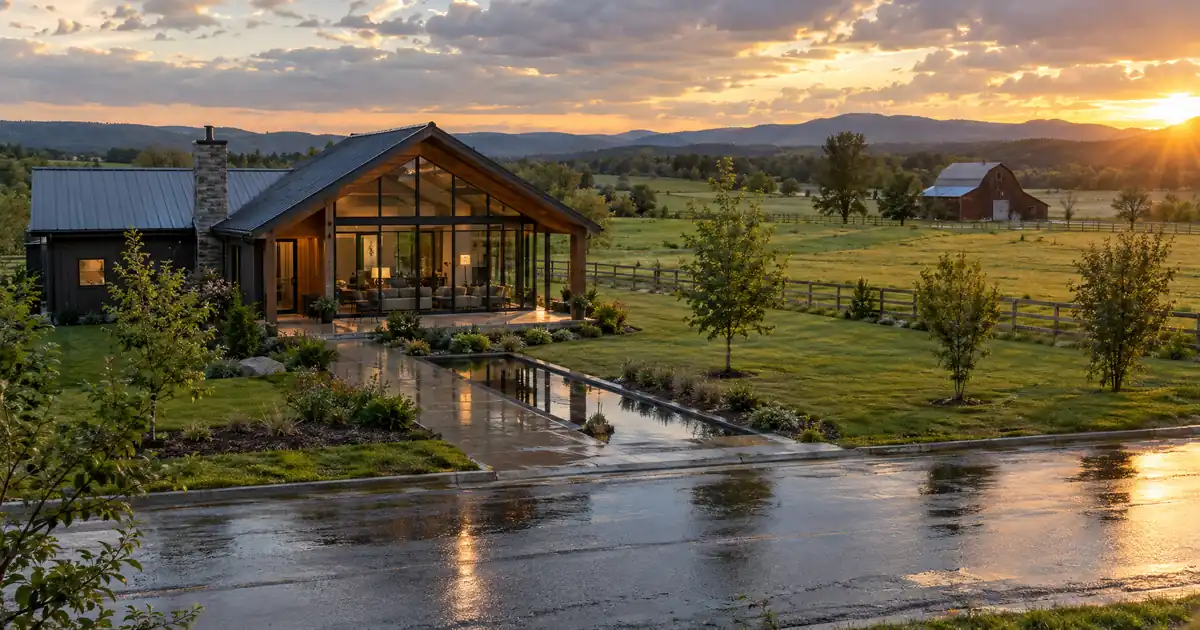
The Quick Read: You can use a VA loan on land only when the property is a home you will live in. There is a house, you move in, and the land supports the home rather than a business. VA sets no acreage cap, so the real tests are the appraisal and the lender’s own rules.
Key Takeaways
- The property needs a dwelling, and it must become your primary residence. Vacation farms and second homes do not fit.
- Move-in is generally expected within 60 days of closing. Longer can work in specific, documented cases.
- Acreage itself is not capped by VA. Appraisers and individual lenders are where limits show up.
- The loan covers the residential value only. Livestock, crops and equipment are out.
- A working commercial farm is the usual place these files fail.
What Does “Residence” Actually Mean Here?
Residence means the home is where you will live day to day. On a VA purchase, you certify that you intend to occupy the property as your home. You sign that certification at closing, and the lender relies on it.
VA payment estimate
Starting assumptions reflect an example price with no down payment and a first-use funding fee. Replace them with your own figures.
Editable benchmark: 7.32% as of October 22, 2026 · Freddie Mac 30-year average via FRED®. A conventional market reference, not a VA loan quote.
Illustrative starting assumptions: a $350,000 price, no down payment with full entitlement, a first-use funding fee financed into the loan, a thirty-year term at the current Freddie Mac benchmark, and property taxes and insurance estimated at typical national rates. Every field is editable.
Illustrative estimate only — not a Loan Estimate, approval, quote, or commitment to lend. The rate field carries the weekly Freddie Mac thirty-year conventional benchmark, a market reference and not a VA loan quote; your rate is set by the lender at lock. The funding fee follows VA’s published table for the use and down payment entered; the residual-income figure is VA’s guideline for the region and family size, and the rough residual shown subtracts only the housing payment and the debts entered, while VA also deducts taxes, maintenance and utilities. Taxes, insurance and dues are editable estimates; closing costs are not included. Licensed in sixteen states for consumer mortgages. Lendmire is not affiliated with or acting on behalf of the Department of Veterans Affairs.
The timing is more flexible than many buyers expect, but it has edges. You either live there already or plan to move in within a reasonable time. In practice, that means within 60 days of closing. A longer window can be reasonable when you certify a specific move-in date and a real event makes that date possible, such as finishing a required repair or a pending retirement. Occupancy later than 12 months after closing generally cannot be considered reasonable.
That 12-month figure is a limit on how long you can delay moving in. It is not a rule about how long you must stay once you move in. Those are two different questions, and mixing them up causes a lot of bad advice.
One sentence on a common detour: a second home or a vacation farm does not meet the occupancy test, because occupancy decides whether VA financing applies at all. The no-down-payment, no-mortgage-insurance structure of a VA purchase is built for a primary residence, subject to the conditions covered below, and that is the lane this article covers. Lendmire’s VA loan programs are built around that same owner-occupied premise.
How the Loan Is Underwritten, Step by Step
Here is the order a farm or acreage file usually moves in.
1. Confirm eligibility. Your certificate of eligibility (COE) comes from VA and decides whether you can use the benefit. Service requirements are VA’s rules.
2. Pick a lender that handles rural files. Many lenders are comfortable with a house on a few acres. Fewer want a property with hay fields and a working barn. Across the wholesale programs Lendmire places VA files with, the property type changes which lenders are a fit.
3. Order the VA appraisal. The appraiser values the home and land and issues a Notice of Value. That figure sets the ceiling on the loan.
4. Check the property standards. The appraiser looks at access, zoning, water and sewage, and whether the parcel is one marketable unit.
5. Underwrite the borrower. Residual income is the controlling test. That is the money left each month after debts, taxes and living costs. The 41% debt-to-income figure is a guideline, not a hard cap. A higher ratio needs residual income well above the table.
6. Close and certify occupancy. You sign the certification and then move in on the timeline above.
On the money side, a VA purchase can run at 100% financing, meaning no down payment, as long as the price is not above the appraised value. There is no mortgage insurance of any kind, and no VA loan limit when you have full entitlement. With remaining entitlement instead of full, a down payment may be required, so speak with a loan officer. The wholesale programs Lendmire works with start at a 580 decision score, though some lenders set a higher floor. A one-time funding fee applies, and it is waived for veterans receiving service-connected disability compensation and other exempt groups. Every figure is subject to lender guidelines and full file review.
Acreage: What VA Sets and What Lenders Set
VA does not cap acreage. The VA Farm Loans fact sheet says so directly. It also says there must be a farm residence on the land and that the veteran must live in it as a primary residence.
So where do acreage limits come from? Two places.
The first is the appraisal. The fact sheet says appraising acreage should not pose a problem as long as similar properties in the area recently sold primarily for residential use. If the appraiser cannot find homes with similar land that sold as residences, value gets hard to support.
The second is the lender. Some lenders set their own acreage limits, and some will not touch working farms. That is a lender rule, not a VA rule. A “no” from one lender does not mean the property is ineligible. It may mean you need a different lender.
| Who decides | What they decide |
|---|---|
| VA | Occupancy, residential purpose, valuation rules |
| Appraiser | Value, marketability, property standards |
| Lender | Acreage comfort, farm income, extra overlays |
| You | Intent to occupy, and what the land is used for |
Residential Use or Farm Business?
This is where acreage files get decided. VA-backed loans can only be used for residential purposes, not to buy a business. Valuation also excludes livestock, crops, and farm equipment and supplies.
VA does not publish a percentage that separates a homestead from a farm business. The test is whether the property is primarily residential. The residential character cannot be impaired by non-residential use, and the VA Lenders Handbook’s property standards allow a property with no more than one business. Some lenders use their own percentage caps on commercial space. Those are lender choices.
Run a few pictures through that test:
| Situation | How it usually reads |
|---|---|
| House on 5 acres, small barn, a few horses | Residential, usually fits |
| House on acreage, hay leased to a neighbor | Depends on scale and lender view |
| Roadside produce stand as a side activity | Depends on scale, lender view and appraiser notes |
| Large cattle or crop operation, house is secondary | Often fails the residential test |
| Farm bought to farm for income, no one living there | Does not qualify |
Treat the middle rows as questions to ask a lender before you write an offer. Where a case turns on judgment, get the lender’s view first.
How the Appraisal Handles Land and Outbuildings
The appraisal is where acreage hits your wallet. Under the VA Lenders Handbook, if a loan includes farmland, that land is appraised at its residential value only. Barns, sheds, corrals, stables and pastures are valued at fair market value, and the valuation leaves out livestock, crops and equipment.
Here is the catch. Your maximum loan follows the reasonable value on the Notice of Value, not the sales price. Say a seller prices a property high because of productive farmland or a fully stocked barn. The appraisal may come in lower. With full entitlement, financing can reach 100% of the appraised value with no down payment, but only when the price is not above that value. If the price is higher, the gap comes out of your pocket or gets renegotiated.
Land-heavy properties are the most exposed. When most of the value sits in the acreage rather than the house, the appraiser has fewer comparable sales and a lower residential value to work with. That is a key reason these files need a lender who has seen them before.
Where the Rule Bends
The general rule has named exceptions. These are the ones that come up most.
Interest rate reduction refinances. The occupancy requirement applies to all VA loan types except the IRRRL, the streamlined refinance of an existing VA loan. For an IRRRL you only certify that you previously lived there. If you already own acreage and are weighing a cash-out instead, Lendmire’s piece VA Cash-Out Refinance Land Rules for Acreage in a High-Cost Closing State covers how land is treated.
Active-duty spouse. Where active duty keeps a service member from moving in, the rules on spouse occupancy can apply. The details differ by loan type, so ask the lender to confirm in writing.
Retirement or a delayed move-in. A veteran retiring soon may be able to certify a specific later date. The 12-month outer limit still applies.
Multiple parcels. Parcels can be combined if they are contiguous and legally marketable. The appraisal is made subject to putting all parcels on one deed. Parcels that do not touch are a real problem.
A road or stream cutting through. The appraiser has to judge whether the split leaves the property readily marketable.
Vacant land. There must be a dwelling. A VA purchase is not a way to buy raw acreage. Building a home on land you already own is a separate construction path with its own rules.
Wells, Septic and Access
Rural homes get checked for the basics. Each property needs safe, adequate access from a public or private street with an all-weather surface. Private roads generally need a permanent easement and a maintenance agreement. Zoning matters too: the property must comply with local zoning, or the appraiser must note it as a legal non-conforming use and comment on marketability.
Wells and septic systems fall under the same VA property standards, which are tied to federal rules described in a VA Federal Register notice on minimum property requirements. Specifics vary, so ask for the current standard. If the appraiser finds a safety, sanitation or structural problem, the appraisal comes back subject to repairs. Those repairs can delay move-in, which is one reason to raise it with your lender early.
Qualifying With Farm Income
Underwriting for a farm home is generally the same as for any other house. If you need income from farming to make the payments, VA expects that income to be established and your experience as an operator to be shown. It is handled like self-employment income, so expect more paperwork. Many files simply qualify on wages or retirement pay and treat the farm as a bonus. That is the cleaner route.
Does This Listing Fit? A Quick Checklist
- Is there a finished house you can live in as your primary home?
- Can you realistically move in within 60 days of closing, or certify a specific later date?
- Is the land used mostly to support the home, not to run a business?
- Do recent nearby sales include homes with similar acreage?
- Are the parcels contiguous, and can they go on one deed?
- Is access by an all-weather road, with any private road protected by an easement?
- Do the well and septic have no obvious condition problems?
- Has your lender confirmed it works with this property type?
Several “no” answers do not always kill a deal, but they tell you which questions to ask before you make an offer.
Key Terms Defined
Certificate of Eligibility (COE): The VA document that confirms you can use the home loan benefit.
Notice of Value (NOV): The appraised value VA issues, which caps how much the loan can be.
Residual income: The money left each month after debts, taxes and basic living costs.
Overlay: A lender’s own rule that is stricter than VA’s.
Contiguous: Touching along a boundary, with no gaps between parcels.
Legal non-conforming use: A property use that predates a zoning rule and is still allowed to continue.
Next Step
If you are buying a home and want to see whether a VA loan fits your file, Lendmire can help you compare the options and what each one asks of the file. A mortgage broker can also help you find a lender that actually takes acreage files.
Frequently Asked Questions
Is there a maximum number of acres on a VA loan?
No, VA does not set one. Limits come from the appraisal, which must be supported by comparable residential sales, and from lenders who set their own comfort levels. If one lender declines, another may take the same property.
Can I buy a farm with a VA loan and run it as a business?
Not with the loan. VA-backed loans are for residential purposes only. The loan will not finance a business, and valuation leaves out livestock, crops and equipment. Some owners keep small farm activity going alongside the home, but the property must stay primarily residential.
How long after closing do I have to move in?
Generally within 60 days. A longer window may be reasonable if you certify a specific date and a particular event makes it possible. Occupancy beyond 12 months after closing generally cannot be considered reasonable.
Do I have to live there for a set number of years?
The VA Lenders Handbook does not state a minimum stay as part of the move-in rule. What matters is that your intent to live there was real when you signed. Plans change, but a certification you never meant to honor creates serious trouble.
What if the appraisal comes in below the price?
The loan follows the appraised residential value. You can negotiate the price, cover the difference out of pocket, or walk away if your contract allows. Land-heavy properties face this most often.
For your own numbers, request a scenario review with Lendmire.
About Lendmire
Lendmire, NMLS# 2371349, is a mortgage brokerage with consumer lending licenses in 16 states. FHA, VA, conventional and jumbo purchase and refinance loans are arranged through wholesale lending partners, and each application is reviewed individually by the lender. Scotsman Guide named Lendmire a Top Mortgage Workplace in both 2025 and 2026.
Get Started
Ready to find the right loan for you?
In about two minutes you can review financing options available for your home or investment property. No commitment required.
Informational only. Not a Loan Estimate, approval, or commitment to lend. Program availability and eligibility are subject to lender guidelines, credit approval, property review, and underwriting.
References
2. VA Lenders Handbook, Chapter 3: The VA Loan and Guaranty
3. Federal Register: Minimum Property Requirements for VA-Backed and Direct Loans
This article is part of Lendmire’s VA loan program — full qualification details, guidelines, and scenarios live on the program page.
Related reading: VA Cash-Out Refinance Requirements Versus a VA Streamline · VA Loan Eligibility Requirements for National Guard Members · How to Remove an Ex-Spouse or Co-Borrower From a VA Loan
Brandon Miller
Founder & CEO, Mortgage Loan Originator, Lendmire LLC
- Mortgage Loan Originator · NMLS# 1129696 · Verify on NMLS Consumer Access
- North Carolina Real Estate Broker · License# 343312 · Verify on NCREC
- North Carolina Insurance Producer · License# 19053198 · Property, Casualty, Life, Health · Verify on NAIC SBS
- Lendmire LLC · Firm NMLS# 2371349 · Verify firm licensure
Legal disclosures. Lendmire (NMLS# 2371349) is a state-licensed mortgage brokerage that arranges financing through wholesale lender relationships. Lendmire is not a direct lender, depository institution, or registered financial advisor. The discussion above is general informational content about real estate financing — it is not financial, legal, or tax advice, and readers should consult licensed professionals for guidance on their individual circumstances. Loan inquiries are subject to lender underwriting; this article does not represent a commitment to lend. Loan terms, rates, and qualification standards vary by borrower, property, and state, and are subject to change at any time. Equal Housing Opportunity. NMLS Consumer Access: nmlsconsumeraccess.org.