
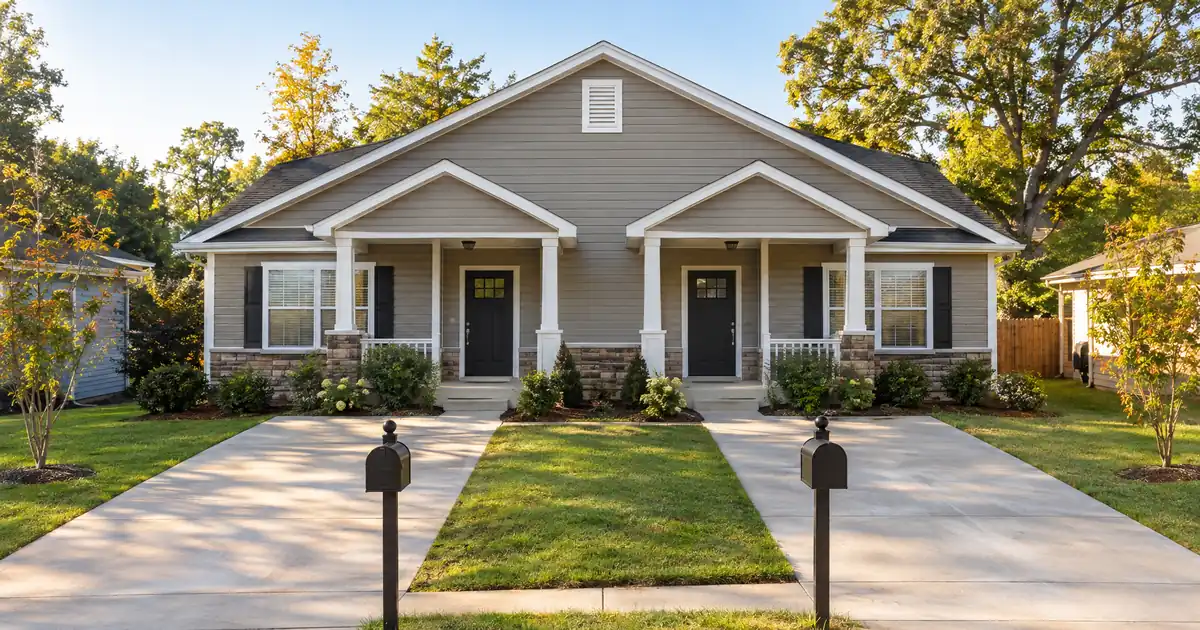
The Quick Read: Yes, when you live in one of the two units and the assistance option accepts a two-unit home. The grant option Lendmire arranges takes one- to four-unit homes with an FHA first mortgage. The forgivable and repayable second-lien options are written for one- to two-unit homes. USDA is the tricky one, and the exceptions are below.
Which Assistance Options Take a Duplex?
Three of the four option types can touch a duplex. The grant and the two second liens do. The refinance-cost second applies only after you own the home. Each is a different kind of help, with different rules on units, credit, and loan type. All are available through wholesale lenders, subject to program guidelines and full underwriting.
Here is how they line up. Across the wholesale programs Lendmire places files with, these are the shapes buyers ask about most.
| Option | First mortgage | Units | Credit floor |
|---|---|---|---|
| Grant (nothing to repay) | FHA only | 1-4 | 620 |
| Forgivable second | FHA, USDA, HUD-184 | 1-2 | 640 |
| Repayable second | FHA, USDA, HUD-184 | 1-2 | 660 |
| Refinance-cost second | FHA refinance | 1-4 | 660 |
Blended scores can apply on the two second-lien options when a co-borrower’s score is lower. Credit floors are the lowest representative score among all borrowers. Treat every figure as a guideline, not a commitment to lend.
Two things stand out. The grant is often a strong option that reaches three- and four-unit buildings. And a duplex fits the unit count on every option, including the one that applies only to refinances.
One caution on the second-lien options. Their property types are single-family detached or attached, condominium, and PUD (planned unit development, a community with shared common areas). A true two-unit building is within the unit count, but the lender should confirm how the program classifies your exact property before you write an offer.
How Does the Grant Work on a Two-Unit Home?
The grant covers 2% or 3.5% of the purchase price toward the FHA minimum investment. There is nothing to repay. It is released at closing with no lien, no payment, and no interest. The rules around it still apply, though. You must complete an HUD-approved homebuyer education course, and the cost is credited back at closing.
The grant sits on an FHA first mortgage only. FHA is the loan that lets a buyer put 3.5% down on a home that costs more than a starter house. HUD’s handbook for FHA single-family loans limits these programs to one- to four-unit owner-occupied principal residences. It defines a two-unit property as a single-family residential property with two individual dwelling units. So a duplex is not an exception. It is inside the box. Each figure is subject to lender guidelines and a complete review of property type, leverage, and credit.
Who qualifies for the grant? You need any one of these:
- Household income at or below 140% of area median income.
- A qualifying category: first responder, educator, medical worker, civil servant, or military member (current, retired, or volunteer).
- A first-time buyer, meaning no ownership interest in a residence in the prior three years.
- A home in an underserved census tract.
You do not have to be a first-time buyer. Repeat and move-up buyers qualify. The grant is not offered in Washington.
It also cannot be combined with another assistance program, FHA High Balance, FHA $100 Down, or a few other special FHA products. Pick one path.
What About the Forgivable and Repayable Seconds?
A second lien is a separate small loan that sits behind your main mortgage. Both second-lien options carry no income limit beyond USDA’s own limits on a USDA first mortgage. Neither requires first-time buyer status. Both work with FHA, USDA, and HUD-184 first mortgages.
The forgivable second is 3.5% of the lesser of the price or the appraised value. It has no interest and no monthly payment. It is forgiven after the first 36 or 60 on-time first-mortgage payments, depending on the version. You need a 640 credit score, or 660 with blended scores. It is still a lien, so selling or refinancing before the forgiveness date is a conversation to have up front. Leverage, reserves, and pricing vary by lender and program; the final terms follow the full file review.
The repayable second is 3.5% or 5% of the lesser of price or value. At 5%, it also helps with closing costs and prepaid items. This is a real loan. It carries interest, a monthly payment, a 30-year amortization, and a balloon due in year 10. A balloon means the remaining balance comes due in one lump. The lender gives you its own disclosure, and the second counts in your debt ratios. You need a 660 score, or 670 blended. Manual underwriting is not allowed on this one.
Which fits a duplex buyer better? It is a toss-up that depends on your cash. The forgivable second keeps the monthly budget clean. The repayable second gives you a larger bite at the 5% level and helps with closing costs. But the payment and the year-10 balloon are real obligations, and a buyer should plan for both.
Can You Use USDA on a Duplex?
Usually not. A USDA loan is for a primary residence that cannot be an income-producing property, and buying a whole two-unit building falls on the wrong side of that line.
There is one narrow path. One unit of a duplex may be eligible, but buyers cannot purchase both units. Practically, that means one side of a duplex that has its own separate deed. Whether your home qualifies is decided during the appraisal and lender review, not by an online map.
So if you want to buy the whole building and rent the other side, USDA is the wrong first mortgage. FHA is the usual fit.
What About HUD-184 for Native Borrowers?
HUD-184 is a loan guarantee for Native American borrowers, tribes, and tribal housing entities. It allows one- to four-family homes on trust land or in approved areas under 24 CFR Part 1005. It pairs with the forgivable and repayable seconds. The duplex must be one legal property that meets local zoning.
If you may qualify, ask the lender early. Tribal housing assistance can add its own terms.
Why Do Some Programs Say No to Duplexes?
The first mortgage and the assistance program are two separate rule books. FHA allows a duplex. The assistance program may not. When the two differ, the stricter one controls.
Public programs show this. CalHFA’s MyHome program, a state housing agency product, is written for one-unit single-family homes and says the more restrictive of the two rule sets applies. Other public programs allow one to four units. There is no national rule. Many state and local programs limit property type or add recapture periods, so the program’s own guidelines decide.
That split explains why the internet disagrees on this question. One page says “almost never.” Another says “often.” Both are describing programs, not the loan. The honest answer is that it depends on which program sits behind your file.
What Does a Duplex Change on the First Mortgage?
Less than most buyers fear. A few mechanics are worth knowing.
You live in one unit. The FHA loan requires an owner-occupant, a borrower who lives in the home as a principal residence. Every borrower on the file must meet that. Assistance does not apply to second homes or rentals.
Rent from the other unit helps, partly. The lender works from the appraiser’s market-rent figure and does not count all of it. Rent does not replace your income. It can improve your ratios.
The self-sufficiency test is a three- and four-unit rule. HUD’s handbook writes that test for three- to four-unit properties. A duplex sits below it. That is a big reason a two-unit building is easier to finance than a fourplex.
Reserves are lighter on two units. FHA asks for fewer months of reserves after closing on one- to two-unit homes than on three to four units. Your lender will confirm the figure.
Limits and leverage. FHA’s minimum investment is 3.5% of the lesser of price or appraised value, which means 96.5% first-lien leverage. An upfront mortgage insurance premium applies to the base loan and can be financed. An annual premium follows, based on your loan size and leverage. For 2026, one-unit FHA limits vary by county. Two-unit limits are higher, so check your county.
Assistance cannot push you past the combined loan-to-value allowed on the file, and it cannot put cash back in your pocket. Those two guardrails limit how much help can stack.
Does a House With an Accessory Unit Count as a Duplex?
For FHA, no. HUD defines a one-unit property as a single dwelling unit, or a single unit plus one accessory dwelling unit (ADU, a small separate living space such as a garage apartment). So a house with one ADU is still a one-unit home.
That can matter. A program that rejects true two-unit buildings may accept a house with an ADU. Ask the program how it classifies one. Do not assume.
What Happens If You Move Out or Rent Both Sides?
Every assistance option here is for an owner-occupied primary residence. Moving out and renting both units breaks that purpose. The consequences depend on the option.
- Grant: nothing to repay, but you must meet the occupancy rules of the FHA loan itself.
- Forgivable second: the lien is forgiven only after the 36 or 60 on-time payments. Leave early, and you should expect to deal with the balance.
- Repayable second: it is a loan with a payment and a year-10 balloon whether you stay or go.
Duplex or Single-Family: Which Is Better With Assistance?
Here is how it often shakes out.
A single-family home is easier. More programs accept it, and the file has fewer moving parts. A duplex can make the monthly budget easier through rent from the other unit. But it adds an appraisal question, a rent calculation, and a narrower list of eligible programs.
The stronger play for many buyers with thin savings is the duplex plus the grant. It reaches the widest property range and has nothing to repay. A buyer who earns too much for the grant and does not fit a category can use a second lien. Whatever you pick, get the property type approved before you commit to a contract.
Some buyers fund the move with equity from a current home. Lendmire’s piece How to Use a VA Cash-Out for a Down Payment and Keep the Home covers that path for veterans. Assistance does not stack with other assistance, so plan around one source.
How Do You Check Eligibility Before You Make an Offer?
Use this order.
1. Pick your first mortgage. FHA is the broadest fit for a duplex. USDA works only on one separately deeded side. HUD-184 works if you are an eligible Native borrower.
2. Check the unit count. The grant takes 1-4. The seconds take 1-2.
3. Confirm the property type. Ask whether a two-unit building counts under the program.
4. Check your credit score against the floor. Use the lowest representative score among borrowers. Blending may help on seconds.
5. Check income or category. The grant uses 140% of area median income unless you fit a category.
6. Confirm funding. Programs can pause or run out. Do not assume assistance in a contract without a reservation.
7. Talk to a counselor if you want a second opinion. HUD-approved counseling agencies can walk through options.
The right questions for a loan officer are simple. How does this program classify a two-unit building? Which first mortgage does it sit behind? Does the second count in my ratios? What happens if I refinance?
Lendmire arranges these structures through wholesale lenders. See Lendmire’s down payment assistance programs page for the full lineup. Consumer lending is licensed in 16 states, and the grant is not offered in Washington.
Key Terms Defined
Owner-occupant: a borrower who lives in the home as a primary residence.
Second lien: a separate loan recorded behind your main mortgage.
Combined loan-to-value: your first mortgage plus any second lien, divided by the home’s value.
Balloon: a lump sum that comes due at the end of a set period instead of being paid off gradually.
Self-sufficiency test: an FHA rental-income test applied to three- and four-unit properties.
ADU: a small separate living unit on the same lot, counted as part of a one-unit home by FHA.
Frequently Asked Questions
Does FHA allow a duplex with down payment assistance?
FHA allows the duplex. The assistance program decides whether it works with the home. The grant option accepts one to four units, and the forgivable and repayable seconds accept one to two. Your lender checks the property type against the program.
Can I use assistance if I am not a first-time buyer?
Yes. No option Lendmire arranges requires first-time status. The grant has a three-year first-time definition, but it is only one of several qualifying categories. Repeat buyers can qualify on income or by fitting another category.
Can I buy a duplex and rent out both units?
No. Assistance is for a primary residence you live in. You can rent the other unit, and the lender counts part of that rent. Renting both sides turns the home into a rental, which is outside these options.
Does the assistance count in my monthly budget?
It depends on the type. The grant and forgivable second have no payment. The repayable second has a monthly payment that counts in your debt ratios, plus a balloon in year 10.
Can I combine two assistance programs?
No. These options do not stack with each other or with other assistance programs. A mortgage credit certificate is also not permitted with the second-lien options.
If you are buying a primary home and want to see whether a down payment assistance option fits your file, Lendmire can help you compare the grant, forgivable and repayable structures alongside an FHA, USDA or HUD-184 first mortgage.
About Lendmire
Lendmire is a mortgage brokerage (NMLS# 2371349) licensed for consumer mortgage lending in 16 states, arranging government-backed purchase loans and the down payment assistance options that sit on top of them through a wholesale lending network. Eligibility is determined by the lender on each file. Scotsman Guide named Lendmire a Top Mortgage Workplace in both 2025 and 2026.
Get Started
Ready to find the right loan for you?
In about 30 seconds you can review financing options available for your home or investment property. No commitment required.
Informational only. Not a Loan Estimate, approval, or commitment to lend. Program availability and eligibility are subject to lender guidelines, credit approval, property review, and underwriting.
References
1. HUD Handbook 4000.1 excerpt on property type eligibility
2. USDA Single Family Housing Guaranteed Loan Program
This article is part of Lendmire’s down payment assistance program — full qualification details, guidelines, and scenarios live on the program page.
Related reading: Does Down Payment Assistance Have to Be Paid Back? · Can a Six-Figure Earner With Student Loans Get Down Payment Assistance? · How A Repayable Down Payment Assistance Second Affects Your DTI?
Brandon Miller
Founder & CEO, Mortgage Loan Originator, Lendmire LLC
- Mortgage Loan Originator · NMLS# 1129696 · Verify on NMLS Consumer Access
- North Carolina Real Estate Broker · License# 343312 · Verify on NCREC
- North Carolina Insurance Producer · License# 19053198 · Property, Casualty, Life, Health · Verify on NAIC SBS
- Lendmire LLC · Firm NMLS# 2371349 · Verify firm licensure
Required disclosures. Lendmire (NMLS# 2371349) operates as a licensed mortgage broker, not a direct lender or depository. The discussion in this article is general in nature and should not be relied upon as financial, legal, or tax advice — every investment scenario is unique and should be reviewed by a qualified professional. Any loan inquiry is subject to lender underwriting, and this article is not a commitment to lend or a guarantee of approval. Mortgage rates, loan terms, and program guidelines vary by borrower, property, and state, and may change without notice. Equal Housing Opportunity. Verify licensure at NMLS Consumer Access.