
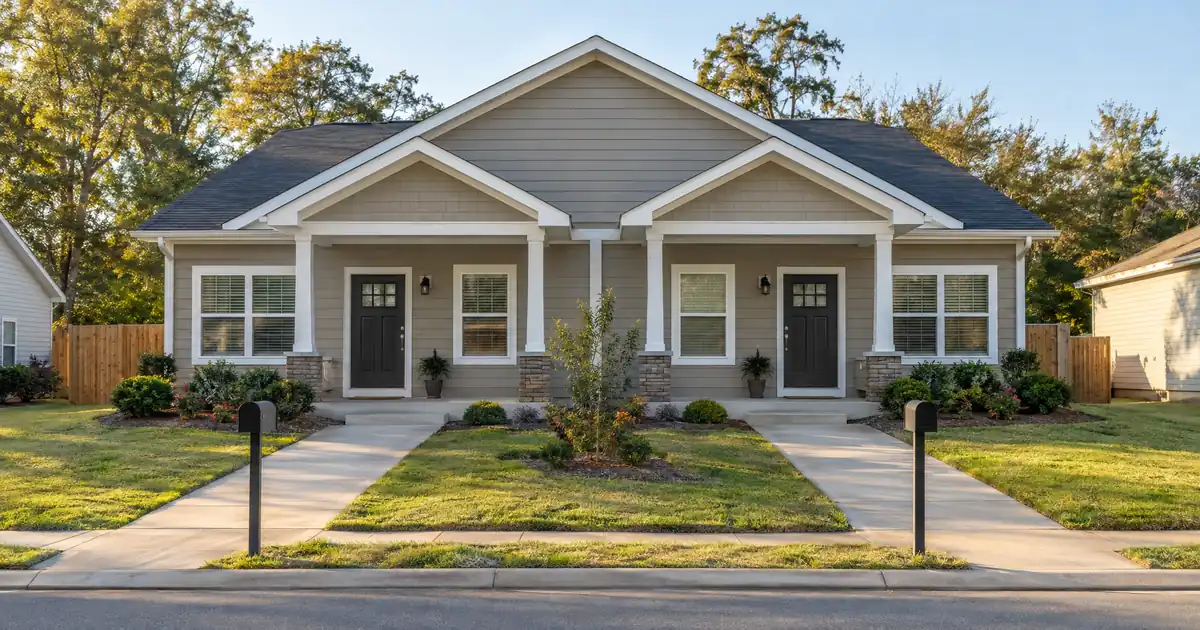
The Quick Read: On an owner-occupied duplex, FHA asks for a smaller down payment than conventional, but the down payment is only one piece of the cash you bring. FHA’s minimum is 3.5% of the price. Fannie Mae’s conventional matrix allows up to 95% financing on a two-unit home you live in, so the floor is 5% down. Closing costs, prepaid items, and reserves sit on top of either number. Seller credits and gifts can shrink the total. Terms depend on the lender’s guidelines, the property type, the leverage, and a full review of the credit profile.
Key Takeaways
- FHA’s minimum investment is 3.5% for a decision score of 580 or higher. Pricing and available terms vary by lender, borrower profile, property type, and full underwriting review.
- FHA adds an upfront mortgage insurance premium of 1.75% of the base loan. Most borrowers finance it, so it raises the balance rather than the cash you bring.
- Conventional with less than 20% down needs private mortgage insurance. That is a monthly cost, not a closing cost.
- Rent from the second unit can help you qualify. It is discounted, and it never replaces the cash you need at the table.
- FHA requires you to live in one of the units. Conventional offers its best leverage only when you do the same.
What Counts as “Cash to Close” on a Duplex?
Cash to close is everything you hand over at closing after credits are subtracted. The down payment is the biggest part, but not the only one.
FHA payment estimate
Starting assumptions reflect an example price and the FHA minimum investment. Replace them with your own figures.
Editable benchmark: 7.32% as of October 22, 2026 · Freddie Mac 30-year average via FRED®. A conventional market reference, not an FHA loan quote.
Illustrative starting assumptions: a $350,000 price, the FHA minimum investment as the down payment, a thirty-year term at the current Freddie Mac benchmark, and property taxes and insurance estimated at typical national rates. Every field is editable.
Illustrative estimate only — not a Loan Estimate, approval, quote, or commitment to lend. The rate field carries the weekly Freddie Mac thirty-year conventional benchmark, a market reference and not an FHA loan quote; your rate is set by the lender at lock. FHA mortgage insurance follows HUD’s published schedule for the term, leverage and loan size entered; taxes, insurance and dues are editable estimates; closing costs are not included; county loan limits are not checked here. Licensed in sixteen states for consumer mortgages. Lendmire is not affiliated with or acting on behalf of FHA, HUD, or the federal government.
Here is the full list:
- Down payment. The part of the price the loan does not cover.
- Lender and third-party costs. Appraisal, title work, recording, and the lender’s charges.
- Prepaids and escrow deposits. Homeowners insurance, property taxes, and interest paid up front.
- Credits. Earnest money you already paid and any seller credit reduce what you bring.
- Reserves. Savings the lender may want left in your account after closing, depending on the file.
The federal consumer-finance regulator explains that “closing costs” leaves out the down payment. The “Cash to Close” line on your final Closing Disclosure is a separate figure. It nets out deposits, credits, and other adjustments. Many first-time buyers read the wrong line and budget too little.
FHA on a Duplex: 3.5% Is the Floor
FHA needs at least 3.5% as your minimum investment, and that is the same for one unit or two. Across the wholesale programs Lendmire places FHA files with, that applies at a decision score of 580 or higher. HUD draws a line between the “Minimum Required Investment” and the “Total Required Investment.” The second one adds your borrower-paid transaction costs to the down payment. So 3.5% is the starting point, not the whole bill.
These are the FHA loan programs mechanics that matter for cash:
- Maximum financing is 96.5%. The minimum investment is figured on the lesser of the price or the appraised value.
- The upfront premium is 1.75% of the base loan. It is normally financed. Your cash to close does not rise, but your balance does.
- The annual premium runs between 0.15% and 0.75% of the balance. Term, loan amount, and loan-to-value (LTV, the loan as a share of value) set the figure. On a 30-year loan above 90% LTV, it lasts the full term. At 90% or below, it ends after eleven years.
- Seller or interested-party contributions can reach 6% of the price. That can cover a large share of closing costs.
- Occupancy is required. FHA is for a principal residence only, one to four units. You live in one unit and rent the other.
Every figure here is subject to lender guidelines and a full file review. None of it is a commitment to lend.
Conventional on a Duplex: 5% Down Is the Floor
On a two-unit home you occupy, Fannie Mae’s eligibility matrix allows a maximum of 95% LTV on a purchase. That is 5% down. Final terms depend on the lender’s guidelines, the property type, and the borrower’s complete credit picture.
A one-unit home can reach 97% on a fixed-rate loan, so the second unit costs you extra down payment. Many buyers still hear that duplexes need 15% down on a conventional loan. That was the old rule. The current matrix says 95% for owner-occupied two- to four-unit purchases.
With less than 20% down, conventional adds private mortgage insurance (PMI, insurance that protects the lender). PMI is billed monthly, so it does not change the cash you bring at closing. It does change the monthly cost. Reserves may also be required, depending on what the underwriting findings say.
Occupancy matters here too, though it works differently than on FHA. Conventional financing does not strictly bar a duplex you will not live in. But Fannie Mae allows far less leverage on one, so the cash needed rises sharply. The 95% figure belongs to buyers who occupy a unit.
FHA vs. Conventional: The Side-by-Side
| Factor | FHA | Conventional |
|---|---|---|
| Occupancy | Required: you live in one unit | Best leverage when you live in one unit |
| Max financing, duplex | 96.5% | 95% (owner-occupied) |
| Minimum down payment | 3.5% | 5% (owner-occupied) |
| Upfront insurance | 1.75% of base loan, usually financed | None |
| Ongoing insurance | Annual premium, 0.15%-0.75% | PMI under 20% down |
| Credit floor | 580 (through Lendmire’s wholesale programs) | Varies by file |
Read the table by rows, not by headline. FHA wins the first row on cash. The insurance rows decide the long-term cost. Conventional PMI can often be removed as your equity grows. On FHA above 90% LTV, the annual premium stays for the loan term, though a later refinance can change that.
Picture a duplex bought with a 3.5% down FHA loan. You bring less cash, but your balance starts higher once the premium is financed. Now picture the same duplex on a 5% down conventional loan. You bring a bit more cash and finance no upfront premium. Neither is “cheaper” in general. The cheaper loan depends on your savings, your credit, and how long you hold the home.
How the Second Unit’s Rent Counts
Rent can help you qualify, but the lender discounts it. Neither loan lets you count every dollar.
On conventional loans, Fannie Mae’s underwriting job aid generally uses 75% of gross rent for net rental income. The appraisal reports market rent for each unit, and that figure feeds the calculation. Fannie Mae also limits how much subject-property rent a buyer can add when they have under a year of landlord history. So a first-time landlord should expect less credit than a seasoned one.
On FHA, documented rent from a two- to four-unit home you occupy can count as income. The lender will want a lease or appraisal support. Commercial space in the building does not count.
FHA’s ratio structure starts at 31/43 (housing payment to income, then total debts to income) with no compensating factors. Documented compensating factors can reach 40/50 at the top tier. The automated finding governs most files. Rent can move you into a better ratio, but it never replaces the money you need to close.
FHA’s rent test for self-sufficiency, where net rent must cover the full payment, targets three- and four-unit homes. HUD’s glossary defines it as “Net Self-Sufficiency Rental Income.” A duplex generally avoids that hurdle, which is one reason two units are the easiest multifamily purchase to finance.
Where the Rule Bends
The simple answer, 3.5% versus 5%, holds for most duplex files. These edge cases change it.
Gifts. A gift can go toward the minimum investment, not just closing costs. HUD’s FHA guidance says a gift needs a signed, dated letter naming the donor, address, phone, relationship, dollar amount, and a no-repayment statement. A gift toward the minimum investment must also meet the source rules. Gifts of equity are allowed only between family members.
Seller credits. A credit lowers cash to close. It does not erase the minimum investment you owe. FHA allows contributions to 6% of the price. Conventional caps are tied to your down payment, so check your lender’s limit.
Three or four units. The rent test arrives, and some down payment assistance stops at two units. A duplex is the sweet spot.
County loan limits. FHA limits are set by county and change each year. HUD ties the floor and ceiling to the national conforming limit, and the floor applies where 115% of the area median price falls below it, per HUD’s announcement. Duplexes get a higher limit than single-family homes. Look up your county before you shop, because pricey areas can push a duplex past the cap. Conventional high-cost areas have their own limits too.
Refinancing later. FHA Streamline refinances an existing FHA loan with no appraisal and a net tangible benefit, and the premium continues. An FHA cash-out reaches 80% LTV on a home you have owned and occupied for 12 months. A conventional cash-out on a duplex is limited to 75%. Those caps matter if you plan to pull equity out down the road. For the replacement math, see Lendmire’s article on how much an FHA cash-out releases when it replaces a conventional loan. Exact terms depend on the lender’s guidelines, property type, leverage, and a full review of the borrower’s file.
The Cash Buyers Forget to Budget
Most duplex buyers plan for the down payment and closing costs. The surprises come after.
- Appraisal repairs. An older two-unit building may come back with required repairs, which cost you cash or force a renegotiation.
- Inspection costs. Two kitchens, two sets of systems, and often two utility meters.
- Prepaids on two units. The insurance policy on a multi-unit building can be bigger than a single-family policy.
- A vacancy cushion. If the other unit sits empty, you still carry the full payment.
- Moving and setup. Small, but real, when you are also becoming a landlord.
Lendmire sees many first-time buyers qualify on paper but run short because they budgeted only for the down payment. A broker working with wholesale lenders can map the full number before you write an offer.
How to Choose
This is a decision about cash, credit, and time. Use a simple read.
If your savings are thin, FHA’s 3.5% minimum and the 6% seller contribution cap give you the most room. If your score sits comfortably above the minimum and you want the insurance to fall away, conventional’s 5% down often fits better. If you plan to hold the duplex for many years, run both loans over that period. The cash you save up front can cost more over time.
The comparison is rarely close on the day you apply. It gets close when you add the insurance and the years.
Key Terms Defined
Minimum Required Investment. The smallest cash contribution FHA accepts from you, at least 3.5% of the property’s adjusted value.
Total Required Investment. Your down payment plus the transaction costs you pay yourself.
Cash to Close. The final amount you bring to closing after deposits and credits are applied.
Upfront mortgage insurance premium. A one-time FHA charge equal to 1.75% of the base loan, usually added to the balance.
Private mortgage insurance. Monthly insurance on a conventional loan with under 20% down.
Reserves. Savings left in your accounts after closing, which some files must show.
Frequently Asked Questions
Is 3.5% down all the cash I need for an FHA duplex?
No. The 3.5% is the minimum investment. You also pay closing costs and prepaids, and some files need reserves. Seller credits and gifts can reduce that total, subject to lender guidelines.
Can I use FHA or conventional on a duplex I will rent out entirely?
Not with FHA, which requires you to occupy a unit as your principal residence. Conventional is different: it can be possible, but Fannie Mae allows far less leverage when you do not live there. That means a much larger down payment. Occupancy decides how much cash you need.
Does the rent from the second unit reduce my cash to close?
No. Rent can improve your qualifying income, but it does not lower the amount due at closing. Fannie Mae generally counts 75% of gross rent, and FHA wants documented rent. Credits and gifts are what reduce cash to close.
Can a gift cover my down payment on a duplex?
Yes, with the right paperwork. FHA accepts a gift toward the minimum investment with a signed gift letter and a documented source. Gifts of equity are limited to family members.
Is the FHA upfront premium paid in cash?
Usually not. Most borrowers finance the 1.75% premium into the loan. Your cash to close stays about the same, but your balance and monthly cost go up.
Next Step
If you are buying a home and want to see whether an FHA loan fits your file, Lendmire can help you compare the options and what each one asks of the file. A two-unit home gives you both housing and rent, and the loan you choose decides how much of your savings it takes to get there.
For your own numbers, request a scenario review with Lendmire.
About Lendmire
As a mortgage broker (NMLS# 2371349), Lendmire helps homeowners and home buyers in 16 states with FHA, VA, conventional and jumbo purchase and refinance loans arranged through wholesale lenders. Lendmire is never the lender; program terms are set by the lender and the agency guidelines. Scotsman Guide named Lendmire a Top Mortgage Workplace in both 2025 and 2026.
Get Started
Ready to find the right loan for you?
In about 30 seconds you can review financing options available for your home or investment property. No commitment required.
Informational only. Not a Loan Estimate, approval, or commitment to lend. Program availability and eligibility are subject to lender guidelines, credit approval, property review, and underwriting.
References
1. CFPB
2. HUD Handbook 4000.1 Glossary
3. Fannie Mae Eligibility Matrix
4. Fannie Mae DU Job Aid: Entering Income from Rental Property
5. HUD FHA FAQ: Gifts of Equity
6. HUD 2026 FHA Loan Limits Announcement
This article is part of Lendmire’s FHA loan program — full qualification details, guidelines, and scenarios live on the program page.
Related reading: How to Lower FHA Cash to Close on New Construction · How Much a Conventional Loan Saves Over FHA Insurance on a Condo · How Much a Conventional Loan Saves Over FHA After PMI Cancels
Brandon Miller
Founder & CEO, Mortgage Loan Originator, Lendmire LLC
- Mortgage Loan Originator · NMLS# 1129696 · Verify on NMLS Consumer Access
- North Carolina Real Estate Broker · License# 343312 · Verify on NCREC
- North Carolina Insurance Producer · License# 19053198 · Property, Casualty, Life, Health · Verify on NAIC SBS
- Lendmire LLC · Firm NMLS# 2371349 · Verify firm licensure
Disclosure information. Lendmire is a state-licensed mortgage brokerage under NMLS# 2371349. Lendmire is not a depository institution, direct lender, or financial advisor — all loans referenced are placed through wholesale lender partners and are subject to each lender's underwriting standards. This article is provided for general informational purposes and is not a commitment to lend, nor does it constitute financial, legal, or tax advice. Loan programs, terms, rates, and qualification standards change without notice and depend on borrower profile, property type, and the state in which the subject property is located. Equal Housing Opportunity provider. NMLS Consumer Access: nmlsconsumeraccess.org.