
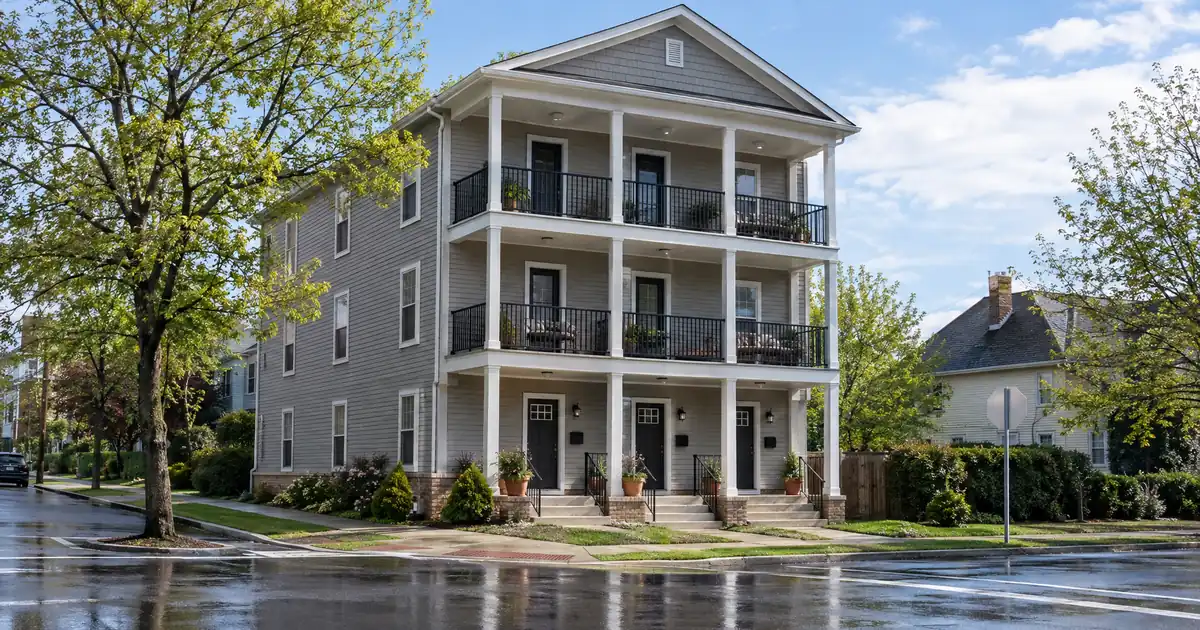
The Quick Read: On an owner-occupied duplex, triplex or fourplex, a bigger down payment lowers your loan-to-value ratio, and that is what drives mortgage insurance. The savings come in steps, not in a straight line. Insurance disappears completely once you start at 80% LTV or lower. Your credit score, your cash reserves and whether you live in one of the units all shape how big each step turns out to be. Every figure here varies by lender and program — guidelines, property type, leverage, and credit profile all apply.
Key Takeaways
- PMI (private mortgage insurance) is required on a conventional loan above 80% LTV. It protects the lender, not you.
- Owner-occupied 2-4 unit purchases can go up to 95% LTV, which means 5% down. Investment-property 2-4 unit purchases are capped at 75%.
- Each extra slice of down payment lowers the coverage tier and the premium. The biggest drop is the last one: reaching 80% removes PMI entirely.
- Credit score moves the premium too. A strong score with a smaller down payment can beat a weak score with a larger one.
- Extra cash down is not free. On a multi-unit file it competes with the reserves the lender wants to see. Final terms depend on lender guidelines, property type, leverage, and the borrower’s complete credit picture.
How Does a Bigger Down Payment Change PMI?
A bigger down payment shrinks the loan relative to the home’s value. That lowers LTV, and LTV is the number the mortgage insurer prices. Lower LTV means less coverage is required, a smaller premium, and a shorter road to cancellation.
Conventional payment estimate
The starting figures are an example price at the first-time buyer’s minimum down payment. Replace them with yours.
Editable benchmark: 7.32% as of October 22, 2026 · Freddie Mac 30-year average via FRED®. A conventional market reference, not a conventional loan quote.
Estimate seeded at the low end of Fannie Mae’s published range (0.58%–1.86% a year); the insurer prices the actual premium on the score and the leverage. Applies only above 80% loan-to-value.
Illustrative starting assumptions: a $350,000 price, the first-time buyer’s minimum down payment, a thirty-year term at the current Freddie Mac benchmark, mortgage insurance at the low end of Fannie Mae’s published range, and property taxes and insurance estimated at typical national rates. Every field is editable.
Illustrative estimate only — not a Loan Estimate, approval, quote, or commitment to lend. The rate field carries the weekly Freddie Mac thirty-year conventional benchmark, a market reference and not a conventional loan quote; your rate is set by the lender at lock. The mortgage insurance figure is an editable estimate seeded from Fannie Mae’s published typical range, not a premium quote; the insurer prices the actual premium, and the cancellation month assumes scheduled payments with no extra principal and no change in value. Taxes, insurance and dues are editable estimates; closing costs are not included. Conforming loan limits apply by county. Licensed in sixteen states for consumer mortgages.
Here is the mechanic in plain steps. Your LTV is the loan amount divided by the value. On a purchase, the value is the lower of the sales price or the appraisal, which is how Fannie Mae’s Selling Guide defines it. Mortgage insurance is required on a conventional loan above 80% LTV. These specifics are subject to lender guidelines and a full review of property, leverage, and credit.
For the home you live in, the conventional loan programs Lendmire arranges through wholesale lenders allow a 2-4 unit principal residence up to 95% LTV. That is 5% down. The 97% option for first-time buyers applies to one-unit homes, so it does not reach a duplex or fourplex. Terms depend on the lender’s guidelines, the property type, the leverage, and a full review of the credit profile.
Here is how the down payment ladder looks. The percentages are illustrative steps, not quotes.
| Down payment | LTV | What happens to PMI |
|---|---|---|
| 5% | 95% | Required, highest coverage tier |
| 10% | 90% | Required, a lower tier |
| 15% | 85% | Required, lower again |
| 20% or more | 80% or less | Not required |
Insurers price every loan on its own risk. Published typical annual premiums run from about 0.58% to 1.86% of the loan balance. That is a wide range, not a quote, and where you land inside it depends on your file.
Why the Savings Come in Steps, Not a Straight Line
Coverage requirements move in bands as LTV climbs. Fannie Mae’s mortgage insurance coverage rules set a required coverage level for each band, and the level is higher in each band above it. Put 1% more down and you may stay inside the same band. Put enough more down to cross into the next band and the coverage requirement drops.
That is why “each extra 1% cuts PMI by the same amount” is a myth. The first dollars you add may change little. The dollars that carry you across a band line change more. The final move to 80% LTV changes the most, because the insurance goes away. The exact numbers vary by lender and program and follow a full review of property, leverage, and credit.
In the files Lendmire arranges, this is the pattern borrowers notice. Someone who sits just a few points short of the next lower band is often better off finishing the climb than stopping short. Someone far from the next band line is often better off keeping the cash.
Pricing has a second layer too. Lenders sell loans to investors, and investors charge adjustments based on credit score, LTV, occupancy and unit count. Fannie Mae calls them loan-level price adjustments and published a redesigned framework in its LL-2023-01 announcement. They stack on top of each other. In general, they rise with LTV, and unit count can add to them. The direction is what matters here rather than any specific figure, because the live matrix changes.
What Is Different About a 2-4 Unit?
A multi-unit home follows the same PMI logic as a single-family home, with three differences: the leverage cap, the pricing adjustments, and the reserves. The structure is the same, but the cushion around it is thinner.
Occupancy comes first. You must live in one unit. That is what makes the loan a principal-residence loan with leverage up to 95%. If you do not occupy a unit, it is an investment property, and the cap on a 2-4 unit purchase falls to 75%. At 75% there is no PMI zone at all. It is a different loan with a much bigger down payment, and occupancy decides which one you are in. Fannie Mae’s Eligibility Matrix lays out the caps by occupancy and unit count. Final terms depend on the lender’s guidelines, the property type, and the borrower’s complete credit picture.
Unit count can add cost. Pricing adjustments tend to be higher for more units at the same LTV. A fourplex at 95% can cost more to place than a duplex at 95%. So more down can help on a bigger building even if the PMI tier looks the same.
Rent counts, but not for PMI. The rent from the other units does not change your mortgage insurance amount. It can help you qualify, because the lender may count part of it toward your debt-to-income ratio (DTI). The lender is also required to report the gross monthly rent for each unit, whether or not you use it to qualify. Treatment depends on your documentation and rental history, and a cap can apply when you have no history as a landlord. So rent shapes whether the whole payment fits. It does not shape the PMI line.
Reserves matter more. Multi-unit files often ask for more cash in the bank after closing than a single-family file does. The exact amount depends on LTV, score and the automated finding, so check it against your file. This is the hidden cost of a bigger down payment, and I come back to it below.
Credit Score or Down Payment: Which Moves PMI More?
Both matter, and they interact. Think of down payment as the lever you control today and credit score as the lever you built over years. Neither works alone.
Across the wholesale programs Lendmire places files with, the conventional floor is a 620 decision score. A borrower right at that floor with 5% down is at the expensive corner of the grid. Adding down payment helps, but a better score helps as well. A borrower with a strong score and the same 5% down often pays noticeably less than the first borrower, and may pay less than a weaker-score borrower who put 10% down.
Here is the decision in a compact form.
| Your situation | The stronger lever |
|---|---|
| Score near the floor, cash available | More down, plus work on the score before applying |
| Strong score, tight reserves | Keep the cash, accept a smaller down payment |
| Close to 80% LTV | More down, because crossing the line removes PMI |
| Far from 80% LTV | Compare the tier drop against what the cash could do elsewhere |
One more point. The automated underwriting finding governs most files, with a total ratio ceiling of 50%. Putting more down can also lower your monthly obligations, which may help your DTI. That can matter on a multi-unit file where the whole payment is bigger.
Is the Extra Cash Worth It?
It depends on how long you will keep the loan, what else the cash could do, and how much cushion you want left. The way to test it is to compare the extra cash you put in with the yearly premium it saves.
Picture a buyer at 90% LTV on a fourplex who is deciding whether to add enough to reach 85%. The move lowers the balance and may drop the coverage tier. It does not remove PMI. The savings are real but modest, and the payback takes a long time. Each figure is subject to lender guidelines and a complete review of property type, leverage, and credit.
Now picture the same buyer at 82% LTV deciding whether to reach 80%. The cash needed is small, and the whole premium disappears. The payback is much shorter. Same buyer, same building, very different answer. Leverage, reserves, and pricing vary by lender and program; the final terms follow the full file review.
A simple way to run it: take the extra cash and divide it by the annual premium you would stop paying. That gives you the number of years to break even. Then ask whether you expect to hold the loan that long, or whether a sale or refinance would end the premium sooner anyway. At the low end of the premium range I quoted, payback stretches out. At the high end it shortens.
The honest toss-up is the middle zone, between about 85% and 90% LTV. The math may favor keeping reserves and a cash buffer, or it may favor paying down. Reasonable buyers split on it. I lean toward protecting reserves on a multi-unit building, because a vacant unit or a big repair hits harder than a PMI line. Terms vary by lender guidelines, property type, leverage, credit profile, and full file review.
Three costs of putting more down are easy to miss:
- Thinner reserves. A building with several units has more things to break. Draining your savings to cut PMI can leave you exposed.
- Lost flexibility. Cash in the walls is hard to get out again without a refinance.
- Opportunity cost. Money that is not in the down payment can pay off higher-cost debt or build an emergency fund.
Where the General Rule Breaks
The ladder above works for the standard case. Several situations bend it.
Cash-out refinance. A cash-out on a 2-4 unit home is capped at 75% LTV, so it generally has no PMI zone. If you are weighing that path, Lendmire’s piece How Much Cash a Conventional Cash-Out Releases on a 2-4 Unit Home walks through the leverage limit.
Manual underwriting and super-conforming loans. Some lenders and investors hold manually underwritten loans, and loans in high-cost areas, to lower leverage than the automated route. Manual files also carry tighter ratios, 36% or 45% depending on the reserve and score factors. If your file falls outside the automated finding, the ladder may start lower.
Subordinate financing. A second loan used to cut the first mortgage’s LTV still counts in the combined LTV. Fannie Mae’s matrix caps combined leverage for the standard 2-4 unit principal residence and limits when a second lien can be used at all. A piggyback does not dodge the cap.
Lender-paid mortgage insurance. Some lenders offer to pay the insurance and build the cost into the loan terms instead. The cancellation rights I describe below do not apply to it. You cannot request removal later. It can trade a lower monthly bill today for a cost that stays.
FHA. FHA is a separate program with its own mortgage insurance, not PMI. It follows different rules and is often not cancellable. If FHA is on your list, compare it as its own option.
Homebuyer programs. Some conventional programs for income-limited buyers allow reduced insurance coverage at high LTV, and they carry an income limit of 80% of area median income. Some set separate rules for 2-4 units. Programs vary by lender, so check the details on your file.
New York. Mortgage insurance decisions on non-co-op properties are based on the appraised value alone. That is a small wrinkle, but it can change your LTV.
What Are the Alternatives to a Bigger Down Payment?
If the cash is tight, you have a few other levers. Each has a catch.
- Improve the score first. A better decision score can lower the premium without touching your savings. This only works if you have time before you buy.
- Choose borrower-paid monthly insurance. It is the standard structure. It can be cancelled later, which makes it the most flexible.
- Consider lender-paid insurance carefully. It can lower the monthly cost, but it cannot be cancelled by you. Run the long-term view before choosing it.
- Ask about the structure. Some insurers offer upfront or split payment options. The Loan Estimate will show how the insurance is charged, so you can compare the whole cost across offers.
- Negotiate the price or seller help. A lower price or a seller concession changes the cash you need at the same LTV. Ask your agent what the market allows.
When Does PMI Come Off?
Your down payment sets the starting point. Federal law then sets the finish line for most borrower-paid PMI. Under the Homeowners Protection Act, as the Consumer Financial Protection Bureau’s examination procedures explain, you can ask in writing to cancel PMI once your balance reaches 80% of the home’s original value. You need a good payment history, no subordinate liens and no decline in value. The servicer must end it automatically when the balance is first scheduled to reach 78%, if you are current.
Two details matter. The test uses original value, not today’s value. If your home has appreciated, that does not automatically move the date. Some servicers will review a new appraisal under their own policy, but that is the servicer’s call. And extra principal payments count toward the 80% date, so prepaying can bring it closer.
A larger down payment moves the whole schedule up. If you start at 90% LTV, the 80% line is closer than if you started at 95%. That is the “how long” half of the down-payment decision. For the choice between waiting for the scheduled date, asking for an appraisal, or refinancing, see Lendmire’s article PMI Appraisal vs Refinance for a House Hacker’s 2-4 Unit Conventional Loan. Exact terms depend on the lender’s guidelines, property type, leverage, and a full review of the borrower’s file.
Key Terms Defined
PMI (private mortgage insurance): Insurance on a conventional loan above 80% LTV that protects the lender if you stop paying. The CFPB describes it the same way.
LTV (loan-to-value): Your loan amount divided by the home’s value. A lower LTV means a bigger down payment.
Coverage tier: The share of the loan the insurer covers, which steps up as LTV rises.
Loan-level price adjustment: A pricing add-on the lender’s investor charges for risk factors such as score, LTV and unit count.
Reserves: Cash you still have after closing, counted in months of housing payments.
DTI (debt-to-income ratio): Your monthly debts divided by your monthly income.
Principal residence: The home you live in as your main address. For a 2-4 unit, it means living in one unit.
Lender-paid mortgage insurance: Insurance the lender pays and builds into the loan terms. You cannot cancel it.
A Short Checklist: Should You Put More Down?
1. Confirm you will live in one unit. If not, the leverage cap and the whole picture change.
2. Find out how far you are from 80% LTV. If you are close, finishing the climb is usually worth a close look.
3. Check your reserves after the larger down payment. If they get thin, stop.
4. Compare your score against what you can improve before you apply.
5. Ask for borrower-paid and lender-paid options side by side on the Loan Estimate.
6. Estimate how long you will keep the loan. A short hold shrinks the payoff from extra cash.
7. Confirm everything against your own file, since program figures are subject to lender guidelines and full file review.
Where to Go From Here
If you are buying a home and want to see whether a conventional loan fits your file, Lendmire can help you compare the options and what each one asks of the file. The answer to “how much more down” is easier to see once the real numbers for your property and score are side by side.
Frequently Asked Questions
Do I need 20% down on a duplex or fourplex?
No, not if you live in one unit. Owner-occupied 2-4 unit purchases can go up to 95% LTV, which is 5% down, subject to lender guidelines. You pay mortgage insurance above 80% LTV. If you do not occupy a unit, the purchase cap on two to four units drops to 75%.
Does PMI drop gradually as I put more down?
Not smoothly. Coverage and pricing move in bands, so some extra down payment changes little and some changes a lot. Crossing into a lower band cuts the requirement. Reaching 80% LTV removes it. Credit score interacts with each band.
Does the rent from the other units lower my PMI?
No. Rent can help you qualify by counting toward your DTI, subject to documentation and landlord history. It does not change the mortgage insurance premium. The lender reports the gross monthly rent for each unit either way.
Is a bigger down payment or a better credit score the better lever?
It depends on where you stand. Near the 620 floor, both help and improving the score first can pay off. With a strong score, a smaller down payment may cost less than you expect. Near 80% LTV, more down wins, because the insurance ends.
Can I get rid of PMI sooner than the scheduled date?
Often, yes. You can request cancellation once your balance reaches 80% of original value, with a good payment history, no second liens and no decline in value. Extra principal brings that date closer. Lender-paid insurance cannot be cancelled this way.
For your own numbers, request a scenario review with Lendmire.
About Lendmire
Lendmire is a mortgage brokerage (NMLS# 2371349) licensed for consumer mortgage lending in 16 states, arranging FHA, VA, conventional and jumbo purchase and refinance loans through a wholesale lending network. Eligibility is determined by the lender on each file. Scotsman Guide named Lendmire a Top Mortgage Workplace in both 2025 and 2026.
Get Started
Ready to find the right loan for you?
In about 30 seconds you can review financing options available for your home or investment property. No commitment required.
Informational only. Not a Loan Estimate, approval, or commitment to lend. Program availability and eligibility are subject to lender guidelines, credit approval, property review, and underwriting.
References
1. Fannie Mae Selling Guide B7-1-01: Provision of Mortgage Insurance
2. Fannie Mae Selling Guide B7-1-02: Mortgage Insurance Coverage Requirements
3. Fannie Mae LL-2023-01 loan-level price adjustment announcement
4. Fannie Mae Eligibility Matrix
5. CFPB Homeowners Protection Act examination procedures
6. CFPB
This article is part of Lendmire’s conventional loan program — full qualification details, guidelines, and scenarios live on the program page.
Related reading: How Much Cash a Low Down Payment Conventional Loan Needs at Closing · How Much More Down Lowers PMI on a Move-Up Conventional Loan · Smaller vs Larger Down Payment on a Conventional Loan for a 2-4 Unit
Brandon Miller
Founder & CEO, Mortgage Loan Originator, Lendmire LLC
- Mortgage Loan Originator · NMLS# 1129696 · Verify on NMLS Consumer Access
- North Carolina Real Estate Broker · License# 343312 · Verify on NCREC
- North Carolina Insurance Producer · License# 19053198 · Property, Casualty, Life, Health · Verify on NAIC SBS
- Lendmire LLC · Firm NMLS# 2371349 · Verify firm licensure
Disclosure information. Lendmire is a state-licensed mortgage brokerage under NMLS# 2371349. Lendmire is not a depository institution, direct lender, or financial advisor — all loans referenced are placed through wholesale lender partners and are subject to each lender's underwriting standards. This article is provided for general informational purposes and is not a commitment to lend, nor does it constitute financial, legal, or tax advice. Loan programs, terms, rates, and qualification standards change without notice and depend on borrower profile, property type, and the state in which the subject property is located. Equal Housing Opportunity provider. NMLS Consumer Access: nmlsconsumeraccess.org.