
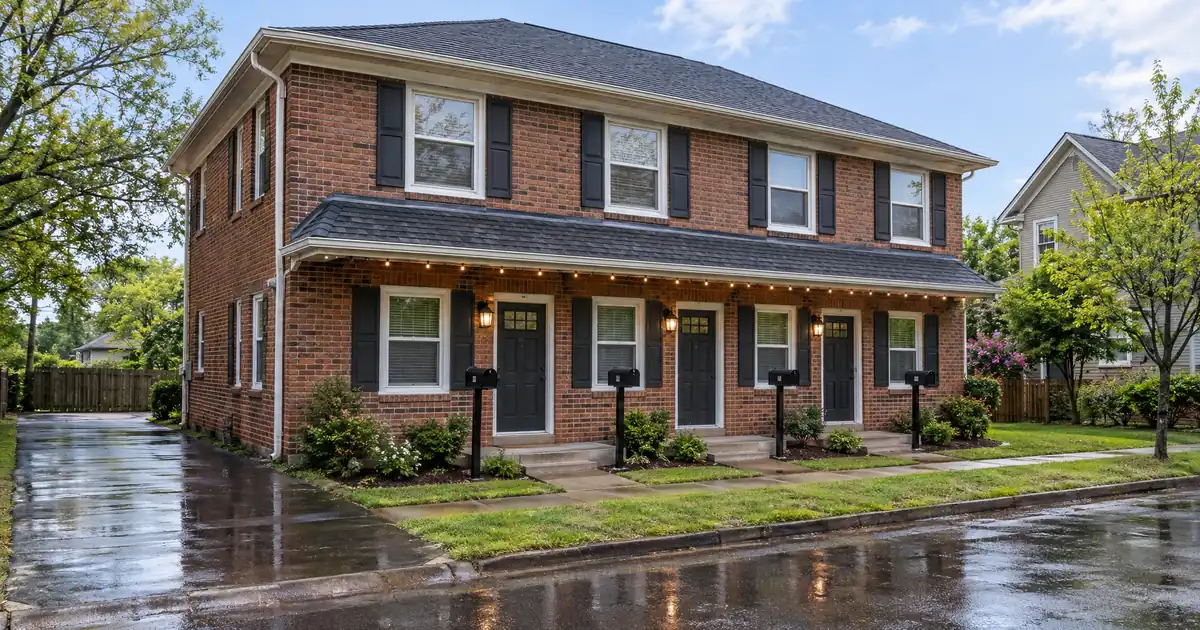
The Quick Read: Not automatically. On a conventional cash-out refinance, a duplex and a fourplex that you live in share the same leverage ceiling: 75% of value. What differs is the appraised value, the debt you owe today, the costs rolled in, and the rules around the building. A fourplex can release more cash than a duplex, the same, or less. The percentage doesn’t decide it. The dollars underneath it do.
What Is the Leverage Limit on a Duplex vs. a Fourplex?
The limit is 75% of appraised value for both. Conventional cash-out refinances on two- to four-unit principal residences sit on one line, so a duplex and a fourplex get the same ceiling. A one-unit home is the exception, at 80%.
Cash-out refinance estimate
The starting figures are an example value with a balance and a cash request in proportion. Replace them with yours.
Editable benchmark: 7.18% as of November 5, 2026 · Freddie Mac 30-year average via FRED®. A conventional market reference, not a cash-out refinance quote.
Illustrative starting assumptions: a $350,000 home value, a $193,000 current balance, the agency cap on a one-unit principal residence, a thirty-year term at the current Freddie Mac benchmark, and property taxes and insurance estimated at typical national rates. Every field is editable.
Illustrative estimate only — not a Loan Estimate, approval, quote, or commitment to lend. The rate field carries the weekly Freddie Mac thirty-year conventional benchmark, a market reference and not a cash-out refinance quote; a cash-out loan is priced by the lender at lock. The cash available is the loan the program cap allows less the balances paid off, before closing costs, which are not included. The HELOC line is the program’s combined loan-to-value ceiling applied to the same value and balance. Taxes and insurance are editable estimates. Licensed in sixteen states for consumer mortgages.
Freddie Mac’s Seller/Servicer Guide groups all two- to four-unit primary residences under a single 75% cash-out line. Fannie Mae’s Eligibility Matrix is the authority for its own caps, and the wholesale programs we place files with follow the same 75% figure for two- to four-unit owner-occupied homes. Terms vary by lender guidelines, property type, leverage, credit profile, and full file review.
Two things follow:
- At least 25% of the building’s value stays in the property after closing, versus 20% on a one-unit home.
- Unit count inside the two-to-four range doesn’t move the cap. If someone told you a fourplex gets a lower ceiling than a duplex, that’s a leftover from older purchase and rate-and-term rules. It doesn’t apply to cash-out.
Lendmire’s cash-out refinance programs page lays out the broader lanes if you want to see where a multi-unit home fits.
Why Can a Fourplex Still Release a Different Amount?
Because the cap is a percentage, and the cash is whatever is left after subtracting what you owe. Same percentage, different base, different result.
The formula has four steps:
1. Take the appraised value of the whole building.
2. Multiply by 75% to get the maximum new loan.
3. Subtract the payoff on your current first mortgage, plus any second lien that must be paid off.
4. Subtract financed closing costs and prepaids. What remains is your cash.
Notice what’s missing: the number of units. A fourplex usually appraises higher than a duplex in the same area, so 75% of its value is a bigger number. But if you also owe more on it, the cash can shrink or vanish. Picture two owners, each with the same loan balance as a share of value. The fourplex owner’s larger building produces a larger dollar gap. Now picture a fourplex owner who bought at the top of a market and carries a heavy balance. Their gap may be smaller than a duplex owner who has paid down more.
That’s the whole answer in miniature. The equity you can release is a function of value minus debt, capped by the percentage. Units are a side issue.
Equity You Have vs. Equity You Can Release
These are different numbers, and mixing them up is a common mistake.
- Equity is value minus what you owe.
- Loan-to-value (LTV) is the new loan divided by value.
- Releasable cash is the maximum loan minus payoff, minus financed costs.
Say your equity is 40% of value. That doesn’t mean you can pull out 40%. The 75% cap means the new loan can’t exceed 75% of value, so you can only reach the gap between your current debt and that ceiling, and costs come off the top. If your current debt is 60% of value, you have 15 percentage points of room before costs. If it’s 70%, you have 5.
The cap limits the loan, not your equity. Freddie Mac’s guide also counts subordinate liens and home equity credit lines in its combined-leverage tests, so a second lien you keep still uses up room.
Duplex vs. Fourplex: Side by Side
Here’s the comparison with unit count isolated. All figures describe conventional, owner-occupied cash-out.
| Factor | Duplex | Fourplex |
|---|---|---|
| Maximum LTV | 75% | 75% |
| Rent from other units | One rented unit | Up to three rented units |
| Appraisal comparables | Usually more available | Often fewer available |
| Typical value and payoff | Usually smaller | Usually larger |
The first two rows are identical. The rent and comparables rows describe typical patterns, not rules, and your building may differ.
Does Unit Count Change Anything at All?
Yes, but in the file, not in the cap. Four things move.
Appraisal. Two- to four-unit properties are appraised on a small residential income property report, which looks at rents and comparable multi-unit sales. A fourplex has fewer true comparables in most areas, so the appraisal can take more work and sometimes lands with more variance than a single-family home. That swing flows straight into your maximum loan.
Qualifying income. Rent from the unit you occupy generally can’t count. Rent from the other units can, within agency limits and with support such as leases or the appraisal’s rent schedule. A fourplex owner living in one unit has three rented units to point to. A duplex owner has one. That can help a debt-to-income ratio, but it doesn’t raise the leverage cap.
Reserves. Larger buildings can bring higher reserve expectations from the lender, and the borrower’s profile matters. These are file requirements, not a different LTV rule.
Existing debt. A fourplex tends to carry a bigger loan. That’s the quiet reason it might release less despite higher value.
A practitioner’s note: on multi-unit owner-occupied files, the line item that surprises people is the payoff, not the cap. Owners estimate their equity from a purchase price or an old appraisal, then the new appraisal comes in lower or the payoff includes a second lien they forgot about. Pulling a current payoff statement before running the numbers saves a lot of disappointment.
A Worked Example With Percentages
Let’s keep this in percentages of value, since the dollars depend on your building.
Owner A (duplex). Existing debt is 55% of value. The cap is 75%. Room before costs is 20 points of value. Financed costs take a slice of that. The remainder is cash.
Owner B (fourplex). Existing debt is 55% of value. The cap is 75%. Same 20 points of room, same slice for costs in proportion. Because the building’s value is larger, 20 points of it is more dollars than 20 points of the duplex’s value.
Owner C (fourplex, heavier debt). Existing debt is 72% of value. Room is 3 points before costs. Costs can consume most or all of it. This owner may not have a cash-out worth doing.
Same cap, three outcomes. The first two differ only by building size. The third shows why debt level beats unit count.
Reverse Math: Start With the Cash You Want
If you have a target, work backward. The new loan has to equal your payoff plus financed costs plus your target cash. That total, divided by appraised value, has to come in at or under 75%.
- If the result is under 75%, the target fits.
- If it’s over, you need a higher appraisal, a smaller target, or a lower payoff.
- If it’s right at 75% with no room, any shortfall in the appraisal will erase the margin.
Run this with a conservative value, not an optimistic one. Appraisals on small multi-unit buildings can come in under what an owner expects.
What Shrinks Your Number
- Appraised value. The biggest swing factor on a multi-unit building.
- Payoff and liens. Your first mortgage plus any second lien that must be cleared.
- Financed closing costs and prepaids. Fannie Mae’s Selling Guide treats a refinance as cash-out when proceeds exceed the payoff and financed costs, and those financed costs sit inside the new loan, so they reduce net cash.
- Seasoning. The first mortgage being paid off must be at least 12 months old, measured note date to note date, and a borrower must have been on title for six months. Exceptions exist for delayed financing after an all-cash purchase, inheritance, and legal awards. Subject to lender guidelines.
- Occupancy. Everything above assumes you live in the building. A non-owner-occupied two- to four-unit property is a different product with its own leverage, and it’s outside the scope here.
- Credit and ratios. The wholesale conventional programs start at a 620 decision score, with a total ratio ceiling of 50% on most automated files. These are subject to full file review.
Do Government Loans Change the Picture?
Somewhat, and the gap is smaller than people assume.
FHA. HUD Mortgagee Letter 2019-11 cut the maximum cash-out leverage from 85% to 80% of adjusted value for case numbers on or after September 1, 2019, as Consumer Finance Monitor reported. That narrowed the old advantage over conventional. FHA also has county loan limits and carries mortgage insurance, and the borrower must occupy the home. Exact terms depend on the lender’s guidelines, property type, leverage, and a full review of the borrower’s file.
VA. VA states a veteran can refinance up to 100% of the appraised value on a home they own and occupy, and VA-backed loans can cover up to four units when the veteran lives in one. In practice, lenders often set lower caps than VA’s ceiling, and entitlement can limit sizing. The duplex and fourplex are treated alike.
Streamlines. The FHA Streamline and VA IRRRL are for people who already hold an FHA or VA loan, and they aren’t built to release equity. If cash is the goal, they aren’t the tool.
Where that leaves you. A veteran living in a fourplex may be able to reach more leverage than the conventional cash-out limit of 75% on two- to four-unit properties. A non-veteran has two routes: an FHA cash-out at 80% of adjusted value, which requires living in the home, or a conventional cash-out with 75% as the working ceiling on a fourplex.
Should You Take the Maximum?
Not necessarily. The maximum is a ceiling, not a recommendation.
Taking less can make sense when:
- The new payment would stretch your budget, since it covers the whole bigger loan, not just the cash you receive.
- Your current loan is a good one and the cash need is small. A smaller second-lien option may leave the first loan alone.
- The cash would sit idle. Borrowing against a building you live in and then parking the money isn’t free.
Taking the maximum can make sense when the use of funds is concrete and the larger loan still fits comfortably in your ratios. (A renovation that raises rents on the other units is the classic case, though that’s a judgment call, not a promise.)
Also remember that a refinance of your principal residence carries a three-business-day right of rescission, so funds aren’t disbursed until that window passes. The CFPB explains the right in plain terms.
Key Terms Defined
Cash-out refinance: a new mortgage that pays off the old one and gives you the difference in cash.
LTV (loan-to-value): the first mortgage amount divided by the property’s appraised value.
Seasoning: the minimum time you must have owned the home or held the loan before a cash-out is allowed.
Subordinate lien: a second loan or credit line sitting behind the first mortgage.
Limited cash-out refinance: a refinance that allows only incidental cash back, also called rate-and-term.
Frequently Asked Questions
Does a fourplex release more cash than a duplex?
It can, but not because of the unit count. Both share the same 75% conventional cap on an owner-occupied home. A fourplex usually appraises higher, which raises the maximum loan, but a larger existing balance can cancel that out. Run value, payoff and costs for your own building.
Can I take all of my equity out?
No. The cap limits the new loan to 75% of value on a conventional two- to four-unit primary residence, so at least a quarter of the value stays in the building. Closing costs financed into the loan reduce your cash further. VA may allow more leverage for eligible veterans, subject to lender guidelines.
Does the rent from the other units count toward qualifying?
Often, within limits. Rent from the units you don’t occupy can generally be used, supported by leases or the appraisal’s rent schedule. Rent from your own unit generally can’t. Lenders may ask for rental history, and this affects your ratios, not the leverage cap.
What if I just bought the building?
There’s a wait. The loan being refinanced generally must be at least 12 months old, and a borrower must have been on title for six months. Delayed financing is an exception for recent all-cash buyers, and it’s priced as cash-out. All other requirements still apply.
Is a cash-out the same as a rate-and-term refinance on a fourplex?
No. Rate-and-term allows only incidental cash back and has its own leverage rules, while cash-out releases equity under the 75% line. The higher leverage on some rate-and-term programs doesn’t carry over to cash-out. Which one fits depends on whether cash is the goal.
If you are weighing a cash-out refinance against keeping the loan you have, Lendmire can help you compare the programs and the equity each one reaches. Every figure here is subject to lender guidelines and full file review, and nothing here is a commitment to lend.
For your own numbers, request a scenario review with Lendmire.
For current guidelines and terms, see Lendmire’s refinance programs page.
About Lendmire
As a mortgage broker (NMLS# 2371349), Lendmire helps homeowners and home buyers in 16 states with FHA, VA, conventional and jumbo purchase and refinance loans arranged through wholesale lenders. Lendmire is never the lender; program terms are set by the lender and the agency guidelines. Scotsman Guide named Lendmire a Top Mortgage Workplace in both 2025 and 2026.
Get Started
Ready to find the right loan for you?
See your offer in seconds. No credit pull, no obligation.
Informational only. Not a Loan Estimate, approval, or commitment to lend. Program availability and eligibility are subject to lender guidelines, credit approval, property review, and underwriting.
References
1. Freddie Mac Seller/Servicer Guide §4203.1
2. Fannie Mae Eligibility Matrix
3. Fannie Mae Selling Guide B2-1.3-03
5. VA Cash-Out Refinance Home Loans
This article is part of Lendmire’s cash-out refinance program — full qualification details, guidelines, and scenarios live on the program page.
Related reading: How Much Cash Comes Out of a Cash-Out Refinance to Access Cash From Home Equity? · How Much Cash Comes Out of a Cash-Out Refinance on One Income?
Brandon Miller
Founder & CEO, Mortgage Loan Originator, Lendmire LLC
- Mortgage Loan Originator · NMLS# 1129696 · Verify on NMLS Consumer Access
- North Carolina Real Estate Broker · License# 343312 · Verify on NCREC
- North Carolina Insurance Producer · License# 19053198 · Property, Casualty, Life, Health · Verify on NAIC SBS
- Lendmire LLC · Firm NMLS# 2371349 · Verify firm licensure
Disclosures. The information presented in this article is general market commentary, not financial, legal, or tax advice. Lendmire is a mortgage brokerage (NMLS# 2371349) — not a direct lender or depository institution — and loan placement is subject to lender underwriting. Nothing in this content represents a commitment to lend. Loan terms, pricing, and program availability vary based on borrower qualifications, property characteristics, and state of subject property, and are subject to change at any time. Lendmire complies with Equal Housing Opportunity requirements. Consumer access: nmlsconsumeraccess.org.