
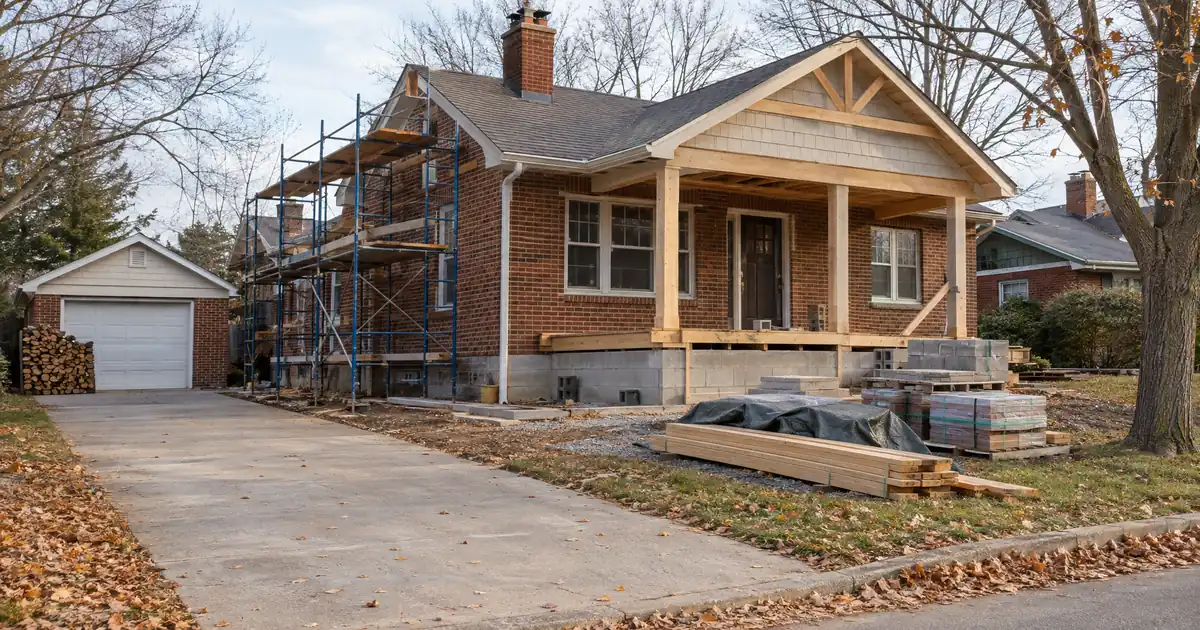
The Quick Read: Sometimes, but finishing the rehab is not what unlocks the loan. Two clocks decide it: how long a borrower has been on title, and how old the mortgage being paid off is. Both start at the purchase or the original loan, not at the end of construction. A narrow exception called delayed financing helps some cash buyers, and it recovers what was spent, not the new value created.
What Actually Gates a Cash-Out After a Rehab?
Two clocks gate it: time on title and the age of the loan being paid off. A finished rehab starts neither one.
Cash-out refinance estimate
The starting figures are an example value with a balance and a cash request in proportion. Replace them with yours.
Editable benchmark: 7.24% as of October 29, 2026 · Freddie Mac 30-year average via FRED®. A conventional market reference, not a cash-out refinance quote.
Illustrative starting assumptions: a $350,000 home value, a $193,000 current balance, the agency cap on a one-unit principal residence, a thirty-year term at the current Freddie Mac benchmark, and property taxes and insurance estimated at typical national rates. Every field is editable.
Illustrative estimate only — not a Loan Estimate, approval, quote, or commitment to lend. The rate field carries the weekly Freddie Mac thirty-year conventional benchmark, a market reference and not a cash-out refinance quote; a cash-out loan is priced by the lender at lock. The cash available is the loan the program cap allows less the balances paid off, before closing costs, which are not included. The HELOC line is the program’s combined loan-to-value ceiling applied to the same value and balance. Taxes and insurance are editable estimates. Licensed in sixteen states for consumer mortgages.
Across the wholesale programs Lendmire places files with, the conventional cash-out rules read the same way. At least one borrower must have been on title for 6 months. The first mortgage being paid off must be at least 12 months old, counted note date to note date. Both Fannie Mae and Freddie Mac set the title test. Freddie Mac’s Guide requires at least one borrower on title for six months before the note date.
Neither guide appears to say that a rehab, or the money spent on it, shortens or resets that clock.
Note the phrase “at least one borrower.” The six months does not have to apply to everyone on the new loan.
Key Terms Defined
Seasoning: The minimum time a borrower has owned the home, or a loan has existed, before a new loan can be based on it.
Title clock: The months a borrower has been on title, counted from the acquisition date, not from the end of renovation.
Loan-age clock: The age of the existing first mortgage, counted from its note date to the new note date.
Cash-out refinance: A new mortgage that pays off the old one and delivers cash beyond closing costs and certain payoffs.
Limited cash-out (rate-and-term) refinance: A refinance that pays off the existing first mortgage, closing costs and a purchase-money second lien, with only incidental cash back.
Delayed financing: An exception that lets a cash buyer borrow against the home before the six months pass, under set conditions.
How Do the Two Clocks Compare?
| Clock | What it measures | When it starts |
|---|---|---|
| Title clock | Time on title | Purchase or acquisition date |
| Loan-age clock | Age of the loan being paid off | Note date of that loan |
| Rehab completion | Nothing in the guides | Not a trigger |
The title clock is the one most people trip on. A buyer who closes on a fixer, spends months renovating, and then calls a lender is often surprised. The renovation months do count, because they sit inside the ownership period. The point is that the date of the final inspection counts for nothing by itself.
The loan-age clock matters when the purchase or rehab was financed. If a short-term or rehab loan is being paid off, that loan’s age becomes its own test. A 12-month seasoning requirement can apply to the first mortgage being paid off. A separate check on any renovation loan you carry is worth doing early.
What Does the Lender Use to Size the Loan?
The lender sizes a standard cash-out on appraised value, within the program’s leverage cap. Delayed financing is different: it is limited by what you documented spending, not by the new value.
On a standard conventional cash-out, the maximum is 80% loan-to-value on a one-unit principal residence. It is 75% on two- to four-unit principal residences and on second homes. After a rehab, the appraisal is where the work shows up. A freshly renovated home can appraise well above what you paid, and that can lift the dollar amount available within the cap.
Under delayed financing, the logic flips. Fannie Mae and Freddie Mac tie the exception to the borrower’s documented investment, so it works as a way to get your cash back, not to harvest equity from the improvements. Delayed financing is also treated as cash-out for pricing and leverage, so the same leverage caps apply.
| Situation | Typical basis for the loan |
|---|---|
| Past six months on title, seasoned loan | Appraised value, within the cap |
| Cash buyer under six months (delayed financing) | Documented purchase cost plus qualifying costs |
| Financed purchase under six months | Generally not eligible for cash-out yet |
Can a Cash Buyer Skip the Wait?
Often yes, through delayed financing. It exists for borrowers who paid cash and want that money back before the six months are up.
Where no borrower has six months on title, the purchase Settlement or Closing Disclosure must show that no financing secured by the property was used to buy it. More conditions apply, including documenting where the purchase funds came from.
Picture a buyer who purchased a dated property outright, funded a gut renovation from savings, and wants to replenish the account. If the closing disclosure shows no mortgage on the purchase, delayed financing may apply. The loan would reimburse documented costs, not capture a larger appraised value.
The exception fails when the purchase was financed. A short-term loan secured by the property breaks the no-financing condition, and the borrower generally waits out the clock. Paying off that loan at closing may also be treated as cash-out rather than a limited refinance, so check the classification with your loan officer before assuming otherwise.
Other exceptions exist, including those tied to inheritance and legal awards. Fannie Mae’s treatment of ownership from the date of transfer in those cases should be confirmed against the guide before you plan around it.
Does a Renovation Reset the Waiting Period?
No, as far as the agency guides read. Finishing the work neither restarts the clock nor shortens it.
Some online pages assert a special seasoning rule for substantial renovations without pointing to a guideline. The two agency sections reviewed for this piece frame the test around acquisition and title, with no renovation trigger. If a lender tells you otherwise, ask which guide section or internal overlay the answer comes from.
Three related misconceptions come up often:
- “Delayed financing works for any recent purchase.” It does not. It requires a purchase without secured financing.
- “Six months applies to every borrower.” It applies to at least one borrower.
- “A cash-out after a rehab is just a regular refinance.” It is classified and priced as cash-out, with loan-level price adjustments that a rate-and-term refinance does not carry.
Why Do Lenders Give Different Answers?
Because agency rules, lender overlays and rule changes over time all get mixed together in conversation. Two lenders can both be right and still say different things.
The agencies set the baseline. A wholesale lender may add stricter requirements on top, such as a higher score floor or extra documentation. Rule versions also change, and an answer that was correct on an older guide can be stale now. When you shop, ask these questions:
- Which clock are you applying, title or loan age, and from what date?
- Does my purchase or rehab financing break the delayed-financing condition?
- Would paying off my rehab loan be treated as cash-out?
- Do you apply any requirement beyond the agency guide?
A file that is clean on paper, with dated closing disclosures and funding-source records, tends to get cleaner answers. Eligibility problems often come from documentation, not from the rules themselves.
What Does the Appraiser Look At on a Fresh Rehab?
The appraiser values the home as it stands, comparing it to recent sales nearby. A completed renovation can support a higher value, but only if the work is finished, visible and comparable to what sold.
Helpful items to have ready:
- A list of completed work with dates
- Permits and final sign-offs where required
- Receipts or contracts showing what was spent
- Photos of the before and after condition
Unfinished work, unpermitted changes or comps that do not match the improved quality can hold the value down. Gathering this before the appraisal is cheap. It does not guarantee a number.
What If You Are Too Early?
If the clocks have not run, you have three realistic paths, and the right one depends on how the rehab was funded and what you need the money for.
| Your situation | Likely path |
|---|---|
| Cash purchase, cash rehab, under six months | Ask about delayed financing |
| Financed purchase or rehab loan, under the clocks | Wait, or look at a limited cash-out if the loan is reviewed |
| Past both clocks | Standard cash-out, sized on appraised value |
| Need renovation money, not yet spent | Ask about renovation loan programs |
A rate-and-term refinance does not carry the cash-out seasoning rules in the same way. It reaches 95% loan-to-value on a one-unit principal residence, and it allows only incidental cash back. If your goal is simply to replace a short-term loan with a long-term one, it may fit. If your goal is to pull equity, it will not.
Fannie Mae’s HomeStyle and Freddie Mac’s CHOICERenovation are the renovation-financing products. Their terms vary by lender and change over time, so ask a loan officer about them directly if you still have work to fund.
Here is a plain timeline. A buyer closes on the home. Months of rehab follow. The home is finished, maybe rented or lived in, and then an appraisal is ordered. If the title clock and loan-age clock have both been met by the closing date, the standard cash-out can proceed. If they have not, the loan cannot close as a standard cash-out yet, because the closing date, not the application date, is what the guides test. A borrower can often apply early but cannot close until the period ends.
How Does This Fit the Rest of Your Qualification?
The six-month rules are only one gate. Everything else works like any cash-out refinance.
- Credit: The wholesale conventional programs start at a 620 decision score, subject to lender guidelines.
- Ratios: The automated finding governs most files, with a total ratio ceiling of 50%.
- Mortgage insurance: Required above 80% loan-to-value on most conventional loans, though a standard cash-out stays at or under 80%.
- A special lane: One wholesale lane reaches 89.99% loan-to-value with no mortgage insurance at a 680 score and a 50% ratio. It is limited to a thirty-year fixed on a primary residence at a conforming balance, and it carries its own six months of seasoning. In Texas, a cash-out on the homestead is capped by the state constitution at the agency figure, and that wholesale lane is not written there.
If the home is a second home or a rental, occupancy changes the leverage, and the figure above for two- to four-unit and second homes is 75%. That is the only note this article needs on that point.
Refinancing swaps an existing loan for a new term, and closing costs apply. How much a household nets depends on the full file, so compare programs rather than a single headline number.
Frequently Asked Questions
Can I cash out the day the rehab ends?
Usually not. The guides test time on title and the age of the loan being paid off, and neither starts at the end of construction. A cash buyer who meets the delayed-financing conditions is the main exception, and that route recovers documented costs.
Does finishing early shorten the wait?
No. Nothing in the agency sections reviewed ties seasoning to rehab completion. The clock runs from acquisition, so an early finish only means the home is ready to appraise sooner.
Does a hard-money or short-term loan payoff count as cash-out?
It can, depending on how the payoff is classified. Paying off a loan taken for the rehab may be classified as cash-out rather than a limited refinance, and the age of that loan can matter. Ask your loan officer to confirm how your payoff would be treated before you plan around it.
What if I paid cash for the rehab?
If the purchase was also cash and the closing disclosure shows no secured financing, delayed financing may let you borrow before the six months pass. The loan is tied to your documented investment, not the improved value.
Does only one borrower need to meet the six months?
Yes. Both Fannie Mae and Freddie Mac say at least one borrower on title for six months. Confirm with your lender how it applies to your file, since lenders can layer their own requirements.
Where Does This Leave You?
If you are within the clocks and your funds came from cash, ask about delayed financing. If you financed the purchase or rehab, plan around the calendar and gather your paperwork now. If you are past both clocks, the appraisal does the heavy lifting.
If you are weighing a cash-out refinance against keeping the loan you have, Lendmire can help you compare the programs and the equity each one reaches. Start with Lendmire’s cash-out refinance programs page. Program figures are subject to lender guidelines and full file review, and nothing here is a commitment to lend.
For your own numbers, request a scenario review with Lendmire.
About Lendmire
Lendmire — NMLS# 2371349 — is a mortgage broker that arranges FHA, VA, conventional and jumbo home purchase and refinance financing in 16 states through wholesale lenders. Every option is subject to the lender’s guidelines and full underwriting. Scotsman Guide named Lendmire a Top Mortgage Workplace in both 2025 and 2026.
For the program’s current guidelines, see conventional loan programs.
Get Started
Ready to find the right loan for you?
See your offer in seconds. No credit pull, no obligation.
Informational only. Not a Loan Estimate, approval, or commitment to lend. Program availability and eligibility are subject to lender guidelines, credit approval, property review, and underwriting.
References
1. Freddie Mac Seller/Servicer Guide 4301.5 Cash-out refinance Mortgages
This article is part of Lendmire’s cash-out refinance program — full qualification details, guidelines, and scenarios live on the program page.
Related reading: How Much a Conventional Loan Refinance Lowers a Payment · How to Find Out Whether Your Conventional Loan Is Fannie or Freddie · Can You Waive Escrow on a Conventional Loan After Closing?
Brandon Miller
Founder & CEO, Mortgage Loan Originator, Lendmire LLC
- Mortgage Loan Originator · NMLS# 1129696 · Verify on NMLS Consumer Access
- North Carolina Real Estate Broker · License# 343312 · Verify on NCREC
- North Carolina Insurance Producer · License# 19053198 · Property, Casualty, Life, Health · Verify on NAIC SBS
- Lendmire LLC · Firm NMLS# 2371349 · Verify firm licensure
Required disclosures. Lendmire (NMLS# 2371349) operates as a licensed mortgage broker, not a direct lender or depository. The discussion in this article is general in nature and should not be relied upon as financial, legal, or tax advice — every investment scenario is unique and should be reviewed by a qualified professional. Any loan inquiry is subject to lender underwriting, and this article is not a commitment to lend or a guarantee of approval. Mortgage rates, loan terms, and program guidelines vary by borrower, property, and state, and may change without notice. Equal Housing Opportunity. Verify licensure at NMLS Consumer Access.