
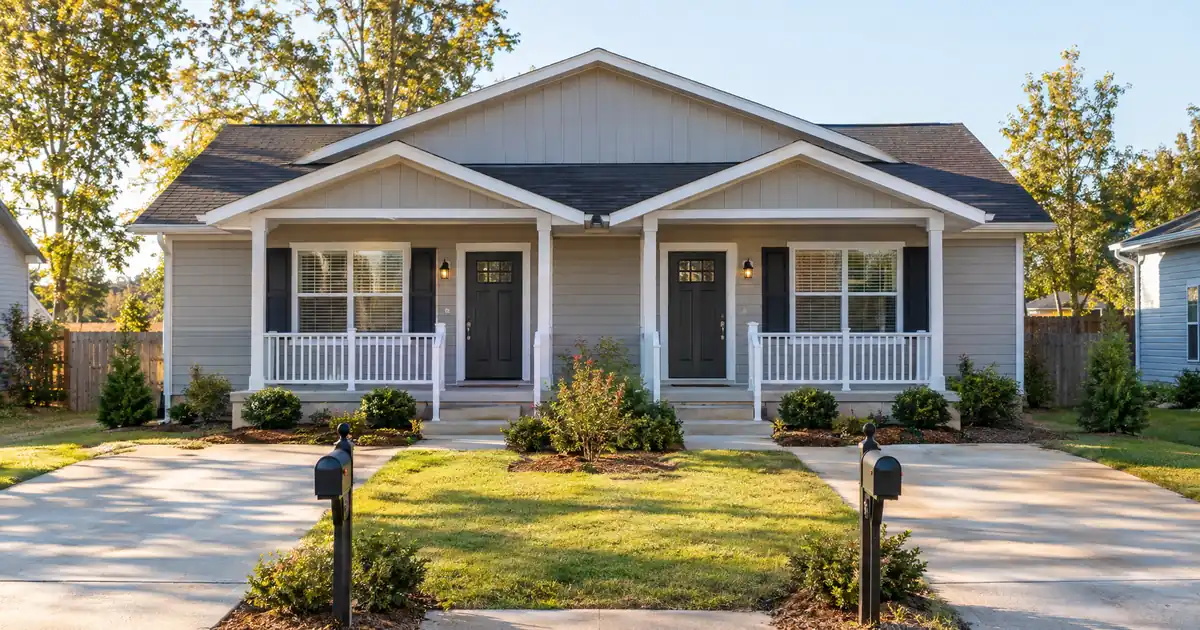
The Quick Read: Usually not, unless the cash solves a problem that costs more than the loan you would give up. An FHA cash-out refinance replaces your entire mortgage, so the new rate, new term and new mortgage insurance apply to the whole balance, not just the cash you pull out. On a duplex you live in, that trade can still make sense when the existing loan is not especially cheap, when you cannot add a second loan, or when the cash pays off higher-cost debt or funds work on the second unit.
What an FHA Cash-Out Actually Replaces
An FHA cash-out refinance pays off your current first mortgage and puts a new, larger FHA loan in its place. The difference between the new balance and the payoff, after costs, comes to you as cash. Nothing from the old loan carries over. The rate goes. The remaining term goes. The balance you have already paid down gets re-borrowed.
FHA cash-out estimate
Seeded with an example value, a balance to match, and a round cash request; change any field.
Editable benchmark: 7.24% as of October 29, 2026 · Freddie Mac 30-year average via FRED®. A conventional market reference, not an FHA cash-out refinance quote.
Illustrative starting assumptions: a $350,000 home value, a $193,000 current balance, the FHA cap on a principal residence with the upfront premium financed, a thirty-year term at the current Freddie Mac benchmark, and property taxes and insurance estimated at typical national rates. Every field is editable.
An illustration, not a Loan Estimate, an approval, a quote, or a commitment to lend. The rate shown is the weekly Freddie Mac thirty-year conventional benchmark, used as a market reference; an FHA cash-out is priced by the lender at lock, and this is not an FHA cash-out refinance quote. HUD’s cap limits the base loan; the upfront premium is financed on top of the capped base loan; the monthly premium for the first year follows the snapshot’s schedule. Cash available means the base loan the cap permits less the balances retired, before closing costs, which this calculator leaves out. The line figure applies the line program’s combined loan-to-value ceiling to the same value and balance. Taxes and insurance are estimates you can edit. Licensed in sixteen states for consumer mortgages.
That is the part people miss. A common assumption is that you only “pay the new rate on the cash.” You don’t. The new rate sits on the full balance.
Across the wholesale programs Lendmire places FHA loans with, the cash-out option reaches 80% of the home’s value, and the home must have been owned and occupied for 12 months before the case number is assigned. Those are program figures, subject to lender guidelines and full file review. Lendmire’s FHA cash-out refinance program page lays out how the product fits into the broader FHA lineup.
Does a Duplex Qualify?
Yes, with a condition: you must live in one of the two units as your principal residence. FHA is an owner-occupant program for one to four units. If you moved out and rent both sides, the FHA cash-out is no longer the right tool, and occupancy decides the leverage on whatever you pursue instead.
The rules for the property itself are written in HUD’s Single Family Housing Policy Handbook 4000.1. That handbook governs eligibility, seasoning, appraisal and how rental income is treated. Read the current version before you rely on any summary, including this one.
On a duplex, three things change compared with a single-family home:
- The appraisal covers both units, and the appraiser reports on the second unit.
- Rent from the other unit may help you qualify, but only if it is documented under HUD’s rules. It does not count automatically.
- The file carries more paper: leases, proof of the rent actually being collected, and a clear picture of which unit you occupy.
What You Give Up: The Ledger
The cost of a cash-out is rarely the cash itself. It is everything the old loan was doing for you quietly. Here is the ledger for a duplex owner with a low existing rate.
| What you hold now | What an FHA cash-out does |
|---|---|
| Your existing rate | Replaced for the full balance |
| Years already paid down | Term resets on the new loan |
| Current mortgage insurance (if any) | New upfront and annual premiums start |
| Existing equity | Reduced to the 80% leverage cap |
| Existing closing history | New appraisal, title and lender costs |
The rate. This is the headline loss. If your current rate is well below what is available today, you are paying that gap on the entire balance for as long as you hold the new loan.
The term. Restarting a thirty-year clock lowers the pace of principal paydown. Even if the monthly number looks similar, total interest over the life of the loan can rise.
Mortgage insurance. In the programs Lendmire places, FHA carries an upfront premium of 1.75% of the base loan, which is financed into the balance. The annual premium runs between 0.15% and 0.75% of the balance depending on term, loan amount and LTV. On a thirty-year loan above 90% LTV, the annual premium lasts for the term. At or below 90% LTV, it ends after eleven years. Because a cash-out tops out at 80%, that lower-LTV schedule is the one that generally applies, subject to the actual file. These are program facts, not prices, and HUD publishes the governing rules.
The costs to get there. You pay for a new appraisal, title work and lender charges, plus the financed upfront premium. These are usually rolled into the balance or taken out of your proceeds. Your net cash is always less than your equity, and it is smaller still after the payoff and costs.
When Is the Trade Not Worth It?
Say you hold a first mortgage well below today’s market and you want cash for a kitchen in your unit. The new rate covers the whole balance, so you would be raising the cost of every dollar you owe to fund one project. For most owners in that spot, that is a bad trade.
Skip the cash-out when:
- Your current rate is clearly below the market and you plan to stay in the home a long time.
- You only need a modest amount of cash relative to your balance.
- You are close to paying the loan off and a term reset would undo years of progress.
- You can fund the need another way without touching the first loan.
The lock-in is an asset. Giving it up needs a reason that outweighs it.
When Does an FHA Cash-Out Still Make Sense?
It can win in narrower cases. The first is a first mortgage that is not low-cost. If your current rate is at or above what is available now, you are not giving up much, and the cash comes bundled with a fresh loan.
The second is the borrower who cannot qualify for a second loan behind the first. A home equity loan or line keeps your first mortgage intact, but it depends on the lender’s appetite, your equity and your credit. FHA has no direct home equity line product, so the choice is not like-for-like.
The third is a purpose that pays for itself. Retiring high-cost consumer debt, or putting money into the second unit so it rents better, can shift the math. A larger loan costs more each month, so the borrowing has to buy something worth more than that.
The fourth is where FHA’s credit flexibility matters. Across the wholesale programs Lendmire places, FHA starts at a 580 decision score, which can reach borrowers who sit below some conventional floors. That flexibility is the real draw. It is not a reason to cash out if the rest of the numbers fail.
Break-Even and Hold-Period Test
Three questions settle most of these decisions. Answer them before you apply.
1. How long will you keep this home? The longer you hold, the longer you pay the new rate on the full balance. Short holds make closing costs harder to recover.
2. What does the cash replace? If it replaces debt that costs more than the new loan, you may come out ahead. If it funds a want rather than a need, the reset is harder to justify.
3. Could you get the same cash without touching the first loan? If a second lien, savings or a smaller project does the job, keep the lock-in.
If the answers point toward a long hold, a modest need and a low existing rate, leave the loan alone.
Comparing the Alternatives
| Option | Keeps your first loan? | Cash available? |
|---|---|---|
| FHA cash-out refinance | No, replaced | Yes, up to 80% LTV |
| Second lien (home equity loan or line) | Yes | Yes, lender-dependent |
| FHA Streamline | No, replaced | No cash |
| Conventional cash-out | No, replaced | Yes, different limits |
| Savings or personal loan | Yes | Limited |
One point trips up owners who already hold an FHA loan on the duplex. The FHA Streamline refinances an existing FHA loan with no appraisal and a limited credit review, but it requires a net tangible benefit and it cannot pay out cash. If you want a lower payment only, the streamline is the comparison. If you want cash, it is not the tool. The mortgage insurance premium also continues on a streamline.
Conventional cash-out carries its own limits, mortgage insurance rules and multi-unit treatment, so compare it on the same sheet rather than assuming either way.
Duplex-Specific File Friction
Duplex files stall on documentation, not on the idea. The pieces to line up before you apply:
- Occupancy proof. Show clearly which unit is your principal residence.
- Lease evidence. A signed lease for the second unit, plus proof the rent is actually being paid.
- Seasoning. A full 12 months of ownership and occupancy before the case number, with a clean recent payment history on the current loan.
- Appraisal access. Both units need to be reachable for the appraiser. A tenant who will not allow entry creates a problem.
- Rental income treatment. HUD’s rules decide whether and how the rent counts toward qualifying, so do not assume it offsets your obligations until the file is reviewed.
Files that assume the seasoning away, or that count rent without paperwork, are the ones that get kicked back.
The new loan also comes with a Loan Estimate and a Closing Disclosure. The CFPB’s Owning a Home hub explains both and how to compare costs across offers. Use the Loan Estimate to see what the cash really costs before you commit.
Key Terms Defined
Cash-out refinance: A new mortgage that pays off your old one and gives you the difference in cash.
Seasoning: The length of time you must have owned and lived in the home before you can use the program.
LTV (loan-to-value): The loan balance as a percentage of the home’s appraised value.
Upfront premium: The FHA mortgage insurance charge added to the loan balance at closing.
Net tangible benefit: The test an FHA Streamline must pass to show the borrower comes out ahead.
Principal residence: The home you actually live in most of the year.
Frequently Asked Questions
Will I lose my low rate if I do an FHA cash-out?
Yes. The new rate applies to the full new balance, not only the cash you take out. Your old rate and remaining term are gone once the new loan replaces the old one.
Do I need to already have an FHA loan?
No. A cash-out refinance can replace a loan of another type. The FHA Streamline is different: it only refinances an existing FHA loan, and it does not pay out cash.
Can rent from the other unit help me qualify?
It may, but only under HUD’s documentation rules for two-to-four unit properties. Expect to provide leases and proof of payment, and expect the lender’s review to decide how it counts.
Does mortgage insurance apply to a cash-out?
Yes. The FHA premium has an upfront part that is financed and an annual part. At 80% LTV on a thirty-year loan, the annual premium generally ends after eleven years, subject to the specific file.
Is a home equity loan or line better than a cash-out?
It can be, when your first mortgage is low and the amount you need is modest, because it leaves the first loan in place. It depends on your equity, your credit and what lenders will offer. Compare total cost on the Loan Estimate rather than the advertised number alone.
Next Step
If you are weighing a cash-out refinance against keeping the loan you have, Lendmire can help you compare the programs and the equity each one reaches. Program figures are subject to lender guidelines and full file review, and nothing here is a commitment to lend.
For your own numbers, request a scenario review with Lendmire.
About Lendmire
As a mortgage broker (NMLS# 2371349), Lendmire helps homeowners and home buyers in 16 states with FHA, VA, conventional and jumbo purchase and refinance loans arranged through wholesale lenders. Lendmire is never the lender; program terms are set by the lender and the agency guidelines. Scotsman Guide named Lendmire a Top Mortgage Workplace in both 2025 and 2026.
Get Started
Ready to find the right loan for you?
See your offer in seconds. No credit pull, no obligation.
Informational only. Not a Loan Estimate, approval, or commitment to lend. Program availability and eligibility are subject to lender guidelines, credit approval, property review, and underwriting.
References
This article is part of Lendmire’s FHA cash-out refinance program — full qualification details, guidelines, and scenarios live on the program page.
Related reading: VA Cash-Out vs FHA Cash-Out for a Former Service Member’s Spouse · How to Exit FHA Mortgage Insurance Instead of an FHA Cash-Out · Best FHA Cash-Out Refinance Program With an Existing HUD-Insured FHA Mortgage
Brandon Miller
Founder & CEO, Mortgage Loan Originator, Lendmire LLC
- Mortgage Loan Originator · NMLS# 1129696 · Verify on NMLS Consumer Access
- North Carolina Real Estate Broker · License# 343312 · Verify on NCREC
- North Carolina Insurance Producer · License# 19053198 · Property, Casualty, Life, Health · Verify on NAIC SBS
- Lendmire LLC · Firm NMLS# 2371349 · Verify firm licensure
Required disclosures. Lendmire (NMLS# 2371349) operates as a licensed mortgage broker, not a direct lender or depository. The discussion in this article is general in nature and should not be relied upon as financial, legal, or tax advice — every investment scenario is unique and should be reviewed by a qualified professional. Any loan inquiry is subject to lender underwriting, and this article is not a commitment to lend or a guarantee of approval. Mortgage rates, loan terms, and program guidelines vary by borrower, property, and state, and may change without notice. Equal Housing Opportunity. Verify licensure at NMLS Consumer Access.