
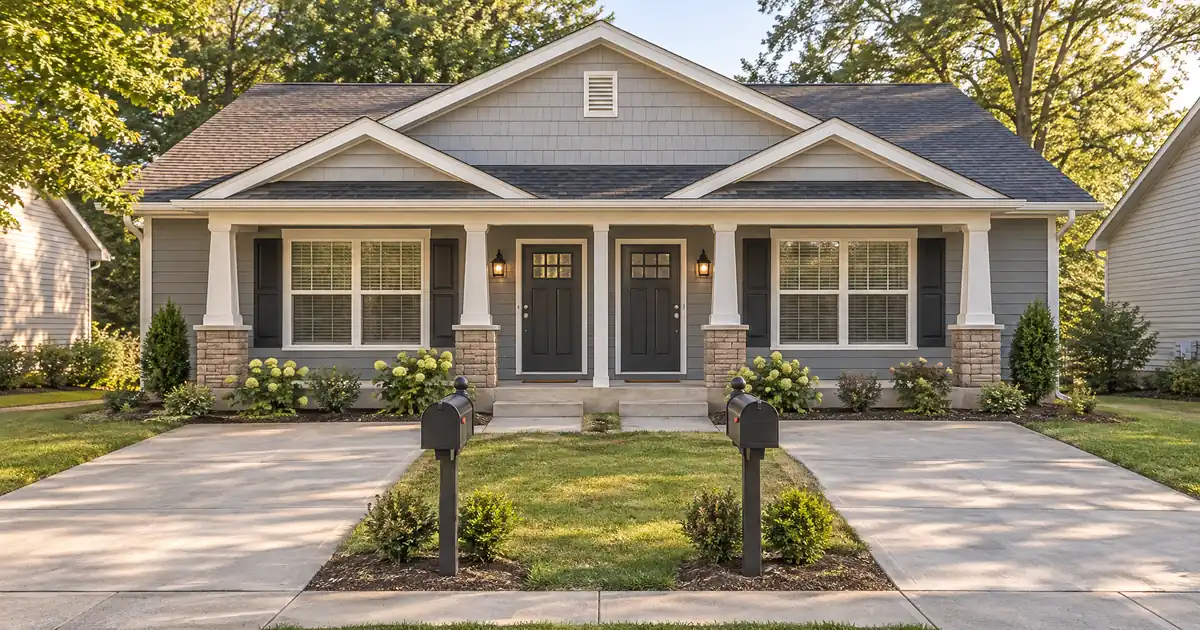
The Quick Read: On a duplex, the reserve requirement depends on how the file is underwritten, not on a single blanket rule. A file that gets an automated approval has no duplex-specific reserve line in HUD’s automated section, while a manually underwritten file needs one month of mortgage payment in verified liquid funds after closing. The cash you take out at settlement never counts toward those reserves. Every figure here is subject to lender guidelines and full file review.
That short answer hides a few moving parts, and the contradictions you may have seen online come from them. This guide walks through the mechanics step by step, the variations, the edge cases, and what the decision looks like for a homeowner who lives in one unit and wants to tap equity.
Key Takeaways
- Reserves are verified liquid assets left over after closing. They are separate from the cash you receive.
- A duplex falls under the lighter one-to-two unit treatment. Three- and four-unit homes need more.
- The underwriting path (automated or manual) decides whether a reserve line applies to your file.
- An FHA cash-out reaches 80% loan-to-value on a home you have owned and lived in for 12 months before the case number is assigned, subject to lender guidelines and full file review.
FHA cash-out estimate
Seeded with an example value, a balance to match, and a round cash request; change any field.
Editable benchmark: 7.18% as of November 5, 2026 · Freddie Mac 30-year average via FRED®. A conventional market reference, not an FHA cash-out refinance quote.
Illustrative starting assumptions: a $350,000 home value, a $193,000 current balance, the FHA cap on a principal residence with the upfront premium financed, a thirty-year term at the current Freddie Mac benchmark, and property taxes and insurance estimated at typical national rates. Every field is editable.
An illustration, not a Loan Estimate, an approval, a quote, or a commitment to lend. The rate shown is the weekly Freddie Mac thirty-year conventional benchmark, used as a market reference; an FHA cash-out is priced by the lender at lock, and this is not an FHA cash-out refinance quote. HUD’s cap limits the base loan; the upfront premium is financed on top of the capped base loan; the monthly premium for the first year follows the snapshot’s schedule. Cash available means the base loan the cap permits less the balances retired, before closing costs, which this calculator leaves out. The line figure applies the line program’s combined loan-to-value ceiling to the same value and balance. Taxes and insurance are estimates you can edit. Licensed in sixteen states for consumer mortgages.
What Is a “Reserve,” and Why Does HUD Care?
A reserve is money you still have after the loan closes. HUD’s Mortgagee Letter 2023-17, which amends HUD Handbook 4000.1, defines reserves as the borrower’s verified, documented liquid assets remaining after closing. The same letter says reserves do not include the cash taken at settlement in a cash-out transaction, or incidental cash received at settlement.
The logic is simple. A lender wants to know you can keep making payments if income dips for a month. Money you just pulled out of the house to hand to yourself doesn’t prove that. It is borrowed against the same property.
Reserves are measured in months of PITI: principal, interest, taxes and insurance, plus mortgage insurance on an FHA loan. A requirement of “one month” means one month of that full housing payment, sitting in an account you can document.
Key Terms Defined
Reserves: Verified liquid assets you still hold after closing, not counting the cash-out proceeds.
PITI: Principal, interest, property taxes and homeowners insurance, the core monthly housing payment. On FHA, mortgage insurance rides along with it.
Automated underwriting: A computer-based review of the file that issues a finding. HUD’s version is called TOTAL.
Manual underwriting: A human underwriter reviews the file against the handbook’s written rules, usually when the automated system refers the file or can’t approve it.
Adjusted value: HUD’s value figure for the property, which is the base the 80% cap applies to.
Seasoning: The length of time you have owned and occupied the home before the case number is assigned.
How Is an FHA Duplex Cash-Out Underwritten, Step by Step?
The process runs in a fairly fixed order. Here is how a file moves through it.
1. The eligibility screen. The home must be your principal residence. Standard FHA cash-out requires 12 months of ownership and occupancy before case-number assignment, with on-time mortgage payments over that stretch. A duplex qualifies as a one-to-four unit owner-occupied property, as HUD’s refinance reference guide confirms. That guide is older, so treat it as a description of eligibility, not a source of current numbers.
2. The appraisal sets the value. The 80% cap applies to adjusted value. A duplex is appraised as a two-unit property, so the appraisal drives how much cash is even possible. A low appraisal shrinks the available equity before reserves ever come up.
3. The underwriting path decides the reserve line. This is the step most articles skip. A 2023 HUD mortgagee letter has separate reserve sections for automated and manual underwriting. The automated section lists reserve requirements only for a one-unit home with an accessory dwelling unit (two months of PITI) and for three- and four-unit homes (three months of PITI). A plain duplex isn’t listed there. The manual section requires one month of PITI after closing for one- and two-unit properties. The exact numbers vary by lender and program and follow a full review of property, leverage, and credit.
4. The reserve math. Take your verified liquid assets, subtract any funds due at closing, and see whether what’s left covers the required months of PITI. Cash-out proceeds, gift funds, equity in another property and borrowed funds don’t count. The cash-out exclusion comes straight from the HUD letter.
5. The documents. Expect to provide asset statements for the reserve accounts, a payoff statement for the existing loan, proof you live in the home, and your mortgage payment history. The payoff statement must be current, and the loan must be current for the month due.
Why Do Sources Disagree About Duplex Reserves?
Because each source is answering a slightly different question. Some claim a duplex carries no reserve requirement at all, since the automated section lists no duplex line. Others apply the three-month figure that belongs to three- and four-unit homes. Both are over-simplifications.
The accurate picture has three layers:
- Automated approval: no duplex-specific reserve line in the automated section, though the automated findings can still attach conditions to your file.
- Manual underwriting: one month of PITI after closing for a one- or two-unit home.
- Lender overlays: an individual lender may add conditions beyond HUD’s baseline.
Here’s the catch for borrowers: you don’t always choose the path. A file that starts automated can shift to manual review if the system refers it or a credit or income issue appears. Keeping a month of PITI documented in a bank or investment account protects you either way, and costs little when the money is already sitting there.
How Do Reserves Change by Unit Count and Path?
| Property | Automated (TOTAL) | Manual underwriting |
|---|---|---|
| One unit, no ADU | No reserve line listed | Per handbook rules |
| One unit with ADU (rent used) | 2 months PITI | Per handbook rules |
| Duplex (two units) | No reserve line listed | 1 month PITI |
Read the duplex row carefully. “No reserve line listed” does not mean “no conditions possible.” It means HUD’s automated section doesn’t set a fixed month count for a two-unit home.
What Counts as a Reserve Asset, and What Doesn’t?
| Generally counts | Does not count |
|---|---|
| Checking and savings balances | Cash-out proceeds from this loan |
| Verified investment accounts | Gift funds |
| Documented liquid retirement funds | Equity in another property |
| Other verified liquid assets | Borrowed funds |
The documentation matters as much as the balance. Large, unexplained deposits tend to draw questions, so a paper trail for any recent transfer helps. Accounts need statements that show the money has been there, not just a screenshot of today’s total.
Can cash-out proceeds ever help in some indirect way? Not as reserves on this loan. If you use proceeds to pay off debt, your monthly obligations may drop, which can help your ratios. But the proceeds themselves are excluded from the reserve count. Those are two separate questions.
A Worked Duplex Example, in Percentages
Picture a homeowner who has lived in one side of a duplex for several years, with plenty of seasoning. The existing loan has a payment history that is clean for the past 12 months. The appraisal comes in and sets adjusted value.
At 80% loan-to-value, the new loan can’t exceed 80% of that adjusted value, and it must cover the payoff of the old loan. Whatever room is left between the payoff and the 80% line is the cash the borrower can take, before closing costs. If the owner started with a low down payment, that room can be thin. If the appraisal is light, it gets thinner.
Now the reserve check. Say the file is approved through automated underwriting: no fixed duplex reserve line applies, though conditions can still appear. Say instead it shifts to manual: the borrower needs one month of full housing payment in verified liquid funds beyond what’s due at closing. The cash received at settlement doesn’t count toward that. If the borrower’s only liquid money is the cash-out itself, the manual path has a problem. That is where reserves become the bottleneck.
The fix is practical: leave a month’s payment in a documented account before the case moves forward, or ask whether the file can be structured to stay on the automated path.
Where the General Rule Breaks
A duplex is the easy case. These are the situations where the usual answer changes.
Three or four units. Three months of PITI apply to three- and four-unit homes, whether the file is automated or manually underwritten. HUD’s older reference guide also describes a self-sufficiency test for three- and four-unit cash-outs, though that guide is dated and should be read as qualitative only.
An ADU on a one-unit home. Two months of PITI apply when ADU rent is used to qualify. This is not a duplex rule, but borrowers often confuse the two. A one-unit home with a backyard unit and a true two-unit property are treated differently.
Reserves as a compensating factor. On a manual file, extra reserves can offset weaker ratios. Across the wholesale programs Lendmire places, documented compensating factors can lift ratios from the 31/43 base toward 40/50 at the top tier, and reserves are one of the factors an underwriter weighs. How much they help depends on the full file.
A non-occupant co-borrower. On a cash-out refinance, a non-occupant co-borrower’s income may not be used to qualify, per the same HUD letter. That surprises families who used a parent as a co-signer on the original purchase.
Hawaiian Homelands loans. Loans under Section 247, which cover Hawaiian Home Lands, are the exception to the 80% cap that HUD set for cash-out refinances. If your property falls under that section, the cap discussed below does not apply in the same way.
A rate-and-term refinance instead. If you take no extra cash, the file is a rate-and-term refinance, which can reach 97.75% on a principal residence occupied for the previous twelve months. Taking even modest extra cash makes it a cash-out and changes the leverage.
Investment property or second home. Standard FHA cash-out isn’t available. Occupancy decides the leverage, and this loan is for the home you live in.
Why Is the Cap 80%?
HUD lowered the maximum loan-to-value on cash-out refinances to 80% of adjusted value in Mortgagee Letter 2019-11, for case numbers assigned on or after September 1, 2019. HUD’s press release on the change explains the cap had been 85% and, before 2009, 95%, and that the move aligned FHA with the cash-out cap used for conventional loans backed by the housing finance agencies.
So if you read that FHA cash-out goes to 85%, the number is out of date. It is a common misconception, and it matters because it changes how much equity you must leave in the home.
What Does the Decision Look Like in Practice?
The honest question isn’t “do I meet the reserve rule?” It is “does this loan serve what I need, given what it costs?” A few practical points.
Leverage. At 80%, you keep at least 20% equity. Buyers who put down the minimum a few years ago often have little room, and a lower appraisal shrinks it further.
The budget. The Consumer Financial Protection Bureau explains that a cash-out refinance replaces your mortgage with a bigger one and gives you the difference in cash, and that you often pay closing costs. A larger loan usually means a larger monthly payment, and it may lengthen your payoff time.
Mortgage insurance. The FHA loan carries an upfront premium of 1.75% of the base loan, typically financed, plus an annual premium that depends on term, loan amount and LTV. Across the wholesale programs Lendmire places, a thirty-year loan above 90% LTV carries the annual premium for the term, while at or below 90% it ends after eleven years. A cash-out at 80% falls into the second group. Subject to lender guidelines, this is a program fact, not a price quote.
Reserves are separate from your cash. If the file is manual, you need about one month of PITI in other liquid funds. Those funds are not the money you receive at closing.
What people do with the money. The CFPB found in a report on cash-out borrowers that many use the cash to pay down credit card and auto debt, with credit scores rising sharply at first and then worsening gradually. That is a reminder that paying off cards with home equity only helps if the spending doesn’t return.
If you are weighing a duplex cash-out against other options, a homeowner with an existing FHA loan might compare it to a streamline, which skips the appraisal but offers no cash.
A Short Checklist Before You Apply
- Confirm you have owned and lived in the duplex for at least 12 months.
- Check that your mortgage payments have been on time for those 12 months.
- Gather two months of statements for any account you plan to count as reserves.
- Keep one month of full housing payment in a documented account, apart from the cash you plan to receive.
- Avoid large, unexplained deposits before applying.
- Don’t count gift funds or borrowed money toward reserves.
- Ask whether your file is likely to be automated or manual.
Common Mistakes
Assuming a duplex follows the fourplex rule. The three-month figure belongs to three- and four-unit homes.
Assuming no reserves ever apply. A manual file adds a one-month requirement, and automated findings can add conditions.
Counting the cash-out as reserves. HUD excludes it.
Thinking you can rent out your own unit. The owner must occupy the home as a principal residence.
Expecting 85% leverage. The cap is now 80%. Final terms depend on the lender’s guidelines, the property type, and the borrower’s complete credit picture.
Frequently Asked Questions
Does an FHA cash-out on a duplex require reserves?
It depends on the underwriting path. HUD’s automated section doesn’t list a fixed duplex reserve line, but a manually underwritten file requires one month of PITI in verified liquid assets after closing. Automated findings and individual lender overlays can still add conditions, so plan to document at least a month of payment.
Can the cash I receive at closing count as my reserves?
No. HUD defines reserves as verified liquid assets remaining after closing and specifically excludes the cash taken at settlement in a cash-out transaction. You need other documented funds, such as savings or a verified investment account.
What if I live in one unit and rent the other?
That is the standard owner-occupied duplex arrangement, and it is eligible as a one-to-four unit principal residence. You must own and occupy the home for 12 months before the case number. Renting both units while living elsewhere makes it an investment property, which isn’t eligible for standard FHA cash-out.
How much can I borrow on a duplex cash-out?
Up to 80% of the home’s adjusted value, and the new loan must pay off the old one first. Anything left in that room is your cash, before closing costs. County loan limits also apply, and every figure is subject to lender guidelines and a full file review.
Does a three- or four-unit property change the reserve rule?
Yes. The requirement rises well above the duplex’s one-month manual line, as the section on three- and four-unit homes explains. An accessory unit on a single-family home carries its own two-month requirement when its rent is used to qualify.
For your own numbers, request a scenario review with Lendmire.
About Lendmire
Lendmire — NMLS# 2371349 — is a mortgage broker that arranges FHA, VA, conventional and jumbo home purchase and refinance financing in 16 states through wholesale lenders. Every option is subject to the lender’s guidelines and full underwriting. Scotsman Guide named Lendmire a Top Mortgage Workplace in both 2025 and 2026.
Get Started
Ready to find the right loan for you?
See your offer in seconds. No credit pull, no obligation.
Informational only. Not a Loan Estimate, approval, or commitment to lend. Program availability and eligibility are subject to lender guidelines, credit approval, property review, and underwriting.
References
1. HUD Mortgagee Letter 2023-17
2. HUD archive HOC Reference Guide, Refinances
3. HUD Mortgagee Letter 2019-11
5. Ask CFPB: what other types of loans are similar to a HELOC
6. CFPB: CFPB Report Finds Cash Out Mortgage Refinance Borrowers Improve Credit Scores
This article is part of Lendmire’s FHA cash-out refinance program — full qualification details, guidelines, and scenarios live on the program page.
Related reading: FHA Cash-Out Refinance Rules for Buying Out a Co-Owner · FHA Cash-Out Refinance Requirements to Go Fixed · Does an FHA Cash-Out on a Triplex Require Reserves?
Brandon Miller
Founder & CEO, Mortgage Loan Originator, Lendmire LLC
- Mortgage Loan Originator · NMLS# 1129696 · Verify on NMLS Consumer Access
- North Carolina Real Estate Broker · License# 343312 · Verify on NCREC
- North Carolina Insurance Producer · License# 19053198 · Property, Casualty, Life, Health · Verify on NAIC SBS
- Lendmire LLC · Firm NMLS# 2371349 · Verify firm licensure
Disclosures. The information presented in this article is general market commentary, not financial, legal, or tax advice. Lendmire is a mortgage brokerage (NMLS# 2371349) — not a direct lender or depository institution — and loan placement is subject to lender underwriting. Nothing in this content represents a commitment to lend. Loan terms, pricing, and program availability vary based on borrower qualifications, property characteristics, and state of subject property, and are subject to change at any time. Lendmire complies with Equal Housing Opportunity requirements. Consumer access: nmlsconsumeraccess.org.