
The Quick Read: A VA cash-out lender counts 75% of the rent from the unit you do not live in, and only that unit. The lender adds the counted rent to your other income and keeps the full new payment in your ratios. Rent from the unit you occupy never counts. Reserves are usually required when rent is used, and cash-out proceeds cannot fund them.
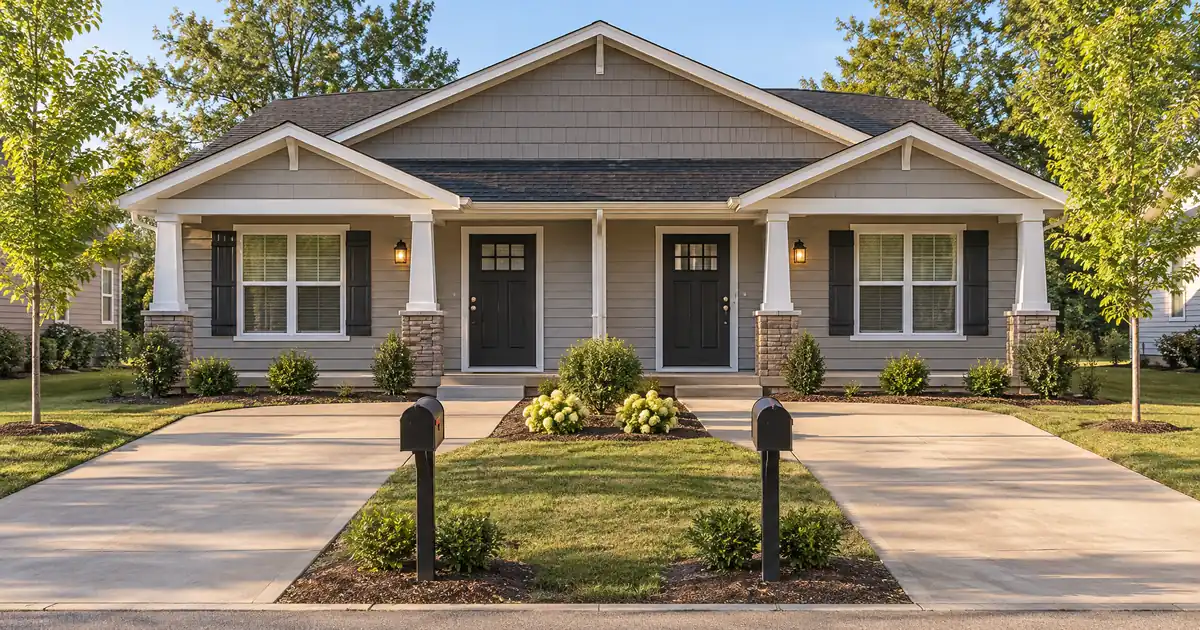
Say you live in one side of a duplex and a tenant rents the other. You want to pull equity out through a VA cash-out refinance. The first question is whether that tenant’s rent helps you qualify. It does, but with limits. This article walks through how the rent gets counted, what the lender checks, and where the rule bends.
VA cash-out estimate
Seeded with an example value, a typical balance, and a round cash request at the first-use fee; change any field.
Editable benchmark: 7.18% as of November 5, 2026 · Freddie Mac 30-year average via FRED®. A conventional market reference, not a VA cash-out refinance quote.
Illustrative starting assumptions: a $350,000 home value, a $193,000 current balance, the full-value VA cap with the first-use funding fee financed, a thirty-year term at the current Freddie Mac benchmark, and property taxes and insurance estimated at typical national rates. Every field is editable.
Illustrative estimate only — not a Loan Estimate, approval, quote, or commitment to lend. The rate field carries the weekly Freddie Mac thirty-year conventional benchmark, a market reference and not a VA cash-out refinance quote; a VA loan is priced by the lender at lock. The total loan, funding fee included, is capped at the program leverage on the reasonable value; the fee follows the tier chosen. The cash available is what the cap allows less the balances paid off and the fee, before closing costs, which are not included. The HELOC line is the line program’s combined loan-to-value ceiling applied to the same value and balance. Taxes and insurance are editable estimates. The debt-to-income figure is a guideline; residual income decides a VA file. Licensed in sixteen states for consumer mortgages.
Lendmire’s VA cash-out refinance program page covers the loan itself. Here the focus is the rent.
What Does the VA Actually Say About Duplex Rent?
For an existing two-to-four unit home that secures the loan, the VA tells lenders to count 75% of the lease or rental agreement amount as effective income. That is in Chapter 4 of the VA Lenders Handbook. A higher share counts only if it can be documented.
Why 75% and not 100%? The missing quarter works as a cushion for vacancy and repairs. That is the usual explanation in the industry, not VA text. The VA simply sets the percentage.
One more point. The rule covers purchases and regular cash-out refinances. An interest rate reduction loan (IRRRL) often involves limited underwriting, so rent rarely comes up there, subject to lender guidelines. A secondary source traces the same 75% language to 38 CFR 36.4340, though the Handbook is the document lenders work from.
Which Unit’s Rent Counts?
Only the units you do not occupy. You must live in one unit, and the rent tied to that unit never helps you. A VA cash-out is an owner-occupied loan. A property you no longer live in is not eligible.
Picture a duplex where you live in Unit A and a tenant pays rent on Unit B. The lender looks at Unit B only. Unit A is your home.
How Is the Rent Documented?
The answer depends on whether the unit is leased.
- Leased unit: The lender uses the lease or rental agreement.
- Vacant or unleased unit: The VA appraiser reports a market rent opinion, and the lender works from that.
- Lease and appraisal disagree: Lenders differ on how they compare the two. Across the wholesale programs we place VA files with, the safer assumption is that the lower figure can control. Expect your loan officer to confirm which one your lender uses.
This is where appraisal risk shows up. If the appraiser’s rent opinion lands below your actual lease, the lender may count less than you expected. Strong comparable rents and a clean, current lease make that conversation easier.
How Does a Lender Build Your Qualifying Income, Step by Step?
Here is the sequence on a duplex cash-out file.
1. Eligibility. You need a certificate of eligibility (COE) from the VA, and you must live in one unit.
2. Appraisal. The VA appraiser sets the property’s reasonable value and reports market rent for the other unit. The property also has to meet VA minimum property requirements.
3. Rent documentation. The lender gathers the lease or relies on the appraiser’s rent opinion.
4. Income build. The lender takes 75% of the counted rent and adds it to your other effective income.
5. Ratios. The lender runs debt-to-income and residual income using the full new payment. Rent raises your income. It does not shrink the payment.
6. Reserves check. During underwriting, before closing, the lender verifies that you have savings that will remain after closing, since reserves are required when subject-property rent is used.
7. Cash-out tests. The loan must show a net tangible benefit, and the lender provides a loan comparison disclosure. The new loan, with all financed fees, can reach 100% of the appraised value.
That last point matters. The VA’s own lender call materials show the loan reaching 100% LTV with fees included, and the net tangible benefit being one of eight listed benefits. The loan comparison disclosure is part of that framework. Many lenders set a lower cap as their own overlay. Those are lender rules, not VA rules.
How Does Rent Move Debt-to-Income and Residual Income?
Rent helps the debt-to-income ratio because it adds to the income side. Think of a file that sits just above the 41% guideline without rent. Adding the counted rent can pull the ratio down. The 41% figure is a guideline, not a cap. A ratio above it needs residual income well above the VA table.
Residual income is the controlling test. It is the money left each month after your debts, taxes and living costs. Counted rent can lift the income that feeds it. But the full payment stays in the math.
So a tight file can look stronger, because rent adds to what you qualify with. Whether it becomes approvable still turns on residual income and the lender’s full review. Your household owes the whole payment if the tenant leaves. Qualifying income and real cash flow are different things. A good decision looks at both.
Do You Need Reserves, and Can Cash-Out Proceeds Cover Them?
Reserves are required when you use subject-property rent to qualify. The VA is explicit that cash proceeds from a regular cash-out refinance cannot count toward the required reserves on a rental property. Home equity does not count either.
Reserves are the usual surprise on these files. Borrowers expect the cash-out to fund everything. It does not. Reserves need to come from verified assets you already hold.
If you choose not to use rent to qualify, the full payment is considered and the reserve requirement on that property falls away. Some borrowers qualify on their own income and skip the rent entirely. Final terms depend on the lender’s guidelines, the property type, and the borrower’s complete credit picture.
VA Rule or Lender Overlay?
| Item | VA rule | Lender overlay |
|---|---|---|
| Share of rent counted | 75% of lease amount | Some use a lower share |
| Occupancy | Live in one unit | Rarely stricter |
| Cash-out LTV | 100% with fees | Some set a lower cap |
| Landlord experience | Check the Handbook | Common on 3-4 units |
| Self-sufficiency test | Applies to 3-4 units | Extra rules vary |
| Reserves | Required with rent | Amounts differ |
One item is unsettled. Landlord-experience conditions may come from the VA or from a lender’s own overlay, depending on the lender and the file. Treat it as something to confirm file by file. Wholesale lenders differ here more than anywhere else, which is exactly why a broker shopping several of them earns its keep.
Where Does the Rule Break?
Former residence. If you moved out of a home and kept it as a rental, the VA treats that rent as an offset against the payment, not as effective income. The text says this rental income may not be included in effective income. That is a different treatment from the other unit in your own duplex.
Rent not used. If rent will not or cannot be used, the lender considers the full payment and does not need reserves on this basis.
Other rental properties. If you own other rentals, negative rental income reduces your income after depreciation is added back.
Higher than 75%. Possible only with documentation, and lenders rarely volunteer it.
Non-VA loan being paid off. A VA cash-out can refinance any loan type into a VA loan, so the loan being paid off does not have to be a VA loan. You still need a COE from the VA. The seasoning and recoupment questions that come with VA-to-VA refinances do not apply to a non-VA payoff. Across the programs we place, the VA cash-out carries seasoning and a net tangible benefit. The half-percent rate-reduction and fee-recoupment tests belong to the IRRRL, not the cash-out.
Moving out later. The loan is owner-occupied at closing. Plan for what a future move means for the property before you borrow against it.
What Does the Funding Fee Look Like?
The VA funding fee on a cash-out refinance is 2.15% for first use and 3.3% after that. It is financeable, and it is waived for veterans receiving compensation for a service-connected disability and the other exempt groups. Because the fee is financed, it counts toward the 100% LTV ceiling. Each figure is subject to lender guidelines and a complete review of property type, leverage, and credit.
There is no mortgage insurance on a VA loan. With full entitlement there is no VA loan limit. The wholesale programs we use start at a 580 decision score and serve amounts to $4,000,000 with full entitlement. The VA itself sets no minimum credit score. Everything here is subject to lender guidelines and full file review.
Key Terms Defined
Effective income: The income a lender counts toward qualifying you, after any required adjustments.
Residual income: The money left each month after debts, taxes and living costs. It is the controlling VA test.
Net tangible benefit (NTB): A measurable improvement the VA requires a cash-out to deliver. The VA lists eight acceptable ones.
Certificate of eligibility (COE): The VA document that confirms you qualify for the benefit.
Reserves: Verified savings left after closing that a lender may require.
Overlay: A rule a lender adds on top of the VA’s minimums.
What Should You Gather Before You Apply?
- Your COE.
- The current lease for the other unit, with proof of rent received if available.
- Recent income documents for your own earnings.
- Statements for the savings you plan to use as reserves.
- A list of any other rental properties you own.
- Details on any landlord history, since some lenders ask.
If the unit is vacant, expect to rely on the appraiser’s rent opinion. If the lease is below market, say so early. A lower figure may be the one that counts.
Frequently Asked Questions
Does rent from the unit I live in ever help me qualify?
No. Only rent from the units you do not occupy counts. The home you live in is your residence, and its value as housing is not income.
Does 75% of the rent mean I can borrow against 75% of the property’s value?
No. Those are separate ideas. The 75% applies to rent counted as income. Loan size is a separate matter and can reach 100% of the appraised value, including the financed fee, subject to lender guidelines.
Can I use cash-out proceeds to meet the reserve requirement?
No. VA says proceeds from a regular cash-out cannot count as reserves on a rental property. Reserves come from assets you already hold, and equity does not qualify. Leverage, reserves, and pricing vary by lender and program; the final terms follow the full file review.
What if my unit is vacant when I apply?
The lender typically relies on the appraiser’s market rent opinion rather than a lease. The same 75% treatment applies to that figure, subject to the lender’s own overlays.
Does the VA cap cash-out at 90% of value?
No. The VA’s lender materials show 100% with fees included, and 90% appears only as one of the eight net tangible benefit options. A lower cap you hear about is usually a lender overlay.
The Decision in Practice
Counted rent can move a duplex file from tight to workable. It is not free money. You get 75% of the other unit’s rent as income, you carry the full payment, you need reserves that proceeds cannot fund, and a lender overlay can change the picture. Compare your realistic rent, not the best case.
If you are weighing a cash-out refinance against keeping the loan you have, Lendmire can help you compare the programs and the equity each one reaches. Tax treatment can depend on your situation; borrowers should speak with a qualified tax professional before relying on any deduction or credit. All program details are subject to lender guidelines and full file review, and nothing here is a commitment to lend.
For your own numbers, request a scenario review with Lendmire.
About Lendmire
Lendmire is a mortgage brokerage (NMLS# 2371349) licensed for consumer mortgage lending in 16 states, arranging FHA, VA, conventional and jumbo purchase and refinance loans through a wholesale lending network. Eligibility is determined by the lender on each file. Scotsman Guide named Lendmire a Top Mortgage Workplace in both 2025 and 2026.
Get Started
Ready to find the right loan for you?
See your offer in seconds. No credit pull, no obligation.
Informational only. Not a Loan Estimate, approval, or commitment to lend. Program availability and eligibility are subject to lender guidelines, credit approval, property review, and underwriting.
References
1. VA Pamphlet 26-7, Chapter 4
This article is part of Lendmire’s VA cash-out refinance program — full qualification details, guidelines, and scenarios live on the program page.
Related reading: How a Lender Sizes a VA Cash-Out Ceiling After a Value Jump · How a Lender Weighs VA Cash-Out Against Conventional for a Veteran · How a VA Cash-Out Lender Treats a Home in Probate
Brandon Miller
Founder & CEO, Mortgage Loan Originator, Lendmire LLC
- Mortgage Loan Originator · NMLS# 1129696 · Verify on NMLS Consumer Access
- North Carolina Real Estate Broker · License# 343312 · Verify on NCREC
- North Carolina Insurance Producer · License# 19053198 · Property, Casualty, Life, Health · Verify on NAIC SBS
- Lendmire LLC · Firm NMLS# 2371349 · Verify firm licensure
Disclosures. The information presented in this article is general market commentary, not financial, legal, or tax advice. Lendmire is a mortgage brokerage (NMLS# 2371349) — not a direct lender or depository institution — and loan placement is subject to lender underwriting. Nothing in this content represents a commitment to lend. Loan terms, pricing, and program availability vary based on borrower qualifications, property characteristics, and state of subject property, and are subject to change at any time. Lendmire complies with Equal Housing Opportunity requirements. Consumer access: nmlsconsumeraccess.org.