
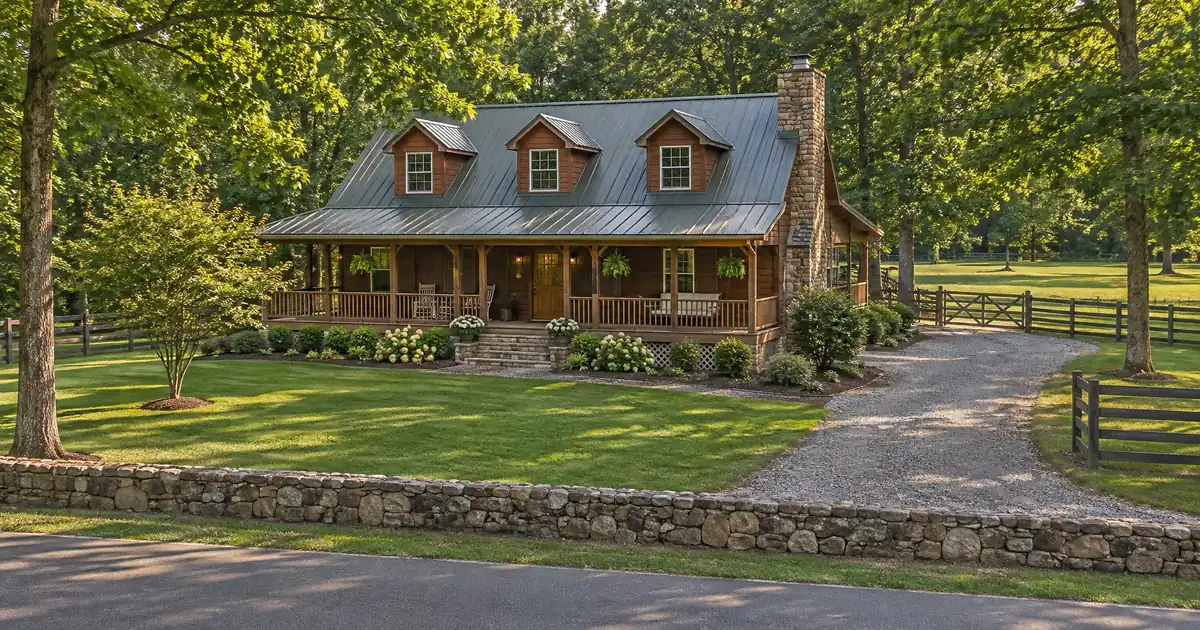
The Quick Read: A cash-out refinance replaces your current mortgage with a larger one and hands you the difference as cash at closing. You then spend that cash on the roof, well, septic system, or whatever the property needs. On a conventional loan for a one-unit principal residence, leverage tops out at 80% of the home’s value, so the cash you can reach depends on your appraised value and your payoff balance. Subject to lender guidelines and full file review, the plan works best when you size the loan from your contractor bids, not from the maximum the program allows.
Key Takeaways
- A cash-out refinance replaces your first mortgage. A HELOC or home equity loan sits next to it.
- Repair cash is cash-out money. A rate-and-term refinance cannot carry it.
- The appraiser values the home as it stands today, not as it will look after the work.
- Acreage alone does not usually disqualify a rural home. Character and use do.
- Build the loan amount backward from bids plus a cushion.
What Is a Cash-Out Refinance, and Does It Fit Repairs?
A cash-out refinance pays off your existing first mortgage with a new, larger loan, and you keep the difference. It fits repairs well when the work is needed, the equity is there, and you can live with a new loan replacing the old one.
Cash-out refinance estimate
The starting figures are an example value with a balance and a cash request in proportion. Replace them with yours.
Editable benchmark: 7.18% as of November 5, 2026 · Freddie Mac 30-year average via FRED®. A conventional market reference, not a cash-out refinance quote.
Illustrative starting assumptions: a $350,000 home value, a $193,000 current balance, the agency cap on a one-unit principal residence, a thirty-year term at the current Freddie Mac benchmark, and property taxes and insurance estimated at typical national rates. Every field is editable.
Illustrative estimate only — not a Loan Estimate, approval, quote, or commitment to lend. The rate field carries the weekly Freddie Mac thirty-year conventional benchmark, a market reference and not a cash-out refinance quote; a cash-out loan is priced by the lender at lock. The cash available is the loan the program cap allows less the balances paid off, before closing costs, which are not included. The HELOC line is the program’s combined loan-to-value ceiling applied to the same value and balance. Taxes and insurance are editable estimates. Licensed in sixteen states for consumer mortgages.
The federal consumer-finance regulator describes cash-out refinances as a way to tap equity for debts or needed home repairs. Roofs, wells, septic systems, foundations, driveways, and outbuildings all qualify as uses. So does nearly anything else, because this is a no-holdback structure. The programs covered here do not require you to prove the money went to repairs. That freedom is useful. It also puts the discipline on you.
Say a homeowner owns a farmhouse with a failing roof and an aging septic system. Both jobs are urgent, and neither is cheap. One loan, one closing, one payment. That is the appeal. The tradeoff is that the old loan disappears, along with its rate and term.
How Does a Cash-Out Refinance Differ From a Rate-and-Term Refinance?
A refinance (also called limited cash-out) changes your rate or term and allows only small incidental cash back. Repair money is not incidental. Once you want cash for work on the house, the loan is a full cash-out refinance with its own leverage cap and rules.
Across the wholesale programs Lendmire places files with, a rate-and-term refinance on a one-unit principal residence reaches 95% LTV. LTV means loan-to-value: the loan balance divided by the home’s appraised value. Cash back there is capped tightly. Fannie Mae allows the lesser of 2% of the new loan amount or $2,000. Those limits cover small leftovers, not a roof. Terms vary by lender guidelines, property type, leverage, credit profile, and full file review.
Fannie Mae’s Selling Guide draws the line the same way. Limited cash-out is its own category, and repair funding falls outside it. Cash-out refinances sit in a separate category with their own rules.
Here is the catch for homeowners hoping for a cheaper route. You cannot label a repair loan “rate-and-term” and get the higher 95% leverage. The cash decides the category.
How Does the Loan Work, Step by Step?
The process runs in seven steps: scope the work, pick the product, test seasoning, appraise, underwrite, close, and spend the cash. Each step has a decision attached. Skipping the first one is how people end up borrowing too much or too little.
Step 1: Scope the repairs and get bids. Write down every job. Get written bids from contractors before you talk numbers with anyone. Rural contractors can be booked far out, so bids from two or three tell you both cost and availability.
Step 2: Match the product to your current loan. Conventional cash-out follows Fannie Mae and Freddie Mac rules. FHA cash-out follows HUD. VA cash-out follows VA. Lendmire’s cash-out refinance programs page lays out the conventional options. FHA Streamline and VA IRRRL are streamlines for existing government loans. They are no-cash-out products, so they are not repair routes.
Step 3: Check seasoning. Seasoning is the waiting period before you can refinance. The first mortgage being paid off must be at least 12 months old, counted from note date to note date, per Fannie Mae’s cash-out eligibility announcement. A borrower must also have been on title for 6 months, with exceptions for delayed financing, inheritance, and legal awards.
Step 4: Appraisal and property review. The appraiser values the home as it is today. A leaking roof you have not yet fixed does not count as a new roof. More on rural appraisal issues below.
Step 5: Underwriting. The lender reviews credit, income, debts, and reserves. Reserves are savings left over after closing. Wholesale conventional programs start at a 620 decision score, and the automated finding governs most files, with a total debt ratio ceiling of 50%. Manually underwritten loans use 36% or 45% ceilings tied to score and reserve factors in the Eligibility Matrix. Fannie Mae’s Eligibility Matrix also notes reserves for cash-out files with a debt ratio above 45%.
Step 6: Closing. The new loan pays off the old first mortgage. You receive the remainder as cash.
Step 7: Spend with a plan. Open a separate account for the cash. Pay contractors from it. Track every draw.
How Much Cash Can You Actually Reach?
On a conventional one-unit principal residence, cash-out leverage tops out at 80% of appraised value. Your cash is that 80% figure, minus your current payoff and the closing costs you roll in. A thin appraisal shrinks it directly.
Run the logic with percentages. Say your home appraises at a value where your current mortgage equals 50% of it. The 80% cap leaves about 30% of value as the ceiling for cash plus closing costs. If your mortgage is already at 70% of value, the room drops to about 10%. The closer you already are to the cap, the less a repair loan can do.
A few more rules shape the number:
- Two- to four-unit principal residences, second homes, and investment properties cap at 75% on a conventional cash-out. Occupancy sets the leverage.
- One narrow wholesale lane is the exception to the 80% cap and reaches 89.99% LTV with no mortgage insurance. It requires a 680 score, a 50% ratio, a thirty-year fixed rate, a primary residence, a conforming balance, and its own six months of seasoning. Subject to lender guidelines, it is not written in Texas.
- In Texas, a cash-out on a homestead (a Section 50(a)(6) loan) is capped at 80% of the home’s value by the state constitution.
- Mortgage insurance is required above 80% LTV on the agency path, except in that wholesale no-MI cash-out lane. Where it applies, you may request cancellation at 80% of the original value with good payment history, no subordinate liens, and no decline in value. The servicer must end it automatically at 78%.
- FHA cash-out is capped at 80% of adjusted value, and the FHA’s current handbook holds current policy.
Back-solving beats maxing out. Add your bids, add a contingency cushion, add closing costs, then see whether the total fits under the cap. Borrow that, not the ceiling.
Where Do Rural Properties Trip Up the Appraisal?
Rural homes face two questions that city homes skip: is the property residential, and are there enough comparable sales? Acreage alone does not answer the first. Thin comps can move the second.
Freddie Mac states it has no site size or acreage limits. When a large parcel sits where commercial farms or ranches are typical, though, the lender must look further to confirm the property is residential. Freddie Mac also does not buy loans on vacant land or properties used primarily for agriculture. Individual lenders can set their own acreage limits, so ask early.
| Rural factor | Likely effect | What helps |
|---|---|---|
| Large acreage | Extra review of residential character | Show home is primary use |
| Big barns or silos | May suggest agricultural use | Document how outbuildings are used |
| Few comparable sales | Larger adjustments, distant comps | Provide recent local sales data |
| Manufactured home | Lower cash-out cap than site-built | Check the Eligibility Matrix cell |
| Income-producing land | Can block eligibility | Keep farm use secondary |
Fannie Mae’s Eligibility Matrix lists a lower cash-out cap for manufactured housing than for site-built homes. Ask your loan officer for the exact figure on your file.
Nearby farms do not make your home ineligible.
Here is a practitioner note. Few nearby sales means the appraiser reaches farther, and the value can land lower than a listing-based guess. Confirm any acreage overlay before you pay for the appraisal.
What About USDA, FHA, and VA Homes?
Each government program has its own cash-out rules, and USDA is the one that does not fit. USDA’s Single Family Guaranteed program has no specific acreage limit, but the property cannot be primarily income-producing. Do not assume a USDA cash-out refinance exists. If you hold a USDA loan and need repair cash, ask a loan officer which conventional or other path applies.
FHA: Cash-out is for your own home. Expect mortgage insurance and the 80% cap noted above.
VA: A cash-out refinance can fund needs like home improvements, and it can refinance a non-VA loan into a VA-backed loan. VA does not lend directly. You go through a private lender, and a funding fee may apply at closing. You need a Certificate of Eligibility, satisfactory credit, enough income, and occupancy.
Streamlines: The FHA Streamline needs an existing FHA loan and a net tangible benefit. The VA IRRRL needs an existing VA loan, charges a 0.5% funding fee unless exempt, and requires seasoning of the later of 210 days and 6 payments. Neither pays out cash.
Should You Use a HELOC, a Renovation Loan, or Cash-Out?
Pick cash-out when you want one new loan and your current loan has no special value. Pick a HELOC or home equity loan when your first mortgage is worth keeping. Pick a renovation loan when the work is large and you want it released in stages.
| Option | First mortgage | Cash arrives | Best for |
|---|---|---|---|
| Cash-out refinance | Replaced | Lump sum at closing | One-time repairs, current loan not worth keeping |
| HELOC / home equity loan | Stays in place | Line or lump sum | Keeping an existing first loan |
| Renovation loan | Replaced | Released in draws | Large projects with draw rules |
| Grant or assistance | Untouched | Varies | Qualifying low-income repair needs |
The CFPB draws the same line: a cash-out refinance replaces the original mortgage, while home equity loans and HELOCs leave the first lien in place. That is the key tradeoff for anyone with a first mortgage worth keeping. Consider a scenario where your current loan has terms you would not match today. Giving it up for repair cash is a real cost, and a second lien may fit better.
If the repair is urgent and equity is modest, a smaller second lien can look better. If the repair is large and the first mortgage is not special, the single cash-out loan is usually cleaner.
How Do You Time Repairs Around the Appraisal?
Fix emergencies first and everything else after closing. The appraisal reflects current condition, so cosmetic work done beforehand rarely adds value you can borrow against.
A working order for rural repair projects:
1. Safety and water first. Failed well pumps, septic failures, and structural issues come ahead of finishes.
2. Envelope next. Roof, windows, and siding protect everything else.
3. Mechanical systems. Heating, electrical, and fuel systems follow.
4. Site and outbuildings last. Driveway, fencing, and barn repairs can wait.
If the home needs urgent work before closing, tell your loan officer. A condition problem can affect the appraisal and the file. Some work, like a failed septic or a hazard, may need to be addressed before the lender will proceed.
How Do You Protect Yourself From Overruns?
Build in a contingency, keep the cash separate, and track each payment. Rural jobs run over for ordinary reasons: remote access, scarce contractors, and surprises behind walls.
Practical habits:
- Add a cushion on top of the bids when sizing the loan, rather than borrowing the maximum.
- Keep the cash in a dedicated account.
- Pay in stages tied to finished work.
- Pull permits where required, and plan for scheduling delays.
- Hold off on discretionary projects until essential work is paid for.
Remember what the new loan does to your budget. The CFPB’s guide on using home equity notes a cash-out refinance can lengthen the time to pay off your mortgage, and the monthly payment may rise because a larger loan replaces the current one. Ask for the Loan Estimate and compare the full terms before you commit.
Key Terms Defined
Cash-out refinance: A new, larger mortgage that pays off the old one and gives you the difference in cash.
LTV (loan-to-value): The loan balance divided by the home’s appraised value, shown as a percentage.
Seasoning: The waiting period required before a loan or ownership qualifies for a refinance.
Limited cash-out (rate-and-term): A refinance that changes rate or term and allows only small incidental cash back.
Reserves: Savings you still hold after closing, which lenders count when they review your file.
Mortgage insurance: Coverage that protects the lender on loans above 80% LTV, and that can be cancelled as the balance falls.
Mistakes to Avoid
- Borrowing the maximum instead of the plan. Extra cash is extra debt.
- Assuming a rate-and-term loan can carry repair money.
- Skipping the acreage and outbuilding questions until after the appraisal.
- Counting on the appraisal to credit repairs you have not made.
- Giving up a valuable first mortgage without comparing a second lien.
- Spending the cash on other things and leaving the repairs short.
Frequently Asked Questions
Can I use a cash-out refinance for repairs on a house that needs work today?
Usually yes, with limits. The appraiser values the home in its current condition, so serious defects can lower the value and the cash available. Safety or habitability problems may need attention before the lender moves forward. Subject to lender guidelines and full file review, talk through the condition with a loan officer before ordering an appraisal.
Does acreage disqualify a rural home?
Not by itself. Freddie Mac states it has no acreage limits, but it expects a closer look when a large parcel sits in a farm or ranch area. The lender wants to see a residential property, not an agricultural one. Individual lenders may set their own limits, so ask before you pay for an appraisal.
Do I have to prove I spent the money on repairs?
Under the programs described here, no. There is no holdback or draw schedule on a standard cash-out. That differs from renovation loans, which release funds in stages. Because nobody checks your spending, keep the cash in its own account and track your payments.
How is this different from a HELOC?
A cash-out refinance replaces your first mortgage with one new loan. A HELOC or home equity loan sits beside the first mortgage and leaves it untouched. If your current first mortgage is worth keeping, a second lien may fit better. If it is not, one new loan can be simpler.
Can an FHA Streamline or VA IRRRL pay for repairs?
No. Both are streamlines of existing government-backed loans and do not pay out cash. VA cash-out is a separate product that can fund home improvements, and it can refinance a non-VA loan into a VA-backed one.
If you are weighing a cash-out refinance against keeping the loan you have, Lendmire can help you compare the programs and the equity each one reaches. Call 828-256-2183 to talk it through.
For your own numbers, request a scenario review with Lendmire.
About Lendmire
Lendmire is a mortgage brokerage (NMLS# 2371349) licensed for consumer mortgage lending in 16 states, arranging FHA, VA, conventional and jumbo purchase and refinance loans through a wholesale lending network. Eligibility is determined by the lender on each file. Scotsman Guide named Lendmire a Top Mortgage Workplace in both 2025 and 2026.
Get Started
Ready to find the right loan for you?
See your offer in seconds. No credit pull, no obligation.
Informational only. Not a Loan Estimate, approval, or commitment to lend. Program availability and eligibility are subject to lender guidelines, credit approval, property review, and underwriting.
References
1. CFPB
2. Fannie Mae Selling Guide B2-1.3-02
3. Fannie Mae cash-out eligibility announcement
4. Fannie Mae’s Eligibility Matrix
5. Freddie Mac Guide FAQ on acreage
7. USDA
8. CFPB Office of Research blog on cash-out refinances
9. CFPB guide to using home equity
This article is part of Lendmire’s cash-out refinance program — full qualification details, guidelines, and scenarios live on the program page.
Related reading: How a Cash-Out Refinance Works After a Second-Home Cash Purchase · Cash-Out Refinance Options With a Second Mortgage Already on the Property · How a Property Release Works in a Cash-Out Refinance
Brandon Miller
Founder & CEO, Mortgage Loan Originator, Lendmire LLC
- Mortgage Loan Originator · NMLS# 1129696 · Verify on NMLS Consumer Access
- North Carolina Real Estate Broker · License# 343312 · Verify on NCREC
- North Carolina Insurance Producer · License# 19053198 · Property, Casualty, Life, Health · Verify on NAIC SBS
- Lendmire LLC · Firm NMLS# 2371349 · Verify firm licensure
Disclosures. The information presented in this article is general market commentary, not financial, legal, or tax advice. Lendmire is a mortgage brokerage (NMLS# 2371349) — not a direct lender or depository institution — and loan placement is subject to lender underwriting. Nothing in this content represents a commitment to lend. Loan terms, pricing, and program availability vary based on borrower qualifications, property characteristics, and state of subject property, and are subject to change at any time. Lendmire complies with Equal Housing Opportunity requirements. Consumer access: nmlsconsumeraccess.org.