
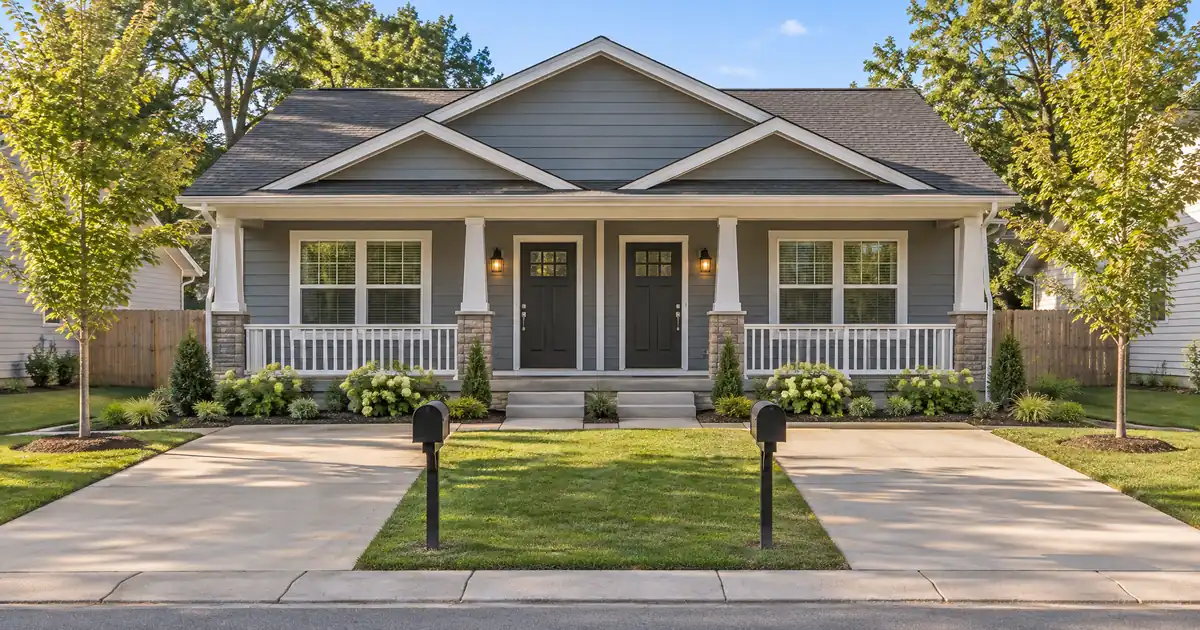
The Quick Read: It depends on what happens to the loan you already have. An FHA cash-out replaces your whole first mortgage with one new, larger loan, capped at 80% of the home’s adjusted value. A HELOC leaves your first mortgage alone and adds a second loan behind it. The FHA cash-out is usually the stronger fit when you need a large lump sum and your current loan has no special terms worth keeping. The HELOC fits when you want to keep the first loan and borrow in stages.
Who each option is really for, in plain terms:
- FHA cash-out suits the owner-occupant of a duplex who has lived in it at least 12 months, wants one payment, and needs a defined amount of money at once.
- HELOC suits the owner who likes the existing first mortgage, wants flexibility on timing and amount, and can find a junior lender willing to lend on a two-unit home.
FHA cash-out estimate
Seeded with an example value, a balance to match, and a round cash request; change any field.
Editable benchmark: 7.18% as of November 5, 2026 · Freddie Mac 30-year average via FRED®. A conventional market reference, not an FHA cash-out refinance quote.
Illustrative starting assumptions: a $350,000 home value, a $193,000 current balance, the FHA cap on a principal residence with the upfront premium financed, a thirty-year term at the current Freddie Mac benchmark, and property taxes and insurance estimated at typical national rates. Every field is editable.
An illustration, not a Loan Estimate, an approval, a quote, or a commitment to lend. The rate shown is the weekly Freddie Mac thirty-year conventional benchmark, used as a market reference; an FHA cash-out is priced by the lender at lock, and this is not an FHA cash-out refinance quote. HUD’s cap limits the base loan; the upfront premium is financed on top of the capped base loan; the monthly premium for the first year follows the snapshot’s schedule. Cash available means the base loan the cap permits less the balances retired, before closing costs, which this calculator leaves out. The line figure applies the line program’s combined loan-to-value ceiling to the same value and balance. Taxes and insurance are estimates you can edit. Licensed in sixteen states for consumer mortgages.
Neither one is better in every case. A duplex adds a few wrinkles, mostly around occupancy, rental income, and how many lenders will touch a second lien on a two-unit property. The rest of this piece covers those.
Side-by-Side
| Factor | FHA cash-out refinance | HELOC |
|---|---|---|
| What happens to your first loan | Paid off and replaced | Stays in place |
| Number of loans after closing | One | Two |
| How funds arrive | Lump sum at closing | Draw as needed up to a limit |
| Leverage | Up to 80% of adjusted value | Set by the junior lender |
| Occupancy | You must live in the duplex | Set by the junior lender |
| Ownership history | 12 months owned and occupied | Lender policy |
| Mortgage insurance | FHA premiums on the new loan | None from FHA |
| Documentation | Full appraisal, income, credit | Equity, income, credit, often an appraisal |
Those are program shapes, not promises. Every figure here is subject to lender guidelines and a full file review.
How an FHA Cash-Out Works on a Duplex
An FHA cash-out is a new first mortgage that pays off the old one and hands you the difference. HUD Mortgagee Letter 2019-11 cut the maximum loan-to-value and combined loan-to-value on these loans from 85% to 80% of adjusted value. Across the wholesale programs Lendmire places files with, the FHA cash-out tops out at 80% on a home you have owned and occupied for 12 months before the case number is assigned.
Two points trip people up.
First, the 80% covers the whole new loan, not just your cash. It includes the payoff of your old mortgage. If you owe most of that 80% already, there is little left to take out.
Second, the 12 months count back from the FHA case number, not from your application date. A borrower who moved in eleven months ago and applies “next month” may still be short.
On a duplex, the home must be your principal residence. You live in one unit and rent the other. If you move out, or the home was never your residence, FHA cash-out is not the right tool.
What the lender does with the other unit
Rent from the second unit can help you qualify. Under HUD Mortgagee Letter 2023-17, rental income from the subject property can count on a two- to four-unit home. Where the unit has little or no rental history, the lender uses 75% of the lesser of the appraiser’s fair market rent or the lease rent. The unit you live in does not count as income.
The appraisal on a two-unit property also reports unit and market-rent information. That is one reason the appraisal on a duplex gets more scrutiny than on a single-family home. Leases, when you have them, make the file cleaner.
Mortgage insurance
FHA loans carry an upfront premium of 1.75% of the base loan, usually financed into the balance. There is also an annual premium that depends on term, loan amount, and LTV, ranging from 0.15% to 0.75% of the balance. On a thirty-year loan above 90% LTV, the annual premium lasts for the loan term. At or below 90%, it ends after eleven years, and a cash-out capped at 80% sits in that second group. Term and loan amount still set the annual figure. Think of the premium as a cost built into the loan, not a line you can negotiate away.
How a HELOC Works Behind Your First Mortgage
A HELOC is an open-end line of credit. The CFPB describes it as a way to borrow repeatedly against your equity, which is the home’s value minus what you owe. If you already have a mortgage, the HELOC is a second mortgage paid on top of the first. HELOCs usually carry adjustable rates, so the payment moves with the balance.
FHA does not offer HELOCs. A HELOC comes from a separate lender, which decides whether it will take a junior lien behind an FHA first mortgage. No federal rule answers that question for a duplex. It is a lender-by-lender policy, and some lenders pass on two- to four-unit homes or on FHA-first situations. Expect to ask before you apply.
The credit limit is generally built from a share of the home’s value, minus your first-mortgage balance. The lender looks at equity, income, and credit, and often orders an appraisal. The CFPB also notes that a lender can refuse further draws if the home’s value drops significantly, and that falling behind can cost you the home.
Your FHA first loan does not change. Its terms, its insurance, and its payment stay put. For an owner with a first mortgage worth keeping, that is the whole appeal.
When an FHA Cash-Out Is the Better Fit
An FHA cash-out is the better fit in these situations:
- You need a large, defined amount once. Repairs on both units, a roof, a unit renovation. One loan, one payment, one closing.
- Your current first mortgage has nothing special about it. If there is no feature you would be giving up, replacing it costs you little in that respect.
- You have a HELOC or second lien already. The new loan can pay it off. Any lien that stays counts against the same 80% combined limit, so folding it in often keeps the structure simple.
- Credit is in the middle range. Across the wholesale programs Lendmire places FHA loans with, the floor is a 580 decision score. Maximum financing on a purchase reaches 96.5%, and cash-out is held to 80%. Debt-to-income limits can stretch with documented compensating factors, and the lender’s review governs.
- You want rent from the other unit to help you qualify. FHA rules give a defined way to count it.
- You want a payment that does not move with a draw balance. One loan means one payment structure.
The cost side is real. You reprice the entire balance, not only the new money. You pay FHA mortgage insurance on a larger loan. The appraisal and the closing steps are heavier than a line of credit. And a refinance is a consumer mortgage, so the Loan Estimate and Closing Disclosure apply.
There is a three-business-day right to cancel on a refinance of your primary residence. The CFPB explains that cancelling a refinance leaves you with your original loan, and that funds must be returned within 20 calendar days after a notice.
When a HELOC Is the Better Fit
A HELOC is the better fit in these situations:
- You like the first mortgage you have. Replacing it would mean giving up its terms and starting a new premium schedule.
- You do not know the final amount. A phased renovation, work on the second unit as tenants turn over, or a cushion you may never use.
- You may refinance again later. A line of credit is easier to leave alone than a fresh first mortgage.
- You are under 12 months of ownership or occupancy. FHA cash-out is off the table until you pass that test. A HELOC lender sets its own seasoning rules.
- Your equity is solid and your income is steady. You are comfortable carrying two loans.
The costs are different, not absent. The CFPB notes that HELOC lenders can charge certain fees when the line opens, and some plans carry a minimum draw or balance. A variable payment is hard to budget when the balance swings. And the lender can limit draws if values fall, so a HELOC is a weaker backstop than it looks in a good market.
The practical risk on a duplex is availability. A HELOC that works on a single-family home may not be offered on yours.
Think out loud about the tradeoff
The stronger play often depends on one question: is the first mortgage worth keeping? If yes, a HELOC protects it, provided a lender will do the second lien. If no, an FHA cash-out cleans up the structure. When a borrower can’t find a junior lender for the duplex, the choice is made for them.
What Changes Because It’s a Duplex
Occupancy. FHA cash-out is a principal-residence product. A duplex where you live in one unit qualifies. A duplex you have rented out entirely, or moved out of, does not. An inherited home that was rented is a related edge case: the borrower would need to occupy it as a principal residence for 12 months before cash-out opens up. If you are in a rental situation of that kind, an occupancy conversation with a loan officer comes first.
Rental income. For FHA, the rent from the other unit helps you qualify under a defined rule. It does not promise vacancy-free cash flow after closing. A HELOC lender may treat the same rent differently, or ignore it.
Appraisal and lender appetite. Two-unit homes get a fuller appraisal, and fewer lenders are comfortable with them. That affects both paths but hits the HELOC search harder.
County loan limits apply to FHA loans and vary by county and unit count. Check HUD’s published limit lookup for your county. Keep the 80% test in mind as well, since it caps the new loan separately from any county limit.
A Worked Comparison, No Dollar Figures
Picture a homeowner with a duplex worth a given appraised value. The existing FHA first mortgage is well under 60% of that value. The owner wants to renovate the rental unit.
With an FHA cash-out, the new loan can go up to 80% of adjusted value, and it pays off the old mortgage first. The room left for cash is the gap between that 80% and the payoff. One loan results, with FHA mortgage insurance on the new balance.
With a HELOC, the lender sets a limit from the home’s value less the first-mortgage balance, often using a cushion below 80% combined. The first loan stays. The owner draws as bills come due. The payment moves.
Now change one fact: the owner has a first mortgage near 78% of value. The FHA cash-out leaves almost nothing. A HELOC faces the same ceiling, because the combined limit is tight. Equity, not product choice, decides the outcome.
Change another: the owner moved in nine months ago. FHA cash-out is closed for now. The HELOC lender’s own policy governs.
Common Mistakes
- Reading 80% as 80% in cash. It caps the entire new loan, payoff included.
- Counting 12 months from the application. The count runs back from the FHA case number.
- Assuming FHA has a HELOC. It does not.
- Counting all the duplex’s rent as income. The rule is 75% of the lesser of market rent or lease rent, and only for the rented unit.
- Treating a HELOC as always cheaper or always safer. No neutral source supports either claim. The CFPB’s advice is to consider a HELOC only if you are confident you can keep up the payments, since the home is collateral.
- Skipping the combined-lien math. If you already have a HELOC or second lien, any part that stays in place counts toward the 80% limit on an FHA cash-out, so check it before you choose.
Key Terms Defined
Adjusted value: The appraised value after HUD’s adjustments, used to set the 80% cap.
Combined loan-to-value (CLTV): All liens on the home added together, divided by the home’s value.
Open-end credit: A line you can borrow against, repay, and borrow again up to a limit.
Principal residence: The home where you live as your main address.
Junior lien: A loan that sits behind the first mortgage in repayment priority.
Case number: The FHA identifier assigned to the loan, which starts the 12-month occupancy count.
The Balanced Verdict
Choose the FHA cash-out when you need a defined sum, your first mortgage is not worth protecting, and you meet the 12-month ownership and occupancy test. Choose the HELOC when the first mortgage is worth keeping, the amount is uncertain, and a lender will actually lend behind it on a duplex.
If neither fits, a rate-and-term refinance or an FHA Streamline may serve a different goal, though neither is built to pay you cash.
If you are weighing a cash-out refinance against keeping the loan you have, Lendmire can help you compare the programs and the equity each one reaches. Program terms are subject to lender guidelines and full file review, and nothing here is a commitment to lend.
Frequently Asked Questions
Can I get an FHA cash-out on a duplex if I rent out the other unit?
Yes, as long as the duplex is your principal residence and you have owned and lived in it for 12 months before the case number. The rented unit’s income can help you qualify under HUD’s rules for two- to four-unit homes. If you no longer live there, the property does not qualify for FHA cash-out.
How much can I borrow with an FHA cash-out?
Up to 80% of adjusted value, including the payoff of your current mortgage. County loan limits also apply, though most homeowners reach the 80% test first. The cash you receive is whatever room remains after the payoff and the lender’s review.
Does a HELOC work behind an FHA first mortgage?
Sometimes. FHA does not issue HELOCs, so a separate lender decides whether to lend behind your FHA loan and whether it will lend on a two-unit home. Policy varies by lender, so ask before you commit to the appraisal.
What happens to an existing HELOC during an FHA cash-out?
The new loan can pay it off, or the HELOC lender must agree to stay behind the new first mortgage. Either way, it counts toward the 80% combined limit.
Can I back out after signing a cash-out refinance?
Yes, within three business days, under the CFPB’s right-of-rescission guidance. You keep your original loan if you cancel, and funds must be returned within 20 calendar days of the notice.
For your own numbers, request a scenario review with Lendmire.
About Lendmire
Lendmire (NMLS# 2371349) is a mortgage brokerage serving homeowners and home buyers in 16 states. FHA, VA, conventional and jumbo purchase and refinance loans are arranged through wholesale lending channels; Lendmire brokers the financing and the lender underwrites each application. Scotsman Guide named Lendmire a Top Mortgage Workplace in both 2025 and 2026.
Get Started
Ready to find the right loan for you?
See your offer in seconds. No credit pull, no obligation.
Informational only. Not a Loan Estimate, approval, or commitment to lend. Program availability and eligibility are subject to lender guidelines, credit approval, property review, and underwriting.
References
1. HUD Mortgagee Letter 2019-11
2. HUD Mortgagee Letter 2023-17
3. CFPB
4. CFPB: Right of rescission on a second mortgage or refinance
This article is part of Lendmire’s FHA cash-out refinance program — full qualification details, guidelines, and scenarios live on the program page.
Related reading: FHA Cash-Out vs HELOC for a Homeowner Dodging Lifetime MIP · How to Get an FHA Cash-Out on a Home Owned Before Marriage · How an FHA Cash-Out Works on a Duplex With a Locked-in Mortgage
Brandon Miller
Founder & CEO, Mortgage Loan Originator, Lendmire LLC
- Mortgage Loan Originator · NMLS# 1129696 · Verify on NMLS Consumer Access
- North Carolina Real Estate Broker · License# 343312 · Verify on NCREC
- North Carolina Insurance Producer · License# 19053198 · Property, Casualty, Life, Health · Verify on NAIC SBS
- Lendmire LLC · Firm NMLS# 2371349 · Verify firm licensure
Disclosures. The information presented in this article is general market commentary, not financial, legal, or tax advice. Lendmire is a mortgage brokerage (NMLS# 2371349) — not a direct lender or depository institution — and loan placement is subject to lender underwriting. Nothing in this content represents a commitment to lend. Loan terms, pricing, and program availability vary based on borrower qualifications, property characteristics, and state of subject property, and are subject to change at any time. Lendmire complies with Equal Housing Opportunity requirements. Consumer access: nmlsconsumeraccess.org.