
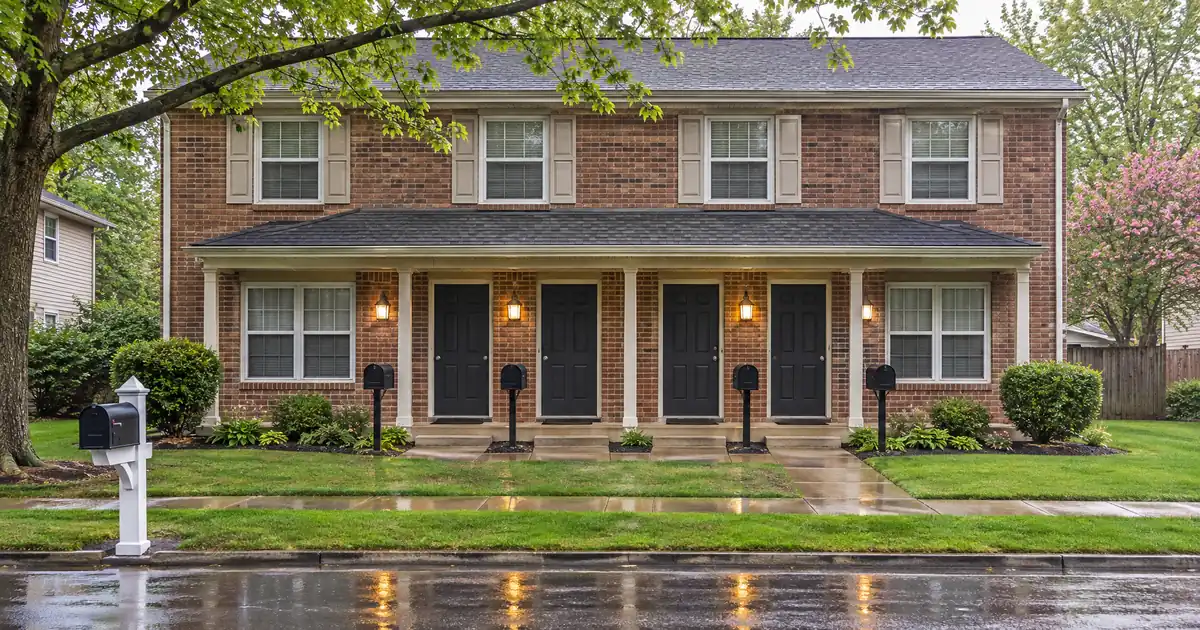
The Quick Read: VA allows a cash-out loan of up to 100% of the appraised value on a fourplex you live in, with the funding fee counted inside that ceiling. What reaches your hands is smaller: it is the new loan minus your payoff, the financed fee, and any closing costs you roll in. Qualifying is the second limit, because only part of the rent from the other three units counts as income. Every parameter here is subject to lender guidelines and full file review, and nothing is a commitment to lend.
What Does the 100% Ceiling Actually Cover?
The ceiling is 100% of the value VA assigns to the property, and the funding fee sits inside it, not on top. The VA Lenders Handbook, Chapter 6 says a cash-out loan may not exceed 100 percent of VA’s reasonable value. It also lets the funding fee and certain energy-efficiency improvements be financed, as long as the total stays under that line.
VA cash-out estimate
Seeded with an example value, a typical balance, and a round cash request at the first-use fee; change any field.
Editable benchmark: 7.18% as of November 5, 2026 · Freddie Mac 30-year average via FRED®. A conventional market reference, not a VA cash-out refinance quote.
Illustrative starting assumptions: a $350,000 home value, a $193,000 current balance, the full-value VA cap with the first-use funding fee financed, a thirty-year term at the current Freddie Mac benchmark, and property taxes and insurance estimated at typical national rates. Every field is editable.
Illustrative estimate only — not a Loan Estimate, approval, quote, or commitment to lend. The rate field carries the weekly Freddie Mac thirty-year conventional benchmark, a market reference and not a VA cash-out refinance quote; a VA loan is priced by the lender at lock. The total loan, funding fee included, is capped at the program leverage on the reasonable value; the fee follows the tier chosen. The cash available is what the cap allows less the balances paid off and the fee, before closing costs, which are not included. The HELOC line is the line program’s combined loan-to-value ceiling applied to the same value and balance. Taxes and insurance are editable estimates. The debt-to-income figure is a guideline; residual income decides a VA file. Licensed in sixteen states for consumer mortgages.
“Reasonable value” comes from the VA appraisal and appears on the Notice of Value. On a fourplex, the appraiser typically weighs comparable sales and the rent the units produce.
Three points clear up common confusion, and each is listed separately below:
- 90% is not VA’s cap. It shows up as one of VA’s net tangible benefit criteria and in a narrow case involving a fixed-rate loan refinanced into an adjustable one with more than one discount point. Many lenders cap cash-out lower as their own policy. Across the wholesale programs we place files with, the full 100% is available on VA cash-out, but each lender’s guidelines and your file decide what applies to you.
- There is no VA loan limit with full entitlement. The wholesale programs we use serve amounts up to $4,000,000 with full entitlement. If you have only partial entitlement left, speak with a loan officer about how that changes things.
- The current loan can be any type. A conventional or FHA loan can be refinanced into a VA loan. VA treats that as a cash-out even if you take no cash.
Lendmire’s VA cash-out refinance program page covers the program basics if you want the single-family version first.
How Is the Loan Sized, Step by Step?
The lender works from the appraised value down to your net cash in a fixed order. Each step can shrink the number, which is why “value times 100%” overstates what you take home.
1. Eligibility. You need a valid certificate of eligibility (COE), satisfactory credit, and enough income. VA decides eligibility. Lenders set the credit floor; the wholesale programs we place VA loans with start at a 580 decision score.
2. Occupancy. On a fourplex, the VA underwriting handbook requires you to occupy one unit as your residence. A fourplex you rent out entirely, or one you have moved out of, does not fit this loan.
3. Appraisal. The Notice of Value sets the 100% ceiling.
4. Payoff and fee. The new loan must cover your existing balance first. VA’s funding fee for a cash-out refinance is 2.15% for first use and 3.3% for subsequent use, and it is financed into the loan.
5. Closing costs. Costs other than the funding fee must fit under the ceiling or be paid in cash. This is where net cash shrinks again.
6. Qualifying. Income, residual income, and rent treatment decide whether the loan you want is the loan you can have.
7. Net tangible benefit. The lender must show the refinance helps you in at least one of VA’s listed ways, and the federal regulation requires the lender to give you that test.
How Does the Math Run on a Fourplex?
Think in percentages of value. Say the appraisal sets your ceiling at 100% and your current loan is 60% of that value. The gross room is 40%. Now subtract the funding fee, charged on the whole new balance rather than only the cash, plus any closing costs you roll in. The fee on a first-use cash-out is 2.15% of the new loan, so a loan near 100% of value carries a fee of roughly that much of the value. Net cash lands meaningfully below 40%.
Two things follow:
- A bigger loan means a bigger fee. The fee applies to the entire balance, not just the new cash. Pulling out less can cost proportionally less in fee than pulling out everything.
- Hitting the ceiling can force a trim. If the payoff, fee, and costs would exceed 100%, the loan is reduced to fit, or you cover the gap in cash.
Each figure above is a modeled illustration, not a quote. Your appraisal, payoff, and costs set the real numbers.
Does the Rent From the Other Units Count?
The VA handbook says that for an existing multi-unit property the lender counts 75 percent of the amount on the lease or rental agreement, and a greater percentage can be used if documented. The remaining 25% is a cushion for vacancy and upkeep.
Rent helps in two ways. It adds qualifying income, and it offsets part of the payment on the building. The handbook also says reserves are required when rental income is used to qualify. How many months, and whether cash-out proceeds can count toward them, depends on the lender. Confirm the treatment with your loan officer before you count on the proceeds.
VA’s training materials also say the lender looks for landlord experience or a background in property maintenance or rental. A first-time landlord can still qualify, but the file may need more explanation.
Why Residual Income Controls the Loan
Residual income is the money left each month after your obligations, taxes, and basic living costs, measured against a table that scales with family size and region. It is VA’s controlling test. The 41% debt-to-income figure is a guideline, not a cap. A ratio above it needs residual income that clears the table by a meaningful margin, and the lender sets how much.
On a fourplex, that has a practical effect. The full payment is counted against you, while only 75% of the rent counts for you. A building with strong rents and modest leverage passes more easily than one carrying a large balance on thin rents. Taking less cash can be the difference between passing and failing.
Where Do VA Rules End and Lender Overlays Begin?
VA sets the ceiling and the occupancy rule. The lender sets almost everything else. The table separates the two.
| Item | VA rule | Lender decision |
|---|---|---|
| Maximum loan | Up to 100% of reasonable value | May set a lower cap |
| Occupancy | Live in one unit | Documentation required |
| Rent used | Typically 75% of lease amount | May require leases or decline to count it |
| Credit score | VA sets no minimum | Wholesale floor starts at 580 |
| Reserves | Required when rent is used | Months vary by lender |
If one lender offers a lower cap or a stricter rent treatment than another, the file is not necessarily weaker. Different lenders interpret the same VA rules differently, which is a reason to compare before you commit.
Where the General Rule Breaks
Several situations change the answer:
- Fixed-to-adjustable Type I refinance. When a fixed-rate loan becomes an adjustable one and more than one discount point is charged, the cap drops to 90% of reasonable value.
- VA-to-VA seasoning. Refinancing a VA loan requires seasoning: the later of 210 days from the first payment and the 6th payment, per the federal regulation. The same seasoning and a net tangible benefit apply to the cash-out. The half-percent rate-reduction and fee-recoupment tests belong to the streamlined IRRRL and do not apply to a VA cash-out.
- Partial entitlement. The refinanced loan uses the entitlement tied to the loan being paid off. If you have remaining entitlement only, the maximum can change.
- Moved out or planning to. The loan assumes you live there. If you are leaving, a cash-out on that building is the wrong tool.
- State limits. Some states restrict cash-out lending. Lendmire’s consumer lending covers 16 states, and a loan officer can tell you whether a state rule applies.
- Five or more units. Not covered by this program. VA’s multi-unit lane runs through four units.
Should You Take Cash Out at All?
It depends on what the money does. Using it to pay off higher-cost debt, fund repairs that raise the building’s value, or consolidate can make sense. Borrowing to 100% of value also leaves no equity cushion if values fall, and a larger balance raises the payment you carry on a building where only part of the rent counts.
A quieter alternative is to take less than the maximum. A smaller loan carries a smaller funding fee, passes residual income more easily, and keeps equity in the building. Another option is to skip the cash-out and keep your current loan, if it already works.
Key Terms Defined
Reasonable value: The value VA sets through its appraisal, which caps the loan.
Notice of Value: The document that reports reasonable value to the lender and borrower.
Entitlement: The amount of VA’s guaranty available to you, which determines how much you can borrow without a down payment.
Funding fee: A one-time VA charge, financeable and waived for exempt veterans.
Residual income: The monthly cash left after obligations, measured against VA’s family-size table.
Net tangible benefit: A measurable gain the refinance must give you, such as a shorter term or higher residual income.
Frequently Asked Questions
Can I use a VA cash-out on a fourplex?
Yes, if you live in one of the four units and meet the standard VA requirements. You need a valid COE, satisfactory credit, and enough income. A building with five or more units, or one you do not occupy, does not fit.
Do lenders lend the full 100%?
Some do and some cap lower. VA allows up to 100% of reasonable value. The wholesale programs we place VA files with reach that figure, but each lender’s guidelines and your file decide the actual limit.
Does the funding fee come out of my cash?
Effectively, yes. It is financed into the new loan and counts toward the 100% ceiling, so it reduces what is left for you. Veterans who are exempt from the fee do not owe it.
Do I need an existing VA loan?
No. A conventional or FHA loan can be refinanced into a VA loan. VA-to-VA refinances carry seasoning, and the same net tangible benefit rule applies to every cash-out.
Will all the rent count toward qualifying?
Typically 75% of the lease amount does, and more can count when documented. Lenders may ask for leases, reserves, and evidence of landlord experience.
If you are weighing a cash-out refinance against keeping the loan you have, Lendmire can help you compare the programs and the equity each one reaches.
For your own numbers, request a scenario review with Lendmire.
About Lendmire
Lendmire is a mortgage brokerage (NMLS# 2371349) licensed for consumer mortgage lending in 16 states, arranging FHA, VA, conventional and jumbo purchase and refinance loans through a wholesale lending network. Eligibility is determined by the lender on each file. Scotsman Guide named Lendmire a Top Mortgage Workplace in both 2025 and 2026.
Get Started
Ready to find the right loan for you?
See your offer in seconds. No credit pull, no obligation.
Informational only. Not a Loan Estimate, approval, or commitment to lend. Program availability and eligibility are subject to lender guidelines, credit approval, property review, and underwriting.
References
1. VA Pamphlet 26-7 Ch. 6 Refinancing Loans
2. VA Pamphlet 26-7 Ch. 4 Credit Underwriting (PDF)
This article is part of Lendmire’s VA cash-out refinance program — full qualification details, guidelines, and scenarios live on the program page.
Related reading: VA Cash-Out vs Conventional Cash-Out on a Premarital Home · How to Plan and Use a VA Cash-Out Refinance to Go Fixed · How Much a VA Appraisal Value Caps a Cash-Out Loan
Brandon Miller
Founder & CEO, Mortgage Loan Originator, Lendmire LLC
- Mortgage Loan Originator · NMLS# 1129696 · Verify on NMLS Consumer Access
- North Carolina Real Estate Broker · License# 343312 · Verify on NCREC
- North Carolina Insurance Producer · License# 19053198 · Property, Casualty, Life, Health · Verify on NAIC SBS
- Lendmire LLC · Firm NMLS# 2371349 · Verify firm licensure
Compliance and disclosures. Lendmire (NMLS# 2371349) is a licensed mortgage broker and is not a direct lender, depository institution, financial advisor, or tax professional. Content in this article is general market analysis and educational information — not financial, legal, or tax advice for any specific situation. Lendmire does not guarantee loan approval; every transaction is subject to underwriting by the funding lender. Mortgage pricing and loan program guidelines are subject to change at any time without notice and vary by borrower characteristics, property type, and state regulations. Lendmire complies with Equal Housing Opportunity. Licensure verification: NMLS Consumer Access.