
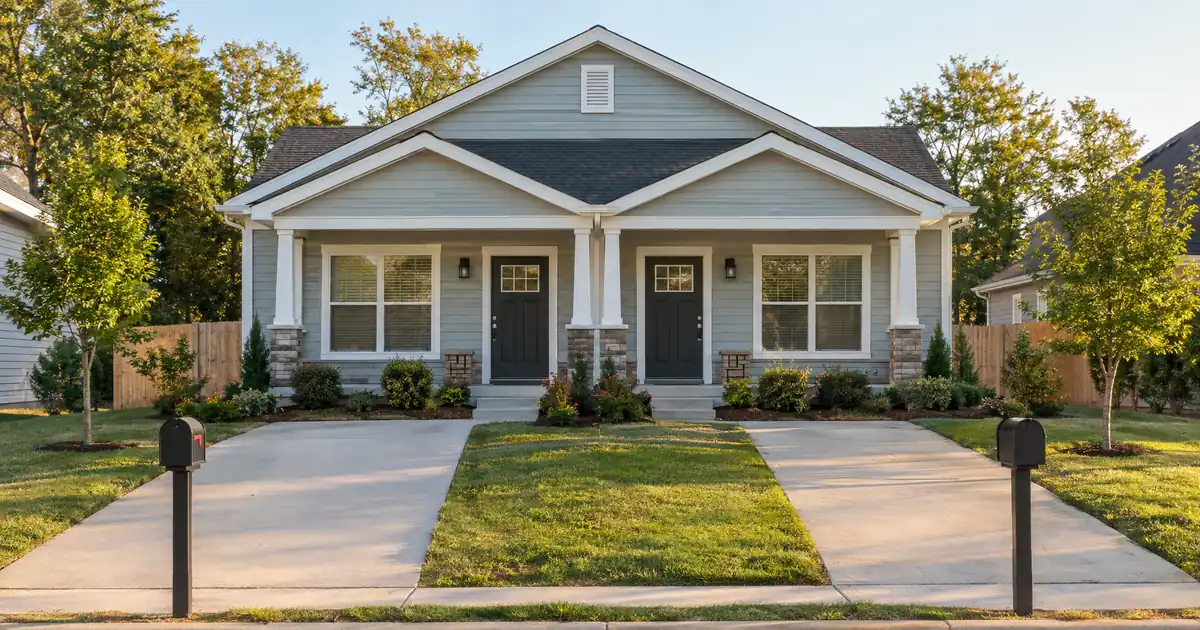
The Quick Read: The best program depends on your occupancy, equity, credit, and military status, not on one product. For a duplex where you live in one unit, the real choices are conventional, FHA, and VA cash-out. Conventional cash-out on a two-unit home is capped at 75% of the appraised value, below the 80% allowed on a one-unit home. The loan you already have also matters, because a streamline refinance cannot pull cash out.
Key Takeaways
- Living in one unit makes the property a primary residence, which opens the owner-occupied programs.
- Conventional cash-out tops out at 75% LTV (loan-to-value, the loan as a share of the home’s appraised value) on a two-unit home.
- Seasoning rules decide timing: the loan you are paying off must be at least 12 months old, and a borrower must have been on title for 6 months.
- FHA and VA streamlines refinance an existing government loan. They do not give you cash.
- Which door fits depends on your situation. A broker that shops several wholesale lenders can match the file to the program. Terms depend on the lender’s guidelines, the property type, the leverage, and a full review of the credit profile.
What Is a Cash-Out Refinance on a Duplex?
A cash-out refinance replaces your current first mortgage with a larger one. You keep the difference, minus closing costs. The lender measures the new loan against the appraised value of the whole building.
Cash-out refinance estimate
The starting figures are an example value with a balance and a cash request in proportion. Replace them with yours.
Editable benchmark: 7.24% as of October 29, 2026 · Freddie Mac 30-year average via FRED®. A conventional market reference, not a cash-out refinance quote.
Illustrative starting assumptions: a $350,000 home value, a $193,000 current balance, the agency cap on a one-unit principal residence, a thirty-year term at the current Freddie Mac benchmark, and property taxes and insurance estimated at typical national rates. Every field is editable.
Illustrative estimate only — not a Loan Estimate, approval, quote, or commitment to lend. The rate field carries the weekly Freddie Mac thirty-year conventional benchmark, a market reference and not a cash-out refinance quote; a cash-out loan is priced by the lender at lock. The cash available is the loan the program cap allows less the balances paid off, before closing costs, which are not included. The HELOC line is the program’s combined loan-to-value ceiling applied to the same value and balance. Taxes and insurance are editable estimates. Licensed in sixteen states for consumer mortgages.
The loan is larger than what you owe, so the new balance rises. That is the trade: cash now, a bigger debt later.
You can use the proceeds for nearly anything. Research from the Consumer Financial Protection Bureau defines a cash-out refinance as one where the new loan plus any junior liens runs more than 5% above the old balance. It also found that borrowers often put the money toward closing costs and savings. That is a research definition, not an underwriting rule. Underwriters apply their own tests.
A refinance that only pays off your old loan and covers closing costs is a limited cash-out or rate-and-term refinance. The industry calls it “limited cash-out” because it allows only small incidental cash back. Go past that allowance and the file becomes a full cash-out, with cash-out limits.
Why a Duplex You Live In Is Its Own Category
A duplex where you occupy one unit counts as a principal residence. That is good news. Principal residences get the best terms in the mortgage world.
The unit count changes the leverage, though. Lenders treat a two-unit building as riskier than a one-unit house. Two units means more moving parts, a tenant’s lease, and a value that depends partly on rent.
So the cap drops. Across the wholesale programs Lendmire places files with, conventional cash-out on a one-unit principal residence runs to 80% LTV. On a two- to four-unit principal residence it runs to 75%. Those figures are subject to lender guidelines and full file review, and they are not a commitment to lend.
Here is the line people miss. If you live in the duplex, you are in the owner-occupied lane. That is a different lane from a property you do not live in, which carries different rules. Occupancy decides the leverage. Say you live there today but plan to move out, and the lender should hear that up front. Stating occupancy honestly is not optional. A misstatement can cause real trouble later.
How the Loan Is Underwritten, Step by Step
The process follows the same order on almost every file. Knowing it saves surprises.
Step 1: Classify the transaction. The lender decides whether your goal is rate-and-term or cash-out. If you want meaningful cash, it is cash-out. That sets the leverage cap and the pricing approach.
Step 2: Check seasoning and occupancy. Seasoning is the waiting period before you can refinance. On conventional cash-out, the first mortgage being paid off must be at least 12 months old, counted from note date to note date. A borrower must also have been on title for 6 months. Exceptions exist for delayed financing, inheritance, and legal awards.
Step 3: Order the appraisal. The appraiser values the whole duplex. On a two-unit home the rent from the second unit affects the comparables and the value conclusion. The appraisal also drives your LTV.
Step 4: Underwrite the borrower. The lender looks at credit score, debt-to-income ratio (your monthly debts as a share of your monthly income), and reserves. Reserves are the cash left in the bank after closing. Across the wholesale conventional programs, the floor starts at a 620 decision score, and the automated finding governs most files. Total ratios can run to 50% on an automated approval. Manually underwritten files run tighter, at 36% or 45%.
Step 5: Review the disclosures and close. You get a Loan Estimate early. Compare it across lenders. Before signing, match the Closing Disclosure against that estimate.
How Mortgage Insurance Fits
Mortgage insurance is required above 80% LTV. Conventional cash-out on a duplex stops at 75%, so most duplex cash-outs never reach that threshold. That is one quiet advantage of the lower cap. It also means a lower balance than a one-unit borrower might take. The exact numbers vary by lender and program and follow a full review of property, leverage, and credit.
What Does the Lender Do With the Rent From the Other Unit?
Lenders may count part of the second unit’s rent toward qualifying. They will not count all of it, and they will not count your own unit at all.
Expect to document it. A lender typically wants a signed lease and an appraiser’s rent schedule. Many lenders also discount the rent for vacancy. How much rent counts is the lender’s call, so ask early.
A vacant unit changes the file. If the second unit sits empty, the income may not count. Then you qualify on your own income, or the file needs a different structure. If your income carries the loan without rent, this section matters little. If it does not, test the numbers before paying for an appraisal.
Rent also adds risk. When a tenant pays part of your mortgage, a vacancy hits your budget. Borrowers who take more cash out raise the stakes. Think about a three-month vacancy before you commit.
Which Program Fits? The Main Paths Compared
The table shows program types, not companies. Each row is a family of programs. Details vary by lender and are subject to full file review.
| Program type | Who it fits | Occupancy | Cash-out on a duplex you live in |
|---|---|---|---|
| Conventional cash-out | Solid credit, real equity | Primary residence | Yes, to 75% LTV |
| FHA cash-out | Lower credit scores | Owner-occupied principal residence | Yes, with an 80%-level HUD ceiling |
| VA cash-out | Eligible veterans, service members | You must live in the home | Yes, with a Certificate of Eligibility |
| Jumbo cash-out | Balances above the conforming limit | Primary residence | Depends on the lender |
| FHA Streamline or VA IRRRL | Existing FHA or VA loan | Varies | No. Rate-and-term only |
Conventional is the default for borrowers with decent credit. The Fannie Mae Eligibility Matrix sets maximum LTV by transaction, occupancy, and unit count. Lenders also pay a pricing adjustment on many cash-out files. It rises with leverage and falls with credit score. Freddie Mac’s Guide section 4301.5 defines cash-out as a loan with no restriction on how you use the proceeds. It also treats a home owned free and clear as a cash-out when you borrow against it.
FHA cash-out is open only to owner-occupied principal residences. A duplex you live in is reviewed on occupancy. FHA tends to suit borrowers whose credit would price poorly on a conventional file. The cash-out ceiling sits below the rate-and-term ceiling.
VA cash-out suits veterans. The VA’s cash-out page says the loan lets you replace your current mortgage, take cash from equity, or refinance a non-VA loan into a VA-backed one. You need a Certificate of Eligibility. The loan comes from a private lender, not from VA directly, and a funding fee may be due. A duplex you occupy is a common way for a veteran to use this benefit on a two-unit home.
The Streamlines Are Not Cash-Out Tools
This one trips up a lot of people. The FHA Streamline and the VA IRRRL both refinance an existing government-backed loan. Neither pulls out equity.
The FHA Streamline requires that the loan already be FHA-insured, be current, and show a net tangible benefit. “Streamline” describes the documentation, not a lack of costs. The VA IRRRL carries a funding fee unless the borrower is exempt, and it requires seasoning of the later of 210 days and 6 payments. Streamlines are the right tool for a lower payment on an existing government loan. They are the wrong tool for cash.
The Best Program by Situation
“Best” turns on who is asking. Here is how the match usually works.
| Your situation | The program family that usually fits |
|---|---|
| Strong credit, plenty of equity | Conventional cash-out |
| Lower credit score, owner-occupied | FHA cash-out |
| Veteran or service member | VA cash-out |
| Large balance above the conforming limit | Jumbo lane |
| Existing FHA or VA loan, no cash needed | Streamline |
| Owned less than 6 months, or loan under 12 months old | Wait, or ask about exceptions |
Notice the last row. Timing alone can close a door. If you bought the duplex recently, the seasoning clock may decide the answer before credit does.
Two notes on state law. Some states restrict cash-out on a homestead. Texas is one example: its state constitution limits cash-out on a homestead property, so a higher-leverage cash-out option may not be available there. Your state’s rules can change the answer, so ask.
A Worked Example: Duplex Versus House
Run the numbers on two homes with the same appraised value and the same payoff. Assume the home is worth 100 units. You owe 60% of it. Closing costs come out of your proceeds.
- Duplex appraised value: 100%.
- Duplex maximum conventional loan at 75% LTV: 75% of value.
- Duplex room to take cash, before costs: 15% of value.
- One-unit house maximum at 80% LTV: 80% of value.
- One-unit room to take cash, before costs: 20% of value. Final terms depend on the lender’s guidelines, the property type, and the borrower’s complete credit picture.
The duplex owner has 5 percentage points less room. That is a quarter less cash on the same equity. Costs then shrink what you actually receive. Closing costs can be paid in cash, deducted from proceeds, or financed into the loan. Financing them shrinks your net cash the same way.
This example is illustrative only. Your appraisal, payoff, and lender guidelines set the real numbers. The takeaway is the gap: the duplex penalty is real, and planning around it beats finding it at the appraisal.
What Lenders Look For (And What to Prepare)
Lenders review the same few things on nearly every file. Get these ready.
- Occupancy proof: Your ID, mail, and records should show you live in one unit.
- Lease and rent records: A signed lease for the second unit, plus payment history.
- Credit report review: Fix errors before the file goes in. A higher score helps pricing and approval odds.
- Income documents: The kind depends on the program and your job type.
- Reserves: Some cash-out files require months of reserves.
- Title and loan dates: Know when you bought and when your current loan closed. Those dates run the seasoning clock.
Credit events matter too. The agencies set waiting periods after them: four years from a chapter 7 discharge, seven from a foreclosure, and four from a short sale or deed in lieu. Documented extenuating circumstances can shorten those periods.
Cash-Out or Something Else?
Cash-out is not the only way to tap equity. Compare the options before you replace a good first mortgage.
| Option | How it works | Trade-off |
|---|---|---|
| Cash-out refinance | New, larger first mortgage | Replaces your whole loan |
| Home equity loan or second lien | Separate loan behind your first | Keeps your first mortgage as is |
| Home equity line of credit | Revolving credit against equity | Variable access, separate payment |
| Limited cash-out refinance | Pays off your loan and costs | Little cash back |
If your current first mortgage is a good one, a second lien may protect it. If your current loan is worse than what a new one would offer, cash-out may do double duty. A borrower weighing these should compare the full cost of each, using the Loan Estimate.
Where the General Rule Breaks
A few edge cases change the answer. Know them before you apply.
- Paying off a second lien. Under limited cash-out rules, only certain second liens qualify, such as one used to buy the property. Paying off other junior liens turns the file into a cash-out.
- Free-and-clear homes. Freddie Mac treats borrowing against a home with no mortgage as cash-out.
- Student loan payoffs. Fannie Mae waives its cash-out pricing adjustment when proceeds pay off eligible student loans. The standard cash-out LTV limits still apply.
- Moving out later. The loan is written as a primary residence. If you rent both units in the future, tell your lender and read your loan documents. Different occupancy carries different terms.
- Recent purchase. The six-month title rule and 12-month loan age rule can delay you, with listed exceptions.
- State rules. Texas is the usual example, but state law may apply elsewhere.
Common Mistakes
Borrowers make the same errors over and over.
1. Assuming a duplex acts like a house. The 75% cap catches people off guard.
2. Counting all the rent. Lenders count a portion, and sometimes none.
3. Expecting cash from a streamline. It will not happen.
4. Ignoring seasoning dates. Check them before paying for an appraisal.
5. Focusing only on the payment. Look at the loan amount, costs, and total debt.
6. Taking cash with no plan for a vacancy. If the other unit sits empty, can you carry the loan?
Tax treatment can depend on your situation; borrowers should speak with a qualified tax professional before relying on any deduction or credit.
Next Step
If you are weighing a cash-out refinance against keeping the loan you have, Lendmire can help you compare the programs and the equity each one reaches. Lendmire’s cash-out refinance programs page lays out the options. As a mortgage broker, Lendmire shops multiple wholesale lenders and matches your occupancy, credit, and equity to the program that fits. Call 828-256-2183 to talk through your file.
Key Terms Defined
Cash-out refinance: A new first mortgage larger than your current balance, with the difference paid to you.
Limited cash-out (rate-and-term) refinance: A refinance that pays off your loan and costs, with only small incidental cash back.
LTV (loan-to-value): The loan amount as a percentage of the home’s appraised value.
Seasoning: The waiting period a lender requires before you can refinance, based on how long you have owned the home or held the loan.
Reserves: Cash and liquid assets you still hold after closing.
Principal residence: The home where you live as your main address, including one unit of a duplex.
Net tangible benefit: A measurable gain, such as a lower payment, that a government streamline must show.
Frequently Asked Questions
Can I do a cash-out refinance on a duplex I live in?
Yes, as long as you occupy one unit and meet the program’s rules. Conventional, FHA, and VA cash-out can all apply. The leverage cap is lower than on a one-unit home, and your lender will review occupancy, seasoning, credit, and the appraisal.
How much cash can I take out of a live-in duplex?
On conventional cash-out, the new loan can reach 75% of the appraised value, so the cash is whatever remains after your payoff and closing costs. FHA and VA set their own ceilings. A one-unit home allows 80% on conventional, so the duplex gives up a few points of room.
Does the rent from my other unit count toward qualifying?
Often partly, and it depends on the lender. Expect to provide a lease and an appraiser’s rent schedule. Lenders commonly discount the rent for vacancy, and your own unit’s value does not count as income. If the other unit is vacant, the file may need to qualify on your income alone.
Can I use an FHA Streamline or VA IRRRL to pull cash out?
No. Both refinance an existing government loan and require a net tangible benefit. If you want cash, you need a cash-out refinance. A streamline fits when your goal is a lower payment on an existing FHA or VA loan.
How long do I have to own the duplex before I can cash out?
On conventional cash-out, a borrower must have been on title for 6 months, and the first mortgage being paid off must be at least 12 months old. Delayed financing, inheritance, and legal-award exceptions exist. Lender overlays may add limits, so confirm your dates before ordering an appraisal.
For your own numbers, request a scenario review with Lendmire.
About Lendmire
Lendmire (NMLS# 2371349) is a mortgage broker licensed for consumer lending in 16 states. Lendmire arranges FHA, VA, conventional and jumbo purchase and refinance loans through wholesale lenders; every file is underwritten by the lender under the applicable program guidelines. Scotsman Guide named Lendmire a Top Mortgage Workplace in both 2025 and 2026.
Get Started
Ready to find the right loan for you?
See your offer in seconds. No credit pull, no obligation.
Informational only. Not a Loan Estimate, approval, or commitment to lend. Program availability and eligibility are subject to lender guidelines, credit approval, property review, and underwriting.
References
1. Consumer Financial Protection Bureau
2. Fannie Mae Eligibility Matrix
3. Freddie Mac Guide, Section 4301.5
This article is part of Lendmire’s cash-out refinance program — full qualification details, guidelines, and scenarios live on the program page.
Related reading: Best Cash-Out Refinance Program to Pay for a Roof Replacement · Best Cash-Out Refinance Program to Pay Off Maxed-Out Credit Cards · Can You Do a Cash-Out Refinance on a Home Under a Blanket Lien?
Brandon Miller
Founder & CEO, Mortgage Loan Originator, Lendmire LLC
- Mortgage Loan Originator · NMLS# 1129696 · Verify on NMLS Consumer Access
- North Carolina Real Estate Broker · License# 343312 · Verify on NCREC
- North Carolina Insurance Producer · License# 19053198 · Property, Casualty, Life, Health · Verify on NAIC SBS
- Lendmire LLC · Firm NMLS# 2371349 · Verify firm licensure
Important disclosures. Lendmire (NMLS# 2371349) is a licensed mortgage brokerage. Lendmire is not a direct lender, depository institution, or financial advisor. All loan inquiries are subject to lender underwriting; this article does not constitute a commitment to lend. Rates, terms, and program guidelines are subject to change without notice and vary by borrower profile, property type, and state. Information in this article is general in nature and is not financial, legal, or tax advice. Equal Housing Opportunity. NMLS Consumer Access: nmlsconsumeraccess.org.