
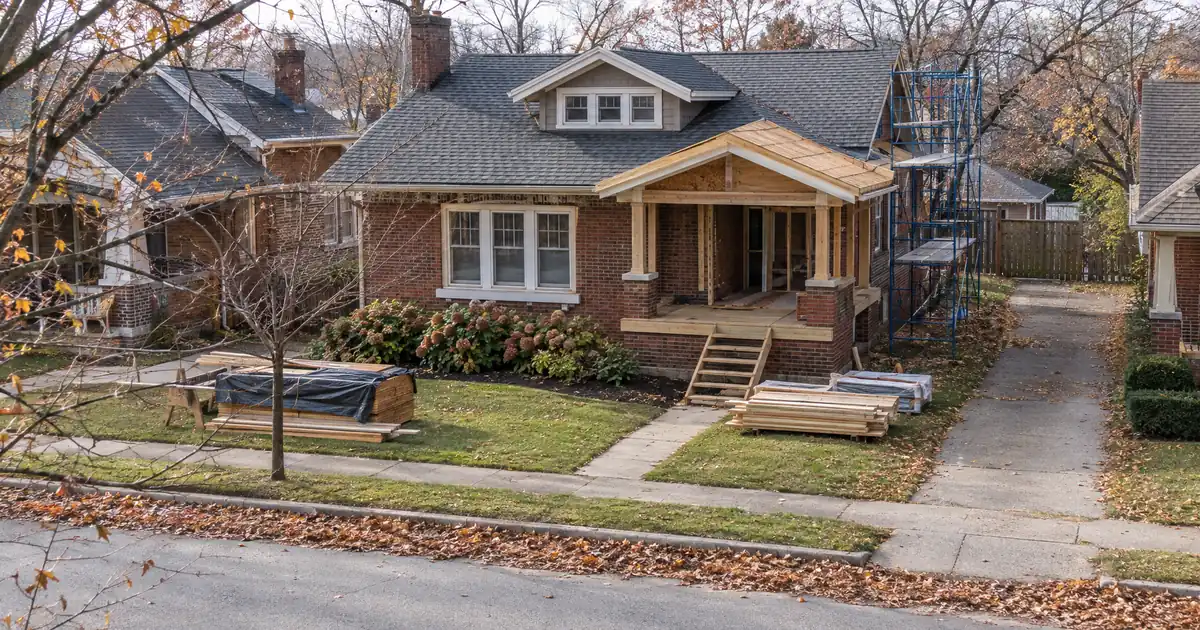
The Quick Read: No single program is best, because the right one depends on your loan, your equity and your paperwork. Rehab bills on credit cards are consumer debt, so paying them off from new loan proceeds generally means a full cash-out refinance. Streamline and rate-and-term loans do not fit this job. A renovation mortgage is the one structure that can sometimes reimburse paid project costs, with conditions.
Why Rehab Cards Point to Cash-Out
Credit card balances are unsecured debt. When a new mortgage pays them off from proceeds, the loan is a cash-out refinance, the type with no limit on how the money is used. That is the logical result of how the agency rules sort loans, not a quirk of one lender.
Cash-out refinance estimate
The starting figures are an example value with a balance and a cash request in proportion. Replace them with yours.
Editable benchmark: 7.24% as of October 29, 2026 · Freddie Mac 30-year average via FRED®. A conventional market reference, not a cash-out refinance quote.
Illustrative starting assumptions: a $350,000 home value, a $193,000 current balance, the agency cap on a one-unit principal residence, a thirty-year term at the current Freddie Mac benchmark, and property taxes and insurance estimated at typical national rates. Every field is editable.
Illustrative estimate only — not a Loan Estimate, approval, quote, or commitment to lend. The rate field carries the weekly Freddie Mac thirty-year conventional benchmark, a market reference and not a cash-out refinance quote; a cash-out loan is priced by the lender at lock. The cash available is the loan the program cap allows less the balances paid off, before closing costs, which are not included. The HELOC line is the program’s combined loan-to-value ceiling applied to the same value and balance. Taxes and insurance are editable estimates. Licensed in sixteen states for consumer mortgages.
The limited cash-out loan (often called rate-and-term) can pay off the existing first mortgage, closing costs and a purchase-money second lien. It allows only incidental cash back. Card balances are not on that list. The same goes for the government streamlines: the FHA Streamline and the VA streamline refinance are built for lowering the cost of an existing government loan, not for retiring other debts.
Across the wholesale programs Lendmire places consumer files with, this sorting happens on day one. A borrower who says “I want to roll in the cards” has described a cash-out file, whatever the loan is called on the brochure. Lendmire’s cash-out refinance programs page lays out the structures in more detail.
Key Terms Defined
Cash-out refinance: A new first mortgage that pays off the old one and lets you take or use extra equity for any purpose, including debt payoff.
Limited cash-out (rate-and-term) refinance: A refinance that covers the old loan and closing costs, with only a small amount of cash back.
Seasoning: The minimum time a loan or ownership must exist before it can be refinanced for cash.
LTV (loan-to-value): The new loan balance divided by the appraised value of the home.
As-completed value: The appraiser’s estimate of the home’s value once planned renovations are finished.
Break-even value: The lowest appraisal at which the new loan still covers everything that has to be paid off.
How the Loan Is Underwritten, Step by Step
1. Classify the debt. Cards used for rehab are unsecured consumer debt. A loan that retires them from equity is cash-out. The only route around that is a renovation product that finances the work itself.
2. Check the existing first mortgage. On conventional cash-out, the first mortgage being paid off must be at least 12 months old, measured note date to note date, per Fannie Mae’s cash-out eligibility notice. The wholesale programs also look for a borrower on title for 6 months, with exceptions for delayed financing, inheritance and legal awards.
3. Order the appraisal. The appraised value sets the LTV cap. On a conventional cash-out, the cap is 80% on a one-unit primary residence and 75% on two- to four-unit homes and second homes. Rehab that is finished and visible can help the value. Rehab that is half done may not.
4. Underwrite the borrower. A cash-out is fully underwritten: credit, income, assets and the debt-to-income ratio. The conventional wholesale programs start at a 620 decision score, and the automated finding governs most files, with a total ratio ceiling of 50%. Higher leverage and lower scores cost more in pricing adjustments. Fannie Mae’s Selling Guide notes that loan-level price adjustments apply to certain cash-out loans by LTV and credit score.
5. Pay the cards at closing. Card balances are paid directly to the issuers, not handed to the borrower. The lender verifies each account on a current statement, and the payoffs show on the Closing Disclosure.
6. Wait out the cancellation period. On a refinance of your home, funds are not disbursed until the three-business-day right to cancel has run, unless you validly waive it for a true financial emergency.
What Decides the Outcome
Five things drive most of these files:
- The age of the current first mortgage
- Appraised value against the LTV cap
- Credit score and the pricing adjustment that comes with it
- Occupancy (you live there)
- Clean statements for every card being paid
Miss one and the file changes shape. Miss the 12-month mark and conventional cash-out is off the table for now.
Scenario Table: Which Path Fits Which Borrower
| Situation | Best-fit path | Watch-out |
|---|---|---|
| Conventional loan over 12 months old, solid equity | Conventional cash-out | Stays within 80% LTV on a one-unit home |
| Existing FHA loan | FHA cash-out | A Streamline cannot fund cards |
| Existing VA loan | VA cash-out | IRRRL does not produce cash |
| Rehab unfinished, bills still coming | Renovation mortgage | Cash proceeds generally not allowed |
| Loan under 12 months old | Wait, or look at other options | Seasoning blocks conventional cash-out |
| Home owned free and clear | Cash-out | A new mortgage on a free-and-clear home counts as cash-out |
That last row comes from Freddie Mac’s guide, which treats a mortgage placed on a home owned free and clear as a cash-out refinance and requires all borrowers to occupy a primary residence.
The Renovation Mortgage Variation
A renovation mortgage finances the work inside the loan. Fannie Mae’s HomeStyle product can cover the first-mortgage payoff, closing costs and the renovation cost on a refinance. The borrower generally cannot take cash proceeds.
There is a narrow reimbursement feature. Per Fannie Mae’s HomeStyle page, a borrower can request reimbursement for materials and properly documented contract labor, but not for their own sweat equity. Leftover funds may go to the balance or to reimburse paid receipts.
The catch is that the reimbursement feature does not clearly treat a credit card charge as the borrower’s own funds. The lender decides that under its documentation rules, so a file should not be planned around it until a loan officer confirms it in writing.
This route also needs the work to be planned and scoped. If the rehab is done and the cards are already maxed, the file looks like a cash-out, because the money is being used to pay a consumer debt rather than to fund work.
Where the Rule Breaks
- Mortgage under 12 months old. Conventional cash-out is blocked. Delayed financing is a narrow exception after a cash purchase, with its own documentation.
- Government borrowers. An FHA cash-out is capped at 80% of adjusted value for case numbers assigned on or after September 1, 2019, per HUD. The cap applies to adjusted value, not to your equity. A VA Type II cash-out has no restriction on use; a Type I does not produce cash. VA also applies a net tangible benefit test to cash-outs.
- Second homes and 2-4 units. Leverage drops to 75% on conventional cash-out.
- PACE liens. On certain properties, a borrower with enough equity who chooses not to pay off an energy-retrofit lien is ineligible for cash-out under the Selling Guide.
- Manufactured homes. Renovation and construction-to-permanent cash-outs have extra limits.
- Texas. A cash-out on the homestead is capped by the state constitution at the agency figure, and the 89.99% wholesale lane is not written there. Some other states add their own cash-out rules too; a loan officer will tell you which apply.
- A rental or second home. Occupancy decides leverage, and the 75% cap above is the answer.
The 89.99% Lane
One wholesale lane reaches 89.99% LTV with no mortgage insurance. It needs a 680 score, a 50% ratio, a thirty-year fixed rate, a primary residence, a conforming balance and its own six months of seasoning. Subject to lender guidelines, it can matter for a borrower whose cards are large relative to equity. It is not available in every state, and not every file fits it.
Rehab Cards vs. Personal-Spending Cards
Lenders paying off cards at closing do not usually care what the charge was for. They care that the balance is verified and the payoff is documented. But a clean rehab trail helps in two places.
First, the appraisal. Invoices and receipts show what was done, which supports the value story.
Second, the renovation-loan question. If reimbursement is on the table at all, paid receipts for materials and contract labor are the evidence. Personal groceries on the same card muddy that trail.
A practitioner habit worth copying: keep one card for the project and don’t mix. It makes every later step easier.
Documentation Checklist
- Current statements for every card being paid
- Contractor invoices and proof of payment
- Receipts for materials
- Permits and final inspection sign-offs, where applicable
- Photos before and after
- The note date on your current mortgage
- Settlement statement from your purchase, if recent
- Homeowners insurance declarations page
Gaps in this list cause most of the back-and-forth on rehab-card files. The statement for a card with a promotional balance is the usual stall point, because the balance moves between the date of the application and the payoff.
The Break-Even Appraisal Test
Before applying, run a simple test in percentages. Add up the current mortgage balance, the card balances, and the closing costs you plan to finance. Divide by 80%. The result is the lowest value at which a one-unit conventional cash-out still works.
If the number is above what you believe the home is worth, you have three options: pay part of the cards from savings, lower the amount being rolled in, or wait. A partial payoff, retiring the highest-balance cards and leaving the rest, is a legitimate structure. It keeps the loan inside the LTV cap.
Appraisals on recently renovated homes can come in light. A written reconsideration request with recent nearby sales is a normal step, not a last resort.
What You Give Up
The CFPB’s research on cash-out refinances and non-mortgage debt paydown raises the cautions that matter here:
- Secured debt. Unsecured card debt becomes debt backed by your home.
- Longer horizon. Short-term card debt stretched over a long mortgage term can cost more in total even when the monthly outlay falls.
- Replacing your current loan. If your existing mortgage carries a lower rate than a new one would, the refinance replaces a good loan with a costlier one. That is often the deciding factor.
- Closing costs. Origination, appraisal, title and other fees apply. Financed costs accrue interest for the life of the loan.
- New balances. Zeroed cards help the debt-to-income ratio, but only if they stay near zero.
Mortgage insurance enters when leverage goes above 80% on programs that allow it. It cancels at 80% on request and ends automatically at 78%, mechanics set by federal law.
Alternatives Compared
| Option | What it does | Fit for rehab cards |
|---|---|---|
| Conventional cash-out | Pays cards from equity | Strong, if seasoning and LTV fit |
| Rate-and-term | Pays old loan only | Does not fit |
| FHA Streamline / VA IRRRL | Adjusts terms of existing loan | Does not fit |
| Renovation mortgage | Funds planned work | Only for unfinished work |
| Paying from cash flow | No new loan | Slow, but avoids a new loan |
How a Broker Finds the Fit
The best program for your situation turns on property type, credit profile, leverage need and documentation. A broker shops more than one wholesale lender and matches the file to the program. Lendmire is a mortgage broker that works with a multi-state network of wholesale cash-out lenders, and it arranges loans rather than making them. Program figures are subject to lender guidelines and full file review, and nothing here is a commitment to lend.
If you are weighing a cash-out refinance against keeping the loan you have, Lendmire can help you compare the programs and the equity each one reaches.
Frequently Asked Questions
Can a rate-and-term refinance pay off my rehab credit cards?
No. A rate-and-term loan pays off the existing first mortgage, closing costs and certain purchase-money second liens, with only incidental cash back. Card balances fall outside that list, so paying them turns the loan into a cash-out.
Does the 12-month rule apply to every refinance?
No. It applies to conventional cash-out, where the first mortgage being paid off must be at least 12 months old from note date to note date. A borrower on title for 6 months is also required, with exceptions such as delayed financing.
Can I cancel after closing and get my cards back?
No. You generally have three business days to rescind a refinance of your home, and Saturdays count. But the CFPB explains that rescinding does not erase your original obligation, and you still owe the original loan.
Will a renovation loan reimburse what I charged to cards?
Possibly, but it is not automatic. Fannie Mae’s HomeStyle allows reimbursement for documented materials and contract labor, not sweat equity. Whether a card-funded expense qualifies is the lender’s call.
What if my appraisal comes in too low?
Work out the break-even value first. If the appraisal falls short, you can request reconsideration with recent sales, pay part of the cards from savings, or retire only the largest balances.
For your own numbers, request a scenario review with Lendmire.
For current guidelines and terms, see Lendmire’s refinance programs page.
About Lendmire
Lendmire (NMLS# 2371349) is a mortgage brokerage serving homeowners and home buyers in 16 states. FHA, VA, conventional and jumbo purchase and refinance loans are arranged through wholesale lending channels; Lendmire brokers the financing and the lender underwrites each application. Scotsman Guide named Lendmire a Top Mortgage Workplace in both 2025 and 2026.
Get Started
Ready to find the right loan for you?
See your offer in seconds. No credit pull, no obligation.
Informational only. Not a Loan Estimate, approval, or commitment to lend. Program availability and eligibility are subject to lender guidelines, credit approval, property review, and underwriting.
References
1. Fannie Mae capital markets notice on cash-out eligibility
2. Fannie Mae Selling Guide B2-1.3-03
3. Freddie Mac Guide section 4301.5
4. Fannie Mae HomeStyle Renovation product page
5. HUD
6. CFPB research: cash-out refinances and paydown of non-mortgage debt
7. CFPB Ask: Right of rescission
This article is part of Lendmire’s cash-out refinance program — full qualification details, guidelines, and scenarios live on the program page.
Related reading: Should Co-Owners Use a Cash-Out Refinance Buyout or Sell the Home? · Best Cash-Out Refinance Program After Buying the Home Within the Seasoning Window · Can You Do a Cash-Out Refinance on a Home Under a Blanket Lien?
Brandon Miller
Founder & CEO, Mortgage Loan Originator, Lendmire LLC
- Mortgage Loan Originator · NMLS# 1129696 · Verify on NMLS Consumer Access
- North Carolina Real Estate Broker · License# 343312 · Verify on NCREC
- North Carolina Insurance Producer · License# 19053198 · Property, Casualty, Life, Health · Verify on NAIC SBS
- Lendmire LLC · Firm NMLS# 2371349 · Verify firm licensure
Compliance and disclosures. Lendmire (NMLS# 2371349) is a licensed mortgage broker and is not a direct lender, depository institution, financial advisor, or tax professional. Content in this article is general market analysis and educational information — not financial, legal, or tax advice for any specific situation. Lendmire does not guarantee loan approval; every transaction is subject to underwriting by the funding lender. Mortgage pricing and loan program guidelines are subject to change at any time without notice and vary by borrower characteristics, property type, and state regulations. Lendmire complies with Equal Housing Opportunity. Licensure verification: NMLS Consumer Access.