
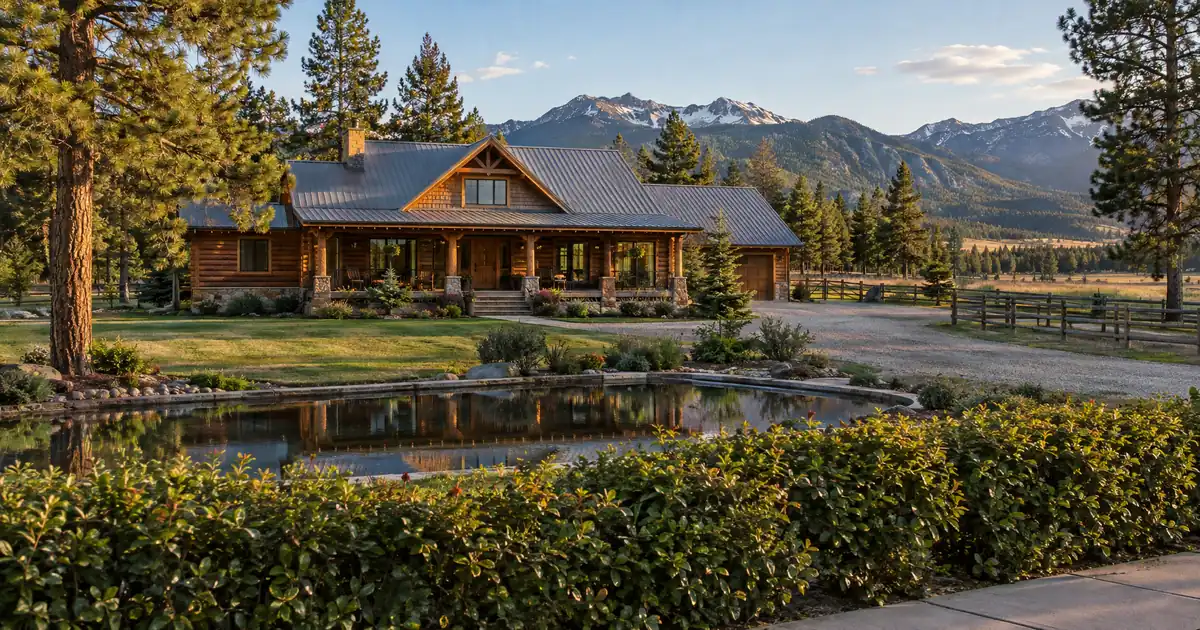
The Quick Read: A ranch purchase in Montana can qualify on assets when the collateral is a residence on rural land, because the lender reviews your documented balances instead of traditional personal-income documentation, pay stubs or employment verification, and the land itself still has to pass the program’s property screen, subject to underwriting. A working cattle or hay operation is a different story. Strong assets prove you can repay the loan, but they do not make farmland eligible.
- Two paths exist. On the asset qualifier path, eligible assets must cover the whole loan. On the asset depletion path, assets become a monthly qualifying income.
- Every file is fully underwritten. The assets are documented with statements, so this is never a no-documentation loan.
- The property screen comes first. Acreage, land use and the type of improvements often decide a ranch file before your balances are ever counted.
- Programs are placed through select lenders, and every figure below is a ceiling or floor, not an offer.
Key Terms Defined
Asset qualifier path: A program path where eligible assets, after credit percentages, must equal or exceed the entire loan amount. No employment or income is documented.
Asset depletion path: A program path that divides usable assets by 60 months to create a monthly qualifying income. That income must carry the housing payment and other debts.
Debt-to-income (DTI): The share of monthly income that goes to debt payments, including the new housing payment.
Seasoning: How long funds have sat in your account before the lender will count them.
Haircut: The share of an account’s balance a lender does not count, because the asset can lose value or carries penalties.
Vesting: The name or entity that holds title to the property.
Who This Route Fits (and Who Should Skip It)
This route fits buyers whose balances are large and whose documented income is not. Think of retirees living on a portfolio, someone who just sold a business, an heir, or a professional who retired early. Their traditional personal-income documentation understates what they can afford.
Skip it if you plan to qualify the ranch on its own operating income. Lendmire’s wholesale network does not underwrite crop or livestock revenue on these programs. Skip it too if the parcel is mostly pasture and water with a modest cabin, and the lender will not treat it as a residence. That buyer usually needs an agricultural lender.
Buyers with steady traditional employment income may prefer a conventional or jumbo loan that uses it. The asset route earns its place when income is the weak spot, not the balance sheet.
The Two Ways Assets Can Qualify You
The asset qualifier path asks one question: do your eligible assets cover the entire loan? The asset depletion path asks a different one: do your assets, converted to monthly income, carry the payment? A borrower is qualified on one path at a time, never a blend.
| Factor | Asset qualifier | Asset depletion |
|---|---|---|
| Core test | Usable assets cover the whole loan | Assets ÷ 60 months = income |
| Income documented | None | Derived from assets |
| Loan amounts | Up to $4,000,000 | $125,000 to $3,500,000 |
| Primary or second home | 80% purchase; 75% refinance | 80% purchase or rate-and-term; 60% cash-out |
| Investment property | Not offered on this path | 65% purchase or rate-and-term; 60% cash-out |
| Credit | 600 minimum score | The lender’s matrix |
Cash-out proceeds never count as qualifying assets on the depletion path. Whether the qualifier path allows cash-out is set by the lender, so treat it as unavailable until a lender confirms it.
Here is an illustrative qualifier-path file, and the lender’s own calculation governs. Picture an $800,000 loan. You hold $330,000 in brokerage accounts, which count at 100%. You also hold $300,000 in a 401(k) while under age 59½, which counts at 90%, or $270,000. Finally, $200,000 sits in savings at 100%. Together that is $800,000 of usable assets, so the file is reviewed on assets alone.
Now an illustrative depletion-path file. Say you hold $1,500,000 in securities, which count at 80%, or $1,200,000. You also hold $300,000 in cash at 100%. That is $1,500,000 usable. Divide by 60 months and you get $25,000 of monthly qualifying income. That income then has to carry the housing payment and your other debts through the DTI test.
Which path fits? If your liquid balances exceed the loan, the qualifier path is cleaner. If your balances are big but smaller than the loan, the depletion path may work, at lower leverage. The depletion path also needs minimum assets. Those are the lesser of $1,000,000 or 1.25 times the loan, and never below $250,000 liquid when assets are your only income. Asset-derived income can also supplement documented income up to a 45% DTI, and the minimum-assets rule is waived in that case.
What Counts as an Asset
Most wholesale programs favor accounts you can liquidate in a day. The two paths treat them differently, so here they are separately.
Asset qualifier path (share of balance counted):
| Asset | Counts at |
|---|---|
| Brokerage accounts | 100% |
| Certificates of deposit | 100% |
| Money market and savings | 100% |
| 401(k) and IRA, under age 59½ | 90% |
| 401(k) and IRA, age 59½ or older | 100% |
Accounts combine, so several balances can add up to the loan amount.
Asset depletion path (share of balance counted):
| Asset | Counts at |
|---|---|
| Cash accounts and CDs | 100% |
| Securities | 80% |
| Private stock | 75% |
| Retirement accounts, any age | 70% |
| Real-estate equity | 60% |
Several items are not eligible on the depletion path. These include custodial accounts, deferred compensation, escrow accounts, foreign funds, cash on hand, stock options, non-vested restricted stock units, and funds from non-regulated financial companies.
Cryptocurrency, precious metals, collectibles and pledged or borrowed funds are not published as eligible on either path. The documented route is to convert them to a seasoned cash balance in a regulated account. The lender then reviews the source of those funds.
Documenting and Seasoning Your Assets
The lender wants a paper trail, not a promise. On the qualifier path, funds need 60 days of seasoning and two months of statements for each qualifying account. On the depletion path, statements must be at least 120 days old at application, plus the most recent statement within 45 days. Funds from the sale of a business, an inheritance or a legal settlement are excused from that seasoning.
Large, recent deposits draw questions. If you just sold a parcel or a business, keep the closing statement and the deposit record together. A buyer who moves money between accounts shortly before applying should expect the lender to ask for the source.
Credit still matters. The qualifier path has a 600 minimum score, while the depletion path follows the lender’s matrix. A first-time investor on the depletion path needs 700. Housing history is typically 0x30x12, and one 30-day late in the last twelve months is considered case by case. Multiple bankruptcies are not eligible, and a housing event needs four years of seasoning on the depletion path.
Reserves are light. The qualifier path requires none at or below 75% loan-to-value, and above that the lender sets them. The depletion path has no published reserve months.
How a Ranch Changes the Underwriting
Assets answer one question: can you repay? They say nothing about whether the property is eligible. For a ranch, the second question is often the harder one.
Most programs that Lendmire places files with treat the collateral as a house on land. A residence on a modest rural parcel fits that mold. A working operation with cattle, hay or crop income does not, because agricultural income is not rental income and these programs are not built to evaluate it. A debt-service-coverage (DSCR) loan is a separate, property-side product, and it has the same limit. The rent has to be rent, not ranch revenue.
Rural is a risk factor, not an automatic no. Several things push a file in the wrong direction:
- Acreage above the lender’s cap. Caps vary by lender and program, so confirm yours before you write an offer.
- A neighborhood with few comparable homes nearby.
- Barns, corrals and shop buildings that dominate the improvements.
- Income from hunting, events or farm stays that you were counting on.
Appraisals deserve their own warning. Large parcels have thin comparable sales. An appraiser may value the residence and a limited share of the land, and an underwriter may exclude excess acreage. That can shrink the loan or end the file even when your balances are strong.
Occupancy matters too. A ranch you will live on is a principal residence. A ranch you will use part of the year is typically a second home. Both paths allow those occupancies. A ranch you plan to lease or rent is an investment property, which is available only on the depletion path at lower leverage, and the business purpose of the loan changes how it is reviewed.
Montana’s Own Classification Is a Warning Light
Tax status is not a lending rule. It does show how the state sees the parcel, and an underwriter may see it the same way. The Montana Department of Revenue classifies agricultural land by ownership, size and use.
MSU Extension lays out the tests. Parcels of 160 acres or more are automatically agricultural unless used for non-agricultural purposes. Smaller parcels must apply and show $1,500 in annual gross agricultural income. A parcel of 20 to 160 acres that does not qualify is non-qualified agricultural land, and MSU describes its rate as roughly seven times the rate on qualified land. MSU also classes barns, sheds, corrals and silos as agricultural improvements, not residential ones.
That last point deserves a second look. Reporting from Montana Free Press notes that agricultural status lowers land value for tax purposes, while structures are taxed at market value. On the depletion path, taxes sit inside the housing payment your derived income must carry. Tax treatment varies, so consult a qualified professional before relying on any classification.
Montana also treats ranching as a use-based status. Under ARM 42.20.682, family-farm classification requires proof that at least 51% of the owner’s Montana income comes from agriculture. If a state uses use-based tests, expect a lender to ask what the land is actually used for.
Montana Diligence: What You and the Lender Each Verify
Ranch diligence has a buyer side and a lender side. Here is a short list of what each needs.
| Item | Why it matters |
|---|---|
| Title and easements | Access and boundaries must be clear |
| Water rights | They determine whether the land is usable |
| Mineral rights | The seller may keep them |
| Well and septic | The lender may require inspection |
| Leases and permits | They may not transfer to you |
| What conveys | Livestock and equipment are often separate |
Separate land value from operating-business value early. The residence and its land are what the lender cares about. Cattle, equipment and grazing leases are not part of the collateral.
Ownership and Vesting
These are consumer mortgages, so most files close in an individual’s name. Trust or LLC vesting is set by each lender, subject to lender program eligibility, and many consumer programs do not allow it. Ask before you sign a purchase contract. Retitling after closing can raise its own problems, so settle it first.
The business-purpose route is different. An investment ranch held in an entity typically goes through a business-purpose program, not a consumer one.
Asset-Based Financing vs. the Alternatives
| Option | Reviewed on | Fit for a ranch |
|---|---|---|
| Asset-based mortgage | Documented balances | Residence on rural land |
| Agricultural lender | The operation’s income and plan | Working ranches |
| Full-documentation jumbo | Traditional personal-income documentation, pay stubs | Buyers with strong income |
| Securities-backed borrowing | A line against a portfolio | Flexible, but keeps risk on your portfolio |
| Seller financing | Terms the seller accepts | Negotiated case by case |
| Cash | Nothing to qualify | Simplest, but ties up capital |
Cash buyers and loan buyers both face a seller who wants certainty. A loan file adds an appraisal and underwriting, so a cash offer is simply a different kind of offer. Each option above follows its own rules, so compare terms from each before you commit.
The Order of Steps
1. Decide what the ranch is: a residence on rural land, or a working operation.
2. Check acreage, outbuildings and land use against what a lender will accept.
3. Pick the path. If liquid balances cover the loan, use the qualifier path. Otherwise consider the depletion path.
4. Gather statements and note any recent large deposits.
5. Review the asset-based mortgage programs that fit your path, leverage and occupancy.
6. Get the appraisal and complete underwriting. Standard consumer-mortgage disclosures apply to these loans.
Mistakes to Avoid
- Assuming big assets override property rules. They do not. Check the land first.
- Counting hay, cattle or hunting income. Do not rely on it to qualify, and do not offer it as a reason the lender should be comfortable.
- Treating a ranch with a house as a plain residence. Barns and corrals may be read as agricultural improvements.
- Mixing the two paths. Name the path before you run any numbers.
- Moving money late. Pull statements early, and keep a record of any large deposit.
- Assuming a crypto or metals balance counts. Convert it to seasoned cash first.
Frequently Asked Questions
Can I buy a Montana ranch with no income at all?
On the asset qualifier path, no employment or income is documented, and eligible assets must cover the entire loan. That is not a no-documentation loan. Every file is fully underwritten, and the assets are documented with statements. You provide no traditional income documentation, pay stubs or employment verification.
Does the ranch have to be my primary home?
No, but occupancy changes the path. Both paths allow a principal residence or second home. An investment property is available only on the asset depletion path, at up to 65% on a purchase or rate-and-term refinance and 60% on a cash-out refinance. A first-time investor on that path needs a 700 score.
Can I use my retirement accounts?
Yes, with different treatment on each path. On the qualifier path, 401(k) and IRA balances count at 90% under age 59½ and 100% at 59½ or older. On the depletion path, retirement accounts count at 70% at any age.
Will the lender count cattle, hay or hunting income?
No, and you should not plan around it. The qualifier path documents no income, and the depletion path uses only income derived from your assets. Hunting, events and farm stays should not be counted on to qualify.
How many acres is too many?
Acreage caps vary by lender and program, so there is no single answer. Large parcels also have thin comparable sales, which can limit the value an appraiser assigns. Confirm the cap, and the appraisal approach, before you make an offer.
What to Do Next
If you are qualifying on assets rather than income and want to see how the numbers work, Lendmire can help you compare asset-based mortgage options based on your statements, the property, credit profile, leverage, and your goals. Montana is one of the 16 states where Lendmire arranges consumer mortgages, and every program is placed through select lenders subject to underwriting.
The ranch you can finance is usually the one that looks like a house with land, not a farm with a house.
Lendmire’s asset-based mortgage in Montana page presents the program for Montana borrowers.
About Lendmire
Lendmire, NMLS# 2371349, is a mortgage brokerage with consumer lending licenses in 16 states. Bank statement, P&L-only, 1099-only and asset-based mortgages are arranged through wholesale lending partners for borrowers whose tax returns understate their income, and each application is reviewed individually by the lender. Scotsman Guide named Lendmire a Top Mortgage Workplace in both 2025 and 2026.
Investors who want the broader program framework can review how DSCR loans work.
Get Started
Ready to find the right loan for you?
In about 30 seconds you can review financing options available for your home or investment property. No commitment required.
Informational only. Not a Loan Estimate, approval, or commitment to lend. Program availability and eligibility are subject to lender guidelines, credit approval, property review, and underwriting.
References
1. Montana Department of Revenue: Agricultural Land
2. MSU Extension: Does My Land Qualify as Agricultural Land?
3. Montana Free Press: Key Takeaways From the Investigation of Montana’s Agricultural Tax Code
4. Cornell Legal Information Institute: ARM 42.20.682
This article is part of Lendmire’s asset-based mortgage program — full qualification details, guidelines, and scenarios live on the program page.
Related reading: How Much Does a Michigan Retiree Need in Assets to Buy a Home Without Income? · How Much Does a California Retiree Need in Assets to Buy a Home Without Income? · How to Get Pre-Approved in Michigan on Assets Instead of Income
Guides: Asset-Based Mortgage in Montana
Brandon Miller
Founder & CEO, Mortgage Loan Originator, Lendmire LLC
- Mortgage Loan Originator · NMLS# 1129696 · Verify on NMLS Consumer Access
- North Carolina Real Estate Broker · License# 343312 · Verify on NCREC
- North Carolina Insurance Producer · License# 19053198 · Property, Casualty, Life, Health · Verify on NAIC SBS
- Lendmire LLC · Firm NMLS# 2371349 · Verify firm licensure
Legal disclosures. Lendmire (NMLS# 2371349) is a state-licensed mortgage brokerage that arranges financing through wholesale lender relationships. Lendmire is not a direct lender, depository institution, or registered financial advisor. The discussion above is general informational content about real estate financing — it is not financial, legal, or tax advice, and readers should consult licensed professionals for guidance on their individual circumstances. Loan inquiries are subject to lender underwriting; this article does not represent a commitment to lend. Loan terms, rates, and qualification standards vary by borrower, property, and state, and are subject to change at any time. Equal Housing Opportunity. NMLS Consumer Access: nmlsconsumeraccess.org.