
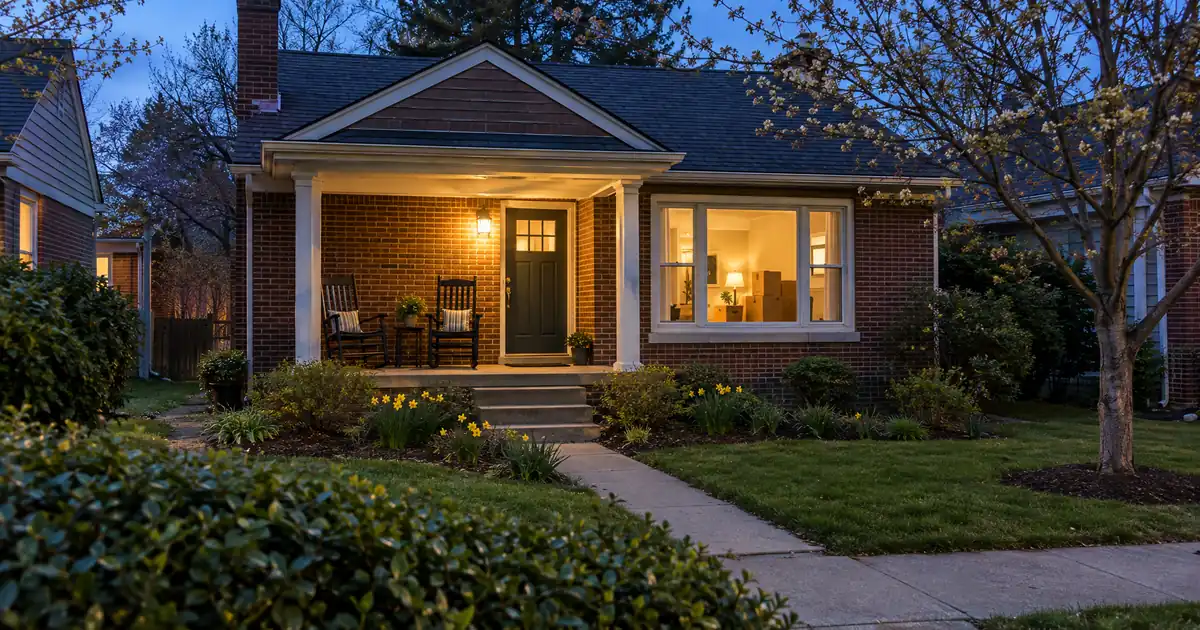
The Quick Read: You can keep your first VA-financed house and buy another with a VA loan, as long as the new home becomes your primary residence. The loan doesn’t work for vacation homes or pure investments. Whether you need a down payment depends on how much entitlement (the part of your benefit VA guarantees to the lender) you have left. Subject to lender guidelines and full file review, this is a common move when orders, a job change, or a growing family pulls you to a new town.
What “Second Home” Means in VA Terms
A VA “second home” is a new primary residence, not a beach house. You live in the new place. The first house becomes a rental, or you keep it for another reason. VA’s own news site frames this as using the benefit more than once.
VA payment estimate
Starting assumptions reflect an example price with no down payment and a first-use funding fee. Replace them with your own figures.
Editable benchmark: 7.32% as of October 22, 2026 · Freddie Mac 30-year average via FRED®. A conventional market reference, not a VA loan quote.
Illustrative starting assumptions: a $350,000 price, no down payment with full entitlement, a first-use funding fee financed into the loan, a thirty-year term at the current Freddie Mac benchmark, and property taxes and insurance estimated at typical national rates. Every field is editable.
Illustrative estimate only — not a Loan Estimate, approval, quote, or commitment to lend. The rate field carries the weekly Freddie Mac thirty-year conventional benchmark, a market reference and not a VA loan quote; your rate is set by the lender at lock. The funding fee follows VA’s published table for the use and down payment entered; the residual-income figure is VA’s guideline for the region and family size, and the rough residual shown subtracts only the housing payment and the debts entered, while VA also deducts taxes, maintenance and utilities. Taxes, insurance and dues are editable estimates; closing costs are not included. Licensed in sixteen states for consumer mortgages. Lendmire is not affiliated with or acting on behalf of the Department of Veterans Affairs.
So the question isn’t “can I own two houses?” Of course you can. The question is whether VA will guarantee a second loan while the first is still open. Having an existing VA loan doesn’t automatically disqualify you.
If you want a vacation home or a pure rental purchase, this program is the wrong tool. Occupancy decides the leverage, and VA financing is built for the home you live in.
Lendmire’s VA loan programs follow the same primary-residence rule. Lendmire is a mortgage broker, so it arranges these loans through wholesale lenders rather than lending directly.
Key Terms Defined
Entitlement: The amount VA guarantees to a lender if you default. It is what lets lenders offer zero-down loans.
Full entitlement: You have never used your benefit, or you have fully restored it. With full entitlement, VA sets no loan limit, though the lender still decides what it will approve.
Remaining entitlement: What’s left when part of your benefit is still tied to a loan you kept. A down payment may be needed on the new loan.
Certificate of Eligibility (COE): The VA document showing your entitlement and any prior VA loans. It is the starting point for every file.
Residual income: What’s left of your monthly income after taxes, debts, and basic living costs for your household size. VA treats it as the controlling test.
Funding fee: A one-time VA charge that can be financed into the loan. Some veterans are exempt.
How a Lender Reviews This Purchase, Step by Step
The review follows a clear sequence. Here is what happens, in order.
1. Pull your COE. The lender looks at entitlement already used and any loan numbers listed. According to VA Pamphlet 26-7, Chapter 8, an entitlement code of 5 or a loan number on the COE signals subsequent use.
2. Work out remaining entitlement. Subtract the entitlement still tied to the first loan from your total. Then test whether what’s left covers the new loan.
3. Count both payments. The lender counts the new payment plus the full payment on the first home: principal, interest, taxes, and insurance. Rent offsets the first home’s payment only when it is documented and meets the rules below.
4. Appraise the new home. It must appraise at or above the price and meet VA’s minimum property requirements. The first home isn’t re-appraised for this purchase.
5. Test residual income. Across the wholesale programs Lendmire places VA files with, residual income is the controlling test. The 41% debt-to-income figure is a guideline, not a cap. A ratio above it needs residual income well above the table.
6. Certify occupancy and close. You certify that you intend to live in the new home, so make sure that certification is accurate before you sign.
Notice what’s missing: a requirement to sell first. You can buy a new home without selling your earlier one, but how much entitlement you have left determines what the purchase looks like. With full entitlement, VA sets no loan limit. With remaining entitlement, a down payment may be required, so speak with a loan officer about your file.
What Is the 25% Rule?
Lenders generally want your remaining entitlement to guarantee at least 25% of the new loan before approving zero down. VA News describes this rule of thumb. If you fall short, the lender may require a down payment to close the gap.
Here is the logic without dollar figures. With full entitlement, the program offers 100% financing with no down payment as long as the price isn’t above appraised value. There is also no mortgage insurance of any kind. With remaining entitlement, the same rule still applies, but your cushion is smaller. A modest price in a low-cost county may still work at zero down. A higher price in a high-cost county may need cash in.
Two buyers can look identical on paper and get different answers. One kept a small first loan in a lower-cost area, so lots of entitlement remains. The other kept a large first loan, so little remains. The difference shows up at the down payment line.
For the exact figure on your file, speak with a loan officer. County limits only matter when you have partial entitlement, and they change.
Your Four Paths When You Want to Keep the First Home
There are several ways to structure this. Each fits a different situation.
| Path | Fits you if | Main trade-off |
|---|---|---|
| Use remaining entitlement | You have plenty left | Down payment if short |
| One-time restoration | First VA loan is paid off, home kept | Used only once |
| Another veteran assumes the loan | A buyer will take over your loan | Risk if they default |
| Sell the first home | You don’t want to be a landlord | You give up the rental |
Path 1: Remaining Entitlement
This is the simplest route. You keep the first loan as is and buy the second using what’s left. If the 25% test passes, you may close with no down payment. If not, the lender asks for money down.
Path 2: One-Time Restoration
If you pay off the first VA loan but keep the home, VA may restore your entitlement. VA News notes that payoff may restore it. The request goes through VA Form 26-1880. Commonly reported rules say it’s available once, adds a notation to your COE, and requires proof of payoff. Confirm the current details on va.gov before you plan around it.
Refinancing the first home into a non-VA loan counts as payoff. That’s one way to free entitlement without selling, though the new loan comes with its own terms.
Path 3: Assumption
An eligible veteran can assume your VA loan and substitute their own entitlement. That frees yours. VA’s Buyer’s Guide warns you to be highly selective about who assumes it. A default on an assumed loan can count against the original veteran’s entitlement.
Path 4: Sell
Selling and paying off the loan restores entitlement. It’s the cleanest option, and it is the right call when you don’t want to be a landlord. It just isn’t the only option.
Can Rent From the First Home Help You Qualify?
Sometimes. Rent doesn’t automatically cancel the old mortgage. It helps only under documented rules.
Based on VA’s Lenders Handbook as summarized in a VA training presentation, prospective rental income can offset only the payment on the home you occupied before the new loan. That deck is older, so confirm against the current Handbook. It also made clear that a short rental history doesn’t count as income.
Many lenders, in practice, count only a discounted share of the rent. They commonly want a documented rental history, often traditional personal-income documentation, for a home you’ve already moved out of. Some add their own reserve requirements. These are lender overlays, not VA rules, so they vary by lender.
The key point: if you qualify with both payments counted in full against your income, the rental rules don’t matter. Run that test first. Rent is a bonus, not a plan.
If you expect to buy later, start renting the first home and documenting that income early.
Worked Examples (Percentages and Plain Words)
Example one: enough entitlement. A veteran kept a first loan on a modest home in a lower-cost county. Remaining entitlement comfortably covers the new loan. The lender runs residual income with both payments counted. It passes. The new loan is 100% financing with no mortgage insurance.
Example two: a shortfall. A veteran kept a larger first loan and now wants a higher-priced home in an expensive county. Remaining entitlement falls short of covering about 25% of the new loan. The lender asks for a down payment sized to the gap. The veteran decides whether to bring that cash or restore entitlement first.
Example three: restoration. A veteran pays off the first VA loan, keeps the home, and files for one-time restoration. Entitlement returns. The new purchase can then work as a full-entitlement loan, with no VA loan limit.
Plug your own numbers in the same order: COE, remaining entitlement, 25% test, both payments, residual income.
What Does the Funding Fee Look Like on a Second Use?
It costs more when you use the benefit again with little down. The fee can be financed into the loan, and it is waived for veterans receiving compensation for a service-connected disability and the other exempt groups. On purchase loans, VA’s fee circular sets these tiers:
| Down payment | First use | Subsequent use |
|---|---|---|
| Under 5% | 2.15% | 3.3% |
| 5% to under 10% | 1.5% | 1.5% |
| 10% or more | 1.25% | 1.25% |
Notice the pattern. Putting 5% down erases the penalty for repeat use. That’s one reason a shortfall down payment isn’t wasted money. It can lower the fee. Every figure here varies by lender and program: guidelines, property type, leverage, and credit profile all apply.
Pamphlet 26-7 also describes an exception: the higher subsequent-use fee doesn’t apply to certain loans when the only prior use was a manufactured home loan. Confirm current rates with a loan officer, since VA updates fees.
Where the General Rule Breaks
A few edge cases change the answer.
- Occupancy timing. The standard expectation is moving in within a reasonable period after closing. Later move-in needs a documented event. Check Pamphlet 26-7, Chapter 3, for the current language.
- Active duty. A spouse or dependent child can satisfy occupancy for a service member who can’t be there. Confirm with the lender.
- Multi-unit homes. A 2-4 unit purchase requires you to live in one unit. Rent from the others is treated under separate rules, and reserves are often higher.
- Foreclosure on the first loan. It can leave entitlement unavailable until VA is repaid. Lenders may add their own waiting periods.
- Full entitlement. Since the Blue Water Navy Vietnam Veterans Act of 2019, borrowers with full entitlement have no VA loan limit. The wholesale programs Lendmire places files with serve amounts up to $4,000,000 with full entitlement.
- Later refinance. The IRRRL (VA’s streamline refinance) generally needs only prior occupancy. So the kept first home can still be streamlined later.
What Credit Score Do You Need?
VA itself sets no minimum credit score. Lenders set their own. The wholesale programs Lendmire places VA loans with start at a 580 decision score. Some lenders set a higher floor. Subject to lender guidelines and file review, a score above the floor doesn’t settle the question. Residual income still controls.
Common Mistakes
- Treating it as a vacation or investment loan. It isn’t one. Occupancy intent must be real.
- Assuming rent cancels the old payment. It only offsets under documented rules.
- Skipping the COE check. Know your entitlement before you shop.
- Ignoring the funding fee tiers. A small down payment can change the fee.
- Counting on restoration twice. The one-time version is used once.
- Letting the wrong person assume your loan. A default can follow you.
Documents to Gather and Questions to Ask
Gather your COE, recent pay stubs, two years of traditional personal-income documentation, the first home’s mortgage statement, and any lease on the first home. If you’ve rented it, bring proof of rental history.
Ask your loan officer:
- How much entitlement do I have left?
- Will I need a down payment, and how is it sized?
- How will you count rent from my first home?
- What reserves do you require?
- Does my funding fee change at a higher down payment?
Compare VA With Other Financing
VA often wins on the new purchase because of zero down and no mortgage insurance. But a conventional loan can make sense if your remaining entitlement is thin and a large down payment would be needed anyway. Compare the full terms on the Loan Estimate, not just the headline. A broker can lay out each option and what it asks of the file.
If you are buying a home and want to see whether a VA loan fits your file, Lendmire can help you compare the options and what each one asks of the file. Details of a related approach appear in Lendmire’s piece How to Keep Your Home and Buy Next With a VA Cash-Out Above the Limit.
Frequently Asked Questions
Can I have two VA loans at the same time?
Yes, if you have enough remaining entitlement or make a down payment when the lender asks for one. You also need to meet credit, income, and occupancy requirements. The new home must be your primary residence.
Do I have to sell my first home before buying a second with a VA loan?
No. You can keep the first home and use remaining entitlement. The lender counts both payments in your qualifying, so your income must support them.
Can I use a VA loan to buy a vacation home or rental?
No. A multi-unit purchase works only if you live in one of the units.
How do I get my entitlement back?
Selling and paying off the loan restores it. If you keep the home, a one-time restoration is available after payoff through VA Form 26-1880. Confirm the current rules on va.gov.
Does VA set a minimum credit score?
No. Lenders set their own. The wholesale programs Lendmire places VA loans with start at a 580 decision score, subject to lender guidelines and full file review. Nothing here is a commitment to lend.
For your own numbers, request a scenario review with Lendmire.
About Lendmire
Lendmire — NMLS# 2371349 — is a mortgage broker that arranges FHA, VA, conventional and jumbo home purchase and refinance financing in 16 states through wholesale lenders. Every option is subject to the lender’s guidelines and full underwriting. Scotsman Guide named Lendmire a Top Mortgage Workplace in both 2025 and 2026.
Get Started
Ready to find the right loan for you?
In about 30 seconds you can review financing options available for your home or investment property. No commitment required.
Informational only. Not a Loan Estimate, approval, or commitment to lend. Program availability and eligibility are subject to lender guidelines, credit approval, property review, and underwriting.
References
1. VA News: Veterans can use VA home loan benefit more than once
2. VA Pamphlet 26-7, Chapter 8 (funding fee)
3. VA Home Loan Guaranty Buyer’s Guide
4. VA training presentation on rental income
5. VA Circular 26-23-06 Exhibit B (loan fees)
This article is part of Lendmire’s VA loan program — full qualification details, guidelines, and scenarios live on the program page.
Related reading: How to Buy With a VA Loan During the Transition Out of Service · How to Buy a Second Home Before a PCS Move With a VA Loan · How to Keep a First VA Loan on Schedule While on Active Duty
Brandon Miller
Founder & CEO, Mortgage Loan Originator, Lendmire LLC
- Mortgage Loan Originator · NMLS# 1129696 · Verify on NMLS Consumer Access
- North Carolina Real Estate Broker · License# 343312 · Verify on NCREC
- North Carolina Insurance Producer · License# 19053198 · Property, Casualty, Life, Health · Verify on NAIC SBS
- Lendmire LLC · Firm NMLS# 2371349 · Verify firm licensure
Disclosure information. Lendmire is a state-licensed mortgage brokerage under NMLS# 2371349. Lendmire is not a depository institution, direct lender, or financial advisor — all loans referenced are placed through wholesale lender partners and are subject to each lender's underwriting standards. This article is provided for general informational purposes and is not a commitment to lend, nor does it constitute financial, legal, or tax advice. Loan programs, terms, rates, and qualification standards change without notice and depend on borrower profile, property type, and the state in which the subject property is located. Equal Housing Opportunity provider. NMLS Consumer Access: nmlsconsumeraccess.org.