
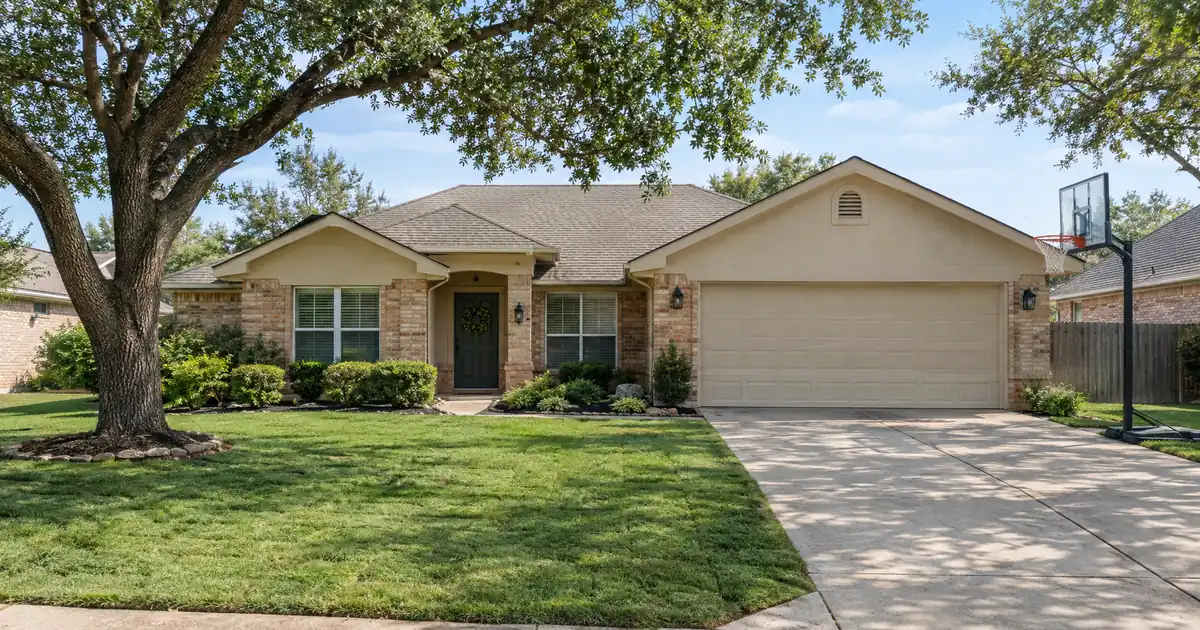
The Quick Read: It depends on how the buyout is documented, and in Texas that is a legal question as much as a VA one. A plain VA cash-out on a Texas homestead is generally off the table. A divorce buyout secured by an owelty lien is a different legal category, but no VA or Texas regulator source confirms how a VA loan treats it. Have your lender and title company confirm the structure in writing before you count on it.
Texas VA cash-out estimate
Seeded with an example value, a typical balance, and a round cash request at the first-use fee; change any field.
Editable benchmark: 7.40% as of October 15, 2026 · Freddie Mac 30-year average via FRED®. A conventional market reference, not a VA cash-out refinance quote.
Illustrative starting assumptions: a $285,000 home value, a $157,000 current balance, the Texas homestead cap with the first-use funding fee financed, a thirty-year term at the current Freddie Mac benchmark, and property taxes and insurance estimated at typical rates for Texas. Every field is editable.
Illustrative estimate only — not a Loan Estimate, approval, quote, or commitment to lend. The rate field carries the weekly Freddie Mac thirty-year conventional benchmark, a market reference and not a VA cash-out refinance quote; a VA loan is priced by the lender at lock. The total loan, funding fee included, is capped at the program leverage on the reasonable value; the fee follows the tier chosen. The cash available is what the cap allows less the balances paid off and the fee, before closing costs, which are not included. The HELOC line is the line program’s combined loan-to-value ceiling applied to the same value and balance. Taxes and insurance are editable estimates. The debt-to-income figure is a guideline; residual income decides a VA file. Licensed in sixteen states for consumer mortgages. On a Texas homestead the state constitution caps a cash-out refinance at eighty percent of value, fee included, and adds a waiting period, a prescribed closing location, and a fee cap; the calculator applies the Texas cap.
What “Buying Out” an Ex-Spouse Means Mechanically
Buying out an ex-spouse means you keep the house and pay your ex their share of the equity. Usually a new loan funds that payment. The new loan pays off the old mortgage, pays your ex, and leaves you alone on the note.
That last part matters. A divorce decree divides property, but it does not remove anyone from the mortgage. Liability stays with both names until the loan is refinanced, assumed with a release, or paid off. Taking your ex off the deed is a separate step from releasing them from the note. You need both.
The size of the payout comes from the decree or a written agreement. Community property, separate property and the valuation date all shape the number, and your family law attorney sets those. The lender then works from that number.
How a VA Cash-Out Works Nationally
Nationally, the VA cash-out is a common buyout tool when the veteran keeps the home. VA describes the cash-out refinance as replacing your current loan with a new one. You can take cash from equity, or refinance a non-VA loan into a VA-backed loan. You need a Certificate of Eligibility, you must meet credit and income standards, and you must live in the home.
Across the wholesale programs Lendmire places VA files with, the envelope looks like this:
- The VA cash-out reaches 100% of the appraised value, including the financed funding fee.
- It can refinance any loan type into a VA loan.
- Wholesale programs start at a 580 decision score. VA itself sets no minimum score, and lenders add their own.
- Residual income is the controlling test. The 41% debt-to-income figure is a guideline, not a cap.
- The funding fee for a cash-out is 2.15% on first use and 3.3% after. Veterans who receive compensation for a service-connected disability, and other exempt groups, do not pay it. It can be financed.
- There is no mortgage insurance.
A buyout adds a wrinkle. The new loan must cover the old payoff plus your ex’s share, so it will usually be larger than the loan it replaces. Under VA’s classification in Circular 26-19-05, a Type I cash-out does not exceed the payoff of the old loan. Anything larger is Type II. By that definition an equity buyout looks like a cash-out on its face. Whether a lien-payoff structure changes that classification is an open point to confirm with your lender.
Lendmire’s VA cash-out refinance program page lays out the national mechanics in more detail.
Why Texas Homestead Law Changes the Answer
On a Texas homestead, a standard VA cash-out is generally unavailable. The Texas Attorney General’s Opinion KP-0183 addressed this directly. It starts from the Texas home-equity framework in Article XVI, Section 50(a)(6) of the Texas Constitution. That section bars additional collateral beyond the homestead. The opinion reasons that the VA guaranty counts as additional collateral, so a VA cash-out is precluded.
An Attorney General opinion is advisory, not binding law. In practice, Texas lenders follow it. Treat it as the working rule.
This is why you see contradictory advice online. National pages treat the VA cash-out as the default buyout path. Texas pages often say flatly that it is unavailable. Both are partly right. The national description is accurate for most states. The Texas homestead rule overrides it here, and Texas is simply the clearest example of a state homestead rule colliding with the VA cash-out idea.
The Owelty Lien: Where a Divorce Changes the Picture
Section 50(a)(3) of the Texas Constitution lists a separate exception to homestead protection: an owelty of partition. It is a lien imposed on the entire property by court order or written agreement. The constitutional text expressly includes a debt of one spouse to the other from the division or award of a family homestead in a divorce.
So a buyout can be secured as an owelty lien, a 50(a)(3) debt, rather than as a 50(a)(6) home-equity loan. Texas family law practitioners say this is why an owelty refinance can avoid the Texas cash-out rules. One Texas law firm describes it as a way to secure the payout without a home-equity loan.
Here is the catch. That is attorney commentary. Neither the Attorney General opinion nor VA addresses an owelty refinance as such. Whether the lender and its investor will underwrite an owelty structure on a VA loan is a lender decision, and overlays vary.
Two more caution points:
- The owelty lien generally must be created by the decree or a written partition agreement. Ask your attorney about this before the decree is final, so the financing route stays open.
- If your home already carries a Texas home-equity loan, Section 50(f) restricts how that debt can be refinanced. The constitutional text lists the conditions. Raise it with your lender early.
Your Options Side by Side
| Route | On a Texas homestead? | Can it fund a payout? |
|---|---|---|
| Standard VA cash-out | Generally precluded | Not in Texas |
| VA IRRRL | Yes, no cash out | No |
| VA refinance with owelty | Lender-dependent, unconfirmed | Possibly, if underwritten |
| Conventional Texas cash-out | Yes, under home-equity rules | Yes |
| Assumption with release | Lender and VA approval | Not by itself |
| Sell the home | Yes | Proceeds split |
The IRRRL deserves a note. It refinances an existing VA loan to a lower rate or from adjustable to fixed, with no VA appraisal. It cannot take equity out or pay off debts beyond the VA loan being refinanced, so it cannot fund a buyout. It can help only when no cash changes hands.
Who Keeps the House Changes the Path
The veteran keeps the home. This is the strongest VA scenario. You hold the entitlement, and the lender underwrites you alone. In Texas, the open question is whether an owelty-secured VA refinance is available through your lender. If it is not, a conventional Texas refinance is the fallback.
The non-veteran spouse keeps the home. A person without entitlement cannot get a VA loan alone. The options are a conventional refinance, an assumption with a release of liability, or substitution of entitlement. That is its own topic. Know that the veteran’s entitlement can stay tied up until the loan is released or paid off, which affects a future VA purchase.
Both spouses are veterans. Substitution of entitlement may apply. Your lender can walk you through it.
What the Lender Checks
The ex-spouse’s income leaves the file when they leave the loan. Expect these steps:
1. Eligibility. Your COE decides it. Service requirements are VA’s rules.
2. Occupancy. VA requires you to live in the home.
3. Full underwriting on you alone. Consumer advocates’ comments on VA’s 2019 refinance rulemaking say covered refinances need full underwriting and ability-to-repay standards. The IRRRL is the exception. Residual income controls, and your income and credit stand by themselves.
4. VA appraisal. The reasonable value caps the new loan. Under 38 CFR 36.4306, the loan may not exceed 100 percent of VA’s reasonable value. That is the federal ceiling. Texas law, not VA, sets any lower limit on a homestead.
5. Net tangible benefit. A cash-out must show a defined benefit. The regulation gives examples: removing monthly mortgage insurance, a shorter term, a lower rate, a loan at or under 90 percent of reasonable value, or moving from an adjustable to a fixed rate. The lender must also provide comparison disclosures.
6. Seasoning for VA-to-VA loans. Refinancing an existing VA loan requires the later of 210 days from the first payment and the sixth payment. Recoupment tests apply too.
7. Closing. The new loan pays off the old mortgage and the owelty amount, and releases the lien. Expect extra legal and title work for the owelty instrument, plus the decree.
A Worked Example, in Percentages
Picture a Texas homestead where you and your spouse built equity together. The decree awards the home to you and sets your ex’s share at half the equity. The VA appraisal comes back and the new loan, which must cover the old payoff plus your ex’s share, lands at about 85% of the appraised value.
That is under the 100% federal ceiling. It also meets one of the net tangible benefit examples, a loan at or under 90 percent of reasonable value. On paper the numbers fit.
Whether the structure works depends on three things:
- The buyout is documented as an owelty lien, not a voluntary payment.
- Your lender and its investor will underwrite the owelty on a VA loan.
- You qualify alone, on residual income and credit.
If the buyout is only a voluntary payment, you are back in 50(a)(6) territory. A plain VA cash-out on a Texas homestead is generally precluded. The same loan, same equity and same VA appraisal can land on opposite sides of the line based only on how the debt is documented. That is the real lesson of this topic.
Common Mistakes
- Assuming the decree removes your ex from the loan. It does not. Liability stays until a refinance, assumption with release, or payoff.
- Treating the Attorney General opinion as statute. It is advisory. Lenders follow it anyway.
- Expecting an IRRRL to pay your ex. It cannot.
- Assuming owelty always works with VA. No primary source confirms it. Lender overlays apply.
- Finalizing the decree first. Ask your attorney whether the owelty language belongs in it before it is signed.
- Moving out after the refinance. VA requires you to live in the home.
- Ignoring entitlement. Using entitlement on the new loan affects future VA purchases.
Questions to Ask Before You Commit
Ask your lender:
- Will you underwrite an owelty lien on a VA loan, and in writing?
- How do you classify the loan, as a cash-out or not?
- Does my home carry an existing Texas home-equity loan?
- How will the funding fee, if I owe it, be handled?
Ask your family law attorney:
- Does the decree create the owelty lien, and does the language fit a lender’s needs?
- How is the buyout number set?
- What happens to my ex’s liability on the current note?
This article is not legal advice. Your attorney and title company make the legal call.
Key Terms Defined
Owelty of partition: A lien on the whole property, created by court order or written agreement, that secures one owner’s debt to another after a division, including a divorce.
Homestead: Your primary Texas residence, which the state constitution protects from most liens.
Entitlement: The amount of VA guaranty you have available to use on a loan.
Certificate of Eligibility (COE): The VA document that confirms you qualify for a VA loan.
Residual income: The money left each month after your major obligations, which VA uses as the controlling underwriting test.
IRRRL: The VA streamline refinance, which replaces an existing VA loan and cannot take equity out.
Net tangible benefit: A measurable gain the refinance must give you, such as removing mortgage insurance or moving to a fixed rate.
Frequently Asked Questions
Can I do a regular VA cash-out refinance on a Texas homestead?
Generally no. The Texas Attorney General concluded that the VA guaranty counts as additional collateral, which the Texas home-equity rules bar. The opinion is advisory, but Texas lenders follow it.
Does the owelty route make a divorce buyout possible with a VA loan?
Possibly, but it is not confirmed. Owelty is a separate constitutional category from a home-equity loan, and attorneys say it can avoid the cash-out rules. No VA source addresses it, so it depends on whether your lender and its investor will underwrite it.
Can an IRRRL pay out my ex-spouse?
No. An IRRRL cannot take equity out or pay off debts beyond the VA loan being refinanced. It works only for a no-cash change, and a spouse without entitlement cannot use it to keep the home.
Does the divorce decree take my ex off the mortgage?
No. Liability stays on the loan until it is refinanced, assumed with a release, or paid off. Removing a name from the deed is a different step from releasing the note.
Can I finance the funding fee?
Yes. The fee can be paid in cash or included in the loan, which adds to the balance. Veterans who receive service-connected disability compensation, and other exempt groups, do not pay it.
If you are weighing a cash-out refinance against keeping the loan you have, Lendmire can help you compare the programs and the equity each one reaches. Program figures are subject to lender guidelines and full file review, and nothing here is a commitment to lend. Tax treatment can depend on your situation; borrowers should speak with a qualified tax professional before relying on any deduction or credit.
For your own numbers, request a scenario review with Lendmire.
About Lendmire
Lendmire, NMLS# 2371349, is a mortgage brokerage with consumer lending licenses in 16 states. FHA, VA, conventional and jumbo purchase and refinance loans are arranged through wholesale lending partners, and each application is reviewed individually by the lender. Scotsman Guide named Lendmire a Top Mortgage Workplace in both 2025 and 2026.
Get Started
Ready to find the right loan for you?
In about 30 seconds you can review financing options available for your home or investment property. No commitment required.
Informational only. Not a Loan Estimate, approval, or commitment to lend. Program availability and eligibility are subject to lender guidelines, credit approval, property review, and underwriting.
References
3. Texas Attorney General Opinion KP-0183
4. Texas Constitution Art. XVI, Section 50
5. Texas law firm commentary on owelty
6. Texas Constitution Art. XVI, Section 50 (text, 50(f))
7. National Consumer Law Center comments on VA’s 2019 refinance rulemaking
9. eCFR 38 CFR Part 36 Subpart B
This article is part of Lendmire’s VA Loans series — every loan program’s qualification details, guidelines, and scenarios live on the loan options page.
Related reading: Can a Surviving Spouse Use the VA Benefit for a VA Cash-Out? · Can You Buy Out a Spouse With VA Cash-Out on Restored Entitlement? · How to Buy Out a Spouse With a VA Cash-Out on a Texas Homestead
Brandon Miller
Founder & CEO, Mortgage Loan Originator, Lendmire LLC
- Mortgage Loan Originator · NMLS# 1129696 · Verify on NMLS Consumer Access
- North Carolina Real Estate Broker · License# 343312 · Verify on NCREC
- North Carolina Insurance Producer · License# 19053198 · Property, Casualty, Life, Health · Verify on NAIC SBS
- Lendmire LLC · Firm NMLS# 2371349 · Verify firm licensure
Compliance and disclosures. Lendmire (NMLS# 2371349) is a licensed mortgage broker and is not a direct lender, depository institution, financial advisor, or tax professional. Content in this article is general market analysis and educational information — not financial, legal, or tax advice for any specific situation. Lendmire does not guarantee loan approval; every transaction is subject to underwriting by the funding lender. Mortgage pricing and loan program guidelines are subject to change at any time without notice and vary by borrower characteristics, property type, and state regulations. Lendmire complies with Equal Housing Opportunity. Licensure verification: NMLS Consumer Access.