
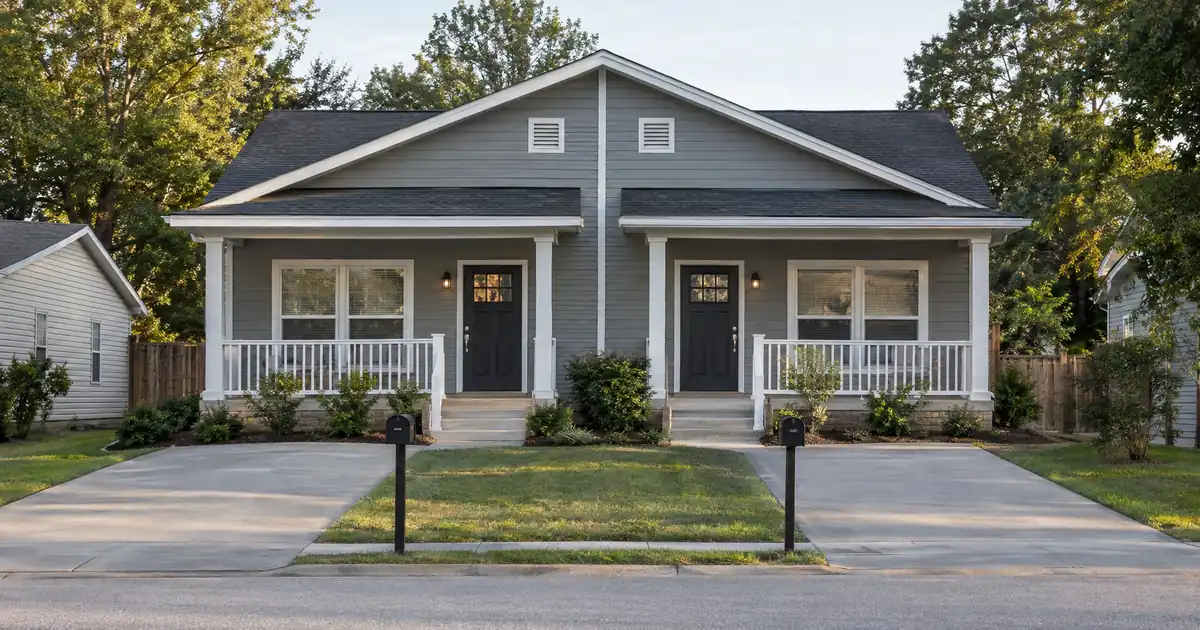
The Quick Read: The cash you walk away with is what remains of a new, larger loan after it pays off your old mortgage, other liens and closing costs. On a 2-4 unit home you live in, conventional programs cap that new loan at 75% of appraised value, versus 80% on a one-unit home. So the check is smaller than your equity, and often much smaller. Every figure here is subject to lender guidelines and full file review, and nothing is a commitment to lend.
Key Takeaways
- The formula is: appraised value × the program ceiling, minus the old mortgage, minus other liens, minus closing costs.
- The ceiling caps the new loan. It does not cap how much of your equity you can use.
- A 2-4 unit primary home gets a lower ceiling than a one-unit home, so the same equity produces less cash.
- Rent from the unit you live in does not count as income. Rent from the other units can, with documentation.
- Two waiting periods apply: time on title and the age of your current first mortgage.
What Does “Creates” Mean Here?
It means three things happen at once: you get cash, your debt goes up, and your equity goes down. A cash-out refinance replaces your whole mortgage with a new one. The new loan is bigger than what you owe. The old lender is paid off, and the difference comes to you.
Lendmire’s cash-out refinance programs work this way for owner-occupied homes. The same logic holds for a duplex, triplex or fourplex. You must live in one of the units. Lendmire is a mortgage broker, so it arranges these loans through wholesale lenders rather than lending itself.
The reader who skims often thinks “75% of my home’s value is mine to take.” That is the most common misunderstanding. The 75% is the size of the new loan. Your old balance has to fit inside it first.
How the Cash Is Calculated, Step by Step
The math is a subtraction chain. Here is each link.
1. Get the appraised value. The appraiser values the whole building, and the number drives everything after it. On a 2-4 unit, appraisers typically look at rents on the other units as part of the value.
2. Apply the ceiling. On conventional programs, the new loan can reach 75% of value on a 2-4 unit primary residence. The Fannie Mae Eligibility Matrix lists 80% for one unit and 75% for 2-4 units on principal-residence cash-out.
3. Subtract your first mortgage. The new loan must pay it off in full.
4. Subtract other liens. A second mortgage or a HELOC (a home equity line of credit) usually gets paid at closing too.
5. Subtract closing costs and financed fees. These can be paid from the proceeds, which cuts the check further.
6. What remains is your cash.
Think of the ceiling as the size of a bucket. Your old debt fills it first, and only the empty space is yours.
At 75%, mortgage insurance is not an issue. It applies only above 80% LTV (loan-to-value, the loan as a percentage of the home’s value). That is one reason cash-out files on 2-4 units stay simple on that front. Final terms depend on lender guidelines, property type, leverage, and the borrower’s complete credit picture.
The Waterfall in Percentages of Value
Take the appraised value as 100%. Here is how the chain reads on a 2-4 unit primary home.
| Step | Share of value |
|---|---|
| Maximum new loan | 75% |
| Less first mortgage payoff | your balance |
| Less other liens | any second or HELOC |
| Cash before costs | what is left |
| Less closing costs, financed fees | comes off the top |
| Equity left in the home | at least 25% |
Equity left is at least 25% because the loan stops at 75%. That cushion is the point of the cap.
Three Buildings, Side by Side
These are modeled assumptions, not market data. Each row assumes a different existing balance, shown as a share of appraised value. The ceiling is 75% on all three.
| Building | Existing first mortgage | Cash before costs |
|---|---|---|
| Duplex | 40% of value | 35% of value |
| Triplex | 55% of value | 20% of value |
| Fourplex | 70% of value | 5% of value |
| Duplex plus a HELOC | 40% first, 10% HELOC | 25% of value |
The pattern is plain. The more you owe, the less the loan creates. A fourplex owner with a 70% balance gets only a thin slice before costs, and the costs may eat most of it. Unit count does not change the 75% figure here, but it does change how the appraisal and income review are handled.
One Unit Versus 2-4 Units at the Same Equity
Picture two homeowners who each owe 50% of their home’s value. One lives in a one-unit home. The other lives in a duplex.
| Factor | One-unit primary | 2-4 unit primary |
|---|---|---|
| Conventional ceiling | 80% | 75% |
| Cash before costs | 30% of value | 25% of value |
Same equity, same balance, and the duplex owner gets five points of value less. The difference comes from the lender’s view of risk. Multi-unit homes carry a lower cap on cash-out under the agency rules.
Occupancy decides the leverage. If you move out and rent every unit, the loan is no longer a primary-residence loan. Investment-property cash-out carries the same 75% cap on 2-4 units, but it is underwritten on a different basis, and it is a separate lane from this one.
What the Appraiser and Underwriter Do With the Rent
Rent from the unit you live in does not count as income. Fannie Mae’s rental income rules generally disallow it. Rent from the other units can help you qualify, but it comes with documentation requirements. The lender also nets the building’s full housing payment against that rent, so the payment is not counted twice.
In an owner-occupied multi-unit purchase, the key measure is your debt-to-income ratio, which simply means your monthly debts divided by your monthly income.
Pricing and available terms vary by lender, borrower profile, property type, and full underwriting review. Most files run on an automated finding with a total ratio ceiling of 50%. Manually underwritten loans use tighter ratios, 36% or 45%, with reserve requirements. Reserves are cash left in the bank after closing. A higher ratio often triggers a larger reserve requirement.
A first-time landlord faces added limits on counting rent, and documentation matters more. Bring leases and proof of rent received. Expect questions if a unit has been vacant.
The Waiting Periods
Two clocks run on conventional cash-out. Fannie Mae’s Selling Guide requires at least one borrower to be on title for six months. Separately, the first mortgage being paid off must be at least 12 months old, measured from its note date to the new note date, per Fannie Mae’s cash-out announcement.
Exceptions exist. Inheritance, property awarded in a divorce or legal separation, and the delayed financing exception for cash purchases can waive the title clock. Many borrowers assume one waiting period applies. There are two, and both must be met.
Where the General Rule Breaks
The 75% figure is a conventional number. Several situations bend it.
Limited cash-out is a different loan. A rate-and-term refinance (also called limited cash-out) pays off the first mortgage, closing costs and a purchase-money second lien, with only incidental cash back. It carries a much higher ceiling than cash-out. A large “just a little cash” request, or paying off a non-purchase second, can flip the loan to full cash-out status and the lower ceiling.
FHA has its own rules. FHA cash-out sets its own ceiling, below its purchase leverage. On three- and four-unit homes, FHA also applies a self-sufficiency test, which checks whether the building’s rent can carry the payment. Confirm the current details before planning around them.
VA is different again. A VA cash-out is for borrowers with a Certificate of Eligibility who live in the home. VA describes it as replacing your current loan with a new one on different terms, and the loan being refinanced need not be a VA loan. VA allows high leverage, but many lenders set lower caps. A VA funding fee also applies.
Streamlines give no cash. The FHA Streamline needs an existing FHA loan and a net tangible benefit, meaning the refinance must improve your position. It allows no real cash back. The VA IRRRL (a streamline refinance of an existing VA loan) carries a 0.5% funding fee unless exempt, and permits no cash out.
Some states add rules. A few states have special cash-out rules for homesteads. In Texas, a homestead cash-out is capped by the state constitution.
Large loans change lanes. Above the conforming loan limit, jumbo programs take over with their own leverage and score requirements.
What Happens to Your Budget and Risk
The new terms apply to your whole balance, not just the cash portion. You are not borrowing only the extra. You are re-borrowing everything.
That cuts both ways. The CFPB’s research notes the benefit depends on whether the new loan costs less than the debt it replaces. It also warns that moving non-mortgage debt into a home-secured loan can put the home at risk if payments become unsustainable.
On a 2-4 unit, the rent from the other units can help carry the new payment. Do the arithmetic before you apply. If the other units’ rent would leave you stretched, the cash is costing more than it appears.
Lower appraisals hurt more than people expect. Because the old payoff does not change, every drop in value cuts the maximum loan by three-quarters of the drop, and the cash falls by the same amount.
Tax treatment can depend on your situation; borrowers should speak with a qualified tax professional before relying on any deduction or credit.
Key Terms Defined
LTV (loan-to-value): The loan amount as a percentage of the home’s appraised value.
Seasoning: The waiting period a loan or ownership must meet before a refinance is allowed.
Limited cash-out refinance: A refinance that pays off the old loan and costs, with only small cash back, and a higher ceiling than full cash-out.
Net tangible benefit: A measurable improvement to the borrower’s position that a streamline refinance must show.
Note date: The date the borrower signs the loan’s promissory note.
Frequently Asked Questions
How much cash can I actually get on a duplex I live in?
It depends on your balance. The ceiling is 75% of appraised value on conventional programs. Subtract your first mortgage, any second lien or HELOC, and closing costs. What remains is the check, and it is always less than your total equity.
Do I get the same cap as a one-unit home?
No. Conventional programs allow 80% on a one-unit primary home and 75% on a 2-4 unit primary home. The five-point gap means less cash at the same equity.
Does the rent from my own unit help me qualify?
No. Conventional guidelines generally disallow rent from the unit you occupy. Rent from the other units can count, subject to documentation rules and lender review.
Can I take cash out right after buying?
Not usually. A borrower generally needs six months on title, and the first mortgage being paid off must be at least 12 months old. Inheritance, legal awards and delayed financing are among the exceptions.
Will a streamline give me cash?
No. The FHA Streamline and VA IRRRL are for existing government loans and are not cash-out tools. If cash is the goal, a full cash-out refinance is the path to compare.
Comparing It Against Keeping Your Loan
The best question is not “how much can I take?” It is “what does the new loan cost across the whole balance, and what will I do with the cash?” A fourplex owner with a high balance may find the check is mostly eaten by costs. A duplex owner with a low balance may find real room.
If you are weighing a cash-out refinance against keeping the loan you have, Lendmire can help you compare the programs and the equity each one reaches.
For your own numbers, request a scenario review with Lendmire.
For current guidelines and terms, see Lendmire’s refinance programs page.
About Lendmire
Lendmire (NMLS# 2371349) is a mortgage brokerage serving homeowners and home buyers in 16 states. FHA, VA, conventional and jumbo purchase and refinance loans are arranged through wholesale lending channels; Lendmire brokers the financing and the lender underwrites each application. Scotsman Guide named Lendmire a Top Mortgage Workplace in both 2025 and 2026.
Get Started
Ready to find the right loan for you?
In about 30 seconds you can review financing options available for your home or investment property. No commitment required.
Informational only. Not a Loan Estimate, approval, or commitment to lend. Program availability and eligibility are subject to lender guidelines, credit approval, property review, and underwriting.
References
1. Fannie Mae Eligibility Matrix
2. Fannie Mae Selling Guide B3-3.1-08, Rental Income
3. Fannie Mae Selling Guide B2-1.3-03, Cash-Out Refinance Transactions
4. Fannie Mae announcement on cash-out refinance eligibility
5. VA, Cash-out refinance loan
6. CFPB, Cash-Out Refinances and Paydown Behavior of Non-Mortgage Debt Balances
This article is part of Lendmire’s Refinance series — every loan program’s qualification details, guidelines, and scenarios live on the loan options page.
Related reading: How Much More a Cash-Out Refinance Costs for a Home Addition or ADU · How Many Days Cash-Out Refinance Funds Take to Arrive on a Primary Home · How to Qualify for a Cash-Out Refinance on a Free-and-Clear Home
Brandon Miller
Founder & CEO, Mortgage Loan Originator, Lendmire LLC
- Mortgage Loan Originator · NMLS# 1129696 · Verify on NMLS Consumer Access
- North Carolina Real Estate Broker · License# 343312 · Verify on NCREC
- North Carolina Insurance Producer · License# 19053198 · Property, Casualty, Life, Health · Verify on NAIC SBS
- Lendmire LLC · Firm NMLS# 2371349 · Verify firm licensure
Disclosure information. Lendmire is a state-licensed mortgage brokerage under NMLS# 2371349. Lendmire is not a depository institution, direct lender, or financial advisor — all loans referenced are placed through wholesale lender partners and are subject to each lender's underwriting standards. This article is provided for general informational purposes and is not a commitment to lend, nor does it constitute financial, legal, or tax advice. Loan programs, terms, rates, and qualification standards change without notice and depend on borrower profile, property type, and the state in which the subject property is located. Equal Housing Opportunity provider. NMLS Consumer Access: nmlsconsumeraccess.org.