
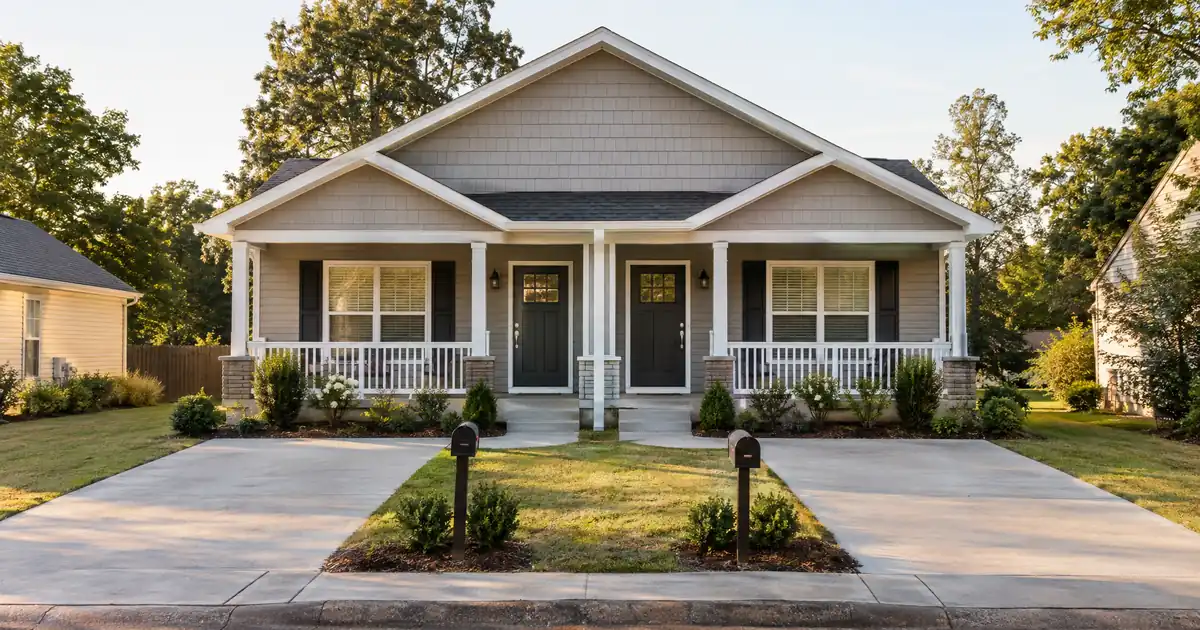
The Quick Read: A cash-out refinance on a duplex you live in replaces your current first mortgage with a larger one and hands you the difference in cash. On a conventional loan, the lender can lend up to 75% of the home’s appraised value on a two-unit principal residence. A one-unit home gets 80%. That five-point gap is the main thing that surprises duplex owners, and it shapes everything below.
Key Takeaways
- A duplex you occupy qualifies as a principal residence, so you get owner-occupant treatment instead of investment-property limits.
- Conventional cash-out tops out at 75% LTV (loan-to-value, the loan as a share of appraised value) on two to four units.
- Your existing first mortgage must be at least 12 months old, and one borrower must have been on title for six months.
- Rent from the other unit can help you qualify, but only a discounted share counts.
- Cash in hand is always less than your available equity, because payoff, closing costs, and reserves come out first. Every figure here varies by lender and program — guidelines, property type, leverage, and credit profile all apply.
What Is a Cash-Out Refinance on a Duplex?
A cash-out refinance pays off your existing first mortgage with a new, larger one. You keep the difference. Fannie Mae’s Selling Guide defines it as a new first mortgage on the same property that retires the old loan.
Compare that with a rate-and-term refinance, which the industry also calls limited cash-out. That loan only pays off your current first mortgage, closing costs, and sometimes a purchase-money second lien. You walk away with, at most, incidental cash back. On a two-unit home, those loans reach 95% LTV, which looks tempting next to 75%. But it is a different product for a different goal. Cash-out leverage is lower because you are taking money out. Final terms depend on lender guidelines, property type, leverage, and the borrower’s complete credit picture.
Lendmire arranges both kinds through wholesale lenders, and the first question on any file is the same: what is the cash for? If it is only a lower payment or a shorter term, rate-and-term may fit. If you need money for a project, debt, or a down payment, cash-out is the tool. Lendmire’s cash-out refinance programs page lays out the product family.
Can You Cash Out While Living in One Unit?
Yes. Live in one unit of a two-unit building, and the property is your principal residence. A principal residence is the home you occupy as your main address. That status unlocks owner-occupant leverage and credit treatment.
So why do some people hear “no”? Three reasons come up on files we see.
- The lender channel. Not every lender sells every program. A lender with a narrow menu may simply not offer multi-unit cash-out.
- State rules. Some states restrict cash-out on certain homes. In Texas, for example, a cash-out on a homestead is capped by the state constitution, and one wholesale lane we use is not written there.
- Occupancy confusion. A loan officer who hears “duplex” may default to investment-property rules. Occupancy decides leverage, so say clearly that you live in one unit.
A “no” from one source is usually a statement about that lender, not about the property type.
The Step-by-Step: How the Loan Is Underwritten
Underwriting is the lender’s review of your file. Here is the sequence on an owner-occupied duplex.
1. Confirm occupancy and property type. The lender confirms you live in one unit. This sets which leverage row applies.
2. Check seasoning. Seasoning is the waiting period between two events. For conventional cash-out, the first mortgage being paid off must be at least 12 months old, counted from its note date to the new note date. Fannie Mae announced this 12-month rule for notes dated on or after a 2023 effective date. At least one borrower must also have been on title for six months. If you listed the home for sale, it must come off the market before the loan funds.
3. Run automated underwriting. Software scores the file on credit, income, debts, and reserves. Across the wholesale conventional programs we place files with, the starting point is a 620 decision score. The automated finding governs most files, with a total ratio ceiling of 50%. Manually underwritten loans run tighter, at 36% or 45%, depending on score and reserves. Per the Selling Guide, a file with DTI (debt-to-income, your monthly debts as a share of income) above 45% on automated underwriting needs six months of reserves. Reserves are cash you keep after closing.
4. Appraisal. A two- to four-unit property is appraised on an income-property report, which includes a market rent schedule for the units. The appraised value is the number everything else multiplies against.
5. Count the rent. More on this in the next section.
6. Do the loan-amount math. The maximum loan is appraised value times the leverage cap. From that, subtract your payoff, closing costs, prepaid items, and any other required liens. What remains is your cash.
7. Close and wait out the cancellation window. A refinance of your primary residence carries a three-business-day right to cancel, per the CFPB. Funds are disbursed after that window passes. You can waive it only in a bona fide personal financial emergency.
How Does the Other Unit’s Rent Count?
It counts, but only partly. When a lender uses a signed lease or a market-rent schedule from the appraisal, conventional guidelines credit 75% of the gross monthly rent. The rest is a cushion for vacancy and upkeep.
Picture a duplex where you live downstairs and a tenant rents upstairs. The lender does not add the full rent to your income. It adds three-quarters of it. If that discounted figure pushes your total debt ratio down, it helps. If your ratio is already comfortable, it may not matter much.
Documentation varies by lender. Expect to provide the lease and possibly proof of rent received. Rent also does something an owner of a single-family home never deals with: it makes your appraisal a two-part story, with a value opinion and a rent opinion. A tenant who pays below market rent can weigh on the qualifying numbers.
How Much Cash Can You Actually Take Out?
Less than your equity. Here is the formula, in words.
1. Start with the appraised value.
2. Multiply by the cap: 75% on a conventional two-unit principal residence.
3. Subtract your current mortgage payoff.
4. Subtract closing costs and prepaid items, if you are not paying them out of pocket.
5. What is left is your gross cash. Any required reserves or liens come out of that.
The cap has real consequences. Take two homes with identical appraised values and identical balances. The single-family owner borrows against a limit five points higher. On the duplex, that 5% of value is simply unavailable. Closing costs can usually be rolled into the new loan, but they use up the same leverage room, so financing them shrinks your cash dollar for dollar.
The CFPB’s home equity guide notes that lenders typically want you to keep 10% to 20% of your home’s value as equity. The 75% cap already builds that cushion in.
Loan Programs Compared
| Program | Cash-out leverage | Occupancy | Notes |
|---|---|---|---|
| Conventional, 1 unit | 80% LTV | Principal residence | Standard single-family cap |
| Conventional, 2–4 units | 75% LTV | Principal residence | Seasoning rules apply |
| Conventional wholesale lane | Up to 89.99% LTV | Primary, conforming balance | One-unit lane; six months seasoning, no MI |
| FHA cash-out | 80% of adjusted value | Owner-occupied | Three- and four-unit homes add a self-sufficiency test |
| VA cash-out | Varies by type | Veteran occupies | Not a streamline |
A few notes on that table. The 89.99% wholesale lane carries a 680 score and a 50% ratio on a thirty-year fixed. It is written for primary residences with conforming balances, so check whether a two-unit scenario fits before counting on it. Subject to lender guidelines, it has its own six-month seasoning requirement.
On FHA, HUD’s Mortgagee Letter 2019-11 cut the cash-out cap to 80% of adjusted value, down from 85%. HUD’s archived refinance guidance describes one- to four-unit properties as eligible if owner-occupied. For three- and four-unit homes, it adds a self-sufficiency test and a minimum of three months of reserves. That archive page is dated, so treat it as a pointer and confirm current handbook rules before relying on it.
VA cash-out comes in two flavors under VA Circular 26-19-05. A Type I stays within the payoff, including the funding fee. A Type II exceeds the payoff. Either way, a veteran refinancing a duplex with cash-out needs to occupy one unit as the primary residence.
Where the Rule Breaks: Edge Cases
The streamlines cannot pull cash. The FHA Streamline and the VA IRRRL (Interest Rate Reduction Refinance Loan) are for existing government loans. They skip the appraisal or credit depth of a full refinance, but they require a net tangible benefit and produce no cash out. Searching “streamline duplex” while hoping for cash leads nowhere.
Delayed financing. Say you bought the duplex with cash and want to recover that money. Conventional guidelines let a cash buyer skip the six-month title wait if the purchase is documented. The loan is still treated as cash-out, with cash-out leverage.
Ownership exceptions. The six-month title rule has exceptions for inheritance and legal awards such as a divorce decree. Expect the lender to ask for documents proving how you came to own the home.
Moving out. If you leave, the property stops being a principal residence. Conventional leverage on investment property is 75% on one unit and lower caps beyond that. Lendmire’s piece non owner occupied cash out refinance loans explains how that side of the line works. The key point here: occupancy is a promise you make at closing, and lenders expect you to honor it.
Listed for sale. A home listed recently must be off the market before disbursement. A seller who relists after closing invites questions.
Rate-and-term at 95%. The 95% two-unit figure on the agency tables applies to purchases and limited cash-out. Do not read it as a cash-out limit.
What Decides the Outcome
From first-hand file work, six things move a duplex cash-out more than anything else:
- the appraised value and how the rent schedule supports it
- the leverage cap for two units
- seasoning on the existing loan and on title
- DTI, including how much rental income counts
- credit score and reserves
- which program the file fits
An appraisal that lands under expectation is the most common surprise. Each point of lost value cuts cash by a larger amount than it seems, because the cap multiplies the shortfall and payoff stays fixed.
Cash-Out Refinance vs. HELOC vs. Home Equity Loan
| Feature | Cash-out refinance | HELOC | Home equity loan |
|---|---|---|---|
| What happens to your first mortgage | Replaced | Stays | Stays |
| Structure | One new loan | Revolving line | Lump sum, second lien |
| Cash delivery | Lump sum | Draw as needed | Lump sum |
| Best for | One large need | Ongoing or uncertain costs | Fixed project cost |
The big question is your existing first mortgage. If your current loan has terms you value, a second lien leaves it alone. If you want one loan and one payment, cash-out consolidates. A cash-out also resets your first mortgage, so weigh what you give up.
Smart Uses of the Cash, and the Risks
The CFPB’s research on cash-out borrowers found that paying off debts was the most common stated reason, followed by home repairs. It also found that moving non-mortgage debt into a mortgage can raise foreclosure risk, and that credit scores tend to drift down after the initial boost.
For a duplex owner, repairs and improvements to the building often make sense. They can raise the value of both units. Using cash to repay credit cards trades unsecured debt for debt secured by your home. That swap needs discipline.
Over-borrowing is the biggest risk. A larger loan means a higher principal-and-interest payment, since the new loan covers the old balance, costs, and the cash you pulled. Taxes and insurance are set separately. And a vacancy in the other unit hits harder when the payment has grown. Tax treatment can depend on your situation; borrowers should speak with a qualified tax professional before relying on any deduction or credit.
Also expect your insurance and escrow to be reviewed. Lenders want coverage that fits a two-unit building with a tenant, and escrow amounts can change at closing.
Common Mistakes
- Assuming duplex limits match single-family. They do not. It is 75% against 80%.
- Counting all the rent. Only 75% counts.
- Refinancing too soon after buying. Seasoning blocks it unless an exception fits.
- Ignoring net proceeds. Equity is not cash.
- Listing the home for sale. It must be off the market at funding.
- Ordering a streamline for cash. It cannot produce any.
Frequently Asked Questions
Can I cash out if I rent the other unit?
Yes. Renting the second unit is the normal setup for a duplex owner-occupant. The lender may count 75% of the gross rent toward qualifying income, based on a lease or the appraisal’s rent schedule. Occupancy of your own unit is what keeps the loan in the owner-occupied category.
Does the tenant affect approval?
Indirectly. The tenant’s lease supports the rental income the lender counts, and the appraisal values the building with both units. A vacant unit usually means no rental income counts, so your own income carries the file. Subject to lender guidelines and full file review.
How soon can I refinance again?
On conventional cash-out, a new refinance looks back at the loan being paid off. That loan must be 12 months old from note date to note date. So a recent cash-out refinance generally means a wait before the next one. Government-backed programs have their own seasoning, such as the VA IRRRL’s later-of-210-days-and-six-payments test.
Is this different from a rental cash-out?
Yes. Occupancy decides leverage. A principal residence duplex uses the 75% cap for conventional cash-out, and the lender treats you as an owner-occupant. A property where you do not live falls under investment-property rules.
Does it work for a triplex or fourplex?
The conventional cap stays at 75% for two to four units. FHA keeps its 80% cap, but three- and four-unit homes add a self-sufficiency test and reserve requirements. Every program is subject to lender guidelines and file review.
Next Step
If you are weighing a cash-out refinance against keeping the loan you have, Lendmire can help you compare the programs and the equity each one reaches. Bring your current payoff, an honest estimate of value, and your lease, and the comparison gets concrete fast. Nothing here is a commitment to lend.
Key Terms Defined
LTV (loan-to-value): The loan amount divided by the appraised value, shown as a percentage.
Seasoning: A required waiting period, such as how long a loan or title has existed before a refinance.
DTI (debt-to-income): Your monthly debt payments as a share of your gross monthly income.
Reserves: Cash or liquid assets you keep after closing to cover payments.
Principal residence: The home you occupy as your main address.
Rate-and-term refinance: A refinance that pays off the old loan and costs without giving you meaningful cash back.
For your own numbers, request a scenario review with Lendmire.
About Lendmire
Lendmire (NMLS# 2371349) is a mortgage broker licensed for consumer lending in 16 states. Lendmire arranges FHA, VA, conventional and jumbo purchase and refinance loans through wholesale lenders; every file is underwritten by the lender under the applicable program guidelines. Scotsman Guide named Lendmire a Top Mortgage Workplace in both 2025 and 2026.
Get Started
Ready to find the right loan for you?
In about 30 seconds you can review financing options available for your home or investment property. No commitment required.
Informational only. Not a Loan Estimate, approval, or commitment to lend. Program availability and eligibility are subject to lender guidelines, credit approval, property review, and underwriting.
References
1. Fannie Mae Selling Guide B2-1.3-03, Cash-Out Refinance Transactions
2. Fannie Mae, Updates to Cash-Out Refinance Eligibility
3. CFPB, Can I ever waive my right to rescind?
5. HUD Mortgagee Letter 2019-11
7. CFPB: CFPB Report Finds Cash Out Mortgage Refinance Borrowers Improve Credit Scores
This article is part of Lendmire’s Refinance series — every loan program’s qualification details, guidelines, and scenarios live on the loan options page.
Related reading: How Much Equity a Cash-Out Refi Releases When Scaling to Ten Doors · Sell vs Cash-Out Refi When You Need Equity for the Next Door · Can an S-Corp Owner Cash Out Without Tax Returns?
Brandon Miller
Founder & CEO, Mortgage Loan Originator, Lendmire LLC
- Mortgage Loan Originator · NMLS# 1129696 · Verify on NMLS Consumer Access
- North Carolina Real Estate Broker · License# 343312 · Verify on NCREC
- North Carolina Insurance Producer · License# 19053198 · Property, Casualty, Life, Health · Verify on NAIC SBS
- Lendmire LLC · Firm NMLS# 2371349 · Verify firm licensure
Legal disclosures. Lendmire (NMLS# 2371349) is a state-licensed mortgage brokerage that arranges financing through wholesale lender relationships. Lendmire is not a direct lender, depository institution, or registered financial advisor. The discussion above is general informational content about real estate financing — it is not financial, legal, or tax advice, and readers should consult licensed professionals for guidance on their individual circumstances. Loan inquiries are subject to lender underwriting; this article does not represent a commitment to lend. Loan terms, rates, and qualification standards vary by borrower, property, and state, and are subject to change at any time. Equal Housing Opportunity. NMLS Consumer Access: nmlsconsumeraccess.org.