
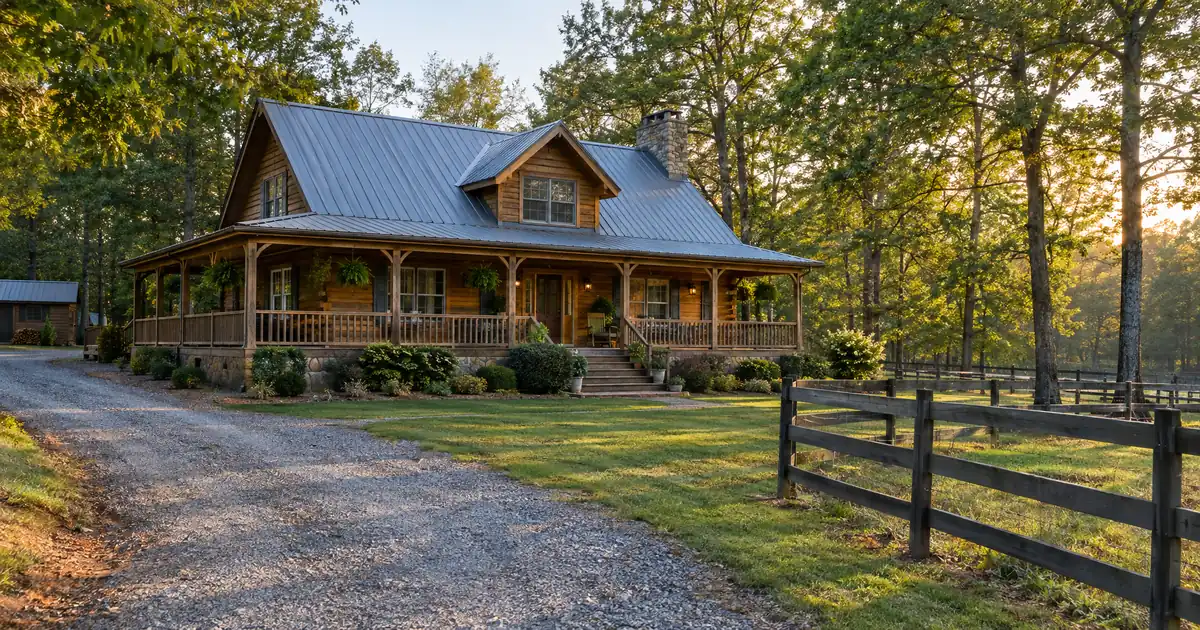
The Quick Read: A cash-out refinance on a hobby farm is possible when the property is primarily a home, not a farming business. Conventional programs cap a one-unit primary residence at 80% loan-to-value on a cash-out. Many lenders say no because of their own acreage and farm-income limits, not because an agency rule forces them to. Different lenders can reach different answers on the same property.
What Does a Cash-Out Refinance Do on Rural Property?
A cash-out refinance replaces your existing first mortgage with a new, larger one. The new loan pays off the old balance, and you receive the difference in cash. Loan-to-value (LTV) is the new loan balance divided by the home’s appraised value. It sets how much equity the lender will let you reach.
This is different from a home equity loan or a HELOC (a revolving credit line against your home). Those sit on top of your first mortgage and leave it in place. A cash-out replaces it. That matters if your current loan has terms you like.
Across the wholesale programs Lendmire places files with, the conventional cash-out on a one-unit primary residence reaches 80% LTV. Two- to four-unit properties, second homes and investment properties top out at 75%. One wholesale lane reaches 89.99% LTV with no mortgage insurance for borrowers with a 680 score and a 50% ratio on a thirty-year fixed loan, a primary residence and a conforming balance. It carries its own six months of seasoning. Every figure here is subject to lender guidelines and full file review, and none of it is a commitment to lend.
Lendmire’s cash-out refinance programs follow that same envelope. Lendmire is a mortgage broker, so it arranges these loans through wholesale lenders rather than lending directly.
What Counts as a Hobby Farm to a Lender?
A hobby farm is a home first and a farm second. It describes small farms where the homeowner farms for personal use. The test is how the property is used, not how many acres it has.
Fannie Mae’s Selling Guide lists agricultural properties, “such as farms or ranches,” as ineligible. Some lenders read it strictly.
Here is what usually pushes a property across the line:
- Primary use. If the land is used mainly for farming or ranching, it is ineligible.
- Outbuildings. Barns and sheds are fine. Silos, animal facilities and large barns draw a closer look, and the lender decides whether the property is still primarily residential.
- Leased land. Renting your pasture to a neighbor’s livestock can count as farming activity. It can tip the property out of hobby status even though you never touch the animals.
Notice who makes the call. The appraiser supplies facts. The lender decides whether the property is primarily residential, using its characteristics, zoning and land use.
Who Will Lend? Agency Rules Versus Lender Overlays
Many lenders decline these files, and the usual reason is an overlay. An overlay is a lender’s own rule layered on top of agency rules.
That distinction explains the confusion in this market. One lender says no and you assume nobody will lend. The agency answer and a lender’s overlay can differ. Here is how the lender types tend to compare:
| Lender type | Typical fit | Common limit |
|---|---|---|
| Large retail lenders | Standard homes, small lots | Acreage and outbuilding overlays |
| Wholesale programs via a broker | Wider menu of lenders | Each lender sets its own overlays |
| Farm-credit-style lenders | Working farms, large parcels | Built for farm income, not homes |
| Community banks | Local knowledge of rural values | Terms vary by bank |
A broker’s advantage here is simple. One application can reach several lenders with different overlays. Lendmire does this for consumer files in 16 states, and a property that one lender declines may fit another lender’s view.
Larger parcels get more scrutiny. When the parcel is big and commercial farms are common locally, the lender must dig further to confirm the property is residential. That is the lender’s job, and it is where files stall.
How Is a Cash-Out Refinance Underwritten, Step by Step?
Underwriting runs in a set order. Knowing it helps you see where a hobby farm file can slow down.
1. Classify the property. The lender decides whether it is primarily residential.
2. Classify the transaction. A cash-out must pass seasoning rules and fit within the 80% ceiling for a one-unit primary home.
3. Check seasoning and title. More on that below.
4. Order the appraisal. Value sets the maximum loan.
5. Underwrite the borrower. Income, assets, credit and debt-to-income ratio (DTI, your monthly debts divided by your monthly income) are all reviewed.
6. Receive your disclosures. The Loan Estimate shows terms, closing costs and cash to close. The Closing Disclosure is the final version.
On the credit side, the wholesale conventional programs start at a 620 decision score. The automated underwriting finding governs most files, with a total ratio ceiling of 50%. Manually underwritten loans run tighter, at 36% or 45%. Credit events carry agency waiting periods: four years from a chapter 7 discharge, seven from a foreclosure, and four from a short sale or deed-in-lieu. Shorter periods may apply with documented extenuating circumstances.
Seasoning and Title Clocks
Seasoning is the waiting period before a loan or ownership counts. Fannie Mae’s cash-out refinance rules set several clocks:
- The first mortgage you are paying off must be at least 12 months old, counted from the old note date to the new note date.
- At least one borrower must have been on title for six months before the new loan is disbursed.
- A property that was listed for sale must be off the market by the disbursement date.
- On loans run through Fannie Mae’s automated underwriting, a DTI above 45% requires six months of reserves.
There are exceptions. Inheritance and legal awards, such as a divorce settlement, can waive the title clock. Delayed financing lets you refinance a cash purchase in under six months. The 12-month rule does not apply to second liens being paid off, or to buying out a co-owner under a legal agreement.
How Does the Appraisal Treat Acreage?
The appraisal is where hobby farm files win or lose cash. Value sets the maximum loan, and rural value is harder to pin down. Comparable sales can be distant. Fannie Mae’s appraisal FAQ says sales more than 12 months old can be used if they are the most appropriate.
Picture a modest house on a large parcel with a big barn. The appraiser weighs how much value the barn and extra land contribute against the home itself. If farm improvements make up a big share of the value, the lender may see a farm, not a home. If the appraisal comes in light, the 80% cap applies to the lower number, and your cash shrinks.
Here is a worked example in percentages only. Say the appraiser values a property and a lender sets the cash-out ceiling at 80% of that value. If you owe 55% of the value today, the most you could reach is the gap between 55% and 80%, before closing costs. If the appraiser trims the value because of thin comparables, both numbers move, and the gap narrows. The 80% is fixed. The appraised value is not.
CFPB’s guide to using home equity notes that lenders typically require you to keep a share of your home value as equity. Equity is value minus total mortgage debt.
Cash-Out Versus Limited Cash-Out: Where the Line Sits
A limited cash-out refinance (also called rate-and-term) pays off the existing first mortgage and closing costs. It allows only incidental cash back. In the wholesale programs, leverage reaches 95% LTV on a one-unit primary residence, and 97% where the existing loan is agency-owned and the first-time-buyer program allows. Mortgage insurance applies above 80% LTV. These specifics are subject to lender guidelines and a full review of property, leverage, and credit.
The cash-back cap is sharp. Per Fannie Mae’s announcement SEL-2025-08, cash back on a limited cash-out is capped at the greater of 1% of the new loan balance or $2,000. Take more than that and it becomes a true cash-out, with cash-out leverage and cash-out rules. Fannie Mae’s Eligibility Matrix shows the 80% ceiling for a one-unit primary residence and 75% for two to four units.
Practically, that means the limited route suits someone fixing a loan, not funding a barn. If you want real cash, plan on the cash-out rules.
Government Loans on a Farm Property
FHA and VA each work differently. The FHA Streamline and the VA IRRRL (the VA’s streamline) are no-cash-out products for existing government loans. Neither can pull equity out. Across the wholesale programs, the FHA Streamline carries no appraisal and a limited credit review, and both streamlines require a net tangible benefit, meaning the refinance must measurably help you. The IRRRL adds a 0.5% funding fee unless you are exempt, and it requires seasoning of the later of 210 days and 6 payments.
A VA cash-out is a different loan. The VA’s Buyer’s Guide says an appraisal is mandatory on cash-out refinances. That report is older, so use it for the concept only. How a VA lender treats acreage varies, and the VA Lenders Handbook governs the minimum property requirements. For FHA, HUD‘s Handbook 4000.1 is the governing document. Ask the lender how it applies FHA or VA rules to farm acreage before you pay for an appraisal.
Above the conforming loan limit, jumbo lanes take over. They carry a 660 decision score, leverage up to 90%, loans up to $5,000,000 and a 50% ratio ceiling on the fixed lanes. Terms depend on the lender’s guidelines, the property type, the leverage, and a full review of the credit profile.
If your hobby farm is a weekend property, occupancy decides the leverage. Second homes and investment properties carry lower cash-out limits than a primary residence.
What Can Go Wrong: Edge Cases and Risks
A farm that looks like a business. Livestock sold at scale, leased pasture and commercial-size structures can reclassify the property.
Timing. The 12-month and six-month clocks, plus the listing rule, can delay a cash-out. If you bought the property recently, the title clock may be your real obstacle.
Replacing a good loan. A cash-out replaces your first mortgage with a larger one. The payment can go up and the term can restart. If your current loan has terms you like, a HELOC or home equity loan might leave it intact.
Debt risk. CFPB’s cash-out research says paying non-mortgage debts with mortgage debt can raise foreclosure risk. You are converting unsecured debt into debt secured by your home.
Closing costs. They reduce your net cash or get added to the new balance. Your Loan Estimate shows both. Compare the full terms, not just the cash amount.
Taxes. Tax treatment can depend on your situation; borrowers should speak with a qualified tax professional before relying on any deduction or credit.
Across the wholesale files Lendmire sees on rural property, the common pattern is a file that stalls at the appraisal, not at the credit review. Borrowers who gather outbuilding details, land use and any lease or sales records up front tend to avoid surprises. That prep is cheap, and the alternative is paying for an appraisal on a property the lender was never going to take.
Questions to Ask Any Lender Before You Apply
- Do you have an acreage limit or farm-income limit beyond agency rules?
- How do you decide whether a property is primarily residential?
- How do you treat a large barn or animal facility?
- Does leased pasture change how you classify my property?
- What seasoning and title rules apply to my loan?
- If the appraisal comes in low, what happens to my cash?
If a lender says no, ask whether the reason is an agency rule or its own overlay. That answer tells you whether to keep looking.
Key Terms Defined
Cash-out refinance: A new, larger mortgage that pays off your old one and gives you the difference in cash.
Limited cash-out (rate-and-term) refinance: A refinance that pays off your existing loan and costs, with only incidental cash back.
LTV (loan-to-value): The loan balance divided by the home’s appraised value.
Overlay: A lender’s own rule added on top of agency guidelines.
Seasoning: The waiting period a loan or ownership must meet before a refinance qualifies.
Hobby farm: A small farm where the owner farms for personal use and the property is primarily a home.
Frequently Asked Questions
Is there an acreage limit on a hobby farm cash-out?
Many lenders set one anyway as an overlay. The agency test is whether the property is primarily residential, so a lender with a low acreage cap may decline a file another lender would take.
Can I sell eggs or produce and still qualify?
Usually, yes. Selling at larger scale, or leasing land to someone who farms it, can change how the lender classifies the property.
Can I do a cash-out right after buying the farm?
Usually not. At least one borrower must be on title for six months, and the existing first mortgage must be at least 12 months old. Delayed financing, inheritance and legal awards are the main exceptions.
Can a VA or FHA streamline take cash out?
No. The VA IRRRL and the FHA Streamline are no-cash-out refinances for existing government loans. A VA cash-out is a separate loan that requires an appraisal and owner occupancy.
How much equity can I reach?
On a one-unit primary residence, a conventional cash-out reaches 80% LTV of the appraised value. The appraisal drives the result, and your cash is what remains after your current balance and closing costs, subject to lender guidelines.
If you are weighing a cash-out refinance against keeping the loan you have, Lendmire can help you compare the programs and the equity each one reaches. Call 828-256-2183 or request a quote.
For current guidelines and terms, see Lendmire’s refinance programs page.
About Lendmire
Lendmire (NMLS# 2371349) is a mortgage brokerage serving homeowners and home buyers in 16 states. FHA, VA, conventional and jumbo purchase and refinance loans are arranged through wholesale lending channels; Lendmire brokers the financing and the lender underwrites each application. Scotsman Guide named Lendmire a Top Mortgage Workplace in both 2025 and 2026.
Get Started
Ready to find the right loan for you?
In about 30 seconds you can review financing options available for your home or investment property. No commitment required.
Informational only. Not a Loan Estimate, approval, or commitment to lend. Program availability and eligibility are subject to lender guidelines, credit approval, property review, and underwriting.
References
1. Fannie Mae Selling Guide B2-3-01, General Property Eligibility
2. Fannie Mae Selling Guide B2-1.3-03, Cash-Out Refinance Transactions
3. Fannie Mae Appraisal and Property FAQs
4. CFPB, Using home equity to meet financial needs
5. Fannie Mae SEL-2025-08 announcement
6. Fannie Mae Eligibility Matrix
8. HUD
9. CFPB: CFPB Report Finds Cash Out Mortgage Refinance Borrowers Improve Credit Scores
This article is part of Lendmire’s Refinance series — every loan program’s qualification details, guidelines, and scenarios live on the loan options page.
Related reading: How to Apply for a Cash-Out Refinance as a Retiree Living on Assets · Can You Get a Cash-Out Refinance on a Paid-Off Condo? · Can a Retiree Use a Cash-Out Refinance to Pay for Tuition?
Brandon Miller
Founder & CEO, Mortgage Loan Originator, Lendmire LLC
- Mortgage Loan Originator · NMLS# 1129696 · Verify on NMLS Consumer Access
- North Carolina Real Estate Broker · License# 343312 · Verify on NCREC
- North Carolina Insurance Producer · License# 19053198 · Property, Casualty, Life, Health · Verify on NAIC SBS
- Lendmire LLC · Firm NMLS# 2371349 · Verify firm licensure
Legal disclosures. Lendmire (NMLS# 2371349) is a state-licensed mortgage brokerage that arranges financing through wholesale lender relationships. Lendmire is not a direct lender, depository institution, or registered financial advisor. The discussion above is general informational content about real estate financing — it is not financial, legal, or tax advice, and readers should consult licensed professionals for guidance on their individual circumstances. Loan inquiries are subject to lender underwriting; this article does not represent a commitment to lend. Loan terms, rates, and qualification standards vary by borrower, property, and state, and are subject to change at any time. Equal Housing Opportunity. NMLS Consumer Access: nmlsconsumeraccess.org.