
Can a Murray rental really support a cash-out when the city’s median sale price fell 21.0% in a year? Sometimes, yes, but only if the lender’s value and the rent schedule both hold up. Redfin put the median sale price near $175K with $140 per square foot, based on only 11 homes sold in the month it measured. The drop says more about a thin sample than about collapsing rental demand, and that thinness is the main thing to underwrite around.
DSCR Cash-Out Calculator
Run the cash-out numbers in Murray, KY
Rate source: Freddie Mac 30-yr average via FRED® — Federal Reserve Bank of St. Louis · effective Sep 24, 2026
Prefilled with starting assumptions — enter your property’s value, balance, taxes, and insurance for a more accurate picture.
Program parameters update from Lendmire’s centralized guideline source. Taxes and insurance are editable estimates.
As of Sep 24, 2026 · General Freddie Mac market benchmark, not a Lendmire loan offer. Property value, balance, taxes, and insurance are editable estimates. Maximum loan-to-value varies by lender, program, property type, and seasoning. Not a Loan Estimate, approval, or commitment to lend. Program availability and eligibility are subject to lender guidelines, credit approval, property review, and underwriting.
The Quick Read:
A cash-out refinance on an investment property in Murray, Kentucky is underwritten primarily on the rental income the property produces measured against its full monthly obligation, with the borrower’s equity capped by a 75% loan-to-value ceiling and sized to what the lender’s appraisal supports, subject to lender guidelines.
- Duplexes near campus stack income better than larger single-family homes.
- Single-family coverage is moderate, so leverage discipline matters more than headline equity.
- Very few sales means appraisal comps may be old or distant.
- Cash-out generally requires about 6 months of ownership from title recording.
- Murray State’s enrollment is steady, which supports occupancy assumptions.
Lendmire (NMLS# 2371349) works with investors buying or refinancing in Murray, Kentucky, helping place DSCR financing across 41 markets, including Washington, D.C. This article skips purchase mechanics. The reader already owns the asset and wants the equity working elsewhere.
Murray Market Snapshot
A quick read on the Murray investor landscape — figures come from the cited sources below. Confirm current property-level numbers before underwriting.
| Metric | Detail |
|---|---|
| Home prices | 11 sales (Redfin, Murray KY housing market) |
| University enrollment | 9,932 total (Murray State University, Fall) |
| Employment | Nearly 1,100 employees (Murray-Calloway County) |
Campus-Edge Duplexes Are Where the Math Holds
The best cash-out candidate in Murray is a small multi-unit building near Murray State University, and it isn’t close. The university reported 9,932 students in its most recent fall count, 8,217 undergraduates and 1,715 graduates. Preliminary figures for the following fall showed 9,982 students, a modest increase. Treat that as preliminary. The direction is stable to rising, which is what a lender wants when it reviews market rent and occupancy.
Retention helps too. Kentucky New Era reported first-to-second-year retention at 78%, the highest in five years. Students who stay past freshman year are the ones looking for off-campus housing. Longer stays mean less turnover on a small rental.
Why duplexes over bigger houses? Rent barely moves with bedroom count here. Rentometer’s local averages run about $1,105 for a 2-bedroom, $1,431 for a 3-bedroom and $1,529 for 4+ bedrooms. The step from three bedrooms to four is roughly $100. A second door adds far more income than another bedroom does. Sources disagree on level, though. Apartments.com shows about $898 for a 2-bedroom, and its citywide average of $616 skews toward per-bed student pricing. Underwrite at the low end.
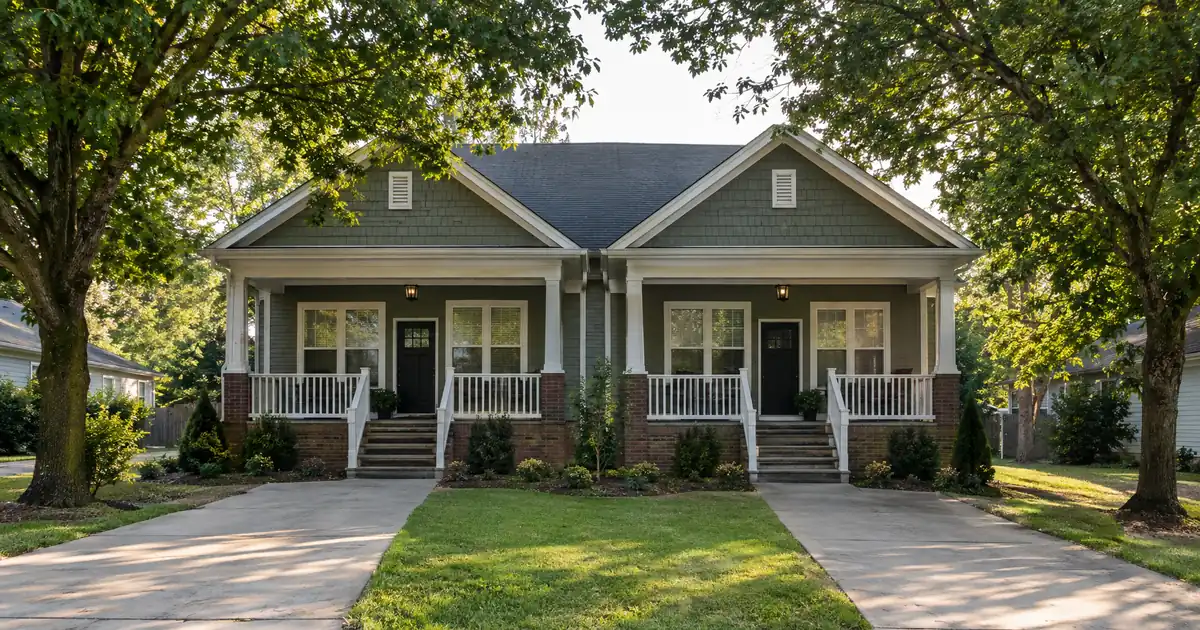
Run the numbers on a modeled duplex valued at $200,000, with two 2-bedroom units renting at $900 each. Those are modeled assumptions, not sourced comps. At the 75% LTV ceiling, rent divided by full PITIA including taxes and insurance comes out around 1.4x. That’s real cushion, even on the pessimistic rent source. If the appraiser’s rent schedule lands closer to the Rentometer figures, the cushion widens. Every figure here varies by lender and program — guidelines, property type, leverage, and credit profile all apply.
The catch is comps. Apartments.com describes the local stock as older craftsman-style homes converted to apartments, purpose-built student communities, and standalone rental houses. Converted small multi-unit buildings are a minority of that stock. Fewer comparable duplexes means the appraiser’s rent schedule and comp selection carry more weight than they would in a bigger market. Pull your leases and rent rolls before the appraisal is ordered.
The Single-Family Reality Check
Single-family is the weaker cash-out case in Murray, and investors expecting easy coverage will be disappointed. Homes.com shows a median single-family rent of $1,250 and about $1,500 for 3-bedrooms, but that rests on only three listings. Its price-to-rent ratio of 16.2 implies a gross yield near 6.2%. Moderate, not generous.
Model a house valued near the $175K median, renting at $1,250. At 75% LTV and full PITIA, coverage lands right around 1.1x. Assume it rents at $1,000 instead and the number slips under 1.00. Stay conservative. At that point investors have a few paths a lender may review: a sub-1.00 program, an interest-only structure, or lower leverage. Each means a tougher file, stronger credit and more cash left in the deal, and none is guaranteed, since eligibility depends on lender guidelines, credit approval and property review.
Rentometer notes the local rental market is dominated by single-family homes, so competition for tenants is real. Outer Calloway County and the Kentucky Lake side are mostly single-family and lake-oriented, which means thinner rent comps and harder appraisals. For cash-out purposes, skip them. One more point on property type: manufactured homes, log homes and barndominiums fall outside these DSCR programs, and rural-edge listings occasionally turn out to be one of them.
Appreciation Is Not the Thesis Here
Murray’s price series is too noisy to bank on. The 21.0% year-over-year decline on 11 sales is small-sample volatility, with days on market at 43. A median that moves on one or two closings can’t be treated as a trend in either direction. Equity extraction here isn’t a bet that the headline will bounce back.
Think about it as three questions. What will the appraiser actually conclude? What does 75% of that conclusion leave you? And does the remaining equity still look good if the value comes in 10% light? Equity depends on rent used for lender review, PITIA, reserves and the LTV ceiling, and it isn’t a guaranteed cash figure. Size the draw to a conservative value, because with this few sales an appraiser may reach for older or farther-away comps.
Working DSCR brokers see a recurring pattern in small college-town markets: the rent side of the file is strong on paper and the value side is the surprise. Files stall when an appraiser, short on local sales, pulls comps from outside the city or from a different property class. Showing recent leases, a clean rent roll and a few documented comparable rentals before the appraisal usually does more for the file than any pricing conversation.
What the Program Requires
The mechanics are straightforward, and for most borrowers the following ranges apply, subject to lender overlays. Cash-out tops out at 75% LTV and generally needs about 6 months of ownership measured from title recording. The baseline coverage benchmark is 1.00x on rent used for lender review against PITIA. Some lenders review lower, but that usually costs leverage or pricing. Credit starts around a 620 floor, with tiers at 660, 680 and 700 for better positioning. Reserves run about 6 months of PITIA. Standard programs go up to $3,000,000. Smaller balances, which describes most Murray loans, route through select lenders in the network. Loans to LLC-titled borrowers are subject to lender program eligibility.
For the full mechanics, see the equity-extraction mechanics in Lendmire’s DSCR guide. The side-by-side comparison covers why investors with multiple financed properties tend to hit conventional limits first. Investors who want a rate-and-term version rather than cash-out can also explore the refinancing options available for investor properties.
Purpose-Built Student Housing Is Your Real Competitor
The N 16th St and Lowes Dr corridor is institutional competition. CEV Murray sits about 1.3 miles from campus with 140 furnished units on individual leases, per RoomChoice. A small landlord renting a whole unit to a group competes with that per-bed pricing, furniture included.
The takeaway: don’t count on maximum student rents to carry the file. Underwrite rents that would still work if a tenant group shrank or a unit rented to staff instead. Student-heavy buildings close to the walkable core near Main St and Sycamore St have the strongest position, but even they face this ceiling.
The Non-Student Demand Base (Thinner Than You’d Like)
Murray-Calloway County Hospital describes itself as the second-largest employer in the region with nearly 1,100 employees. Small rentals near the Poplar St area probably serve that staff, though no sourced rent data backs it up. Treat hospital-adjacent housing as plausible demand, not proven yield.
Per Data USA, the largest resident industries are educational services at 1,561, retail trade at 1,193 and manufacturing at 836. Census Bureau QuickFacts puts the city at 18,080 people across about 11.7 square miles. Schools plus retail plus a hospital is a stable base, and also a narrow one.
Skip the Assumption That Manufacturing Backstops This Market
Briggs & Stratton’s Murray plant closed, and operations moved to Poplar Bluff, Missouri. Older sources list Pella, Mattel and Fisher-Price as former anchors. The Murray-Calloway Economic Development Corporation frames the economy around manufacturing, education and healthcare, with I-69 about 18 miles away and I-24 about 40. The plant history is a reminder that the workforce half of the demand story can shrink. The university half is steadier, but it concentrates the risk in one institution.
Pro-cash-out logic gets weaker the more your rents depend on a single tenant pool. A building whose rent roll mixes students, hospital staff and local workers handles a bad year better than a pure student building.
Where the Equity Goes Next
Cash-out proceeds only matter if they land in a better asset. Murray is a low-price market, so the usual move is redeploying capital into a second duplex or a larger multi-unit elsewhere, since the local stock of those is limited. That is where Kentucky DSCR financing comes in as the next-step conversation. Keep reserves in mind: new acquisitions carry their own reserve requirement, so draw less than the maximum if you plan to keep buying. Final terms depend on lender guidelines, property type, leverage, and the borrower’s complete credit picture.
Investors can see what the numbers look like for a specific Murray property, or call Lendmire at 828-256-2183. Reminder: verify current local rental rules, taxes and insurance with qualified local professionals before sizing a draw.
DSCR vs. conventional financing
There are two common ways to finance an investment property in Murray, KY, and they qualify you differently — here’s how investors weigh them.
Why investors choose it
- Qualifies on the property’s rental income — no personal tax returns, W-2s, or pay stubs needed to document income.
- No personal debt-to-income ceiling to clear, so existing mortgages and obligations don’t cap your borrowing the same way.
- Can be closed in an LLC, keeping the property inside a business entity.
- Built for scaling — not held to the limit on number of financed properties that conventional financing applies.
- Underwriting centers on the deal: generally qualifies when the rent covers the payment, a 1.00x coverage ratio being a common baseline (confirmed in underwriting).
- Designed specifically for investment property, including long-term and, where the program allows, short-term rentals.
Where it’s strong
- Often the lowest ongoing financing cost for a buyer who fully qualifies on personal income — a fit for a first property or a cost-first purchase.
Trade-offs for investors
- Requires full personal income documentation and must fit within a debt-to-income limit — salary, existing debts, and other mortgages all count.
- Typically held in your personal name rather than a business entity.
- Caps how many financed properties you can carry, which can become a ceiling as a portfolio grows.
- Evaluates you as a borrower as much as the property, which usually means more paperwork.
How investors usually choose: a first or single property often optimizes for the lowest financing cost; portfolio builders often optimize for leverage, vesting in an LLC, and scaling past conventional caps. The right answer depends on your goals, the property, and current guidelines — both paths run through select lenders in Lendmire’s wholesale network, with eligibility and terms confirmed in underwriting.
Frequently Asked Questions
Does a duplex near Murray State really cover better than a house?
Yes, on the modeled math. Rent barely rises from three bedrooms to four, so a second unit adds more income than extra bedrooms. A duplex with two 2-bedroom units modeled at conservative rents comes out around 1.4x including taxes and insurance, while a median-priced house sits closer to 1.1x. Real coverage depends on the appraiser’s rent schedule and lender guidelines.
How does Murray’s small number of sales affect a cash-out appraisal?
It makes the value less predictable. With only a handful of closings a month, an appraiser may use older sales or comps from outside the city, and a single sale can move the median noticeably. Size the draw to a conservative value, and bring leases and a rent roll to support the rent side.
Can I pull cash out on a property I bought recently?
Generally you need about 6 months of ownership, measured from title recording, before a cash-out refinance. Leverage tops out at 75% LTV. Exact eligibility depends on the lender, your credit tier and reserves of about 6 months of PITIA.
Will purpose-built student housing hurt my rent numbers?
It can cap them. Underwrite rents that would work even if a unit rented to non-students.
What if my rent only covers the payment at under 1.00x?
Options a lender may review include a sub-1.00 program, interest-only structuring or reduced leverage. Each typically means stronger credit, more cash in the deal and a harder file, and none is guaranteed. Qualification remains subject to lender guidelines and property review.
About Lendmire
Lendmire is a DSCR-focused mortgage brokerage, NMLS# 2371349, placing investor loans across 41 markets, including Washington, D.C. Lenders generally review DSCR eligibility around the property’s rental income rather than personal income documentation, which suits LLC-held rentals (depending on program guidelines), self-employed investors and portfolios scaling beyond conventional financed-property limits. The firm was recognized by Scotsman Guide as a 2026 Top Workplace and recognized by Scotsman Guide in 2025.
Keep one number in mind: the 11 homes that sold in the month behind Murray’s $175K median. Every cash-out appraisal in this market gets built on a sample that small.
Get Started
Ready to find the right loan for you?
In about 30 seconds you can review financing options available for your investment property. No commitment required.
Informational only. Not a Loan Estimate, approval, or commitment to lend. Program availability and eligibility are subject to lender guidelines, credit approval, property review, and underwriting.
References
1. Redfin
2. murraystate.edu — Fall 2025 Enrollment
3. murrayhospital.org — Join Our Team
5. Preliminary figures for the following fall
8. Homes.com
9. RoomChoice
10. Data USA
12. operations moved to Poplar Bluff, Missouri
13. Murray-Calloway Economic Development Corporation
14. recognized by Scotsman Guide as a 2026 Top Workplace
15. recognized by Scotsman Guide in 2025
This article is part of Lendmire’s investment property cash-out refinance program — full qualification details, guidelines, and scenarios live on the program page.
Related reading: Luxury Rental DSCR Loans In New Jersey · Jersey Shore Vacation Rental Loans: DSCR Financing In Ocean City, Cape May And Long Beach Island · DSCR Cash-out Refinance In New Jersey: Pulling Equity From A Rental
Guides: Investment Property Cash-Out Refinance in Kentucky
Brandon Miller
Founder & CEO, Mortgage Loan Originator, Lendmire LLC
- Mortgage Loan Originator · NMLS# 1129696 · Verify on NMLS Consumer Access
- North Carolina Real Estate Broker · License# 343312 · Verify on NCREC
- North Carolina Insurance Producer · License# 19053198 · Property, Casualty, Life, Health · Verify on NAIC SBS
- Lendmire LLC · Firm NMLS# 2371349 · Verify firm licensure
Disclosures. The information presented in this article is general market commentary, not financial, legal, or tax advice. Lendmire is a mortgage brokerage (NMLS# 2371349) — not a direct lender or depository institution — and loan placement is subject to lender underwriting. Nothing in this content represents a commitment to lend. Loan terms, pricing, and program availability vary based on borrower qualifications, property characteristics, and state of subject property, and are subject to change at any time. Lendmire complies with Equal Housing Opportunity requirements. Consumer access: nmlsconsumeraccess.org.