
The Quick Read: Cash-out refinance lenders on a historic home underwrite it like any other one-unit primary residence, because no agency runs a separate “historic” cash-out program. Conventional cash-out generally reaches 80% of the home’s appraised value. The part that changes is the appraisal, since older and unusual houses have fewer comparable sales. Which lenders handle that well depends on your property, credit and the cash you need, and all of it is subject to lender guidelines and full file review.
Key Takeaways
- A historic home is financed as an ordinary primary residence. The label alone doesn’t create a special loan.
- Conventional cash-out generally reaches 80% LTV on a one-unit primary residence and 75% on two- to four-unit properties.
- The appraisal is where historic homes get tested. Comparable sales are scarce, so the appraiser’s experience matters.
- National Register listing usually does not restrict what you can do with your home. Local rules often do.
- A broker that shops several wholesale lenders can match your house to the lenders whose appraisal and condition habits fit it.
What Is a Cash-Out Refinance on a Historic Home?
A cash-out refinance replaces your current mortgage with a larger one and hands you the difference in cash. LTV, or loan-to-value, is the new loan divided by the home’s appraised value. Cash-out caps that figure lower than a plain refinance does, because the lender is taking more risk.
Cash-out refinance estimate
The starting figures are an example value with a balance and a cash request in proportion. Replace them with yours.
Editable benchmark: 7.24% as of October 29, 2026 · Freddie Mac 30-year average via FRED®. A conventional market reference, not a cash-out refinance quote.
Illustrative starting assumptions: a $350,000 home value, a $193,000 current balance, the agency cap on a one-unit principal residence, a thirty-year term at the current Freddie Mac benchmark, and property taxes and insurance estimated at typical national rates. Every field is editable.
Illustrative estimate only — not a Loan Estimate, approval, quote, or commitment to lend. The rate field carries the weekly Freddie Mac thirty-year conventional benchmark, a market reference and not a cash-out refinance quote; a cash-out loan is priced by the lender at lock. The cash available is the loan the program cap allows less the balances paid off, before closing costs, which are not included. The HELOC line is the program’s combined loan-to-value ceiling applied to the same value and balance. Taxes and insurance are editable estimates. Licensed in sixteen states for consumer mortgages.
Historic status doesn’t change that structure. The steps are the same as for a 1970s ranch. You apply, the lender orders an appraisal, underwriting reviews your credit and income, and the loan closes with cash to you after the closing paperwork.
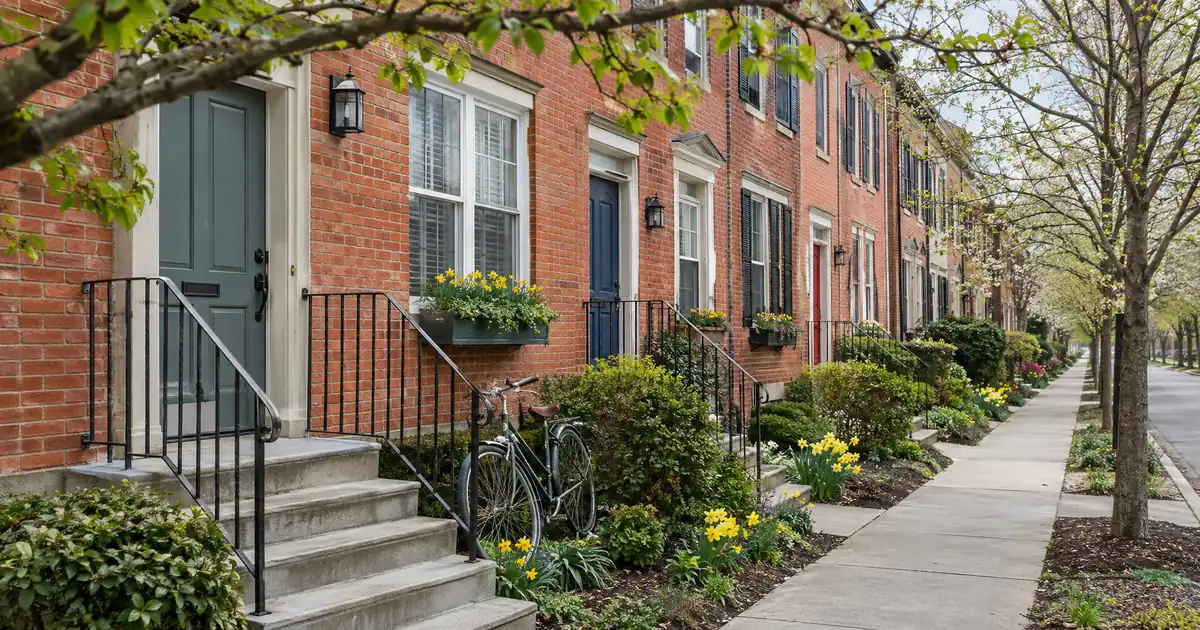
What “historic” changes is how hard the value is to prove. Imagine an 1890s Queen Anne with original millwork on a street where nothing else looks like it. The appraiser has to find sales that resemble it, adjust for the differences, and defend the number. That is the real work of this loan.
If you want the broader program picture first, Lendmire’s cash-out refinance programs page lays out how the options sit side by side.
What Does “Historic” Mean to a Lender?
To a lender, “historic” mostly means “older and harder to appraise.” It is not a legal category in underwriting. Three different things get lumped under the word, and they matter differently.
Old, but not designated. A hundred-year-old house with no listing and no restrictions is just an older home. Underwriting looks at condition and value.
Listed on the National Register of Historic Places. Many owners assume this limits them. The National Park Service says listing places no restrictions on what a private owner may do with the property, unless federal assistance is involved. It shouldn’t hurt your loan by itself.
Inside a local historic district or under a preservation easement. This is where real limits show up. Local ordinances can govern exterior changes, and an easement can bind future owners. A lender may ask for the documents so it understands what the collateral can and can’t become.
| Situation | Usually changes underwriting? | What to expect |
|---|---|---|
| Old house, no designation | No | Standard file, condition focus |
| National Register listing | Rarely | Same as standard primary residence |
| Local historic district | Sometimes | Possible request for district rules |
| Preservation easement | Often | Document review, value questions |
How Does the Loan Get Underwritten, Step by Step?
Underwriting follows a fixed order, and on a historic home the appraisal step takes the most attention.
Step 1: Pick the loan purpose. The main choices are rate-and-term (a limited cash-out refinance that pays off your loan and costs, with only incidental cash back), full cash-out, and the government streamlines that pay nothing out. If you want cash, you are in the cash-out lane.
Step 2: Check ownership and seasoning. Seasoning is the waiting period before you can refinance. Across the wholesale programs Lendmire places files with, the first mortgage being paid off generally must be at least 12 months old, measured note date to note date. A borrower must also have been on title for 6 months. Exceptions exist for delayed financing, inheritance and legal awards. Freddie Mac’s Guide sets out 12-month seasoning and treats a home owned free and clear as cash-out, so paying off nothing doesn’t make it a no-cash-out loan.
Step 3: Receive your Loan Estimate. This is the standard form that shows your loan terms and estimated cash to close.
Step 4: Appraisal. Covered in detail below.
Step 5: Underwriting. Your credit, ratios and reserves are reviewed. Most wholesale conventional programs start at a 620 decision score, and the automated finding governs most files, with a total debt ratio ceiling of 50%. Manually underwritten loans use 36% or 45%, with reserve and score factors from the Fannie Mae Eligibility Matrix. On cash-out files, reserves come into play when the debt ratio is above 45%.
Step 6: Closing and the right to cancel. On a primary residence refinance you generally have three business days to cancel after signing. Funds are paid out after that window passes.
How Does the Appraisal Work on an Older or Unique Home?
The appraisal decides your cash. A low value shrinks the loan directly, because the lender applies its LTV cap to whatever number comes back.
Here is the good news. Fannie Mae’s guidelines accept unique housing when the appraiser has enough information to form a reliable opinion of value. Selling Guide B4-1.3-05 says comparable sales don’t have to match the subject’s design. When no truly similar sales exist, B4-1.3-09 tells the appraiser to pick the best indicators of value and make market-supported adjustments.
So the system isn’t built to reject old houses. It is built to demand support for the number.
What helps on your side:
- A rich file. Give the appraiser a list of restorations, original features kept, and system upgrades.
- Your own comps. Recent sales of similar older homes are useful, even if they sit farther away or are older than usual.
- An appraiser with local older-home experience. You rarely pick the appraiser yourself. But the lender you work with controls how appraisers are assigned, and that is a real difference between lenders.
- A rebuttal path. If the value comes in light, ask the lender about a reconsideration with better comps. Don’t assume the first number is final.
Plenty of lenders say yes to the loan and then stumble on this step. That’s why the question is less “who lends on historic homes” and more “whose appraisal process handles them well.”
Which Lenders Write These Loans, and How Do You Find the Right Fit?
The lenders that write these loans depend on your property and profile, and no single name fits everyone. There’s no honest “top five” for a house with its own quirks. A lender that suits a tidy 1920s bungalow in a plain neighborhood may be the wrong fit for a restored mansion with an easement.
Lendmire is a mortgage broker, not a lender. It works with a network of wholesale cash-out refinance lenders and matches your scenario to the program whose guidelines fit it. That matters here because wholesale lenders differ on appraisal handling, condition standards and how they treat unusual collateral. A broker sees those differences across many files. A single bank sees only its own.
The kinds of lender you’ll run into generally fall into four groups:
| Lender type | Strength for older homes | Watch for |
|---|---|---|
| Large retail bank | Familiar products | Rigid appraisal process |
| Local bank or credit union | Local market knowledge | Narrow program menu |
| Portfolio lender | Flexible on unusual collateral | Terms set in-house |
| Broker shopping wholesale lenders | Many programs, matched to file | Needs a clear scenario |
Which row suits you depends on the property, your credit profile, how much cash you need and your documentation.
What Should You Ask a Lender Before You Apply?
A short question list saves you from finding the problem after the appraisal. Ask:
1. How do you assign appraisers, and do you use ones with older-home experience?
2. What happens if the value comes in low? Is there a reconsideration process?
3. Do you have condition or repair requirements that would apply to an older house?
4. Does a local district rule or an easement change how you review the file?
5. Will you need proof that the home can be insured?
6. Is this a limited cash-out or full cash-out file, and what LTV applies?
Lenders that can answer these plainly tend to have handled this kind of house before.
What Condition, Insurance and Restriction Issues Stall These Loans?
Condition and insurance cause more delays than the label does. Older houses carry deferred maintenance, dated systems and the occasional hazardous material, and a lender may want certain items fixed or resolved before closing.
| Issue | Why it matters | How to prepare |
|---|---|---|
| Deferred maintenance | Lowers value and raises condition flags | Fix visible defects first |
| Dated systems | Can affect condition ratings | Document updates and service records |
| Easement or district rules | Affects marketability | Gather the documents early |
| Insurance availability | Lender needs coverage to close | Get quotes before you apply |
On insurance, the NPS suggests owners contact their state insurance commissioner for guidance. Replacing period materials costs more than replacing standard ones, and that can complicate coverage. Start the quote process early.
What Are the Real Numbers for Leverage and Credit?
Conventional cash-out on a one-unit primary residence generally reaches 80% LTV. For two- to four-unit primary residences, second homes and investment property, the cap is 75%. That occupancy point is the only rental or second-home answer you need here: how you use the home sets the leverage.
Across the wholesale programs Lendmire places files with, a separate lane reaches 89.99% LTV with no mortgage insurance. It requires a 680 score, a 50% ratio, a thirty-year fixed rate, a primary residence and a conforming balance. It has its own six months of seasoning. In Texas, a cash-out on the homestead is capped by the state constitution at the agency figure, and that wholesale lane is not written there. Each figure is subject to lender guidelines and a complete review of property type, leverage, and credit.
The Fannie Mae limited cash-out (rate-and-term) lane reaches much higher leverage. But it gives you only incidental cash back, so it isn’t the answer if you want real proceeds.
| Program | Cash to you? | Leverage notes |
|---|---|---|
| Conventional cash-out | Yes | 80% one-unit primary |
| Rate-and-term | Incidental only | 95% one-unit primary |
| FHA Streamline | No | Existing FHA loan, no appraisal |
| VA IRRRL | No | Existing VA loan, no VA appraisal |
Credit events carry agency waiting periods. They are four years from a Chapter 7 discharge, seven from a foreclosure, and four from a short sale or deed-in-lieu, shorter with documented extenuating circumstances. All of it is subject to lender guidelines and full file review.
Edge Cases Where the General Rule Bends
Free-and-clear homes. A home with no mortgage still counts as cash-out when you borrow against it.
Co-owner buyouts. A divorce or inheritance buyout can qualify under a limited cash-out structure at the agencies, which is a different path from taking equity out.
Restoration financing. Fannie Mae’s HomeStyle Renovation lets renovation costs be financed up to 15% of the as-completed appraised value, with LTV based on the as-completed value, per Fannie Mae’s announcement SEL-2025-10. A buyout under HomeStyle allows no cash proceeds to you. If your goal is to restore the house itself, ask whether a renovation product fits better than plain cash-out.
Streamlines. FHA and VA streamlines skip the appraisal, which sidesteps the historic valuation problem. The tradeoff is that neither pays cash. They also require an existing FHA or VA loan.
How Do You Decide?
Think of the decision as three questions.
First, how much cash do you need, and how much does your appraised value support at 80%? If the value comes in thin, the proceeds shrink with it.
Second, is the money for the house? If you are restoring it in phases, a renovation loan may fit the project better than a lump sum.
Third, does your current loan have a good feature to keep? If you have an FHA or VA loan and don’t need cash, a streamline avoids the appraisal altogether.
Closing costs can be paid out of pocket, taken from proceeds or financed, and your Loan Estimate shows which. A larger balance changes your monthly obligation, so compare it with the loan you hold now.
Key Terms Defined
LTV (loan-to-value): the new loan amount divided by the home’s appraised value.
Seasoning: the minimum time you must hold a loan or title before refinancing.
Limited cash-out refinance: a refinance that pays off your loan and costs, with only incidental cash back.
Easement: a legal restriction recorded against a property, such as a preservation easement.
Appraisal adjustment: a dollar change an appraiser makes to a comparable sale to account for a difference from your home.
Frequently Asked Questions
Can you get a cash-out refinance on a historic home?
Yes, generally. Conventional guidelines treat it as a primary residence and accept unique housing when the appraiser can support the value. Final eligibility depends on the lender, your credit and the property.
Does National Register listing hurt my loan?
Usually not. Local district rules and easements are the more likely sources of limits.
Will the appraisal be harder?
Often, yes. Few comparable sales exist, so the appraiser relies on adjustments and judgment. A detailed list of your updates and your own comparable sales can strengthen the file.
Can I use the cash for restoration?
Yes, in many cases. But a renovation product such as HomeStyle may fit a large project better. Ask about both before you choose.
Which lenders handle these homes?
It depends on your property and profile. A broker that shops several wholesale lenders can steer your file toward the programs whose appraisal and condition practices fit an older home.
Next Steps
If you are weighing a cash-out refinance against keeping the loan you have, Lendmire can help you compare the programs and the equity each one reaches.
Old houses carry their value in details no comparable sale captures, so the best preparation is a file that documents every one of them.
For your own numbers, request a scenario review with Lendmire.
For current guidelines and terms, see Lendmire’s refinance programs page.
About Lendmire
As a mortgage broker (NMLS# 2371349), Lendmire helps homeowners and home buyers in 16 states with FHA, VA, conventional and jumbo purchase and refinance loans arranged through wholesale lenders. Lendmire is never the lender; program terms are set by the lender and the agency guidelines. Scotsman Guide named Lendmire a Top Mortgage Workplace in both 2025 and 2026.
Get Started
Ready to find the right loan for you?
See your offer in seconds. No credit pull, no obligation.
Informational only. Not a Loan Estimate, approval, or commitment to lend. Program availability and eligibility are subject to lender guidelines, credit approval, property review, and underwriting.
References
1. National Park Service, National Register FAQ
2. Freddie Mac Guide Section 4301.5
3. Fannie Mae Eligibility Matrix
4. Fannie Mae Selling Guide B4-1.3-05
5. Fannie Mae Selling Guide B4-1.3-09
6. Fannie Mae announcement SEL-2025-10
This article is part of Lendmire’s cash-out refinance program — full qualification details, guidelines, and scenarios live on the program page.
Related reading: Best Cash-Out Refinance Program After Buying the Home Within the Seasoning Window · Does a Fourplex Cash-Out Refinance Need More Reserves Than a Duplex? · How to Apply for a Cash-Out Refinance on Your Primary Home
Brandon Miller
Founder & CEO, Mortgage Loan Originator, Lendmire LLC
- Mortgage Loan Originator · NMLS# 1129696 · Verify on NMLS Consumer Access
- North Carolina Real Estate Broker · License# 343312 · Verify on NCREC
- North Carolina Insurance Producer · License# 19053198 · Property, Casualty, Life, Health · Verify on NAIC SBS
- Lendmire LLC · Firm NMLS# 2371349 · Verify firm licensure
Important disclosures. Lendmire (NMLS# 2371349) is a licensed mortgage brokerage. Lendmire is not a direct lender, depository institution, or financial advisor. All loan inquiries are subject to lender underwriting; this article does not constitute a commitment to lend. Rates, terms, and program guidelines are subject to change without notice and vary by borrower profile, property type, and state. Information in this article is general in nature and is not financial, legal, or tax advice. Equal Housing Opportunity. NMLS Consumer Access: nmlsconsumeraccess.org.