
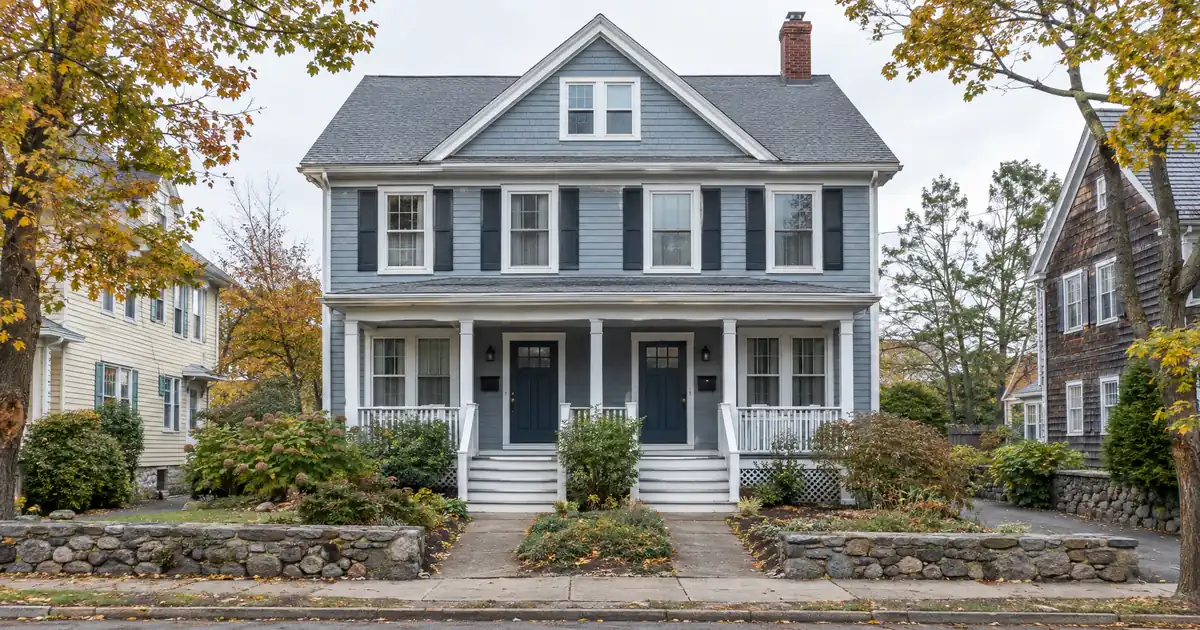
Coolidge Corner is where Brookline’s equity sits, and where the coverage test bites hardest. Redfin shows a median sale price of $1.5 million there, with homes selling in about 18 days. NeighborhoodScout’s figure is lower, at $1,329,097, so treat the real number as a range. An investor who bought a small apartment building near the Green Line C branch some time ago is probably sitting on real appraised equity. The question is how much of it a lender will let out.
The Short Version: A DSCR cash-out refinance on a Brookline, Massachusetts rental is underwritten primarily on the property’s rental income measured against its full monthly obligation. The file turns on lease rents, taxes and insurance, roughly six months of seasoning from title recording, and a 75 percent LTV ceiling that coverage may constrain well before it applies.
DSCR Cash-Out Calculator
Run the cash-out numbers in Brookline, MA
Rate source: Freddie Mac 30-yr average via FRED® — Federal Reserve Bank of St. Louis · effective Sep 24, 2026
Prefilled with starting assumptions — enter your property’s value, balance, taxes, and insurance for a more accurate picture.
Program parameters update from Lendmire’s centralized guideline source. Taxes and insurance are editable estimates.
As of Sep 24, 2026 · General Freddie Mac market benchmark, not a Lendmire loan offer. Property value, balance, taxes, and insurance are editable estimates. Maximum loan-to-value varies by lender, program, property type, and seasoning. Not a Loan Estimate, approval, or commitment to lend. Program availability and eligibility are subject to lender guidelines, credit approval, property review, and underwriting.
- Brookline’s citywide median sits near $1,260,416, essentially flat year over year, per Redfin.
- Local brokerage commentary puts stabilized two- and three-family cap rates at or below 4.5 percent.
- Modeled coverage on a three-family at 75 percent LTV lands well under 1.00.
- Equity extraction here is usually sized by the coverage test, not by the LTV cap.
- Only about 11 multifamily listings were on the market in a recent snapshot, so appraisal comps run thin.
Lendmire (NMLS# 2371349) is a DSCR-focused mortgage broker. Through Lendmire’s DSCR program footprint (41 markets, including Washington, D.C.), lenders may review qualifying rental income subject to program guidelines for Brookline, Massachusetts investors. This article covers the extraction side only: what you can pull from an asset you already own, and what the lender will make of it. Purchase mechanics are a different conversation.
Brookline Market Snapshot
A quick read on the Brookline investor landscape — figures come from the cited sources below. Confirm current property-level numbers before underwriting.
| Metric | Detail |
|---|---|
| Cap rates | ≤4.5% (Metro Realty Corp) |
| University enrollment | 7,000+ students (Public Schools of Brookline) |
| Population | 63,266 population (Census Reporter, Brookline) |
| Employment | 900+ teachers/staff (Public Schools of Brookline) |
| Vacancy | 1.5% owner (Marika & Associates) |
Coolidge Corner: Where the Appraisal Holds and the Coverage Doesn’t
Coolidge Corner offers the strongest appraisal story in town and the weakest cash-flow story. That is the tension in every Brookline cash-out.
The housing stock is mostly small-to-medium apartment buildings, per NeighborhoodScout, and the Green Line C branch and the Harvard Street commercial spine keep demand deep. Rents in the research run roughly $3,600 to $3,800 for a two-bedroom and $4,550 to $4,900 for a three-bedroom across aggregators. RentHop puts the two-bedroom at $3,775 (up 3.66 percent) and the three-bedroom at $4,895. Zumper shows a 7 percent annual gain to a $3,750 average. Underwrite at the RentHop numbers and treat Zumper’s 7 percent as the upper bound.
The catch is that 1BRs are softer than the bigger units. RentHop has the one-bedroom down about 5 percent to $2,720. A building weighted toward 2BR and 3BR units holds up better than one full of studios and one-beds.
Brookline Village and North Brookline: The Longwood Edge
Brookline Village and North Brookline are where the rent stacking is most defensible, because demand here doesn’t depend on the Brookline economy alone. The Longwood Medical and Academic Area sits on the town’s northern edge, and Brookline Place lists Boston Children’s Hospital, Brigham and Women’s, Beth Israel Deaconess, and Dana-Farber among the neighbors, along with Harvard Medical School and Northeastern. Residents, trainees, and campus staff turn over on academic cycles, which keeps lease-up predictable.
Brookline’s own resident workforce points the same way. Data USA reports the top resident sectors as health care and social assistance (9,181), educational services (6,963), and professional, scientific, and technical services (6,847). Renters make up 53 percent of households per RentCafe, so this is a majority-renter town in practice.
Price data in both areas is noisy, so don’t lean on it. Brookline Village posted a $1.1 million Redfin median with 47 days on market, but only 16 homes sold that month. North Brookline’s $1.5 million median came with days on market of 39 versus 22 a year earlier. Redfin’s year-over-year swings in both places (some near 70 percent) are small-sample artifacts. Ignore them as appreciation signals.
A further wrinkle is that 42 percent of Brookline’s rental units were built in 1939 or earlier, per Point2Homes. Older walk-ups and triple-deckers carry the rents, but expect appraisers to scrutinize condition.
Skip South Brookline for Yield.
South Brookline is a lifestyle market, not a coverage market. Redfin has the median at $2.1 million, and sales run about 16 days. Rents are real (Zumper lists $3,665 for the area; four-plus-bedroom houses can approach $7,500 to $8,200 per Rentometer’s notes), but yield-to-value is very thin. Equity there is abundant and cash-out capacity is not. If your only asset is a South Brookline single-family rental, expect the lender to size the loan far below the LTV cap.
Running a Triple-Decker Cash-Out
At Brookline values, coverage math, not the 75 percent LTV cap, decides how much equity comes out. Run the numbers on a three-family appraising near the $2.3 million FY2026 assessed average for two- and three-family parcels cited by Marika & Associates. Assume three 2BR units at a modeled $3,600 each.
That produces gross rent near 5.6 percent of value before any expenses (a modeled figure). A local brokerage, Metro Realty, says stabilized Brookline two- and three-families trade at cap rates at or below 4.5 percent and that pure cash-flow investors will find the entry math challenging. That’s brokerage opinion, but it matches the arithmetic.
DSCR is monthly rent divided by full monthly PITIA: principal, interest, taxes, and insurance. Modeled that way at 75 percent LTV, this building lands in the low 0.7s, well under the 1.00 baseline most standard programs are built around. Pulling leverage down toward roughly half of value brings the same building near 1.00. Those figures are modeled assumptions, not quotes, and they assume a 30-year term.
Sub-1.00 files aren’t dead, but they get harder. Options a lender may review include a sub-1.00 program with stronger credit and more reserves, an interest-only structure, or simply a smaller cash-out. Each is subject to lender guidelines, credit approval, and property review. A shrunken loan can still be worth doing. Cash-out proceeds are capital for the next asset, not a payout.
DSCR files in markets like this one typically look like a strong appraisal paired with modest coverage. The stronger files tend to arrive with lease-level rent documentation instead of neighborhood averages, and with reserves already staged, since balances above $1.5 million call for roughly nine months of PITIA instead of six. The ones that stall usually assumed the LTV cap was the constraint when coverage was.
The Comp Problem
Appraisal risk is the least discussed variable in Brookline multifamily. A Homes.com snapshot showed about 11 multifamily listings in town, priced from $1.295 million to $16 million. That’s a thin comp pool, and appraisers may reach for out-of-town or dissimilar sales. William Raveis data shows inventory up 17.1 percent year over year.
The value picture is also mixed. Redfin has the citywide median at $1,260,416, up 0.03 percent. Zillow’s methodology gives a lower average home value of $1,175,783, down 5.5 percent. This is a genuine toss-up between “flat” and “softening,” and a cash-out sized on last year’s expectation of value can shrink at appraisal. Cash-out is, in that sense, an appreciation bet you’ve already made.
How Does the Six-Month Seasoning Clock Work Here?
Cash-out generally requires about six months of ownership, measured from title recording, and the LTV ceiling is 75 percent. Beyond that, credit tiers run from a 620 floor upward, and loans can go up to $3 million on standard programs, subject to lender guidelines. Holding a LLC-titled property is workable, subject to lender program eligibility.
For a Brookline owner the seasoning clock is rarely the obstacle. Most rental owners here have held far longer than six months. The bottleneck is what the property supports. See the cash-out qualification details for the general framework, and the investor refinance breakdown if you’re weighing a rate-and-term alternative. For a primer, Lendmire’s DSCR guide covers the basics, and the guide “Where DSCR and Conventional Diverge” explains why investors with heavy portfolios often move off conventional.
Brookline’s rental vacancy sits around 3.4 percent by the town Housing Plan as cited by Marika & Associates (confirm against the primary document). That supports a light vacancy assumption on your side, though lenders apply their own haircut anyway.
Verify current local rules, taxes, and insurance with qualified local professionals before sizing any refinance. Brookline economics are sensitive to them.
Frequently Asked Questions
How do you qualify for a DSCR cash-out refinance in Brookline, Massachusetts?
The lender reviews the property’s rent against its full PITIA, typically looking for a 1.00 baseline, along with credit (620 floor), reserves, and about six months of seasoning. In Brookline, coverage on high-value multifamily is usually the binding test, so leverage below the 75 percent cap is common. Eligibility is subject to lender guidelines, credit approval, and property review.
What are the requirements for a cash-out refinance on a Brookline investment property?
Expect the 75 percent maximum LTV, about six months of ownership from title recording, reserves of roughly six months of PITIA (about nine above $1.5 million), and loan sizes up to $3 million on standard programs. Requirements vary by lender and borrower profile, and none of them guarantees a cash figure.
DSCR vs. conventional financing
Two common ways to finance an investment property in Brookline, MA. They qualify you differently — here’s how investors weigh them.
Why investors choose it
- Qualifies on the property’s rental income — no personal tax returns, W-2s, or pay stubs needed to document income.
- No personal debt-to-income ceiling to clear, so existing mortgages and obligations don’t cap your borrowing the same way.
- Can be closed in an LLC, keeping the property inside a business entity.
- Built for scaling — not held to the limit on number of financed properties that conventional financing applies.
- Underwriting centers on the deal: generally qualifies when the rent covers the payment, a 1.00x coverage ratio being a common baseline (confirmed in underwriting).
- Designed specifically for investment property, including long-term and, where the program allows, short-term rentals.
Where it’s strong
- Often the lowest ongoing financing cost for a buyer who fully qualifies on personal income — a fit for a first property or a cost-first purchase.
Trade-offs for investors
- Requires full personal income documentation and must fit within a debt-to-income limit — salary, existing debts, and other mortgages all count.
- Typically held in your personal name rather than a business entity.
- Caps how many financed properties you can carry, which can become a ceiling as a portfolio grows.
- Evaluates you as a borrower as much as the property, which usually means more paperwork.
How investors usually choose: a first or single property often optimizes for the lowest financing cost; portfolio builders often optimize for leverage, vesting in an LLC, and scaling past conventional caps. The right answer depends on your goals, the property, and current guidelines — both paths run through select lenders in Lendmire’s wholesale network, with eligibility and terms confirmed in underwriting.
Why does a Brookline triple-decker struggle to hit 1.00 at 75 percent LTV?
Values run high relative to rents. A three-family near the $2.3 million assessed average grosses roughly 5.6 percent of value in modeled rent, and brokerage commentary puts cap rates at or below 4.5 percent. At full PITIA, that leaves modeled coverage in the low 0.7s at 75 percent LTV, so lower leverage or another structure is usually needed.
Does thin comp inventory affect how much equity I can pull from a Brookline property?
Yes. With only about 11 multifamily listings in one snapshot, an appraiser may use a limited or dissimilar comp set. A value that comes in below expectations reduces the loan available at any LTV. Appraisal risk isn’t a reason to skip Brookline, but it’s a reason to avoid committing cash-out proceeds to a purchase before the value is confirmed.
For current guidelines and terms, see Lendmire’s DSCR loan programs page.
What to Watch This Quarter
Three indicators should tell an owner whether to move now or wait:
- Multifamily inventory. Watch whether the roughly 11-listing pool grows. More sold comps help appraisals, but more listings may pressure values.
- Two- and three-bedroom rents. If RentHop’s modest gains hold while Zumper’s 7 percent fades, underwrite conservatively.
- Brookline Village days on market. It was 47 days on a 16-sale sample. A meaningful drop would suggest Longwood-edge demand is tightening.
Brookline rewards owners who already hold the asset, and it charges buyers for the privilege of arriving late.
About Lendmire
Lendmire, NMLS# 2371349, is a DSCR and non-QM mortgage brokerage with investor loan programs in 41 markets, including Washington, D.C. Lenders commonly review DSCR eligibility around property-level rent rather than personal income documentation, subject to lender guidelines, and the brokerage helps arrange financing for LLC-owned portfolios beyond conventional financed-property limits. Lendmire was named a 2025 Scotsman Guide Top Mortgage Workplace and a top-ranked workplace in 2026. See Lendmire’s 2026 Top Workplace announcement for details. For state coverage, see Massachusetts DSCR investor loans.
Get Started
Ready to find the right loan for you?
In about 30 seconds you can review financing options available for your investment property. No commitment required.
Informational only. Not a Loan Estimate, approval, or commitment to lend. Program availability and eligibility are subject to lender guidelines, credit approval, property review, and underwriting.
References
1. Redfin, Coolidge Corner housing market
3. Metro Realty, multi-family guide
4. Public Schools of Brookline
6. Marika & Associates, small multi-family in Brookline
8. RentHop
9. Zumper
10. Brookline Place
13. Point2Homes
14. Homes.com
15. William Raveis, Brookline median price
16. a 2025 Scotsman Guide Top Mortgage Workplace
17. Scotsman Guide — Top Workplaces 2026
18. Lendmire’s 2026 Top Workplace announcement
This article is part of Lendmire’s investment property cash-out refinance program — full qualification details, guidelines, and scenarios live on the program page.
Related reading: Cash Out Refinance Investment Property in Brookline MA · DSCR Cash Out Refinance Framingham Massachusetts · Cash Out Refinance Investment Property Peabody Massachusetts
Guides: Investment Property Cash-Out Refinance in Massachusetts
Brandon Miller
Founder & CEO, Mortgage Loan Originator, Lendmire LLC
- Mortgage Loan Originator · NMLS# 1129696 · Verify on NMLS Consumer Access
- North Carolina Real Estate Broker · License# 343312 · Verify on NCREC
- North Carolina Insurance Producer · License# 19053198 · Property, Casualty, Life, Health · Verify on NAIC SBS
- Lendmire LLC · Firm NMLS# 2371349 · Verify firm licensure
Disclosures. The information presented in this article is general market commentary, not financial, legal, or tax advice. Lendmire is a mortgage brokerage (NMLS# 2371349) — not a direct lender or depository institution — and loan placement is subject to lender underwriting. Nothing in this content represents a commitment to lend. Loan terms, pricing, and program availability vary based on borrower qualifications, property characteristics, and state of subject property, and are subject to change at any time. Lendmire complies with Equal Housing Opportunity requirements. Consumer access: nmlsconsumeraccess.org.