
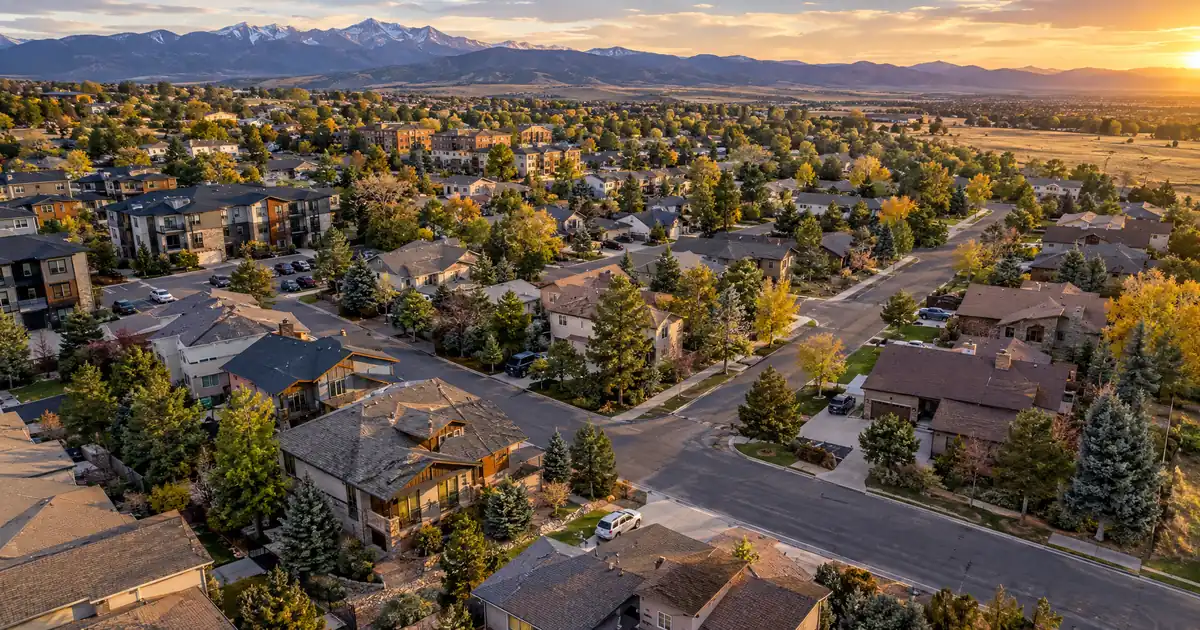
Centennial Airport handled 314,071 civil and military aircraft operations in a single recent year, according to Arapahoe County. It sits in the middle of the Denver Tech Center. The airport also houses more than 125 businesses and 9,200 regional jobs, per Centennial Airport. That is the demand anchor under Centennial rentals. The pricing side is flatter. The Zillow Home Value Index puts the average home value at $641,069, down 1.8% over the past year.
For an owner planning a cash-out refinance, that combination decides the file. Tenant demand is steady and appreciation is not doing the work. DSCR financing for Centennial, Colorado investors runs through wholesale lenders that Lendmire works with across 41 markets, including D.C. Lendmire (NMLS# 2371349) is a DSCR-focused mortgage broker, and the files it sees from suburbs like this one turn on rent evidence and the 75% LTV ceiling more than on value growth. These specifics are subject to lender guidelines and a full review of property, leverage, and credit.
DSCR Cash-Out Calculator
Run the cash-out numbers in Centennial, CO
Rate source: Freddie Mac 30-yr average via FRED® — Federal Reserve Bank of St. Louis · effective Sep 24, 2026
Prefilled with starting assumptions — enter your property’s value, balance, taxes, and insurance for a more accurate picture.
Program parameters update from Lendmire’s centralized guideline source. Taxes and insurance are editable estimates.
As of Sep 24, 2026 · General Freddie Mac market benchmark, not a Lendmire loan offer. Property value, balance, taxes, and insurance are editable estimates. Maximum loan-to-value varies by lender, program, property type, and seasoning. Not a Loan Estimate, approval, or commitment to lend. Program availability and eligibility are subject to lender guidelines, credit approval, property review, and underwriting.
Key Takeaways:
A DSCR cash-out refinance on a Centennial, Colorado rental is underwritten primarily on the property’s rental income measured against its full monthly obligation. The deal works from seasoning proof through appraisal, rent evidence and reserves documentation before any equity is released, and the 75% LTV ceiling sets the outer limit. Terms vary by lender guidelines, property type, leverage, credit profile, and full file review.
- Detached-house rents sit thin against Centennial values, so full-PITIA coverage lands under 1.00 at 75% LTV.
- Values are flat to slightly soft, so equity comes from basis and paydown, not market lift.
- Multi-unit stock is scarce, which means appraisers may have few true comps.
- Cash-out generally needs about 6 months of ownership, measured from title recording.
- The airport, Denver Tech Center and light-rail corridors carry the tenant-demand case.
Centennial Market Snapshot
A quick read on the Centennial investor landscape — figures come from the cited sources below. Confirm current property-level numbers before underwriting.
| Metric | Detail |
|---|---|
| Home prices | $675K median (Homes.com Centennial) |
| Typical rents | $2,213 (City-data Centennial profile) |
| Employment | 9,200 jobs (Centennial Airport) |
Flat Prices, Real Equity Questions
Centennial equity is mostly a basis story. Resideline reports a median price of $650,000, with the middle half of sales falling between $525,000 and $820,000, per Resideline. Zillow’s average sits slightly lower, and the two numbers differ because the methodologies differ. Neither shows a boom.
Population explains why. Census Bureau QuickFacts puts Centennial at roughly 108,860 people, essentially flat. The city is built out. An investor who bought a few years ago is not counting on a rising tide. Equity comes from a purchase made below current value, a renovation, or principal paydown.
Seasoning is the first gate. Lenders generally want about 6 months of ownership, measured from title recording and documented by the settlement statement. Files that assume seasoning away get kicked back. Appreciation math matters too: with values moving sideways, the appraised number can land close to the purchase price, and the 75% LTV cap then leaves little to pull on a recent buy.
What a Thin Rent-to-Price Ratio Does to the Number
Single-family coverage in Centennial typically lands in the mid-0.80s to just under 0.90 on a full-PITIA basis at the 75% LTV ceiling, though the exact figure depends on the rent used and the rate environment. Zumper reports a $2,900 median for houses, and rents are down 5% year over year. Homes.com lists a median single-family rent of $3,200, per Homes.com. Run the numbers on a house valued near the Zillow average of $641,069, with Colorado’s relatively low property-tax rate and insurance included in the payment. Across a range of plausible rates, that setup stays below 1.00 even at the higher rent figure, so a borrower would need a larger down payment, a higher-rent property, or a program that accepts sub-1.00 coverage. These are modeled assumptions, not sourced deal data. Exact terms depend on the lender’s guidelines, property type, leverage, and a full review of the borrower’s file.
Using $2,900 rent against full PITIA (principal, interest, taxes and insurance), coverage lands in the 0.80s. Using $3,200, it lands just under 0.90. Rent choice alone swings the ratio by roughly 10%. Both figures are rounded down and include taxes and insurance.
Many DSCR programs are built around a 1.00x benchmark, and the guide “What Is a DSCR Loan” explains how that ratio is calculated. Below 1.00, a lender may review other structures: a sub-1.00 program, an interest-only schedule, or a lower LTV. Each trades more cash, different pricing or stronger compensating factors for the lower coverage, and it all stays subject to lender guidelines, credit approval and property review.
A rent comp matters more here than almost anywhere. Zillow listings show asking rents spread widely inside the city, from $2,490 for a 3-bed house to $3,700 for a 4-bed, per Zillow. Those are single asks, not averages. A lease on the subject property beats both.
Apartment rents run lower than house rents. RentCafe’s apartment average is $2,063, up 2.17% year over year, and 2-bedrooms average $2,330, per RentCafe. That matters if the refinance property is a small building rather than a house.
Multi-Unit: Smaller Basis, Fewer Comps
Three- and four-unit structures carry a mean owner-reported value of $503,424 in Centennial, against $902,524 for detached houses and $621,605 for attached units, per ACS-based data on City-Data. Those are owner-reported means, not sale prices.
| Structure | ACS mean value | Coverage read |
|---|---|---|
| Detached house | $902,524 | Weakest |
| Attached unit | $621,605 | Middle |
| 3-4 unit building | $503,424 | Strongest |
Several rent streams on a smaller basis is the cleanest way to lift coverage above the roughly 0.45% monthly rent-to-price of a single-family rental. Confirm it against actual rent rolls.
The catch is comp depth. Homes.com lists multi-family properties in Centennial from $425,000 to $950,000, per Homes.com. Zillow’s duplex page for the city showed one listing, per Zillow. An appraiser working a cash-out file with that little local product may reach into adjacent Littleton or Englewood, and the adjustments can pull value down. That is where an appraisal reconsideration request earns its keep. A packet with recent in-area sales, unit-mix adjustments and a clean rent schedule recovers value more often than a bare request does.
Condos carry a different friction. Homes.com notes condos tend to be the most affordable entry point. Low basis helps the ratio, but HOA dues count against coverage, and the HOA questionnaire and condo certification have to be complete before the deal works. Incomplete questionnaires stall these more than any rent issue.
Where the Rents Run Lower
The cash-flow submarkets are the lower-rent ones, though the brief has no neighborhood sale prices to prove it. Rent.com’s average 1-bedroom apartment rents show the spread: Broadway Estates at $1,558, Homestead in the Willows at $1,762, Arapahoe Urban Center at $1,849, Southglenn at $2,474 and Saddle Rock Ridge at $2,587, per Rent.com. Those are apartment rents, not house values. Zumper’s Broadway Estates figure rests on only 13 rentals, so treat it as a thin sample.
Broadway Estates, Homestead in the Willows, Arapahoe Urban Center and the Hampden and Southmoor area likely offer better rent-to-value than the premium pockets. Piney Creek and Saddle Rock still draw multiple offers, which makes them expensive and low-yield for coverage.
It’s a genuine toss-up for an owner already sitting in a premium pocket. The coverage math says hold and refinance at lower leverage, while an owner chasing future appreciation could argue the other way. For an owner already holding in a lower-rent pocket, the cash-out math is simpler.
Who Rents Here (and Why They Stay)
Renters are a small slice. RentCafe shows 19% of households renter-occupied and 81% owner-occupied. The tenant pool is employed, though. Data USA lists Professional, Scientific and Technical Services at 8,525 resident workers, Health Care and Social Assistance at 7,875 and Educational Services at 6,253. The City of Centennial tracks a top-employer list that includes Comcast, United Healthcare, Arrow Electronics, United Launch Alliance and CommonSpirit Health. Denver South says the I-25 corridor region employs more than 220,000 people.
There is no big four-year campus in the city. Arapahoe Community College sits in adjacent Littleton, with roughly 15,000 students per Data USA. Brokerage commentary from Kenna Real Estate Group places Centennial multi-family near the Denver Tech Center and light-rail stations at Dry Creek and Arapahoe. Treat that qualitatively, but the logic holds. Units close to the job center and the stations have the strongest long-term renter demand, which supports the occupancy narrative in a refinance file.
How the Proceeds Get Used
Equity pulled from a Centennial rental is capital for the next deal. It is not a guaranteed figure. The cash available depends on rent used for lender review, PITIA, reserves and the 75% LTV ceiling. Programs typically look for about 6 months of PITIA in reserves (about 9 months above $1,500,000), a credit floor of 620 with tiers above it, and loan amounts up to $3,000,000, all subject to lender guidelines.
Documentation friction hits before any of that. Entity documents, the lease or rent evidence, the settlement statement proving seasoning, and bank statements for reserves are the usual gaps. LLC-titled properties are accepted subject to lender program eligibility. In markets like Centennial, where coverage lands near or below 1.00, the cleaner files tend to arrive with a signed lease, a rent comp and proof of reserves already in hand. The common friction point is an appraisal that comes in light, followed by a lease that doesn’t match the market rent the appraiser used.
The proceeds often go toward a lower-basis target, such as a small multifamily outside Centennial, where coverage clears more easily. One guide covers the mechanics: cash-out refinance on investment property. The program-to-program comparison shows how DSCR differs from conventional. The state-level view lives on the page for DSCR loans in Colorado. Owners ready to scope a file can call 828-256-2183 or connect with Lendmire. Verify current local rental rules, taxes and insurance with qualified local professionals before committing.
Frequently Asked Questions
How do you qualify for a DSCR loan in Centennial, Colorado?
The property’s rental income is measured against its full monthly obligation, including taxes and insurance. Most standard programs use a 1.00x benchmark, though some lenders review lower ratios with stronger compensating factors. Because Centennial single-family rents are thin against values, expect to document a lease or rent comp carefully. Eligibility is subject to lender guidelines, credit and property review.
What are the requirements for an investment property cash-out refinance in Centennial, Colorado?
Typical guidance runs about 6 months of ownership from title recording, a 75% LTV ceiling, a 620 credit floor and roughly 6 months of PITIA in reserves. Coverage generally needs to reach 1.00 on a standard program. Entity documents and rent evidence go into the file at submission.
Does a flat market change how much equity can be pulled in Centennial?
Yes. With values down 1.8% per Zillow and rents softening, a recent buy may appraise close to its purchase price. The 75% cap then leaves little equity above the existing balance. Owners with older holdings or renovated basis have the most room.
DSCR vs. conventional financing
There are two common ways to finance an investment property in Centennial, CO, and they qualify you differently — here’s how investors weigh them.
Why investors choose it
- Qualifies on the property’s rental income — no personal tax returns, W-2s, or pay stubs needed to document income.
- No personal debt-to-income ceiling to clear, so existing mortgages and obligations don’t cap your borrowing the same way.
- Can be closed in an LLC, keeping the property inside a business entity.
- Built for scaling — not held to the limit on number of financed properties that conventional financing applies.
- Underwriting centers on the deal: generally qualifies when the rent covers the payment, a 1.00x coverage ratio being a common baseline (confirmed in underwriting).
- Designed specifically for investment property, including long-term and, where the program allows, short-term rentals.
Where it’s strong
- Often the lowest ongoing financing cost for a buyer who fully qualifies on personal income — a fit for a first property or a cost-first purchase.
Trade-offs for investors
- Requires full personal income documentation and must fit within a debt-to-income limit — salary, existing debts, and other mortgages all count.
- Typically held in your personal name rather than a business entity.
- Caps how many financed properties you can carry, which can become a ceiling as a portfolio grows.
- Evaluates you as a borrower as much as the property, which usually means more paperwork.
How investors usually choose: a first or single property often optimizes for the lowest financing cost; portfolio builders often optimize for leverage, vesting in an LLC, and scaling past conventional caps. The right answer depends on your goals, the property, and current guidelines — both paths run through select lenders in Lendmire’s wholesale network, with eligibility and terms confirmed in underwriting.
Why can multi-unit appraisals be harder in Centennial?
Inventory is scarce, with the Zillow duplex page showing one listing. Appraisers often reach into adjacent Littleton or Englewood for comps. A reconsideration packet with unit-mix adjustments and a rent schedule is a routine response when the first value lands light.
How do DSCR lenders review rental income instead of traditional tax-return income in Colorado?
Lenders review the property’s rent against its monthly obligation rather than the borrower’s W-2s. Lendmire arranges DSCR investor loans. One key feature is qualification on property-level rental income, subject to lender guidelines.
Watchlist for the Next Quarter
Three readings will tell a Centennial owner whether to move now or wait:
1. The Zillow value index versus the 1.8% decline. A reversal widens equity room. Another leg down narrows it.
2. House rents against the $2,900 to $3,200 range. A move in Zumper’s median or the Homes.com median shifts coverage by about 10% either way.
3. Multi-unit listing count. More than one duplex listing on Zillow would give appraisers real local comps.
In a built-out suburb with flat population, those three readings tell an owner more about refinance timing than any citywide headline.
About Lendmire
Lendmire, NMLS# 2371349, is a mortgage brokerage focused on DSCR investor loans. It helps arrange financing across 41 markets, Washington, D.C. included, through wholesale and investor-lending channels. Lenders review property-level rental income rather than W-2 documentation, subject to lender guidelines. That suits entity-owned and multi-property investors. Lendmire is a 2026 Scotsman Guide Top Workplace and a top-ranked workplace in 2025.
Get Started
Ready to find the right loan for you?
In about 30 seconds you can review financing options available for your investment property. No commitment required.
Informational only. Not a Loan Estimate, approval, or commitment to lend. Program availability and eligibility are subject to lender guidelines, credit approval, property review, and underwriting.
References
1. Arapahoe County: Centennial Airport
4. Homes.com
5. City-Data
6. Resideline
8. Zumper
9. Homes.com
10. Zillow
11. RentCafe
12. Zillow
13. Rent.com
16. Denver South
17. Arapahoe Community College
18. Data USA
20. a 2026 Scotsman Guide Top Workplace
21. Scotsman Guide — Top Workplaces 2025
This article is part of Lendmire’s investment property cash-out refinance program — full qualification details, guidelines, and scenarios live on the program page.
Related reading: Luxury Rental DSCR Loans In New Jersey · Jersey Shore Vacation Rental Loans: DSCR Financing In Ocean City, Cape May And Long Beach Island · DSCR Cash-out Refinance In New Jersey: Pulling Equity From A Rental
Guides: Investment Property Cash-Out Refinance in Centennial, CO · Investment Property Cash-Out Refinance in Colorado
Brandon Miller
Founder & CEO, Mortgage Loan Originator, Lendmire LLC
- Mortgage Loan Originator · NMLS# 1129696 · Verify on NMLS Consumer Access
- North Carolina Real Estate Broker · License# 343312 · Verify on NCREC
- North Carolina Insurance Producer · License# 19053198 · Property, Casualty, Life, Health · Verify on NAIC SBS
- Lendmire LLC · Firm NMLS# 2371349 · Verify firm licensure
Required disclosures. Lendmire (NMLS# 2371349) operates as a licensed mortgage broker, not a direct lender or depository. The discussion in this article is general in nature and should not be relied upon as financial, legal, or tax advice — every investment scenario is unique and should be reviewed by a qualified professional. Any loan inquiry is subject to lender underwriting, and this article is not a commitment to lend or a guarantee of approval. Mortgage rates, loan terms, and program guidelines vary by borrower, property, and state, and may change without notice. Equal Housing Opportunity. Verify licensure at NMLS Consumer Access.