
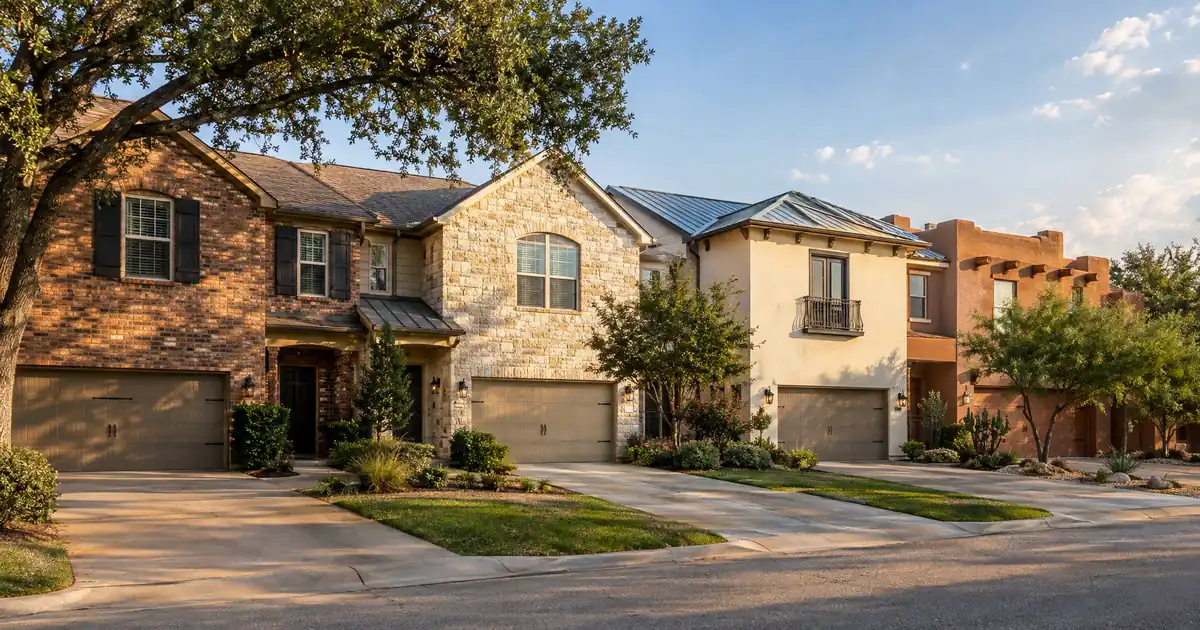
Price momentum in North Richland Hills has stalled, and that changes how a DSCR cash out refinance should be planned over the next 6-18 months. Zillow’s home value index puts the typical value at $367,768, up just 0.5% over the past year. Movoto shows 267 homes sold in June against 308 a year earlier. An investor who bought a rental here expecting appreciation to hand over a fat equity check may find the cash-out ceiling set by basis and rent coverage instead. This analysis covers what the numbers support, where they break, and how proceeds get redeployed.
DSCR Cash-Out Calculator
Run the cash-out numbers in North Richland Hills, TX
Rate source: Freddie Mac 30-yr average via FRED® — Federal Reserve Bank of St. Louis · effective Sep 24, 2026
Prefilled with starting assumptions — enter your property’s value, balance, taxes, and insurance for a more accurate picture.
Program parameters update from Lendmire’s centralized guideline source. Taxes and insurance are editable estimates.
As of Sep 24, 2026 · General Freddie Mac market benchmark, not a Lendmire loan offer. Property value, balance, taxes, and insurance are editable estimates. Maximum loan-to-value varies by lender, program, property type, and seasoning. Not a Loan Estimate, approval, or commitment to lend. Program availability and eligibility are subject to lender guidelines, credit approval, property review, and underwriting.
The Quick Read:
A DSCR cash-out refinance on a North Richland Hills, Texas rental is underwritten primarily on the property’s rental income measured against its full monthly obligation, so the sequence runs from a rent schedule and appraisal, to a leverage ceiling set by seasoning, to a lender review of reserves and credit.
- Median single-family lease of $2,200 against a $400,000 median sale price: about 0.55% gross monthly rent-to-value, per McCaw.
- Full-PITIA coverage on a median house at 75% LTV lands below 1.00x. Duplexes fare better.
- Cash-out LTV tops out at 75%, after about 6 months of ownership from title recording.
- Flat values mean equity comes from purchase basis, renovation, and paydown, not appreciation.
- Two TEXRail stops anchor the rail-served pockets of the rental base. Exact terms depend on the lender’s guidelines, property type, leverage, and a full review of the borrower’s file.
North Richland Hills Market Snapshot
A quick read on the North Richland Hills investor landscape — figures come from the cited sources below. Confirm current property-level numbers before underwriting.
| Metric | Detail |
|---|---|
| Home prices | 267 sales vs. 308 a year earlier (Movoto NRH market trends) |
| Typical rents | $1,650 and $2,025 unit rents (Homes.com multi-family search) |
| University enrollment | 23,000+ students (Birdville ISD HR) |
| Employment | 3,300 employees (Birdville ISD HR) |
Flat Prices Change the Equity Math
North Richland Hills is a cash-flow market, not an appreciation market, and a cash-out plan should be built that way. The data points in the same direction from several angles. Zillow’s index shows 0.5% annual growth. A single-month Redfin median ran 7.2% below the prior year (a one-month read, so weigh it lightly). The portals measure different things, an index in one case and closed-sale medians in the others, but none of them shows a market that is gifting equity.
A second figure needs a contrast frame. McCaw Property Management’s MLS-based mid-year report shows a median closed sale price of about $400,000 across 369 single-family closings over the trailing period it covers. That is higher than Zillow’s index value because a median of recent closings and a smoothed index are different instruments. McCaw is a property manager, so its report may lean toward marketing, but the comp depth it describes is useful: a median of 17 days on market, with 41% of homes selling at or above asking. Sellers are conceding only about 1.4% from list.
Deep comps with tight concessions mean appraisals should be supportable. They also mean values will not jump because an appraiser feels generous. The cash-out amount is capped by the equity-extraction mechanics: a 75% LTV ceiling, seasoning of about 6 months measured from title recording, and a DSCR floor of 1.00x on rent used for lender review against full PITIA. Equity available depends on all of those together. It is never a guaranteed cash figure. Every figure here varies by lender and program — guidelines, property type, leverage, and credit profile all apply.
Where does usable equity come from, then? Three places: a purchase made below market, renovation value added before the appraisal, and principal paydown over time. An investor holding a property bought at a discount, or one that has been renovated, is a stronger cash-out candidate than one who simply held and waited. Skip the appreciation story.
Run the Coverage Math Before You Order the Appraisal
At 75% LTV, a median-priced North Richland Hills single-family rental does not clear 1.00x when taxes and insurance are included. That is the finding that matters most for this city. Final terms depend on lender guidelines, property type, leverage, and the borrower’s complete credit picture.
Here is a modeled scenario, with inputs labeled as assumptions rather than sourced facts. Take a house valued at $400,000 (McCaw’s median sale) leasing at $2,200 (McCaw’s median closed lease). Coverage is monthly rent divided by the full monthly obligation: principal, interest, property taxes, and insurance. Modeled at 75% LTV with Texas-average tax and insurance loads, that runs roughly 0.8x, and rounding down is the honest call. Lower leverage helps only modestly. Around 60% LTV, the same house lands near 0.95x, still short of the standard benchmark. These specifics are subject to lender guidelines and a full review of property, leverage, and credit.
Most standard DSCR programs are built around a 1.00x baseline because rent covers the payment at that level. That is a common benchmark, not a universal rule. Below it, the options a lender might review include a sub-1.00 program, an interest-only structure, or a lower loan amount, each typically with tradeoffs such as lower leverage, different pricing, or more reserves. Whether any of those apply depends on lender guidelines, credit profile, reserves, and property review. It is worth reading up on “What Is a DSCR Loan” before assuming a house will pass.
The rent input is also shakier than city averages suggest. Zumper shows a median of $1,670, with 3-bedrooms at $2,112 and 4+ bedrooms at $3,350, but that sample is only 83 rentals and mixes apartments with houses. RentCafe tracks larger apartment buildings, at an average of $1,491. Torri Realty puts the standalone-house median near $2,350, with 3-bedrooms at $2,200 to $2,400. For a house, the useful cluster is roughly $2,100 to $2,400.
McCaw also shows asking rents running above closed rents: about $2,300 asked versus $2,200 closed for a 3-bedroom, and $3,000 versus $2,747 for a 4-bedroom. The gap is negotiated away, so underwrite at closed rents. The appraiser’s rent schedule is what the lender will use, and it will not care what the listing said.
Duplexes: The Structure That Might Fix It (If You Can Find One)
Multi-unit income stacking is the clearest way to improve coverage in North Richland Hills, but inventory is thin. One duplex example in the Homes.com multi-family search shows two tenant-occupied sides leasing at $1,650 and $2,025, about $3,675 combined. That is far above the $2,200 single-family median lease. Multi-family listings in the same search ranged from $270,000 to $689,000, so pricing spans a wide band, and a single listing is an example, not a market average.
Run the numbers on a hypothetical duplex priced at $450,000 (a modeled assumption) with that $3,675 in combined rent. At 75% LTV, including taxes and insurance, coverage lands around 1.15-1.2x. Compare that with roughly 0.8x on the single-family. Same city, same leverage ceiling, materially different result. The math favors the duplex, provided the price does not run far ahead of the rent. Terms vary by lender guidelines, property type, leverage, credit profile, and full file review.
The catch is supply. PropertyShark lists 19 multi-family homes for sale, and that count includes duplexes, a triplex, and quadplexes, some of them in adjacent cities. An investor who wants a small multifamily probably has to search Hurst, Richland Hills, Haltom City, and Bedford as well. Thin comps also make appraisals harder, which matters when the cash-out is sized off appraised value. Confirm actual list prices, leases, and local permitted use for any specific building.
This is a genuine toss-up for an existing single-family owner. Selling the house and rolling into a duplex might beat refinancing the house, though transaction costs and lost basis make that a real calculation, not an obvious upgrade.
Where the Rent Holds: TEXRail Pockets and the Older Core
The rental base here splits into rail-served pockets and a large stock of older suburban homes. No reliable neighborhood-level price or rent data turned up, so the discussion below is qualitative and attaches no numbers to individual areas.
Iron Horse. The submarket sits about a mile from downtown North Richland Hills, per Apartments.com, with a golf course and a TEXRail station. Wikipedia lists the station at 500 parking spaces. The likely tenant is a commuter or young professional heading to Fort Worth or DFW Airport. The Northeast Tarrant Chamber of Commerce notes two TEXRail stops in the city, Iron Horse and Smithfield, a feature few similar Tarrant County suburbs share (that last claim is unverified, so treat “few” as a soft one).
Smithfield and HomeTown. The second stop anchors newer infill, described locally as a walkable urban village with townhome-style product. It is a newer, transit-oriented submarket. A cash-out here rests on a smaller comp set, so appraisal risk deserves attention.
Central, Rufe Snow, and Davis corridors. Point2Homes gives a median construction year of 1986, so much of the housing stock is 1980s-era. That is a caution as much as a strength: older systems and roofs mean capital expenditures land during the hold, and a DSCR cash-out does not fund them. An investor planning to extract equity from a 1986 house should budget for deferred maintenance, because lender review of the property may surface it.
Tenant pool size matters too. RentCafe shows renters at 36% of households, so 64% of households own. The renter pool is real, but it is not the deep, churning pool of a college town.
Demand Anchors: Steady, Not Explosive
Tenant demand in North Richland Hills rests on a diversified suburban employment base, not a single dominant employer. Birdville ISD reports 3,300 employees and over 23,000 students across the district, the strongest verified employment figure available. The City of North Richland Hills employs more than 700 full- and part-time workers. Medical City North Hills, part of the HCA/Medical City network, adds hospital-sector demand, and the city houses the headquarters of HealthMarkets, among others (no headcounts verified).
The Chamber counts over 1,200 brick-and-mortar businesses and places the city about 15 minutes from and between DFW Airport, the Alliance Global Logistics hub, and downtown Fort Worth. Residents commute rather than working within city limits. Tarrant County College’s Northeast Campus sits in neighboring Hurst, and no four-year university operates in the city. U.S. News reports a median household income of $94,910 and 2.55% unemployment, though the source does not date those figures.
Vacancy data is the gap. No reliable primary-source vacancy rate turned up. McCaw’s leasing figures are the best proxy: a healthy number of rental homes actively listed, quick absorption for well-priced houses, and a steady stream of closed leases over the trailing period. That supports a modest vacancy assumption for well-priced houses. It does not prove one.
Lendmire’s deal desk sees a recurring pattern in suburban markets structurally like this one: the friction point is rarely tenant demand, and usually the gap between the asking-rent number on a listing and the rent schedule the appraiser produces. Files that arrive with a signed lease, a realistic closed-rent comp set, and reserves documented up front tend to move through program review with fewer questions. Files built on portal averages tend to get revised.
Skip the Appreciation Bet
The strongest case against a cash-out plan here is one that assumes rising values. Rents are roughly flat: Zumper shows about a 2% annual gain and a 1% monthly dip, and older Apartments.com data showed only 0.7% annual growth. Zumper also flags a 50.2% year-over-year rent drop in the College Hills area, to $1,595, but that comes from a small sample and is most likely a listing-mix effect, not a real collapse. Don’t underwrite rent increases, and don’t read a single-area outlier as a trend.
Flat rents plus flat values leave the 75% LTV ceiling as the binding constraint. An investor who assumes a refinance will free up enough capital for the next down payment should run the coverage ratio first. If the number lands under 1.00x, the loan structure changes, and so does the cash returned.
How the Proceeds Get Redeployed
Typical parameters, subject to lender guidelines and varying by borrower, property, and loan scenario: credit tiers generally run 620, 660, 680, and 700 with a 620 floor, reserves of about 6 months of PITIA (about 9 months above $1,500,000), and loan amounts up to $3,000,000 on standard programs. Loans to LLC-titled borrowers are subject to lender program eligibility. For how these loans compare with bank products, see our comparison of conventional vs DSCR on investor loans.
The practical sequence: confirm ownership seasoning, get a realistic rent schedule, model coverage with taxes and insurance, then decide on the structure. Investors can request a quote or reach the team at 828-256-2183 to see how a specific file might be reviewed. Verify current local rental rules, taxes, and insurance with qualified local professionals before underwriting.
Frequently Asked Questions
Does a cash-out refinance on a median North Richland Hills house clear 1.00x coverage?
Usually not at the 75% LTV ceiling. Modeled on McCaw’s $2,200 median lease and $400,000 median sale price, with taxes and insurance included, coverage lands around 0.8x. Lower leverage narrows the gap but rarely closes it. Sub-1.00 programs or interest-only structures may be reviewed, subject to lender guidelines and credit approval.
DSCR vs. conventional financing
Two common ways to finance an investment property in North Richland Hills, TX. They qualify you differently — here’s how investors weigh them.
Why investors choose it
- Qualifies on the property’s rental income — no personal tax returns, W-2s, or pay stubs needed to document income.
- No personal debt-to-income ceiling to clear, so existing mortgages and obligations don’t cap your borrowing the same way.
- Can be closed in an LLC, keeping the property inside a business entity.
- Built for scaling — not held to the limit on number of financed properties that conventional financing applies.
- Underwriting centers on the deal: generally qualifies when the rent covers the payment, a 1.00x coverage ratio being a common baseline (confirmed in underwriting).
- Designed specifically for investment property, including long-term and, where the program allows, short-term rentals.
Where it’s strong
- Often the lowest ongoing financing cost for a buyer who fully qualifies on personal income — a fit for a first property or a cost-first purchase.
Trade-offs for investors
- Requires full personal income documentation and must fit within a debt-to-income limit — salary, existing debts, and other mortgages all count.
- Typically held in your personal name rather than a business entity.
- Caps how many financed properties you can carry, which can become a ceiling as a portfolio grows.
- Evaluates you as a borrower as much as the property, which usually means more paperwork.
How investors usually choose: a first or single property often optimizes for the lowest financing cost; portfolio builders often optimize for leverage, vesting in an LLC, and scaling past conventional caps. The right answer depends on your goals, the property, and current guidelines — both paths run through select lenders in Lendmire’s wholesale network, with eligibility and terms confirmed in underwriting.
Should an investor count on appreciation to fund the equity?
No. Zillow’s index shows growth of 0.5% over the past year, and one Redfin single-month median ran 7.2% below the prior year. Equity in this market comes from a below-market purchase, renovation, or paydown. Hold periods that assume price gains carry real risk here.
Is a duplex realistic for a cash-out in North Richland Hills?
Realistic but scarce. PropertyShark lists 19 multi-family homes for sale, some in neighboring cities, and comps are thin. One sample duplex shows about $3,675 in combined rent, which would improve coverage sharply versus a house. Appraisals on thin comps deserve extra attention.
Underwrite house comps, adjusted to closed rents. Zumper’s $1,670 median and RentCafe’s $1,491 apartment average blend in unit types that do not match a single-family rental. A 3-bedroom house clusters around $2,100 to $2,400, and the appraiser’s rent schedule is what the lender uses.
How long must an investor own before pulling equity?
About 6 months, measured from title recording. After that, the 75% LTV ceiling and the coverage ratio decide how much equity, if any, is available.
The Real Choice for a North Richland Hills Owner
An investor holding a single-family rental here faces two paths, and each carries a tradeoff. One is to refinance the house at a lower LTV, accepting a smaller cash-out and possibly a sub-1.00 structure, and keep the asset in a rail-served suburb where rents look stable but flat. The other is to sell or exchange into a duplex or small multifamily, where coverage math is stronger but inventory is scarce, comps are thin, and the search may have to extend past city limits into Hurst, Richland Hills, or Haltom City.
For current guidelines and terms, see Lendmire’s DSCR loan programs page.
About Lendmire
Lendmire, NMLS# 2371349, is a non-QM mortgage broker serving real estate investors in 41 markets, including Washington, D.C., through DSCR investor loan programs. Qualification is generally reviewed around the subject property’s rental income, not the borrower’s W-2 history, which suits LLC-titled portfolios and self-employed investors. All scenarios remain subject to eligibility review and program guidelines. The firm has earned two consecutive Scotsman Guide Top Mortgage Workplace recognitions: a top-ranked workplace in 2025 and a top-ranked workplace in 2026.
A deeper walk-through of investment-property equity extraction lives in our guide to cash-out refinance on an investment property.
For broader investor-financing rules and property-type coverage across the state, see Texas DSCR loans.
Get Started
Ready to find the right loan for you?
In about 30 seconds you can review financing options available for your investment property. No commitment required.
Informational only. Not a Loan Estimate, approval, or commitment to lend. Program availability and eligibility are subject to lender guidelines, credit approval, property review, and underwriting.
References
2. Movoto
3. McCaw Property Management, North Richland Hills Rental Market Report
4. Homes.com multi-family search
5. Birdville ISD Human Resources
7. Zumper
8. RentCafe
9. Torri Realty
10. PropertyShark
11. Apartments.com
12. Wikipedia
13. Northeast Tarrant Chamber of Commerce
14. Point2Homes
15. City of North Richland Hills
17. Scotsman Guide — Top Workplaces 2025
18. Scotsman Guide — Top Workplaces 2026
This article is part of Lendmire’s investment property cash-out refinance program — full qualification details, guidelines, and scenarios live on the program page.
Related reading: Cash Out Refinance Investment Property in North Richland Hills · Cash Out Refinance Investment Property Kyle Texas · Cash Out Refinance Investment Property Flower Mound Texas
Guides: Investment Property Cash-Out Refinance in North Richland Hills, TX · Investment Property Cash-Out Refinance in Texas
Brandon Miller
Founder & CEO, Mortgage Loan Originator, Lendmire LLC
- Mortgage Loan Originator · NMLS# 1129696 · Verify on NMLS Consumer Access
- North Carolina Real Estate Broker · License# 343312 · Verify on NCREC
- North Carolina Insurance Producer · License# 19053198 · Property, Casualty, Life, Health · Verify on NAIC SBS
- Lendmire LLC · Firm NMLS# 2371349 · Verify firm licensure
Compliance and disclosures. Lendmire (NMLS# 2371349) is a licensed mortgage broker and is not a direct lender, depository institution, financial advisor, or tax professional. Content in this article is general market analysis and educational information — not financial, legal, or tax advice for any specific situation. Lendmire does not guarantee loan approval; every transaction is subject to underwriting by the funding lender. Mortgage pricing and loan program guidelines are subject to change at any time without notice and vary by borrower characteristics, property type, and state regulations. Lendmire complies with Equal Housing Opportunity. Licensure verification: NMLS Consumer Access.