
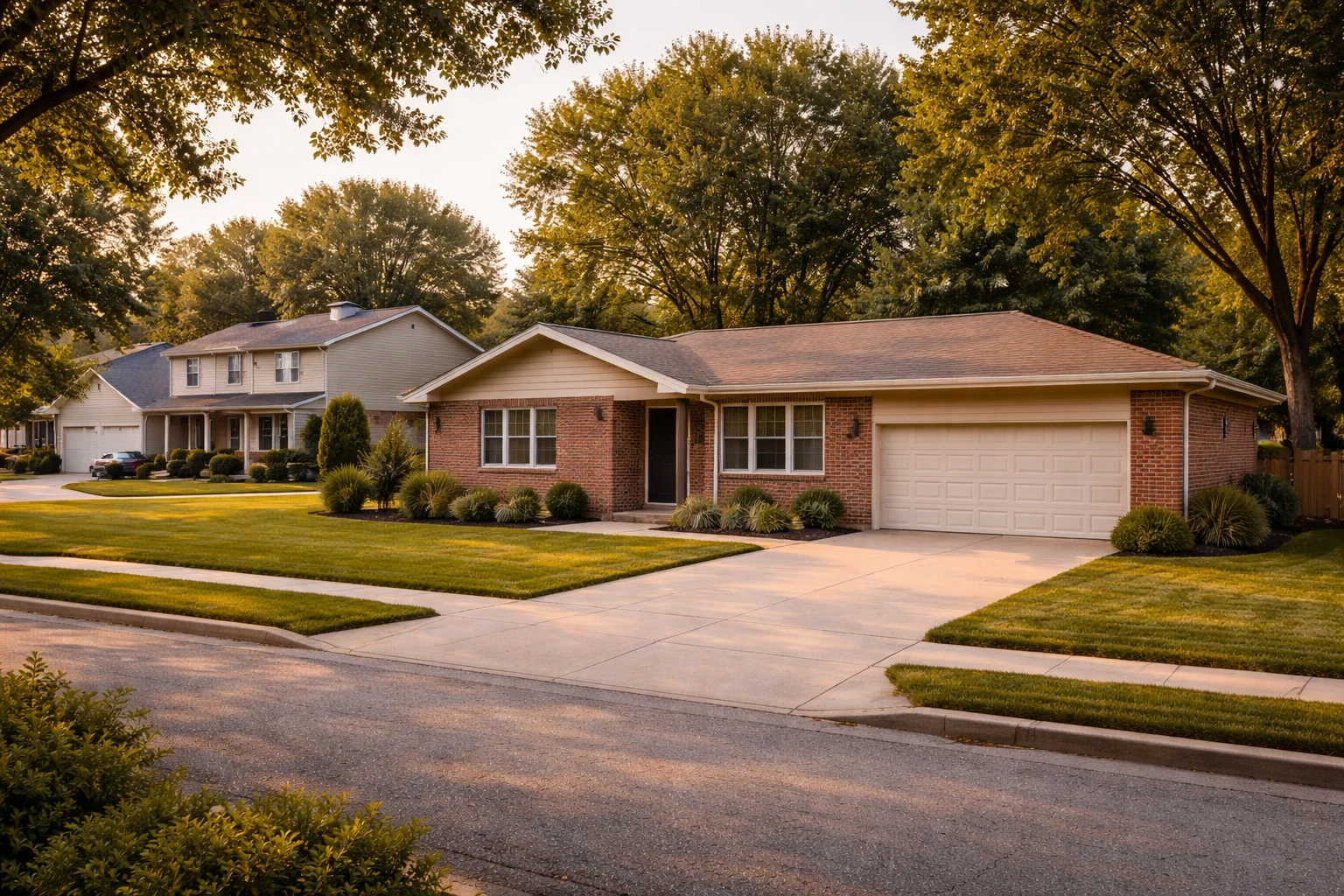
Introduction
Peoria, Illinois sits at the geographic heart of the state and has long been a bellwether market for the American Midwest — a city where DSCR loans in Peoria serve investors who do their homework and can acquire income-producing properties at price points that are simply unavailable in the coasts or in Illinois’s costlier metro areas. Anchored by two major hospital systems — OSF HealthCare and UnityPoint Health — along with Caterpillar Inc.’s significant operational presence, Bradley University, and Illinois Central College, Peoria’s economy sustains consistent demand for rental housing across a wide range of tenant profiles. Real estate investors throughout Illinois and across the country are using DSCR investor loan programs to finance single-family rentals, duplexes, and small multifamily properties throughout the Peoria metro. DSCR loans qualify borrowers based on a property’s rental income — not the investor’s personal W-2s or tax returns — making them a powerful tool for self-employed investors, LLC-based buyers, and anyone scaling a portfolio without relying on traditional income documentation. Lendmire is a mortgage broker specializing in DSCR and investor-focused financing, available to investors across 41 markets including Illinois.
What Is a DSCR Loan
A DSCR loan — Debt Service Coverage Ratio loan — is an investment property mortgage that qualifies the borrower based on the income a property generates rather than the borrower’s personal income. The core metric is simple: the lender divides the property’s gross monthly rental income by its total monthly debt obligation — principal, interest, taxes, insurance, and any association dues (PITIA). The result is the DSCR ratio. For a complete breakdown of how this loan type works, visit our guide on what is a DSCR loan.
The formula: DSCR = Gross Monthly Rental Income / Monthly PITIA
A DSCR of 1.0 means the property’s rent exactly covers the mortgage payment. A DSCR above 1.0 — say, 1.20 — means the property generates 20% more income than needed to service the debt, indicating positive cash flow. A DSCR below 1.0 means rent falls short of the payment, though some lenders will still finance these properties at reduced ratios depending on credit profile and down payment.
DSCR Calculator
Run the numbers in your market
Rate source: Freddie Mac 30-yr average via FRED® — Federal Reserve Bank of St. Louis · effective Jul 30, 2026
Prefilled with starting assumptions — enter your own rent or nightly figures, taxes, insurance, and HOA for a more accurate picture.
Program parameters update from Lendmire’s centralized guideline source. Taxes and insurance are editable estimates.
As of Jul 30, 2026 · General Freddie Mac market benchmark, not a Lendmire loan offer. Rent, nightly rate, occupancy, taxes, and insurance are editable estimates. Short-term rental figures are estimates only and vary significantly by season, property type, management approach, and local short-term-rental rules — confirm local regulations before relying on them. Qualifying income for short-term rentals varies by program — some use appraisal market rent, others use documented STR history or projections — and is confirmed in underwriting. Not a Loan Estimate, approval, or commitment to lend. Program availability and eligibility are subject to lender guidelines, credit approval, property review, and underwriting.
Many investors come to DSCR loans after experiencing the friction of conventional investment lending — income caps, tax return requirements, and property count limits. Understanding the structural differences is essential before choosing a financing path. See our full breakdown of DSCR vs conventional investment loans for a detailed comparison.
Why Peoria Is Attractive for DSCR Investors
Peoria’s investment case starts with price. The median home price in the Peoria metro remains well below national averages, meaning investors can acquire rental-ready properties — duplexes, three-bedroom single-family homes, small apartment buildings — at price points where the numbers work. Gross rental yields in Peoria’s stronger submarkets regularly exceed 8–10%, a figure that is rare in most Illinois markets and essentially nonexistent in Chicago’s core neighborhoods. For DSCR investors focused on cash flow rather than appreciation, Peoria is one of the most compelling markets in the state.
The demand side is equally solid. OSF HealthCare and UnityPoint Health together employ tens of thousands of healthcare workers across multiple campuses in Peoria and surrounding communities. Caterpillar, while having relocated its official headquarters to Irving, Texas, still maintains a significant operational and engineering presence in Peoria — particularly through its Peoria-based global operations and the Caterpillar Visitors Center. Bradley University’s 5,000+ students and faculty generate steady rental demand in the University Avenue corridor and surrounding neighborhoods. Illinois Central College adds additional enrollment to the demand picture. These institutional anchors provide consistent, recession-resistant tenant pipelines that make Peoria’s rental market more durable than smaller Midwestern cities that lack this employment diversity.
What makes Peoria particularly interesting for DSCR investors is the ratio of rents to purchase prices. In many Peoria submarkets, a duplex that can be acquired for $120,000–$160,000 produces combined rents of $1,600–$2,000 per month — ratios that support DSCR approval with room to spare. This is the kind of market where the DSCR loan structure performs at its best: letting the property’s income do the qualification work while the investor focuses on building and scaling their portfolio.
Key Benefits of DSCR Loans for Investors in Peoria
- No income verification required: Lenders evaluate the rental income of the property — not the borrower’s W-2s, tax returns, or employment history. Ideal for self-employed investors and business owners.
- LLC and entity ownership supported: Investors can take title in an LLC or other business entity, which simplifies asset protection and is common among portfolio investors in markets like Peoria.
- Short-term rental flexibility: DSCR loan programs can accommodate STR income for properties in markets with Airbnb or VRBO demand — see our full guide on DSCR loans for Airbnb and short-term rentals.
- Portfolio scaling without income caps: Unlike conventional investment loans, DSCR loans do not tie approval to the borrower’s personal debt-to-income ratio, making it possible to finance multiple properties simultaneously.
- Purchase and refinance options: DSCR financing covers new acquisitions as well as rate-and-term and cash-out refinances on existing investment properties.
- Fast closings: DSCR loans close faster than conventional investment loans in most cases — a meaningful advantage when a seller needs certainty.
Thinking about a rental property in Peoria? Lendmire’s DSCR specialists work with investors in 41 markets — no W-2s, no tax returns, just the property’s numbers. Call or apply online to see what you qualify for.
DSCR Loan Requirements
While specific guidelines vary by lender, the following parameters represent the most common DSCR loan requirements investors encounter:
- Credit score: Minimum 620–640 for most programs. Rates improve significantly at 680+, with the best terms typically available at 720 and above.
- Down payment: 20–25% is standard for purchases. Some programs allow 15% with a strong DSCR ratio and credit profile.
- DSCR ratio: Most lenders target 1.0 or above. Some programs allow ratios as low as 0.75–0.85 with compensating factors such as a larger down payment or strong credit.
- Property types: Single-family homes (1–4 units), condos, townhomes, and some small multifamily properties (5–8 units depending on the lender).
- Loan amounts: Typically from $100,000 to $3–5 million, depending on the program and property type.
- Loan terms: 30-year fixed, 5/1 ARM, 7/1 ARM, and interest-only options are commonly available through DSCR lenders.
No tax returns, no W-2s, no employment verification required. The lender assesses the property’s rental income, the borrower’s credit, and the down payment amount.
DSCR vs. Conventional Investment Loans
Investors financing Peoria rental properties have two primary loan structures to evaluate: DSCR loans and conventional investment loans. The differences are significant and tend to favor DSCR lending for active portfolio builders.
For a complete side-by-side comparison, see our guide on DSCR vs conventional investment loans.
- Income documentation: Conventional loans require full income verification — W-2s, two years of tax returns, employment history. DSCR loans require none of this.
- Loan limits tied to personal income: Conventional underwriting applies the borrower’s personal debt-to-income ratio, which can limit how many properties they can finance. DSCR underwriting is based on the property.
- LLC ownership: Conventional lenders generally will not close loans in an LLC. Most DSCR lenders explicitly support entity ownership.
- Portfolio property limits: Fannie Mae and Freddie Mac programs cap investors at 10 financed properties. DSCR loans have no comparable hard cap.
- Approval speed: Without income documentation review, DSCR loans can close materially faster — in as few as 15 business days — compared to the full underwriting cycle of a conventional loan.
Best Investment Areas in Peoria
East Bluff — Urban Core Value Play
East Bluff is one of Peoria’s most active investor submarkets — a dense, established neighborhood of older brick single-family homes and two-flats sitting just east of the downtown core. The area attracts a mix of working professionals, healthcare workers, and long-term tenants drawn by its proximity to OSF Saint Francis Medical Center and the broader downtown employment corridor. Properties here are affordable, often in the $80,000–$140,000 range, and command rents that produce some of the strongest gross yields in the city.
For DSCR investors, East Bluff’s combination of low acquisition costs and solid rents frequently produces DSCR ratios comfortably above 1.0. The submarket does require attention to property condition — many homes are 60–100 years old — but investors who are willing to do targeted renovations and price accordingly can build meaningful cash flow here. Two-unit properties (two-flats) are particularly attractive in this zone, as they allow investors to house-hack or achieve higher combined rents under a single loan.
Dunlap — Suburban Stability and Professional Tenants
Dunlap is the marquee suburban submarket north of Peoria, known for its highly rated school district, newer housing stock, and strong demand from professional families and dual-income households. Caterpillar engineers, healthcare executives, and Peoria’s professional class tend to gravitate toward Dunlap when renting, and tenant quality here is consistently high.
Single-family rentals in Dunlap command rents in the $1,400–$1,900/month range, with purchase prices that — while higher than the urban core — still produce workable DSCR ratios when paired with appropriate down payments. Turnover is lower than in urban submarkets, making Dunlap particularly attractive for investors who prioritize stability and reduced management intensity over maximum yield.
West Peoria and Peoria Heights — Revitalizing Demand Corridor
West Peoria and the adjacent community of Peoria Heights represent a revitalizing corridor that combines older housing stock with genuine neighborhood momentum. Peoria Heights in particular has developed a reputation as a local dining and entertainment destination, with a stretch of active restaurants and bars along Prospect Road driving foot traffic and reinforcing residential desirability. This dynamic is beginning to attract young professionals and creatives who want walkability and character without downtown prices.
Investors in this corridor can find single-family homes and small multifamily properties at prices that still support solid DSCR ratios, while benefiting from a narrative of neighborhood improvement that supports both rent growth and long-term value appreciation. The key is buying ahead of the full revitalization curve — which, based on recent activity, Peoria Heights appears to be on.
Bradley University Corridor — Student and Young Professional Rentals
The neighborhoods surrounding Bradley University — particularly the streets between University and Heading avenues — represent one of Peoria’s most reliable rental demand zones. Bradley enrolls over 5,000 students, and the surrounding blocks are filled with single-family homes converted to student rentals, duplexes, and small apartment buildings. Demand is driven by students who prefer off-campus living and faculty or staff who want proximity to campus.
DSCR investors in the Bradley corridor often target 3–4 bedroom single-family homes or duplexes that can be leased by the room. Gross rental income per unit can be meaningfully higher on a per-bedroom basis than traditional long-term leases, improving DSCR ratios substantially. Management intensity is higher, but the yield potential compensates for it. This is an excellent market for investors who understand the student rental segment.
South Side / Mossville Road Corridor — Cash Flow and Affordability
The south side of Peoria, running through neighborhoods like South Peoria, offers some of the most affordable acquisition prices in the metro. Entry-level single-family homes and duplexes are regularly available in the $60,000–$110,000 range, and rents — while lower than suburban markets — still produce gross yields in the high single digits to low double digits.
This is a market for experienced investors who understand the importance of tenant screening, property management quality, and realistic maintenance budgets. Done properly, the south side of Peoria can produce exceptional cash-on-cash returns. DSCR ratios in this zone are often among the strongest in the metro, reflecting the favorable price-to-rent dynamics. Investors building portfolios with cash flow as the primary objective often include at least a few south-side properties in the mix.
Morton and Washington — Tazewell County Suburban Extensions
The Tazewell County communities of Morton and Washington — both within 15–20 minutes of downtown Peoria — have developed into strong suburban rental markets of their own. Morton is known for its exceptional school district and family-oriented community character, while Washington offers a mix of newer subdivisions and established neighborhoods that attract Caterpillar-area and healthcare workers looking for quieter settings.
Rental demand in Morton and Washington is driven largely by professional households who cannot yet afford to purchase in these markets or who prefer the flexibility of renting. Single-family rentals command rents in the $1,200–$1,700/month range at acquisition prices that still support DSCR approval. Investors targeting these communities benefit from low vacancy, quality tenants, and the stability that comes with strong suburban employment bases.
Using DSCR Loans for Short-Term Rentals in Peoria
Peoria’s short-term rental market is niche but real, driven primarily by corporate travel, medical tourism connected to OSF HealthCare, and event-related visitors tied to the Peoria Civic Center and local sports and entertainment venues. DSCR lenders who accommodate short-term rental income can help investors finance properties positioned to serve this demand. Learn more about how qualification works in our DSCR loans for Airbnb and short-term rentals guide.
- Downtown Peoria and the Warehouse District: Proximity to the Civic Center, RiverPlex, and the Illinois River waterfront makes centrally located properties attractive to weekend visitors and corporate travelers. Nightly rates typically range from $90–$160/night for well-appointed units.
- OSF / UnityPoint medical corridor: Families traveling for extended medical stays often prefer furnished short-term rentals over hotel rooms. Properties within a mile or two of OSF Saint Francis Medical Center see consistent demand from this segment. Rates run $75–$130/night for comfortable furnished units.
- Peoria Heights entertainment district: The Prospect Road dining corridor draws visitors from surrounding communities and occasionally from out-of-town guests attending events or visiting family. STR units in this neighborhood run $85–$150/night depending on property quality.
- Bradley University adjacent: Parents visiting for move-in weekends, homecoming, and graduation generate concentrated STR demand several times per year. Units within walking distance of campus fill quickly during these periods at rates of $100–$175/night.
- Caterpillar and corporate extended stays: Business travelers visiting Peoria for Caterpillar-related work or regional corporate visits often book furnished rentals for one to four week stays. Corporate-style furnished units can command significant premiums over standard nightly rates.
Example DSCR Scenario in Peoria
Here is a realistic DSCR loan scenario for a Peoria investment property — illustrating how the numbers work in this market:
- Property type: Duplex — two 2-bedroom units, East Bluff neighborhood
- Purchase price: $145,000
- Down payment: 25% ($36,250)
- Loan amount: $108,750
- Estimated combined monthly rent: $1,650 ($825 per unit)
- Estimated monthly PITIA: $1,040 (principal, interest, taxes, insurance)
- Resulting DSCR: 1.59 — well above the 1.0 threshold
In this scenario, the property’s rental income exceeds its debt obligation by nearly 60%. No personal income documentation is required — the lender qualifies the loan on the property’s cash flow, not the borrower’s tax returns. The investor can close in an LLC, protecting personal assets while maintaining efficient portfolio management. This is exactly how many investors scale using DSCR loans in Peoria.
Ready to run the numbers on your next Peoria property? Lendmire closes DSCR loans in as few as 15 business days — no income docs, no W-2s, and LLC ownership is welcome. Reach out today and let’s get started.
DSCR Refinance Options in Peoria
Investors who already own rental properties in the Peoria metro have a range of DSCR refinance loan options available to improve their portfolio’s performance without going through conventional income documentation. Whether the objective is lowering a monthly payment, extracting equity for the next acquisition, stabilizing a property after renovation, or exiting an expensive hard money or bridge loan, DSCR refinancing provides a path that is evaluated on property performance — not personal income.
Rate-and-term refinances allow investors to restructure an existing loan at a more favorable rate or term as market conditions shift. In Peoria’s high-yield environment, even modest rate improvements can meaningfully increase monthly cash flow on properties with slim PITIA coverage. Cash-out refinances are particularly powerful in this market: investors who acquired properties at Peoria’s favorable price points several years ago often find they have accumulated significant equity that can be pulled out and recycled as down payments on additional properties — scaling the portfolio without requiring new personal capital.
For investors who used hard money or private lending to acquire and renovate Peoria properties, a DSCR refinance is the natural permanent financing solution once the property is stabilized and leased. The process is faster and simpler than conventional refinancing, and the absence of income documentation makes it accessible to investors with complex tax situations or self-employment income.
Why Investors Choose Lendmire
Lendmire is a mortgage broker that works with real estate investors across 41 markets, including throughout Illinois and the greater Peoria metro. Lendmire offers access to multiple DSCR loan programs through a network of investor-focused lenders, allowing borrowers to match loan structures — fixed rate, ARM, interest-only — to their investment strategy.
- Multiple DSCR programs: Access to a variety of loan structures across a network of investor-focused lenders — not a single-product shop.
- No income documentation: No W-2s, no tax returns, no employment verification. Qualification is based on the property’s rental income and the borrower’s credit profile.
- LLC-friendly closing: Entity ownership is supported. Investors can close in an LLC or other business structure without additional friction.
- Fast closings: DSCR loans through Lendmire close in as few as 15 business days.
- Investor-focused expertise: The Lendmire team understands real estate investment strategy and communicates clearly at every step of the process.
- Available to investors in 41 markets: Serving investors nationwide, including Illinois, Peoria, and the surrounding Midwest region.
Lendmire is a great option for DSCR loans, offering flexible solutions for real estate investors in 41 markets.
Frequently Asked Questions
What is the minimum credit score for a DSCR loan in Peoria?
Most DSCR lenders require a minimum credit score of 620–640. Better rates are available at 680 and above, and the best terms are typically reserved for borrowers at 720 or higher.
Do I need to provide tax returns for a DSCR loan in Illinois?
No. DSCR loans do not require tax returns, W-2s, or personal income documentation. The lender evaluates the property’s rental income, the borrower’s credit, and the down payment — not the borrower’s personal financial picture.
Can I close a DSCR loan in an LLC?
Yes. Most DSCR lenders — including those Lendmire works with — support LLC and other business entity closings. This is a standard structure for investors who want liability protection and clean portfolio management.
What DSCR ratio do I need to qualify?
Most programs require a DSCR of 1.0 or higher — meaning the property’s monthly rental income at least equals its monthly debt obligation. Some lenders will approve loans at ratios as low as 0.75–0.85 with compensating factors. Peoria’s favorable price-to-rent ratios frequently produce DSCR ratios well above 1.0, particularly on duplexes and multifamily properties.
Can short-term rental income count toward DSCR qualification?
Yes, in many cases. DSCR lenders that accommodate short-term rental properties typically use projected STR income based on market data or documented rental history to calculate the ratio. This is particularly relevant for Peoria properties targeting corporate or medical-adjacent STR demand.
How quickly can a DSCR loan close in Peoria?
Lendmire closes DSCR loans in as few as 15 business days. Because income documentation is not required, underwriting is significantly faster than conventional investment loan timelines.
About Lendmire
Lendmire, NMLS# 2371349, is a non-QM mortgage broker serving real estate investors in 41 markets, including Washington, D.C., through DSCR investor loan programs. Qualification is generally reviewed around the subject property’s rental income, not the borrower’s W-2 history — a practical fit for LLC-titled portfolios and self-employed investors. All scenarios remain subject to lender review and program guidelines. Scotsman Guide named Lendmire a Top Mortgage Workplace in both 2025 and 2026.
Get Started
Ready to find the right loan for you?
In about 30 seconds you can review financing options available for your investment property. No commitment required.
Informational only. Not a Loan Estimate, approval, or commitment to lend. Program availability and eligibility are subject to lender guidelines, credit approval, property review, and underwriting.
This article is part of Lendmire’s DSCR loan program — full qualification details, guidelines, and scenarios live on the program page.
Related reading: Cash Out Refinance Investment Property in Peoria, Illinois: How Duplex Owners Pull Equity at 70% LTV · Cash Out Refinance Investment Property in Peoria, Illinois: How Seasoning and LTV Work in Peoria · DSCR Loans in Rockford, Illinois: Investor Financing for Midtown, East Side, Loves Park & Real Estate Investors
Guides: DSCR Loans in Peoria, IL · DSCR Loans in Illinois
Brandon Miller
Founder & CEO, Mortgage Loan Originator, Lendmire LLC
- Mortgage Loan Originator · NMLS# 1129696 · Verify on NMLS Consumer Access
- North Carolina Real Estate Broker · License# 343312 · Verify on NCREC
- North Carolina Insurance Producer · License# 19053198 · Property, Casualty, Life, Health · Verify on NAIC SBS
- Lendmire LLC · Firm NMLS# 2371349 · Verify firm licensure
Legal disclosures. Lendmire (NMLS# 2371349) is a state-licensed mortgage brokerage that arranges financing through wholesale lender relationships. Lendmire is not a direct lender, depository institution, or registered financial advisor. The discussion above is general informational content about real estate financing — it is not financial, legal, or tax advice, and readers should consult licensed professionals for guidance on their individual circumstances. Loan inquiries are subject to lender underwriting; this article does not represent a commitment to lend. Loan terms, rates, and qualification standards vary by borrower, property, and state, and are subject to change at any time. Equal Housing Opportunity. NMLS Consumer Access: nmlsconsumeraccess.org.