
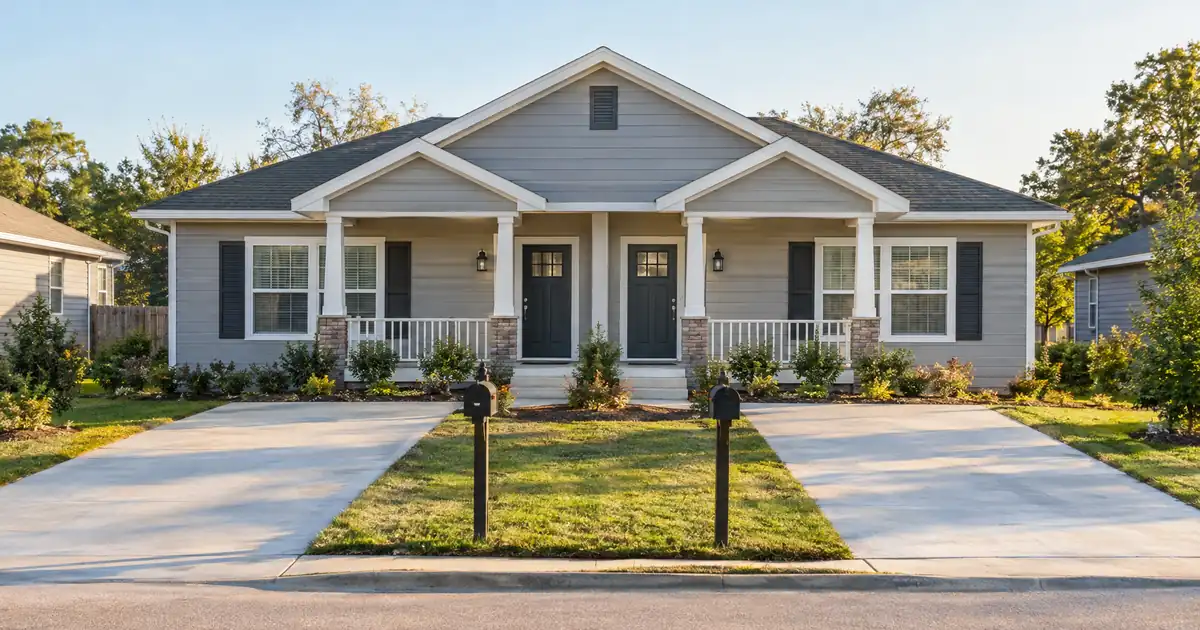
The Quick Read: A duplex owner with a locked-in mortgage can use an FHA cash-out only by replacing that mortgage entirely. The home must be your primary residence, you must have owned and lived in it for 12 months before the case number, and the new loan tops out at 80% of the appraised value. The trade-off is that the new rate and terms apply to your whole balance, not just the cash you pull out. Subject to lender guidelines and full file review.
Key Takeaways
- A cash-out refinance replaces your first mortgage. If your current loan has a low rate, you give it up.
- You must live in one of the two units. A tenant in the other unit does not change that.
- FHA cash-out reaches 80% loan-to-value (LTV), meaning the loan can be up to 80% of the home’s appraised value.
- Mortgage insurance applies to the entire new loan, not only the cash portion.
- A second-lien product can leave your first mortgage in place. It is a different tool with different trade-offs.
What Does an FHA Cash-Out Replace?
An FHA cash-out refinance pays off your current mortgage and gives you a new FHA-insured loan. The new loan is bigger than the old payoff. The difference, after costs, comes to you as cash. You can use it for repairs, debt, or anything else, because cash-out proceeds are not limited to one purpose.
That structure is the whole issue for you. Your “locked-in” mortgage is the low-cost loan you do not want to lose. A cash-out does not sit on top of it. It deletes it and writes a new one. Lendmire’s FHA cash-out refinance program works this way, as does every FHA cash-out we arrange through wholesale lenders.
Don’t confuse it with the FHA Streamline. A Streamline refinances an existing FHA loan with no appraisal and a limited credit review, but it needs a net tangible benefit and it cannot pull equity out. Cash-out is the only FHA refinance that does.
The Requirements Checklist
Here is what a lender reviews on a duplex cash-out. Every item is subject to lender guidelines.
| Requirement | What it means | Duplex note |
|---|---|---|
| Occupancy | Primary residence only | You live in one unit |
| Ownership | Owned and occupied 12 months before the case number | Counts the whole home |
| Maximum LTV | 80% of appraised value | Includes any liens that stay |
| Credit | Decision score of 580 or higher on the programs Lendmire uses | Some lenders set a higher floor |
| Ratios | Base 31/43, up to 40/50 with documented factors | Rent from the other unit may help |
| Payment history | Clean recent record on the current mortgage | Late payments can stop the file |
| Appraisal | Full appraisal required | Rent is documented on the report |
The ratios deserve a plain explanation. The first number is your housing payment as a share of income. The second is all your monthly debts as a share of income. The automated underwriting finding governs most files, and strong documented factors (savings, steady income, low other debt) can lift the allowed ratios.
How Does the Duplex Change the File?
A duplex changes three things: how occupancy is proven, how the rent is counted, and what the appraisal must show.
Occupancy with a tenant next door. Living in one unit makes the loan owner-occupied, even when the other unit is rented. Lenders look for ordinary proof: the address on your license, tax records, utility bills, and mail. A home you do not live in is not eligible. If occupancy is the problem, the leverage you can reach changes, and that is a different conversation than this one.
How the second unit’s rent counts. HUD’s rental-income rules, in Mortgagee Letter 2023-17, allow rent from a two- to four-unit home to count as income. Only the rented unit counts, not your own. And only part of the rent counts, not the full amount, because the formula builds in room for vacancy and upkeep. Where you have a rental history, the lender asks for leases and records. Where you do not, it relies on the appraiser’s market-rent figure.
The appraisal. A cash-out needs a full appraisal. On a two-unit home, the appraiser also documents fair market rent for the rented unit. This is a bigger report than a single-family one.
One point lenders sometimes raise: the self-sufficiency test, where net rent must cover the payment, is aimed at three- and four-unit homes. A duplex is usually treated differently, though the live handbook controls on any given file.
How Much Cash Can You Pull?
The cap is 80% of the appraised value. HUD lowered it for cash-out refinances, and the change shows up in the HUD Handbook 4000.1 transmittal. Older web pages may still show the prior limit.
Think of the cash in four steps:
1. Take 80% of the appraised value. That is the ceiling.
2. Subtract anything that must stay on the home, like a second lien.
3. Check that the result sits under the county loan limit for a two-unit home. County limits apply, and the lower of the two ceilings controls.
4. The new loan pays off your current mortgage first. The 1.75% upfront mortgage insurance premium, which can be financed, and the closing costs come next. What remains is your cash.
Take a home that appraises at a value where 80% is only slightly above your payoff. The cash is small, and the costs can eat most of it. Take one with a much lower payoff, and the cash is meaningful. The ratio of payoff to value decides almost everything here.
Lenders typically want you to keep some equity after closing. The CFPB’s guide to using home equity says the new loan carries a new rate and new terms. It also warns that the payment can rise and the payoff date can move out, because the loan is often reset to a long term.
What Mortgage Insurance Does to the Math
FHA loans carry two premiums. The upfront premium is 1.75% of the base loan, and you can finance it. The annual premium runs between 0.15% and 0.75% of the balance, depending on term, loan amount, and LTV. A summary of HUD’s 203(b) program from the FDIC confirms the upfront premium and the owner-occupied limit.
Duration matters. On a thirty-year loan above 90% LTV, the annual premium lasts the full term. At or below 90%, it ends after eleven years. A cash-out at 80% LTV falls in the second group. These are program facts, not a quote, and your file’s exact tier depends on the details. The exact numbers vary by lender and program and follow a full review of property, leverage, and credit.
Here is the catch. The premium applies to the entire new balance. You are not paying for insurance on just the cash. You are paying on the old payoff, too.
What Do You Give Up With a Locked-In Mortgage?
You give up the cost of your old loan on every dollar of your current balance. This is the part most guides skip, so here is the method. You can run it yourself with your own numbers.
Option A: cash-out. Your whole balance moves to the new rate. Add the premium costs and the closing costs.
Option B: keep the first, add a second lien. Your current balance stays at its low cost. Only the new borrowed amount carries the second loan’s cost.
To compare them, ask three questions:
- What is the yearly cost of the new loan on the full balance, including insurance?
- What is the yearly cost of keeping the old loan, plus the yearly cost of the second lien on just the cash?
- How many years until the cash-out’s added upfront costs are paid back by any difference?
If the second option costs less per year, the cash-out loses on cost, and you would take it only for other reasons, like a fixed single payment or a lack of second-lien options. If the cash-out costs less, it can win, especially when you plan to stay a long time. A blended view helps here: the old rate on the old balance, plus the second loan’s rate on the new money, compared against one new rate on everything.
Lendmire’s piece for how to get an FHA cash-out in Texas with a locked-in first mortgage covers a state where extra equity rules apply.
Which Tool Fits? A Decision Table
| Option | Your first loan | Occupancy | Fits best | Main trade-off |
|---|---|---|---|---|
| FHA cash-out | Replaced | Primary residence | Weaker credit, wants one loan | New terms on full balance |
| Second lien (home equity loan or HELOC) | Stays | Varies by lender | Low first loan worth keeping | Second payment; HELOC can be frozen |
| FHA rate-and-term | Replaced | Lived in 12 months | Wants a better loan, no cash | Reaches 97.75% on a primary residence; no cash |
| FHA Streamline | Replaced (FHA only) | Existing FHA loan | Existing FHA owner | No cash, needs net tangible benefit |
On the second-lien row, the CFPB says home equity loans and HELOCs are second mortgages paid on top of your first. The CFPB also notes a HELOC lender can limit or freeze a line if your home’s value drops or your finances change. A HELOC is not a guaranteed pool of cash. Availability of seconds behind various first mortgages differs by lender.
This one is a genuine toss-up for many duplex owners. The cash-out wins on simplicity and on credit flexibility. The second lien often wins on cost when the first loan is cheap. Lendmire’s article Conventional Cash-Out for the Owner Locked Into a Low First Mortgage walks through that other route.
How Is the File Underwritten, Step by Step?
Practitioners see the same sequence on most duplex cash-outs:
1. Eligibility screen. The lender confirms the home is your primary residence and that the 12-month ownership and occupancy test is met as of the case number date. It reviews the payment history on the current mortgage.
2. Case number and full appraisal. The appraiser sets value and documents market rent. Your 80% cap is measured from this value.
3. Loan sizing. The lower of the 80% ceiling and the county limit controls.
4. Income and rent. The lender counts your income, plus a portion of the other unit’s rent.
5. Underwriting. Credit, ratios, and automated findings run on the new, larger payment, including the financed premium and the monthly insurance.
6. Closing. The new loan pays off the old one, then costs, then you receive the remainder. Standard Loan Estimate and Closing Disclosure rules apply.
Where the General Rule Breaks
Some cases fall outside the usual pattern.
LLC or trust title. FHA is built for an individual’s primary residence. A duplex held in an LLC usually does not fit, and the title question needs review before you apply.
Part-time occupancy. If you live in the duplex only some of the year, the primary-residence test is hard to meet. Plan for this early.
Recent purchase. The 12-month test counts from the case number. A home bought more recently does not qualify for cash-out, though other refinance types may apply.
Inherited home. Heirs can sometimes get an exception to the waiting period. Renting the home out after inheriting removes it.
Forbearance history. A borrower who had forbearance generally must complete the plan and then show a run of on-time payments before cash-out is on the table.
An existing FHA loan. Replacing it with a new FHA loan means a new upfront premium and a new insurance schedule. The Streamline may treat the premium differently, but it cannot pay you cash.
Debt consolidation. A common use of cash-out is paying off other bills, and the CFPB’s research shows paying off other debts is the most common reason. Remember that moving unsecured debt into your mortgage secures it with your home. Missed payments can then put the home at risk. Tax treatment can depend on your situation; borrowers should speak with a qualified tax professional before relying on any deduction or credit.
Key Terms Defined
Cash-out refinance: A new mortgage that pays off your old one and gives you the extra amount as cash.
Locked-in mortgage: A current loan with terms good enough that you hesitate to replace it.
LTV (loan-to-value): The loan amount divided by the home’s appraised value.
Case number: The FHA identifier assigned to your loan file. Its date starts the ownership and occupancy clock.
Upfront premium: A one-time FHA mortgage insurance charge, 1.75% of the base loan, which can be financed.
Annual premium: The FHA insurance paid monthly as a percentage of the balance.
Second lien: A loan, such as a home equity loan or HELOC, that sits behind your first mortgage.
Frequently Asked Questions
Can I keep my low rate and still take cash out with FHA?
No. An FHA cash-out replaces the first mortgage, so the new terms apply to the whole balance. Only a second-lien product leaves the first loan in place. Whether you can add one behind an existing mortgage depends on the lender.
Does the rent from my second unit count in full?
No. Only the rented unit’s rent counts, and only part of it. Your own unit’s rent is not included. The lender documents it through leases, rental history, or the appraiser’s market-rent estimate.
Do I need an appraisal?
Yes. A cash-out needs a full appraisal, which sets the value for the 80% cap. A Streamline can skip the appraisal, but it cannot give you cash.
Is the 80% cap a guaranteed amount?
No. It is a ceiling. Occupancy, payment history, credit, ratios, the county loan limit, and the appraisal all affect what you can actually borrow. Everything is subject to lender guidelines and full file review.
What if I stop living in the duplex?
FHA requires a primary residence at the time of the loan. If you will move out, the product no longer fits, and occupancy changes what leverage other programs allow.
Next Steps
Before you apply, gather your current mortgage statement, two recent pay records, your leases for the rented unit, proof you live in the home, and a list of any other liens. Work through the blended-cost comparison above with your own numbers.
If you are weighing a cash-out refinance against keeping the loan you have, Lendmire can help you compare the programs and the equity each one reaches. Nothing here is a commitment to lend.
For your own numbers, request a scenario review with Lendmire.
About Lendmire
Lendmire (NMLS# 2371349) is a mortgage brokerage serving homeowners and home buyers in 16 states. FHA, VA, conventional and jumbo purchase and refinance loans are arranged through wholesale lending channels; Lendmire brokers the financing and the lender underwrites each application. Scotsman Guide named Lendmire a Top Mortgage Workplace in both 2025 and 2026.
Get Started
Ready to find the right loan for you?
In about 30 seconds you can review financing options available for your home or investment property. No commitment required.
Informational only. Not a Loan Estimate, approval, or commitment to lend. Program availability and eligibility are subject to lender guidelines, credit approval, property review, and underwriting.
References
1. HUD – Mortgagee Letter 2023-17 (rental income)
2. HUD – Handbook 4000.1 transmittal
3. CFPB – Using home equity guide
4. FDIC – 203(b) program summary
5. CFPB – Home equity loan vs. HELOC
7. CFPB: CFPB Report Finds Cash Out Mortgage Refinance Borrowers Improve Credit Scores
This article is part of Lendmire’s FHA Loan series — every loan program’s qualification details, guidelines, and scenarios live on the loan options page.
Related reading: FHA Cash-Out Rules for a First Mortgage With a Prepayment Penalty · FHA Cash-Out Buyout Requirements for a Divorce Decree · Should a Condo Owner Choose FHA Cash-Out or Conventional?
Brandon Miller
Founder & CEO, Mortgage Loan Originator, Lendmire LLC
- Mortgage Loan Originator · NMLS# 1129696 · Verify on NMLS Consumer Access
- North Carolina Real Estate Broker · License# 343312 · Verify on NCREC
- North Carolina Insurance Producer · License# 19053198 · Property, Casualty, Life, Health · Verify on NAIC SBS
- Lendmire LLC · Firm NMLS# 2371349 · Verify firm licensure
Legal disclosures. Lendmire (NMLS# 2371349) is a state-licensed mortgage brokerage that arranges financing through wholesale lender relationships. Lendmire is not a direct lender, depository institution, or registered financial advisor. The discussion above is general informational content about real estate financing — it is not financial, legal, or tax advice, and readers should consult licensed professionals for guidance on their individual circumstances. Loan inquiries are subject to lender underwriting; this article does not represent a commitment to lend. Loan terms, rates, and qualification standards vary by borrower, property, and state, and are subject to change at any time. Equal Housing Opportunity. NMLS Consumer Access: nmlsconsumeraccess.org.