
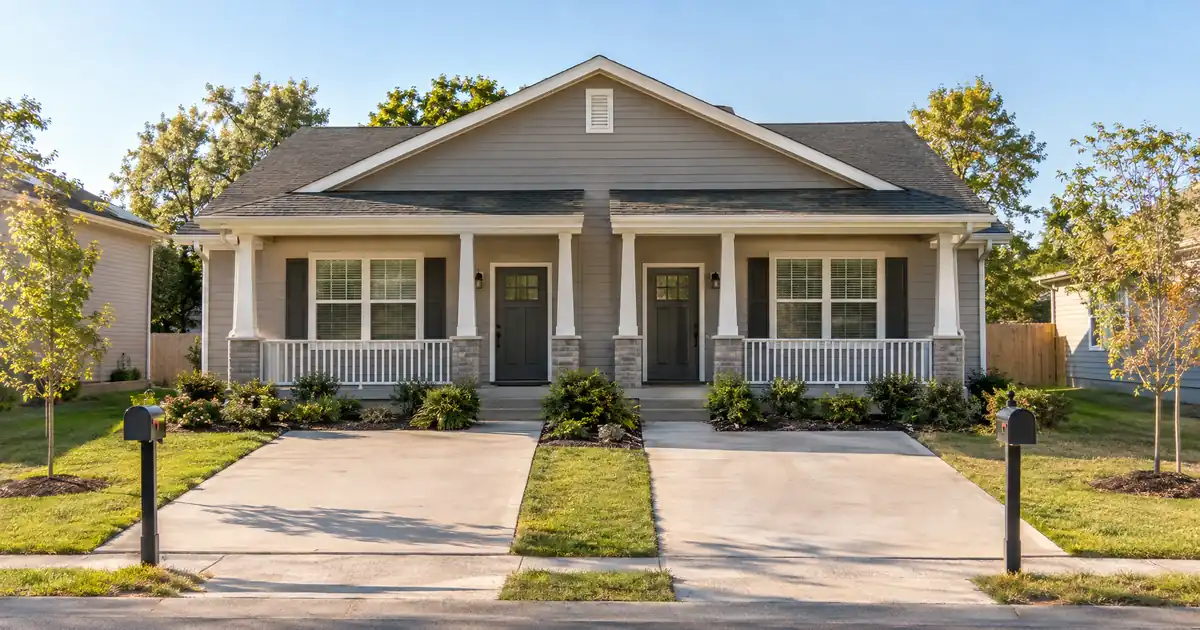
The Quick Read: An FHA cash-out refinance on a two-unit home you live in is allowed, and the loan you already have does not block it. The new loan pays off the old one and adds cash on top. It is a replacement, not a second loan. The tests are the same as for anyone else: you must have owned and lived in the home for 12 months, your payments must be on time, and the new loan generally cannot pass 80% of the appraised value. Everything is subject to lender guidelines and full file review.
Key Takeaways
- A cash-out on your duplex replaces your current FHA loan. It does not stack a second FHA loan on top.
- You must live in one of the two units as your main home. Renting out the other unit is fine.
- The loan tops out at 80% of the appraised value, so a large share of equity stays in the home.
- The new loan carries its own mortgage insurance costs, so ask your lender and a qualified local professional how they apply to your situation.
- Rent from the second unit may help you qualify, but how much counts depends on the lender’s rules.
Are You Asking About a Second FHA Loan or a Cash-Out?
Two different questions get mixed up here, and the mix-up sends many homeowners down the wrong path. A second FHA loan means buying another home while keeping the first. A cash-out means refinancing the home you already own.
| Question | What it means | Existing FHA loan |
|---|---|---|
| Second FHA loan | Buying another property | Stays in place |
| Cash-out refinance | New loan on the same duplex | Paid off at closing |
| Streamline | Swap FHA loan, no cash out | Paid off at closing |
The “one FHA loan at a time” idea belongs to the first row. It limits how many FHA purchases you can carry at once. It has nothing to do with the second row, because a cash-out leaves you with exactly one FHA loan, the new one.
If you want the full program picture, Lendmire’s FHA cash-out refinance program page lays out how this loan fits among the other ways to tap equity.
What Happens to the Existing FHA Loan?
The existing loan is paid off from the new loan’s proceeds at closing. Here is the order of events.
1. The lender opens a new file and orders an appraisal of the whole duplex.
2. Because your current loan is FHA, the lender also takes an extra step. It gets an authorization from FHA’s system before a new case number is issued. That step is routine for the lender. It can stall if the old loan still has an open repair or rehab escrow that was never closed out.
3. The new loan pays off the old balance first.
4. Closing costs and the financed upfront premium come out next.
5. Whatever remains is your cash.
That last point matters. Cash to you is what is left after the old loan, the costs, and any debts you choose to pay at closing.
What Does the Duplex Have to Meet?
The rules are about you and the home, and a duplex is no exception. Across the wholesale programs this brokerage works with, a cash-out on an FHA loan comes down to five tests.
Ownership and occupancy. You must have owned the duplex and lived in it as your principal residence for 12 months before the case number is assigned. A principal residence is the place you actually live most of the year, and you can have only one. If you moved out and rent both units, the duplex does not qualify for an FHA cash-out.
Payment history. Lenders look for a clean record on your mortgage payments across that same 12-month window. A late payment inside it can stop the file.
Equity. The loan cannot pass 80% of the appraised value. More on that below.
Credit and income. The file goes through automated underwriting or a manual review. The base ratio pair is 31/43, meaning housing costs of 31% of income and total debts of 43%. Documented compensating factors, such as strong reserves or a high credit score, can stretch that as far as 40/50 at the top tier. The automated finding governs most files.
Property condition. The appraiser reviews the whole building, both units, against FHA standards. A duplex with a missing handrail or peeling paint on one side is judged as a single property.
Handbook details sit in HUD Handbook 4000.1, the rulebook lenders follow. Each lender may add its own requirements on top.
How Much Cash Can You Take Out of a Duplex?
The ceiling is 80% of the appraised value. HUD lowered the cash-out limit from 85% to 80% for case numbers assigned on or after September 1, 2019. Its stated goal was to leave homeowners with more equity and reduce losses if a loan goes bad. Anything you read that still says 85% or higher is outdated.
Here is a modeled example. These are made-up percentages, not a quote.
- The duplex appraises at 100% of value.
- The loan ceiling is 80% of that.
- Say your current payoff is 55% of value.
- That leaves about 25 points of value in room.
- The financed upfront premium and closing costs come out of that room.
- What remains is your cash.
Run your own numbers the same way: appraised value times 80%, minus your payoff, minus costs.
Does the County Loan Limit Matter?
Sometimes. FHA also caps the total loan at a county limit that depends on the number of units. A duplex gets a higher limit than a single-family home. The limits change every year, so county loan limits apply and your lender confirms the current figure. HUD publishes the national schedule in its annual mortgagee letter, and a county lookup tool shows your exact number.
Many people read the limit as the cash they can take. It is not. It caps the total loan. In most markets the 80% rule binds first, and the county limit only bites on higher-priced homes.
What About a Second Mortgage or HELOC?
If a second lien or HELOC stays in place, it counts. The first mortgage plus the second lien together cannot pass the allowed percentage of value. Many homeowners pay off the second lien inside the new loan to keep the math clean.
Can the Other Unit’s Rent Help You Qualify?
Possibly, and this is where duplex files differ from single-family ones. The second unit’s rent may count as income, but only under the lender’s rental-income rules. Lenders usually want a lease or a market rent schedule from the appraisal. Some count only part of the rent.
Don’t count on the full rent being used. Ask early how your lender treats it.
Two other duplex points help:
- The extra rental self-sufficiency test, where the property’s rent must cover its own payment, applies to three- and four-unit homes. A duplex skips it.
- A duplex does not face the added reserve requirements that come with three- and four-unit homes, though lenders can still ask for reserves on a weaker file. The exact numbers vary by lender and program and follow a full review of property, leverage, and credit.
What Does It Cost Compared With Keeping Your Loan?
Mortgage insurance is the biggest shift. The new loan pays a fresh upfront premium of 1.75% of the base loan, usually financed into the balance. The annual premium then runs between 0.15% and 0.75% of the balance, depending on term, loan amount and LTV. On a thirty-year loan at or below 90% LTV, the annual premium ends after eleven years. Above 90% LTV it lasts the full term. A cash-out caps at 80%, so it falls in the first group.
Because the new loan replaces the old one, the premium applies to the whole new balance. It does not apply only to the cash you take.
Closing costs are the other piece. Your Loan Estimate lists them, and the CFPB’s explainer walks through what each line means. Costs can come out of your cash or be financed into the loan. Compare the final Closing Disclosure to your Loan Estimate and ask about any big changes.
One question matters for FHA-to-FHA refinances: whether any of the old upfront premium comes back to you. Lendmire’s piece Does an FHA Cash-Out Refund Upfront MIP on Your Existing FHA Loan? covers that.
Which Path Fits Your Situation?
| Option | Best when | Watch out for |
|---|---|---|
| FHA cash-out | You need cash and meet the 12-month tests | 80% cap, new premium |
| FHA Streamline | You want a new FHA loan, no cash | No appraisal, no cash out |
| FHA rate-and-term | You want a new loan with an appraisal | Cash is limited to costs |
| Conventional cash-out | You want to drop FHA insurance | Different credit and equity tests |
A streamline refinances an existing FHA loan with no appraisal and a limited credit review. It requires a net tangible benefit, and the mortgage insurance continues. It cannot put cash in your hands. The FHA rate-and-term refinance uses an appraisal and reaches 97.75% on a principal residence you have lived in for the previous twelve months, but its proceeds only pay off the old loan and costs.
Where Does the General Rule Break?
Named edge cases come up often on duplexes.
- Owned less than 12 months. Generally not eligible for cash-out. Rate-and-term follows different rules, and the lender values the home at the lower of price or appraisal.
- You moved out. Renting both units or living elsewhere removes the principal-residence status. A cash-out generally cannot proceed.
- Vacant unit. The unit can sit empty while you live in the other. The appraiser still reviews both units for condition.
- Inherited duplex. HUD carves out limited exceptions to the occupancy period. Ask your loan officer to confirm how they apply to your situation.
- Late payment in the window. A late payment in the previous 12 months can block the file, even if you are current now.
- Forbearance. If you used a forbearance plan, expect extra paperwork and possibly a manual review.
- Co-borrowers. At least one borrower must have owned and lived in the home for the 12 months.
- Using it as a rental. If the duplex is not your home, FHA cash-out is off the table. Occupancy decides the leverage.
What Should You Gather and Do?
1. Confirm you have owned and lived in the duplex for 12 months. 2. Pull your 12 months of mortgage payment history. 3. Collect proof you live there, such as utility bills or pay stubs showing the address. 4. Gather your income documents, and a lease or rent history for the second unit. 5. Check for any open repair escrow tied to the old loan. 6. Decide what you plan to do with the cash.
HUD does not restrict how you use cash-out proceeds, and it offers no extra break for debt payoff. Lendmire’s piece How to Time an FHA Cash-Out on an Existing FHA Loan can help you decide when to apply.
Key Terms Defined
Cash-out refinance: A new mortgage that pays off the old one and gives you the leftover equity in cash.
LTV (loan-to-value): The loan balance divided by the home’s appraised value, shown as a percentage.
Principal residence: The home where you live most of the year. You can have only one.
Upfront mortgage insurance premium: A one-time FHA charge of 1.75% of the base loan, usually added to the balance.
FHA Streamline: A refinance of an existing FHA loan with no cash out and no appraisal.
Combined LTV: The first mortgage plus any second lien, divided by the home’s value.
Frequently Asked Questions
Do I need an existing FHA loan to get an FHA cash-out on my duplex?
No. Any first mortgage can be paid off in an FHA cash-out. If your current loan is FHA, the lender takes one extra authorization step. Otherwise the tests are the same.
Can I rent the other unit and still qualify?
Yes, as long as you live in one unit as your principal residence. Renting the second unit is expected on many duplex files. The lender decides how much of that rent counts as income.
Does a duplex skip the extra test that applies to three- and four-unit homes?
Yes. The rental self-sufficiency test applies to three- and four-unit properties, not duplexes. Lenders still review your credit, income and reserves.
Does a streamline give me cash?
No. A streamline refinances an existing FHA loan with no cash out. If you want equity in hand, you need a cash-out refinance.
What if I have owned the duplex less than a year?
Generally you are not eligible for FHA cash-out yet. A rate-and-term refinance follows different rules, and the home’s value is judged differently. All program figures are subject to lender guidelines and full file review, and nothing here is a commitment to lend.
If you are weighing a cash-out refinance against keeping the loan you have, Lendmire can help you compare the programs and the equity each one reaches.
For your own numbers, request a scenario review with Lendmire.
About Lendmire
Lendmire is a mortgage brokerage (NMLS# 2371349) licensed for consumer mortgage lending in 16 states, arranging FHA, VA, conventional and jumbo purchase and refinance loans through a wholesale lending network. Eligibility is determined by the lender on each file. Scotsman Guide named Lendmire a Top Mortgage Workplace in both 2025 and 2026.
Get Started
Ready to find the right loan for you?
In about 30 seconds you can review financing options available for your home or investment property. No commitment required.
Informational only. Not a Loan Estimate, approval, or commitment to lend. Program availability and eligibility are subject to lender guidelines, credit approval, property review, and underwriting.
References
1. HUD Handbook 4000.1 and FHA information page
2. HUD News Release 19-114: cash-out loan-to-value reduction
3. HUD Mortgagee Letter 2025-23: forward mortgage limits
4. HUD mortgage limits lookup tool
5. CFPB Loan Estimate explainer
This article is part of Lendmire’s FHA Loan series — every loan program’s qualification details, guidelines, and scenarios live on the loan options page.
Related reading: FHA Cash-Out Ownership Requirements on a Texas Homestead · How Much Cash an FHA Cash-Out Releases Over an Existing FHA Loan · FHA Cash-Out Requirements vs What an FHA Streamline Allows
Brandon Miller
Founder & CEO, Mortgage Loan Originator, Lendmire LLC
- Mortgage Loan Originator · NMLS# 1129696 · Verify on NMLS Consumer Access
- North Carolina Real Estate Broker · License# 343312 · Verify on NCREC
- North Carolina Insurance Producer · License# 19053198 · Property, Casualty, Life, Health · Verify on NAIC SBS
- Lendmire LLC · Firm NMLS# 2371349 · Verify firm licensure
Required disclosures. Lendmire (NMLS# 2371349) operates as a licensed mortgage broker, not a direct lender or depository. The discussion in this article is general in nature and should not be relied upon as financial, legal, or tax advice — every investment scenario is unique and should be reviewed by a qualified professional. Any loan inquiry is subject to lender underwriting, and this article is not a commitment to lend or a guarantee of approval. Mortgage rates, loan terms, and program guidelines vary by borrower, property, and state, and may change without notice. Equal Housing Opportunity. Verify licensure at NMLS Consumer Access.